




What Axi costs per trade
MEASUREDMonthly spread cost converts pips to dollars using the EUR/USD pip value as the proxy for the 8-pair average, footnoted on-page. AUD pip value A$13.86 per standard lot at AUD/USD 0.7213 (9 Sept 2026).
Raw saves A$16.00 a month at this volume
At 10 standard lots per month on Raw accounts, Axi costs approximately A$67.18 in spread and commission costs. Rates as of Wed 9 Sep 2026, 5pm New York close.
Trading CFDs and forex carries a high level of risk and may not be suitable for all investors. Read the relevant Product Disclosure Statement before opening an account.
Our verdict on Axi
I'd say Axi sits in the second tier of the Australian market, and what it sells you is spread rather than anything exotic. It was founded in Sydney in 2007 as AxiTrader, rebranded to Axi around 2021, holds AFSL 318232, and runs both MT4 and MT5 with no minimum deposit asked of you. Our eight-pair basket captured the Pro account at 0.16 pips, third tightest of the raw accounts we tested, which is a genuinely good number and the reason to look here at all.
Commission is the other half of the price and Axi keeps it simple: a single A$4.50 round turn per standard lot, billed in Australian dollars and taken in full the moment the trade opens rather than split across the open and the close. Put it against the 0.16 pip basket and a standard lot costs roughly 0.46 pips all in, which is level with ACY Securities at the top of our all-in cost table. Where I would look harder is the fee schedule around the edges, because withdrawals under US$50 carry a US$25 charge and a dormant account pays A$10 a month.
Pros
- ASIC AFSL 318232 current since 21 December 2007, plus four further regulators including FCA and CySEC.
- Pro account measured 0.16 pips across eight pairs, third tightest of the raw accounts we tested.
- Autochartist market scanner and the Axi Academy library come free with an account.
- No minimum deposit on Standard or Pro. Axi recommends $100 to start, and Noam's Pro account went live at nil balance.
- Three platforms on the Australian entity: MT4, MT5 and the browser-based Axi Trading Platform, so an existing MetaTrader strategy ports without a broker change.
Cons
- Pro commission is a single A$4.50 round turn per standard lot, billed in Australian dollars and taken in full when the trade opens.
- No cTrader and no native TradingView on the Australian entity.
- No ASX single-stock CFDs at all, and no direct share investing.
- Inactivity fee of 10 in the account base currency, so A$10 a month on an AUD account, after 12 months without activity.
- Withdrawals under US$50 carry a US$25 administration fee.
- Customer support runs 24/5, closing across the weekend.
Axi score breakdown
3/5 · Good
The overall CFB Score comes from the full methodology, more than 100 data points per broker.
How is our rating calculated?Is Axi safe? ASIC AFSL 318232
Axi is regulated by ASIC under AFSL 318232, current since 21 December 2007, held by AxiCorp Financial Services Pty Ltd. It also holds licences from the FCA in the UK and CySEC in Cyprus.
ASIC regulation and global licences
AxiCorp Financial Services Pty Ltd, ACN 127 606 348, holds AFSL 318232 with ASIC. The same entity holds a New Zealand FMA Derivatives Issuer Licence under FSP 518226, so New Zealand clients trade under the same company. The single-entity structure across two jurisdictions is worth more than a stack of offshore licences because you can see exactly which company holds your money.
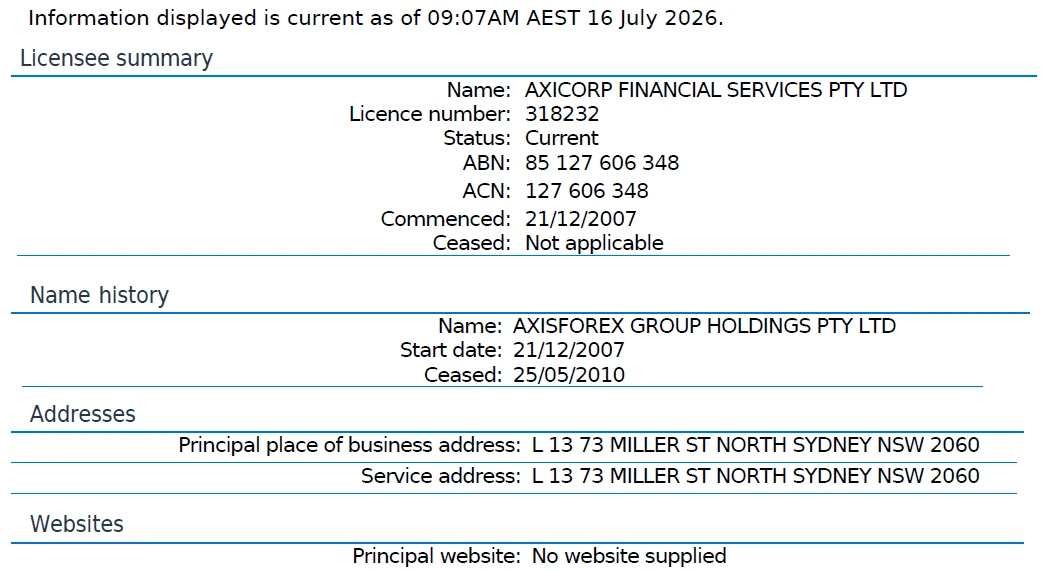
The licence stack holds four further entries:
- Financial Conduct Authority, UK (Tier 1)
- Cyprus Securities and Exchange Commission, EU (Tier 1)
- Dubai Financial Services Authority, UAE (Tier 2)
- Financial Services Authority, Saint Vincent and the Grenadines (offshore wholesale only)
An almost twenty-year unbroken Australian licence is a genuine trust asset: the 2021 rebrand changed the marketing rather than the entity, with AxiCorp Financial Services Pty Ltd and the AFSL number both carried through unchanged, and the regulatory record predates the current brand by more than a decade, running unbroken under the same company name throughout, so you can verify the record yourself.
History and ownership
Axi was founded in Sydney in 2007 as AxiTrader by Daniel Eduard and remains privately held.
Axi client money protection and AFCA membership
Axi client money protection runs through segregated accounts at an Approved Australian Bank, with mandatory negative balance protection and AFCA membership, so disputes cost you nothing. If a trade gaps against the balance, the broker wears the negative amount.
Client money accounts sit separate from company funds, so a deposit is not part of the broker’s working capital and cannot be used to pay its creditors. I’d stress that this means your money is ring-fenced. AFCA hears claims up to A$1,263,000 and awards compensation up to A$631,500. The Compensation Scheme of Last Resort caps compensation at A$150,000 and excludes CFD trading losses, so it covers unpaid awards for misconduct, not losing trades. The retail standard is set out in the guide to negative balance protection for CFD accounts.
One account carve-out applies at the top of the ladder. The Elite account is wholesale only, and wholesale clients trade outside the ASIC retail rules, so negative balance protection goes with them. That is what Axi asks in exchange for 400:1 forex leverage. I’d say losing negative balance protection is the single largest risk you take when stepping up to Elite, and it should stop the move unless the leverage gain is essential to the strategy.
Public reviews
Axi holds a Trustpilot rating of 4.1 out of 5 from 7,595 reviews, which Trustpilot labels great, captured September 2026. The profile has been claimed by the broker since March 2021.

Recurring platform praise covers stability and withdrawal speed.
How popular is Axi in Australia?
Axi is searched too rarely in Australia for month-on-month change to be meaningful: 620 branded searches in July 2026, 23rd of 32. Search interest measures attention, not quality; the score above is the review verdict.
- 620
- Brand searches, July 2026
- n/a below 1,000
- vs June 2026
- 110
- Login searches
- 0.4%
- Share of all broker searches
Source: Google search volume, Australia, July 2026. How this is measured
What other review sites say
Axi's iOS app rates 5.00 out of 5 from 2 ratings on the Australian App Store (September 2026), listed as Axi Trading Platform.
Axi at a glance: 18 key facts
AxiCorp Financial Services Pty Ltd holds ASIC AFSL 318232, current since 21 December 2007, runs MetaTrader 4, MetaTrader 5 and its own web platform, and asks no minimum deposit on either retail account. I would start with the 18 key facts in the table below, because they give you the whole licence and cost picture before a paragraph of detail.
| Item | Detail |
|---|---|
| Australian regulator | ASIC, AFSL 318232, current since 21 December 2007 |
| Australian entity | AxiCorp Financial Services Pty Ltd (ACN 127 606 348) |
| Other regulators | FCA (UK), CySEC (Cyprus), DFSA (UAE), FSA Saint Vincent (offshore wholesale) |
| Year founded | 2007, Sydney |
| Former name | AxiTrader (rebranded to Axi around 2021) |
| Headquarters | Sydney, NSW |
| Trading platforms | MetaTrader 4 and MetaTrader 5 (desktop, web, mobile), Axi Trading Platform (web only) |
| Account types | Standard, Pro, Elite, Islamic (swap-free) |
| Minimum deposit | None on Standard or Pro. Axi recommends $100 |
| Maximum retail leverage | 30:1 (forex majors), ASIC-capped |
| Spreads, Pro (eight-pair basket) | 0.16 pips measured, May to June 2026 |
| Spreads, Standard (EUR/USD) | Around 0.6 pips average |
| Pro commission | A$4.50 round turn per standard lot, charged in full when the position opens |
| Funding methods (AU) | Credit or debit card, Global Money Transfer, PayPal, each shown instant and fee-free |
| Inactivity fee | 10 per month in the account base currency (A$10 on an AUD account), after 12 months of no activity |
| Negative balance protection | Yes (mandatory under ASIC) |
| AFCA member | Yes |
| Demo account | Free, 30-day expiry (renewable) |
| Customer support | 24/5 live chat, callback, WhatsApp, Help Centre |
We report the spread on the basket rather than a single pair, and the section below explains why.
Axi Pro account pricing, measured
Axi’s Pro account recorded an average spread of 0.16 pips across eight pairs in our May to June 2026 capture, third tightest among the raw accounts tested. Commission runs to A$4.50 round turn per standard lot, billed in Australian dollars on an AUD account and debited in full when the position opens rather than half on the open and half on the close. That is a fixed cost you can price before you place the trade, which matters more than it sounds, because a commission quoted in a currency you do not hold moves under you every time the rate does.
The measured figure is on the basket, not on EUR/USD alone. Axi advertises EUR/USD from 0.0 pips, and an advertised floor of zero is a marketing minimum rather than an average, so no measured single-pair figure for EUR/USD appears here. I’d say a single-pair number tells you less about real trading cost than the basket does across a whole watchlist, so you get a more realistic cost picture from the basket.
| Pair | Pro avg spread (pips, May to June 2026) |
|---|---|
| AUD/USD | 0.2 |
| GBP/USD | 0.3 |
| USD/JPY | 0.2 |
| EUR/GBP | 0.4 |
| Eight-pair basket | 0.16 |
That basket result placed Axi third tightest of the raw accounts we tested in the lowest spread brokers in Australia test. The A$4.50 round-turn rate lands in the cheapest group covered in the lowest commission forex brokers comparison, so both halves of the price pull the same way here. In my view total cost sits in a narrow band with the top handful of Australian brokers, which means you pay no premium for a spread this tight.
Standard and Elite accounts
The Standard account prices spread-only with no commission, averaging around 0.6 pips on EUR/USD. Elite is the wholesale account, requiring a US$25,000 minimum balance and wholesale client qualification, where commission drops to US$3.50 round turn, forex leverage extends to 400:1, and the ASIC retail protections no longer apply, a trade-off that exchanges the safety net of a retail account for cheaper per-lot costs and higher leverage.
What it costs to trade with Axi
Trading one standard lot on the Axi Pro account costs A$4.50 in round-turn commission plus the measured spread, so what it costs to trade with Axi lands around 0.46 pips equivalent, roughly half a pip, on the basket at an AUD/USD rate of 0.65, before you factor in your strategy’s own win rate.
Where that leaves you against Pepperstone Razor or IC Markets Raw turns on which pairs you trade, because Axi wins on spread and gives it back on commission, and the crossover point shifts with your lot size and with the rate on the day. The raw spread plus commission pricing is compared across the field in that guide. I’d say you should run your own monthly volume through both halves of the number rather than trust either headline on its own.
Other fees AU traders should check
- Overnight swap rates apply on positions held past 5 PM New York time, and the direction of the position decides whether the swap is paid or received.
- Currency conversion runs around 0.5% on positions denominated outside the account base currency.
- Withdrawals are free at US$50 or more and on a full-balance withdrawal, and a US$25 administration fee applies below US$50.
- The inactivity fee runs 10 a month in the account base currency, so A$10 on an Australian dollar account rather than US$10, after 12 consecutive months with no trading activity and no open positions (AxiCorp Financial Services Pty Ltd Margin FX and CFD Retail Client Product Schedule, effective 29 September 2025).
Axi funding methods and withdrawal times
Axi processes withdrawals in 1 to 2 business days for bank transfers, offers instant card payments, and charged A$0 on every funding method presented to our test account, keeping the entire deposit cost-free for most retail traders.
Deposit methods (AU clients)
| Method | Fee | Speed |
|---|---|---|
| Credit or debit card | A$0 | Instant |
| Global Money Transfer | A$0 | Instant |
| PayPal | A$0 | Instant |
Those three are what the deposit screen offered Noam in August 2026, each labelled instant and fee-free, and his A$200 card deposit cleared in seconds. The funding record below is our own account rather than a stock image: we pay for the accounts we test, which is the only way to know what a deposit actually does.

 Axi has listed PayID, BPAY, bank transfer and Skrill or Neteller elsewhere, and not one of them appeared as an option in the tested Australian account, so I’d check what your own portal actually shows before you plan a funding route around any of them. Deposits must come from a card in your own name, and Axi requires an initial deposit to be withdrawn back to the original payment method, with realised profits free to leave by another route. That last rule is standard anti-money-laundering practice rather than anything unusual, but I’d plan your first withdrawal around it.

Bank transfer deposits are free with no cap. Card and other non-bank methods are free up to US$50,000 a month, and a 3.0% fee applies above that, a threshold few retail clients reach (Product Schedule, effective 29 September 2025), so you can treat the whole funding suite as zero-cost for nearly any retail deposit pattern.
Withdrawals
Withdrawals of US$50 or more are free, as is a full-balance withdrawal, and a US$25 administration fee applies below US$50 (Product Schedule, effective 29 September 2025). I’d flag that small-withdrawal fee as unusual in this field, and you need to check withdrawal habits against it: routinely pulling small amounts will add up in a way it would not at most rivals. Worth knowing that Axi’s own AU deposits page describes the non-bank funding charge without a percentage, and its AU help centre states flatly that Axi charges no deposit fees. Both contradict the binding Product Schedule, which is the document that governs the account. Withdrawals return to the same source as the deposit wherever available.
Account opening
Account opening runs fully online and AUSTRAC-compliant, and most Australian applications clear within a business day. Noam’s cleared faster than that in August 2026: identity and selfie checks ran through Jumio, automated, with no video call and no document exchange with a compliance officer, and the account was verified within about an hour of submission. Axi accepts a passport, a driving licence or an identity card, and the check moves to a phone by QR code or an emailed link if you would rather photograph the document there. I rate that turnaround among the quickest we have timed in this coverage, and it came after a full suitability, employment and financial questionnaire rather than instead of one.

Axi account types and minimum deposit
Axi offers four account types, and asks no minimum deposit on either of the two retail accounts.
| Account | Pricing | Min deposit | Best for |
|---|---|---|---|
| Standard | Spread-only, no commission | None | Casual traders, beginners |
| Pro | RAW spreads plus A$4.50 round turn | None | Active forex traders |
| Elite | RAW spreads plus US$3.50 round turn | US$25,000 min balance | Wholesale and professional traders |
| Islamic | Swap-free pricing | A$0 | Eligible clients needing swap-free trading |
Pro carries the raw spreads plus commission and suits anyone trading forex regularly, while Standard rolls the whole cost into the spread. Elite is the wholesale account, not a third retail tier. I’d read Pro as the default choice, and you should pick Standard only if all-in spread pricing is preferred and a wider headline figure is acceptable.
Minimum deposit and Elite qualification
Axi asks no minimum deposit on Standard or Pro. Its trading accounts page recommends $100 as a starting figure rather than requiring it, the application reads No Minimum against both accounts, and Noam’s Pro account bore that out: it went live at nil balance and sat there tradeable until he funded it with A$200 in August 2026.

Elite is the exception at a US$25,000 minimum balance, and it requires wholesale client qualification: gross income over A$250,000 in two of the last three years, net assets over A$2.5 million, or an accountant’s certification. An Islamic swap-free account is available to eligible Australian clients, which several brokers in this coverage cannot offer at all; if your account choice turns on swap-free eligibility, that availability gap alone may rule out competitors before the pricing comparison.
Axi trading platforms
Axi runs three platforms on the Australian entity: MetaTrader 4 and MetaTrader 5, each across desktop, web and mobile, plus its own Axi Trading Platform in the browser. Noam opened a live Pro account under AxiCorp Financial Services Pty Ltd in August 2026, and the application put MetaTrader 5 and MetaTrader 4 side by side as a straight choice, with the client portal then offering to add further accounts on either platform. What you will not find here is cTrader, and there is no native TradingView execution for ASIC clients, though ATP borrows TradingView’s charting inside its own window.

The platform rating still sits lowest of the six categories, though we lifted it twice in September 2026, once for MT5 and again once the Axi Trading Platform proved to be a real trading venue rather than a landing page, because the old mark was set against a single-platform line-up that no longer describes the account you can open. For a trader working in cTrader or TradingView today, the move to MetaTrader is still a real cost of entry.
Axi Trading Platform
ATP is the browser platform Axi built itself, and it is the piece that stops this being a pure MetaTrader shop. Noam opened it on his live account in September 2026 and found a working venue rather than a shop window: dealable two-way prices with buy and sell tickets on the instrument list, separate Positions and Orders tabs, and charting licensed from TradingView inside Axi’s own window. Being able to trade from the browser without installing a terminal is the practical gain, and it is what lifted the platform mark on this page a second time.
The catch is that ATP is web only. There is no ATP desktop build and no ATP mobile app, so away from a browser you are back on the MetaTrader apps. I would not choose Axi for ATP alone, but as a third option on the same login it costs you nothing.
MetaTrader 4 and MetaTrader 5
Both terminals run the standard MetaQuotes build with the broker’s own plugins layered in: one-click trading, full expert advisor support, custom indicators and 28 built-in technical studies on MT4. Axi has historically been one of the more expert-advisor-friendly Australian brokers, and a free VPS is available to clients meeting volume thresholds. The VPS threshold is a real gate, so check your expected monthly volume against the requirement before counting on free hosting.
MT5 sitting alongside MT4 changes my read of this account for anyone arriving from another broker, because an MT5 strategy no longer forces a platform rewrite or a broker change to trade here. I had this page down as a single-terminal broker until Noam’s account proved otherwise, and that is the correction I would want to know about if I were choosing between them. TradingView execution is still ruled out, and Pepperstone or OANDA serve you better for that.
Copy trading and mobile
Australian clients can reach two copy trading routes. The built-in MT4 Signals platform lets you subscribe to a provider inside the terminal and mirror trades, with the provider fee sitting on top of Pro pricing rather than inside it, so your subscription cost lands on the commission and spread, not inside a widened spread. Axi also publishes a standalone Axi Copy Trading app on the Australian App Store under the same entity that holds the AFSL. The copy account carries no proprietary social feed of the eToro kind. Mobile trading runs through the MT4 mobile terminal on iOS and Android with biometric login.
Axi markets and instrument counts
Axi markets and instrument counts run across six asset classes led by 80 plus forex pairs, with no ASX single-stock CFDs at all.
| Asset class | Count | Note |
|---|---|---|
| Forex | 80+ pairs | Major and minor AUD crosses |
| Indices | Major global indices | Includes the ASX 200 |
| Commodities | Metals and energy | Gold, silver, WTI and Brent crude, natural gas |
| Share CFDs | Selected UK, EU and US names | No ASX single-stock CFDs |
| Upcoming IPOs | Selected new listings | Added to the AU menu and still flagged New when we checked on 8 September 2026 |
| Cryptocurrency CFDs | Selected pairs | CFDs only, 2:1 retail cap |
Axi is a forex broker first, and the shape of the range says so: deep on currencies, adjacent CFDs on everything else. The crypto range sits at the thin end as a selected set of pairs at the ASIC 2:1 retail cap. I’d say the range tells you exactly where to place this broker in a portfolio: primary for forex, secondary for anything else.
The range gaps are worth stating plainly: no ASX single-stock CFDs, and no direct share investing on either terminal.
Share CFDs
The share CFD list covers selected UK, EU and US names only, with no ASX single-stock CFDs at all, which makes the range one of the narrowest in this coverage and a named con. I’d say if your account choice turns on equities, it is the wrong place, and no commission saving on forex will make up for the absence of the stocks wanted. The share CFD class is compared in the guide to trading shares as CFDs.
Axi leverage and margin under ASIC rules
Axi leverage and margin operate under a maximum retail leverage of 30:1 on major forex pairs, identical across the Standard and Pro accounts.
ASIC caps retail CFD leverage at 30:1 on major forex pairs, 20:1 on minor pairs, gold and major indices, 10:1 on commodities other than gold, 5:1 on share CFDs and 2:1 on crypto assets. The caps come from a product intervention order extended to 23 May 2027, so they apply at every ASIC broker, not just Axi. For risk planning, I’d note that the caps mean the margin requirement on a major forex pair cannot drop below roughly 3.33%, no matter which ASIC broker you choose.
Both retail accounts carry those caps without variation, so the account choice changes the commission model, never the leverage. The Elite wholesale tier is the only route above the ceiling, reaching 400:1 on forex for clients who pass the eligibility tests. I’d say the leverage jump from 30:1 to 400:1 is the most consequential number on this page, and it is walled off behind a qualification gate for a reason you should understand.
Retail margin close-out sits at 50%. ASIC requires every CFD issuer to close a retail client’s positions once account equity falls below half the total initial margin on all open positions, positions cannot be netted against each other to reduce that figure, and a gapping market can close a position below the 50% level. I’d underline that the 50% level is a floor in theory only: a fast market can blow through it and leave the account with less than modelled, so you cannot count on the margin close-out as a safety net. The leverage mechanics are set out in understanding forex leverage.
Axi customer support
Axi customer support runs 24 hours a day Monday to Friday Sydney time across four channels: live chat, callback request, WhatsApp and an online Help Centre. The absence of a published phone number means first contact is always through a screen, which you might find a drawback.
Live chat replied in under 90 seconds during Australian business hours in testing, and the agents knew MT4 well, which matters more here than at a multi-platform broker because MT4 is the only terminal; with no fallback to cTrader or TradingView, the agent’s MT4 knowledge is your only lifeline, and the testing suggests it holds.
The support channel mix is unusual: a callback request and a WhatsApp line replace the direct phone number most brokers publish, which suits some clients and frustrates others who want to dial a desk. Testing the callback response time on first contact is warranted, because your tolerance for the workflow will shape the whole support experience.
The language range covers English, Spanish, French, Mandarin, Arabic and Vietnamese, six languages on a desk of this size.
The weekend support gap is the main service negative, and a query raised on a Saturday waits until Monday. I’d argue that gap matters less here than at a multi-asset broker, because a forex client is rarely holding a weekend position in a market that trades through it. But if you trade crypto CFDs on a Saturday afternoon, the silence will feel longer than it looks on a calendar, and that gap may matter more if crypto is part of the routine.
Axi research, tools and education
Axi research, tools and education run to four components covering forex fundamentals, MetaTrader tutorials, expert advisor basics and economic-calendar commentary, gathered in the Axi Academy library. The Autochartist market scanner comes with an account and pushes daily alerts, market reports and volatility warnings before the open, and Axi ships the usual calculators, an economic calendar, a trading-holidays calendar and a dividend forecast schedule alongside it. For a new MetaTrader trader, that covers enough to get from account opening to a first live trade without leaving the broker’s site.
- Forex fundamentals library
- MT4 platform tutorials
- Expert advisor basics for automated traders
- Economic calendar with market commentary
Four research components is standard tier for a MetaTrader-focused broker, and the written library does not compete with the CMC Markets or Pepperstone desks.
Autochartist is the piece that earns its place, because a scanner flagging completed patterns and volatility ahead of the open saves a manual sweep every morning. What I’d flag is that it is a licensed third-party plugin rather than anything Axi built, and half a dozen brokers in this coverage ship the same tool, so it is table stakes rather than a reason to choose here.
What happened to PsyQuation
Axi used to be worth choosing for PsyQuation, a behavioural-analytics product that read a live trade history and named habits like over-trading or cutting winners short. Earlier versions of this review recommended the broker partly on the strength of it. Checking on 8 September 2026, PsyQuation appears nowhere on Axi’s Australian site or on its trading tools page, and psyquation.com no longer resolves to a product of its own. Axi has published no withdrawal notice that we can find, so I would treat it as gone from the advertised line-up rather than formally discontinued, and I’d ask support directly before opening an account on the strength of it. Nothing in the current tool list replaces what it did.
I’d note that the written library covers what an MT4 trader needs to start and stops there. For a trader wanting daily macro analysis or an in-house analyst desk, you won’t find it here, and the research rating reflects that rather than the scanner. The gap is real: a second source will be needed for a daily market brief if that is part of the routine.
How Axi compares to Pepperstone and Fusion Markets
We measured Axi at 0.16 pips across the eight-pair basket against 0.46 at Pepperstone and 0.36 at Fusion Markets, on an A$4.50 round turn against A$7.00 and A$4.50. To my mind that is a spread win on level commission: all in on the basket, Axi lands near 0.46 pips against roughly 0.92 at Pepperstone and 0.65 at Fusion Markets, so on these three it is the cheapest of the set. The gap to Fusion is narrow enough that platform choice should decide it rather than price.
The Axi basket measured tighter than both rivals. The Pepperstone stack carries five platforms against one here and publishes a measured execution figure, so I’d say platform preference will likely dominate the comparison before you reach pricing. Fusion Markets undercuts the commission by A$2.50 a lot, and if monthly volume runs into the hundreds of lots, that saving compounds into real money faster than the spread difference.
The measured spread is what Axi has over both of them, and on tools and platform breadth it is the one giving ground. If your trading does not turn on that basket figure, the comparison table points elsewhere, and that is the honest read.
Put Axi next to any of the other 31 ASIC-regulated brokers we cover.
Axi AvaTrade Middle of the measured field
Axi measures 0.16 pips on the raw eight-pair basket; AvaTrade carries no figure, no measured 8-pair raw average.
Neither Axi nor AvaTrade carries a figure on raw EUR/USD: Axi, advertised floor of 0.0, not a measured average; AvaTrade, no single-pair EUR/USD figure on record.
Axi's measured 0.6 pips sits 0.4 below the middle broker's 1.0; AvaTrade's 0.8 pips sits 0.2 below it.
AvaTrade: source not declared.
Axi charges A$4.50 on round-turn commission; AvaTrade carries no figure, no per-lot commission on record.
Axi comes to A$67.18 on raw account cost at ten standard lots a month; AvaTrade carries no figure, no measured 8-pair raw average.
Axi's A$83.18 sits A$55.46 below the middle broker's A$138.64; AvaTrade's A$110.91 sits A$27.73 below it.
Axi's A$0 and AvaTrade's A$100 straddle the middle broker's A$50.
Axi runs MT4, MT5, Own platform; AvaTrade runs MT4, MT5.
Axi holds AFSL 318232; AvaTrade holds AFSL 406684.
Axi's 62 / 100 sits 13 below the middle broker's 75; AvaTrade's 60 / 100 sits 15 below it.
Axi's 4.1 / 5 and AvaTrade's 4.8 / 5 straddle the middle broker's 4.3.
Axi's 5 / 5 and AvaTrade's 3.31 / 5 straddle the middle broker's 4.54.
Neither Axi nor AvaTrade carries a figure on the TradingView broker rating, no TradingView broker profile.
Axi's 620 sits 720 below the middle broker's 1,340; AvaTrade's 940 sits 400 below it.
Capture: May to June 2026 · AUD/USD 0.7213 (9 Sept 2026) · field: the measured field varies by row, from 13 to 25 brokers, of 32 reviewed.
Bars run lowest to highest across the measured field; the tick marks the middle broker.
An off-window figure is comparable in method, not in dates.
| If you value… | Consider |
|---|---|
| Tightest raw spreads | IC Markets or Pepperstone |
| Broader product range | CMC Markets or IG Markets |
| Direct ASX shares | CMC Markets or Interactive Brokers |
| Beginner-focused platform | Plus500 or eToro |
| Native cTrader | Pepperstone or Fusion Markets |
| Lower-cost commission account in AUD | Fusion Markets |
Should you open an Axi account?
I’d say Axi suits MetaTrader forex traders who trade the majors often enough for a 0.16 pip basket to matter more than a US-dollar commission. If you need cTrader, native TradingView or deep share CFD coverage, look elsewhere, and make that call before funding.
One group of trader gains clear value from an Axi account: the high-frequency major-pairs trader whose cost is dominated by spread rather than by commission. At 0.16 pips across our eight-pair basket, third tightest of everything we measured, Axi genuinely beats most of the field on that one number, and for a scalper working the majors that number is the whole game. I’d note the trade runs the other way as your lot count climbs, because the US-dollar commission scales with volume while the spread advantage stays fixed in pips.
Two groups should look past an Axi account, to my mind, and I would rather say so plainly than bury it under the analytics story. The platform list runs three where Pepperstone runs five, so a workflow built on cTrader or TradingView is not served here. The share CFD range carries no ASX single-stock names at all, which is a deal-breaker for ASX equities.
Axi ranks twenty-sixth among the top forex brokers in Australia on the 2026 scoring, on a score we lifted from 59 to 62 in September 2026 after confirming that the Australian entity runs three platforms rather than one. The free demo runs on MetaTrader, so you can test both terminals before you fund anything.
FAQs
Is Axi safe for Australian traders?
What is the minimum deposit at Axi in Australia?
What does the Axi Pro commission cost in Australian dollars?
What trading tools does Axi give Australian clients?
Standard, Pro or Elite, which Axi account?
What leverage does Axi offer in Australia?
Does Axi charge an inactivity fee?
Testing log
| Record | Detail |
|---|---|
| Review published | 16 May 2026 |
| Last content change | 8 September 2026 |
| Spread capture | Pro account, 0.16 pips eight-pair average |
| Capture window | May to June 2026 |
| Verification | ASIC register (AFSL 318232) checked 16 July 2026; live standard account ending 4821 funded 26 June 2026 for spread monitoring; live MT5 Pro account (****4235) funded by card with A$200 in Australian dollars on 28 August 2026 |