




What OANDA costs per trade
MEASUREDMonthly spread cost converts pips to dollars using the EUR/USD pip value as the proxy for the 8-pair average, footnoted on-page. AUD pip value A$14.27 per standard lot at AUD/USD 0.7010 (25 Sept 2026).
Raw saves A$8.46 a month at this volume
At 10 standard lots per month on Raw accounts, OANDA costs approximately A$132.77 in spread and commission costs. Rates as of Fri 25 Sep 2026, 5pm New York close.
Trading CFDs and forex carries a high level of risk and may not be suitable for all investors. Read the relevant Product Disclosure Statement before opening an account.
Our verdict on OANDA
OANDA ranks second in our ranking of ASIC-regulated brokers, and the regulation is where it starts. OANDA is one of very few brokers in the world holding both an ASIC AFSL and full CFTC and NFA registration in the United States, on top of FCA, MAS, CIRO and JFSA licences. For a chart-led trader, the native TradingView integration is excellent, and the API has a quiet but loyal following among algorithm developers. Past the A$10,000 balance threshold, the spread-only Premium Spreads pricing on EUR/USD is competitive too.
The negatives are equally clear. OANDA is a forex specialist, and the product range of around 130 instruments across 70 plus forex pairs is materially narrower than the CMC Markets 12,000 plus or the IG Markets 17,000 plus. Our September 2026 capture showed the Standard account measured 1.47 pips across the eight-pair basket, ranking fifth of the eight standard accounts benchmarked, even though EUR/USD alone measured 0.99 pips. Share CFD coverage is limited, and direct ASX share investing is not part of the offer.
Pros
- I put the regulatory profile first because it's the foundation. ASIC AFSL 412981 has been current since 26 March 2012, and on top of that you get CFTC and NFA, FCA, MAS, CIRO and JFSA, six further regulators. That's a rare level of global oversight.
- Our live capture measured the Raw account at 0.20 pips on EUR/USD. The commission is A$3.50 per side, A$7.00 round turn, which matches Pepperstone Razor on commission. For a trader who cares about the tightest raw spread, that's a competitive start.
- Platform choice is a real strength here. You get five routes: OANDA Trade, MT4, MT5, native TradingView and a REST and streaming API. That's a breadth that few pure forex brokers offer.
- I like that the barrier to entry is zero. The Standard account carries a A$0 minimum deposit, so you can open an account and explore the platform without committing funds.
- One feature I value for risk management: guaranteed stop-loss orders on OANDA Trade. If you're trading on MT4, MT5 or TradingView, you won't have them, so it's a reason to use the proprietary platform.
Cons
- The Standard account spread is the one I'd flag as a real drawback. Our capture measured 1.97 pips across eight pairs, the widest of the 19 standard accounts we benchmarked. If you're on a budget, that's a significant cost.
- Even the Raw account spreads aren't the tightest. Our July 2026 capture recorded OANDA Raw at 0.44 pips across eight pairs, while our September 2026 capture put IC Markets at 0.26 pips and Fusion Markets at 0.09 pips, ranked first of the 11 raw accounts we measured. That gap matters if you trade frequently.
- The instrument range is a point I keep coming back to. With under 150 instruments, it's the narrowest of the raw-account brokers we cover. That's fine for a currency specialist, but if you want a multi-asset account, it's a constraint.
- To access the Premium tiers, you'll need an A$10,000 balance or US$30 million notional volume in three months. That's a high bar for a retail trader, and I'd consider it only if you really need the professional leverage.
- Two annoyances I'd note: an inactivity fee up to A$20 per client per month after 12 months without trading, though not while a position is open (OANDA AU help page, 17 September 2026). Support is closed at weekends. If you trade casually, that fee can eat into a small balance.
OANDA score breakdown
4.5/5 · Excellent
The overall CFB Score comes from the full methodology, more than 100 data points per broker.
How is our rating calculated?Is OANDA safe? ASIC AFSL 412981
OANDA Australia Pty Ltd holds ASIC AFSL 412981, current since 26 March 2012, plus five further licences including full CFTC and NFA registration in the US. That dual registration carries real weight and is reflected in the trust rating.
ASIC regulation and global licences
ASIC AFSL 412981 is the bedrock, held by OANDA Australia Pty Ltd with the Australian Securities and Investments Commission. The register shows the licence as current since 26 March 2012. That’s a solid, long-standing licence.
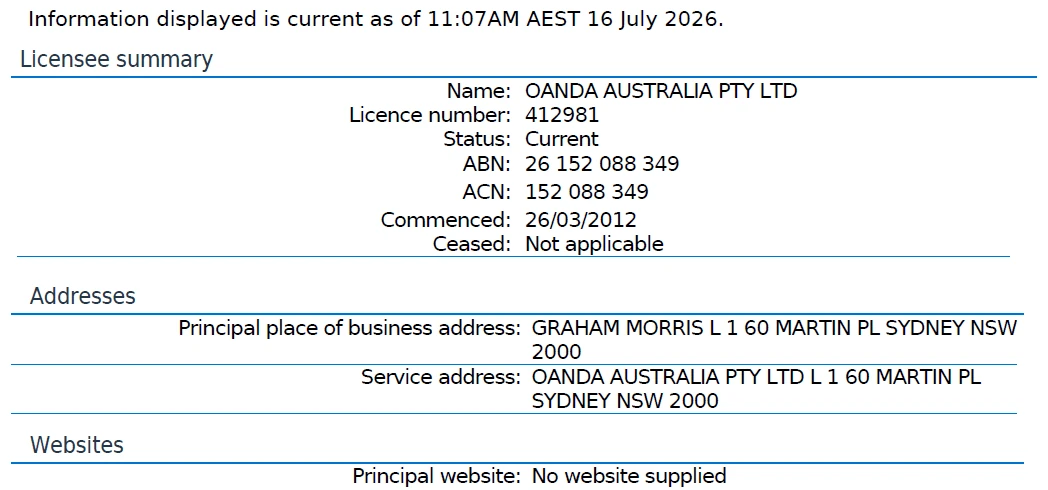
The licence stack holds five further entries:
- CFTC and NFA, USA, Tier 1
- Financial Conduct Authority, UK, Tier 1
- Monetary Authority of Singapore, Tier 1
- Canadian Investment Regulatory Organization, Tier 1
- Japan Financial Services Agency, Tier 2
The dual ASIC and CFTC standing, verified by David Levy against the public registers, is the rare part because very few brokers anywhere are retail-regulated in both Australia and the United States. The US registration carries capital and reporting requirements most offshore-leaning brokers avoid entirely, which is why the trust rating sits at the top of the field.
History and ownership
OANDA’s history goes back to 1996, founded by Michael Stumm and Richard Olsen as one of the first internet-native currency businesses. Most people outside trading know it for the currency converter. The parent ownership passed to CVC Capital Partners in 2018 and remains there. That institutional backing adds stability.
Before depositing, confirm OANDA holds AFSL 412981 using the site's guide to checking a broker on ASIC's register.
OANDA client money protection and AFCA membership
OANDA bases client money protection on segregated accounts at an Approved Australian Bank, with mandatory negative balance protection and AFCA membership.
AFCA membership carries disputes at no cost to the client. Your money sits apart from company funds, which is the baseline expected from any ASIC broker on this site.
Client money is held in segregated client accounts, separate from company funds. AFCA can hear claims up to A$1,263,000 and award compensation up to A$631,500. The Compensation Scheme of Last Resort pays only where an AFCA determination that awards compensation has gone unpaid, up to A$150,000, and only in three areas: personal financial advice, securities dealing for retail clients, and credit. Forex and derivatives trading, CFDs included, is outside it. The retail standard is explained in the guide to the negative balance safeguard.
The professional account tiers surrender those retail protections along with the leverage caps, a trade-off you need to weigh carefully before applying for professional status.
Public reviews
OANDA holds a Trustpilot rating of 3.5 out of 5 from 1,235 reviews, which Trustpilot labels average, captured September 2026. The profile has been claimed by the broker since February 2022.
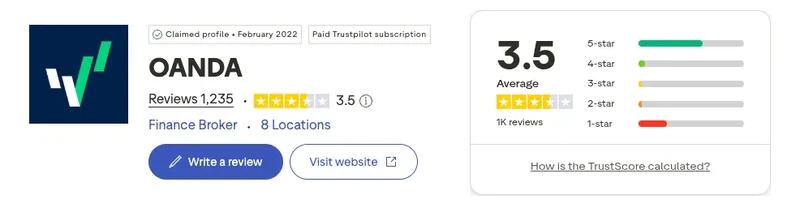
Public reviews show consistent praise for the regulatory pedigree, platform stability and API quality. The complaints that keep surfacing are about the Standard tier spreads and support response times during peak periods. If you’re weighing up an account, those are the trade-offs.
How popular is OANDA in Australia?
Australians made 5,670 branded searches for OANDA in August 2026, placing it 9th of the 32 brokers we review. Search interest measures attention, not quality; the score above is the review verdict.
- 5,670
- Brand searches, August 2026
- +0.7%
- vs July 2026
- 140
- Login searches
- 3.1%
- Share of all broker searches
Source: Google search volume, Australia, August 2026. How this is measured
What other review sites say
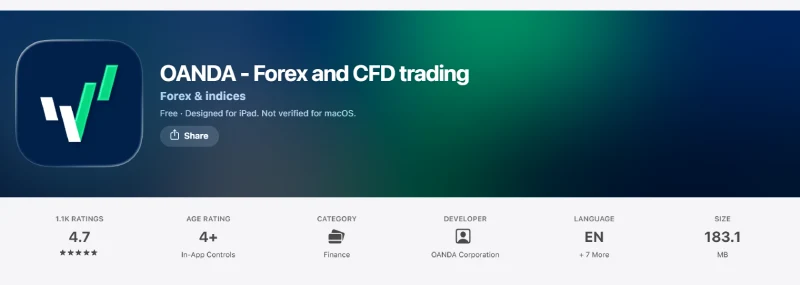
OANDA's iOS app rates 4.65 out of 5 from 1,090 ratings on the Australian App Store (August 2026), listed as OANDA - Forex and CFD trading.
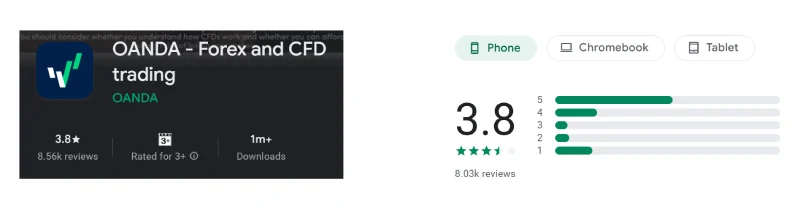
Android users rate OANDA's Android app 3.8 out of 5 from 8.56k reviews worldwide on Google Play (August 2026), listed as OANDA - Forex and CFD trading.
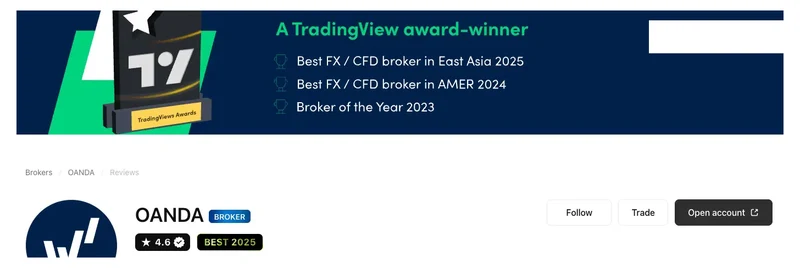
TradingView users rate OANDA 4.6 out of 5 from 32,873 ratings (September 2026). 318.8K TradingView users have connected a OANDA account. TradingView named OANDA its Best in Forex and CFD broker for East Asia 2025, its Best in Forex and CFD broker for the Americas 2024 and its Broker of the Year 2023.
OANDA at a glance: 18 key facts
OANDA holds ASIC AFSL 412981 and has run Australian operations since 2010. The 18 key facts below cover six further regulators and the four pricing tiers.
With a A$0 minimum deposit and around 130 instruments, OANDA is a straightforward entry point.
| Item | Detail |
|---|---|
| Australian regulator | ASIC, AFSL 412981, current since 26 March 2012 |
| Australian entity | OANDA Australia Pty Ltd |
| Other regulators | CFTC/NFA (USA), FCA (UK), MAS (Singapore), CIRO (Canada), JFSA (Japan) |
| Year founded | 1996 (Toronto / New York); AU operations since 2010 |
| Headquarters | Toronto and New York; AU office Sydney |
| Trading platforms | OANDA Trade (web/desktop/mobile), MT4, MT5, TradingView, REST/streaming API |
| Account types | Standard, Raw, Premium Spreads, Premium Commission, Professional, Professional Plus |
| Minimum deposit | A$0 (Standard) |
| Maximum retail leverage | 30:1 (forex majors), ASIC-capped |
| Spreads, Standard (EUR/USD) | 1.4 pips advertised typical; 0.99 pips measured, May to June 2026 |
| Spreads, Raw (EUR/USD) | From 0.0 pips advertised; 0.20 pips measured, July 2026 |
| Raw commission | A$3.50 per side, A$7.00 round turn (forex and metals) |
| Funding methods (AU) | Visa, Mastercard, BPAY, PayID, bank transfer |
| Inactivity fee | Up to A$20 per client per month after 12 months without trading, not charged while a position is open (OANDA AU help page, 17 September 2026) |
| Negative balance protection | Yes (mandatory under ASIC) |
| AFCA member | Yes |
| Demo account | Free, unlimited |
| Customer support | 24/5 phone, live chat, email |
The table shows two measured figures because OANDA prices two accounts on different bases, and the gap between them is the single largest cost decision you make at this broker. Keep both numbers in view as you scan the section below that separates them.
OANDA Standard and Raw account spreads
OANDA spreads are advertised at 0.20 pips on the Raw account and 0.99 pips on the Standard account for EUR/USD. Across eight major pairs, the Raw account averages 0.44 pips. That’s a trade-off to weigh carefully.
That pricing split is the single most important cost fact here. The EUR/USD spread is clearly the strongest on the Standard account, which looks cheap if you trade mostly that pair, while the basket average says the other seven pairs are not and is the number that follows for anyone trading across minors and exotics.
Standard account, spread-only pricing
| Pair | OANDA Standard (advertised typical pips) | AU industry avg (Standard) |
|---|---|---|
| EUR/USD | 1.4 | 1.1 |
| AUD/USD | 1.1 | 1.3 |
| GBP/USD | 1.6 | 1.4 |
| USD/JPY | 1.3 | 1.4 |
| EUR/GBP | 1.5 | 1.4 |
| EUR/JPY | 1.7 | 1.9 |
The table above shows advertised typical figures, not our measured capture, so the EUR/USD line reads 1.4 against the 0.99 pips we measured. For a full comparison of the spread field, see the lowest spread brokers in Australia rankings.
Raw pricing and the Premium tiers
Raw account targets active traders, pairing raw spreads from 0.0 pips advertised with commission of A$3.50 per standard lot per side, A$7.00 round turn, on forex and metals. That commission matches Pepperstone Razor exactly, which makes the spread capture the differentiator.
The two further tiers of premium pricing are gated on an A$10,000 balance or more than US$30 million notional volume in three months, and for a trader clearing that threshold the all-in cost drops materially below the Raw account. Premium Spreads is spread-only from 0.2 pips with no commission, while Premium Commission pairs spreads from 0.0 pips with A$2.75 per side, A$5.50 round turn.
What it costs to trade with OANDA
OANDA sets the costs to trade EUR/USD on the Raw account at A$7.00 in round-turn commission per standard lot, plus the measured 0.20 pip spread, which works out to roughly 0.66 pips equivalent at an AUD/USD rate of 0.66.
That’s competitive, but not the cheapest.
| Account | EUR/USD typical (incl. commission equivalent) |
|---|---|
| OANDA Standard | 1.4 pips advertised typical (0.99 measured) |
| OANDA Premium Spreads | from 0.2 pips |
| OANDA Premium Commission | from 0.0 pips + A$2.75 per side (A$5.50 round turn) |
| OANDA Raw | 0.66 pips |
| Pepperstone Razor | 0.55 pips |
| IC Markets Raw | 0.6 pips |
The Pepperstone and IC Markets figures use the May to June 2026 measured EUR/USD averages plus each broker’s commission converted at AUD/USD 0.66. The OANDA Raw line uses the same conversion on a July 2026 capture, because that account launched after the earlier window. Noam Korbl ran that July capture separately so the comparison stays honest. The raw spread account model is compared across the field in that guide.
Raw account is therefore third of the three on all-in EUR/USD cost. That cost gap is small in absolute terms and consistent across the basket, where the 0.44 pip measured average trails both rivals. You are not paying a large premium here, but there is a premium.
Other fees AU traders should check
- Overnight financing applies to CFD positions held past 5 PM New York time, direction-dependent.
- A currency conversion markup applies to any instrument traded outside the AUD account base.
- The inactivity fee is up to A$20 per client monthly after 12 months without trading, taken from the smallest sub-account, never while a position is open, with a rebate of up to three months’ fees on request if trading resumes (OANDA AU help page, 17 September 2026).
- Withdrawals cost A$0 on standard Australian methods.
OANDA funding methods and withdrawal times
OANDA charges no deposit fee on any of its funding methods, and any fee comes from the card provider or bank (OANDA charges page, 17 September 2026).
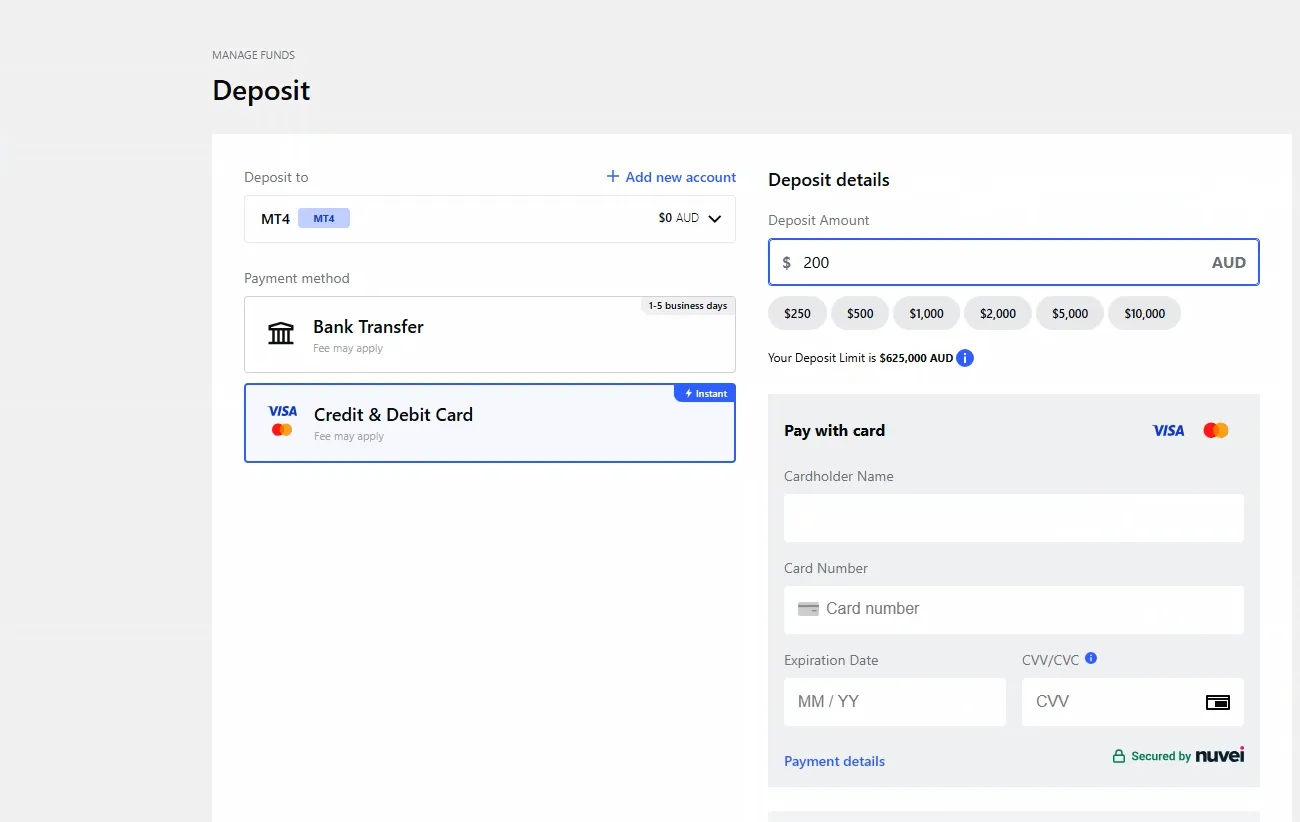
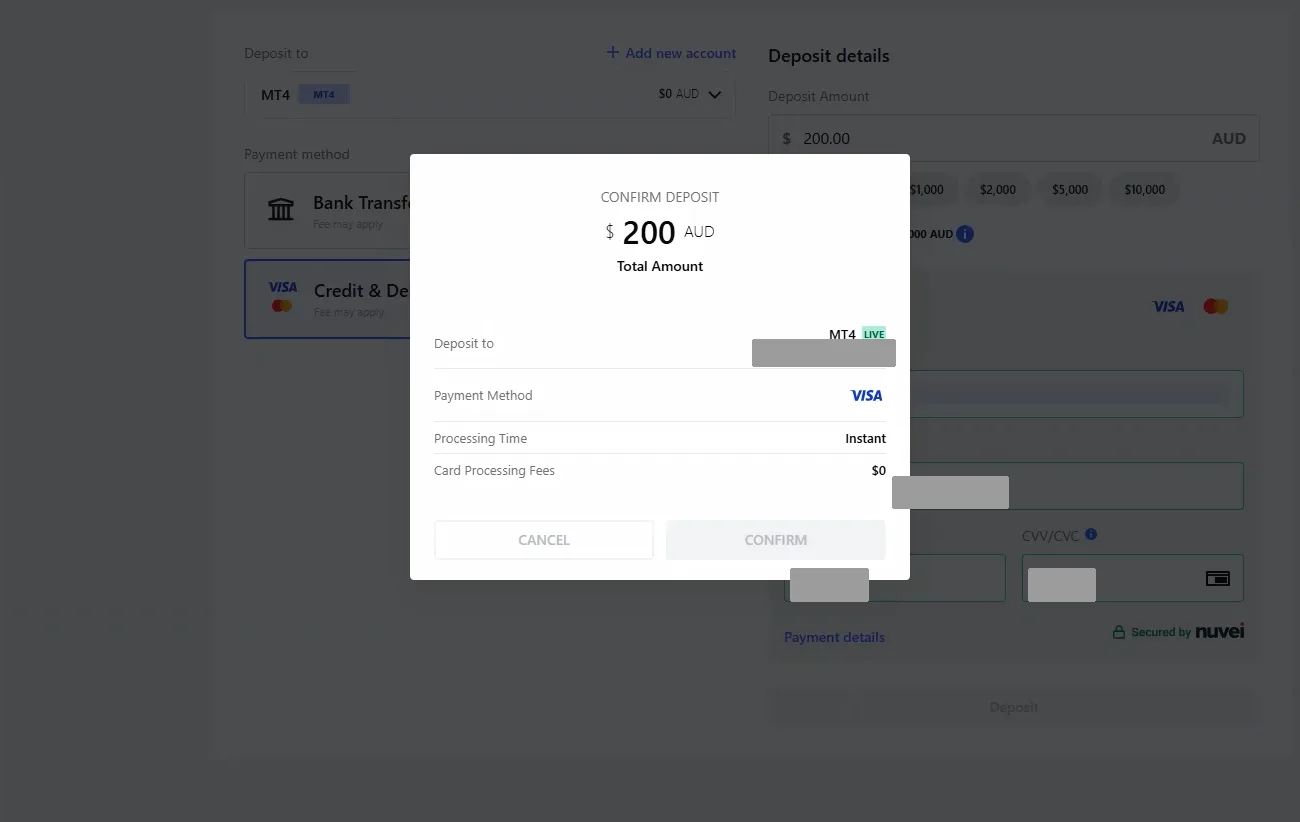
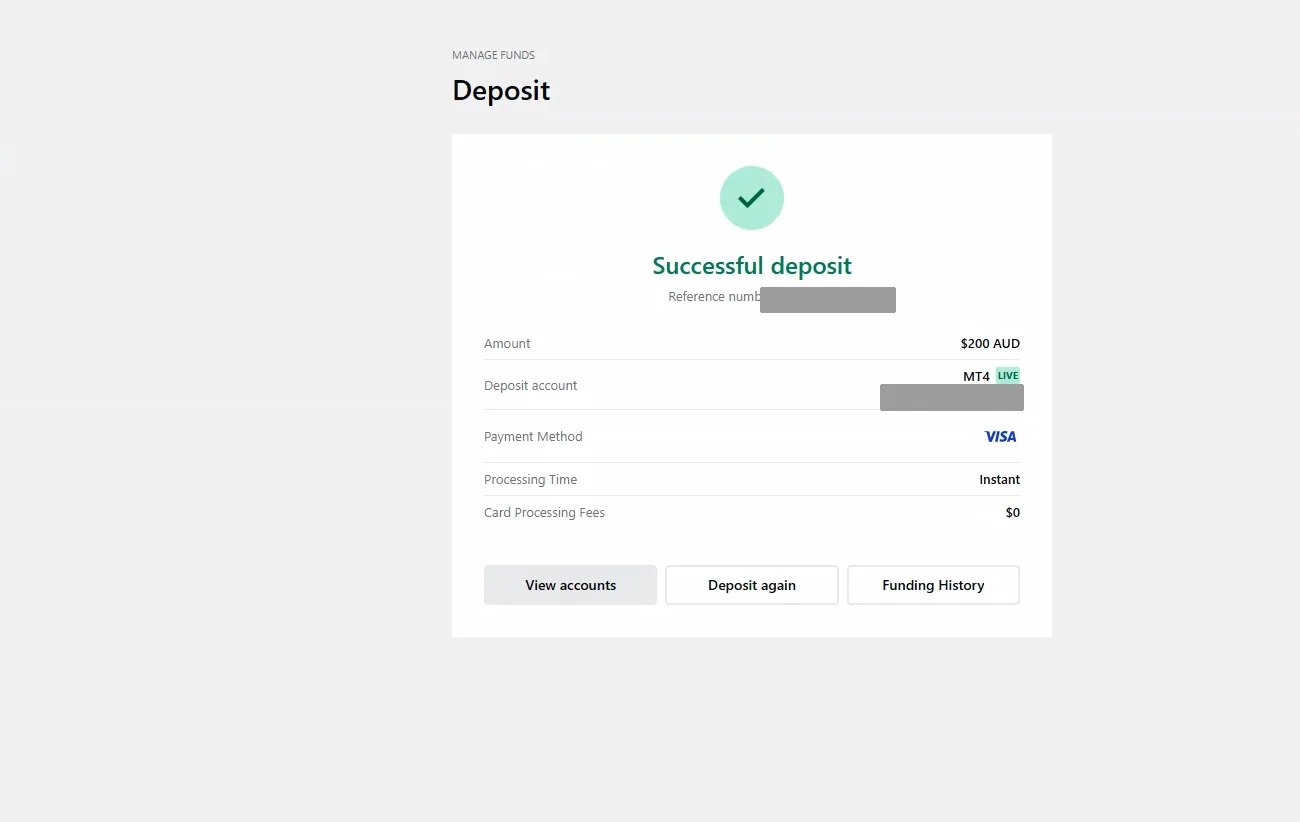
Bank transfer, BPAY and PayID run 1 to 3 business days for local transfers per OANDA’s help page, and Noam Korbl’s A$200 Visa deposit on 1 September 2026 confirmed “Instant” processing with A$0 card fees against an A$625,000 limit.
Deposit methods (AU clients)
| Method | Fee | Speed |
|---|---|---|
| Visa / Mastercard | A$0 from OANDA; your card provider or bank may charge (OANDA AU charges page, 17 September 2026) | Immediate, up to 1 business day in some cases (OANDA AU help page, 17 September 2026); instant on our A$200 Visa test, 1 September 2026 |
| PayID | A$0 from OANDA; your bank may charge (OANDA AU help page, 17 September 2026) | 1 to 3 business days (OANDA AU help page, 17 September 2026) |
| BPAY | A$0 from OANDA; your bank may charge (OANDA AU help page, 17 September 2026) | 1 to 3 business days (OANDA AU help page, 17 September 2026) |
| Bank transfer (standard EFT) | A$0 from OANDA; your bank may charge (OANDA AU help page, 17 September 2026) | 1 to 3 business days local, up to 5 international (OANDA AU help page, 17 September 2026) |
| PayPal | Not offered (AU) | n/a |
Four funding methods make a narrow menu next to the eight at Fusion Markets, and the absence of PayPal is the notable gap given the funding category rates lowest of the eight here. If PayPal is how you move money, a different broker is needed.
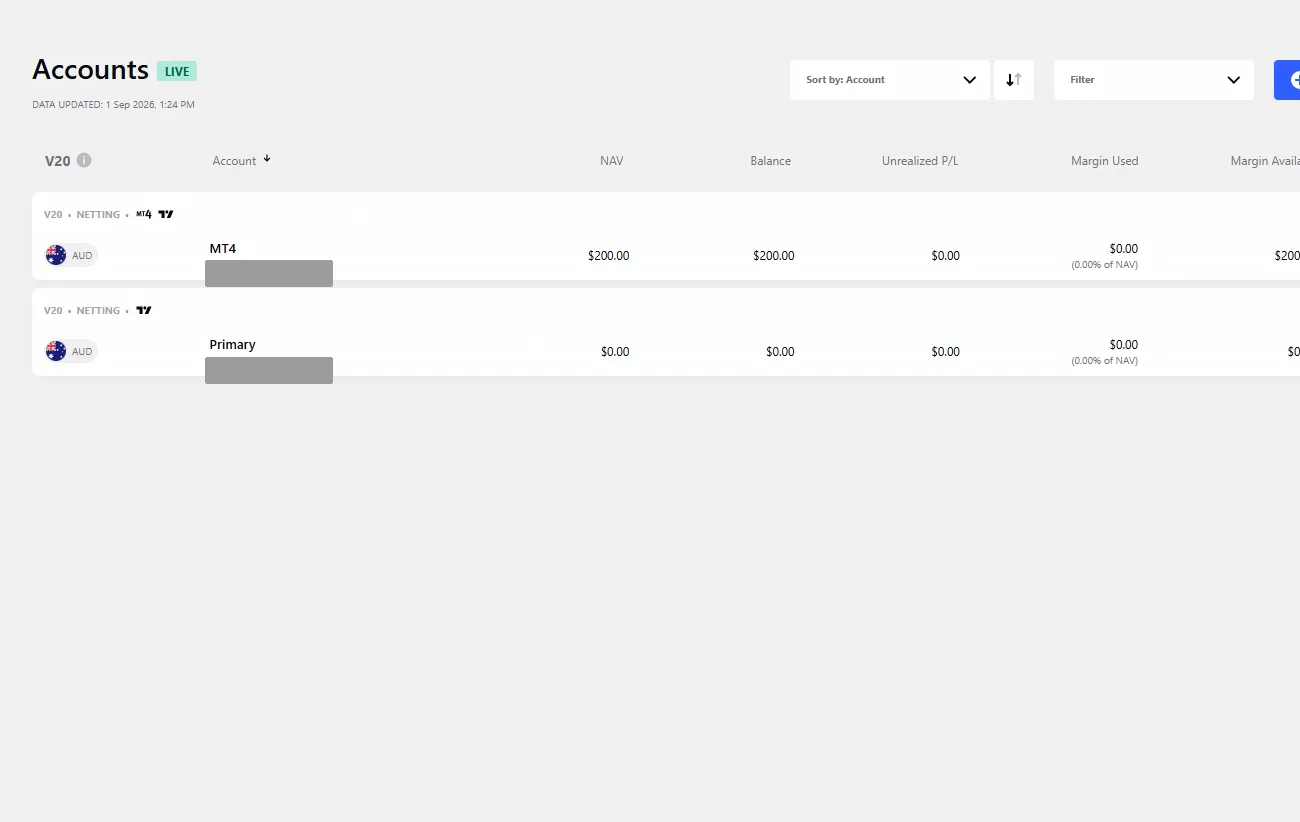
The hub’s Deposit page for the MT4 account showed two tiles on 1 September 2026: Bank Transfer, labelled “1-5 business days” and “Fee may apply”, and Credit & Debit Card (Visa, Mastercard), labelled “Instant” and “Fee may apply”, with a deposit limit of A$625,000 and a card form secured by nuvei. Noam Korbl deposited A$200 by Visa, and the confirmation showed Processing Time “Instant” and Card Processing Fees “$0”. The MT4 account carried the A$200.00 balance at 1:24 pm AEST, four minutes after the dashboard showed the application approved. OANDA’s “Fee may apply” label refers to your bank or card provider’s charges, which OANDA’s charges page states it does not add to (17 September 2026); one deposit on one card is all our capture holds.
Withdrawals
Withdrawals cost A$0 on standard methods, which is what you’d expect. OANDA requires withdrawals to use the same source as the deposit wherever available, following standard anti-money-laundering practice. That’s common and doesn’t usually cause issues.
Account opening
OANDA opens Australian accounts under OANDA Australia Pty Ltd, the ASIC licensee holding AFSL 412981, and Noam Korbl’s application on 1 September 2026 was approved within the same session, with A$200 on the account by 1:24 pm AEST that afternoon. OANDA says the form takes about eight minutes. One application sits behind this, so it is a record rather than a promise.
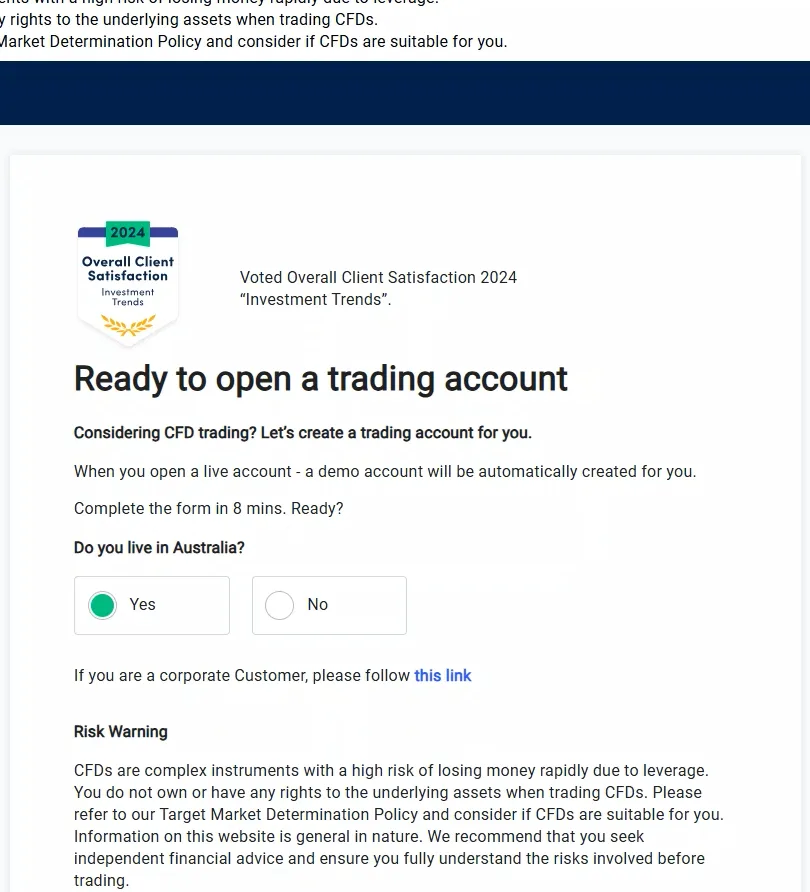
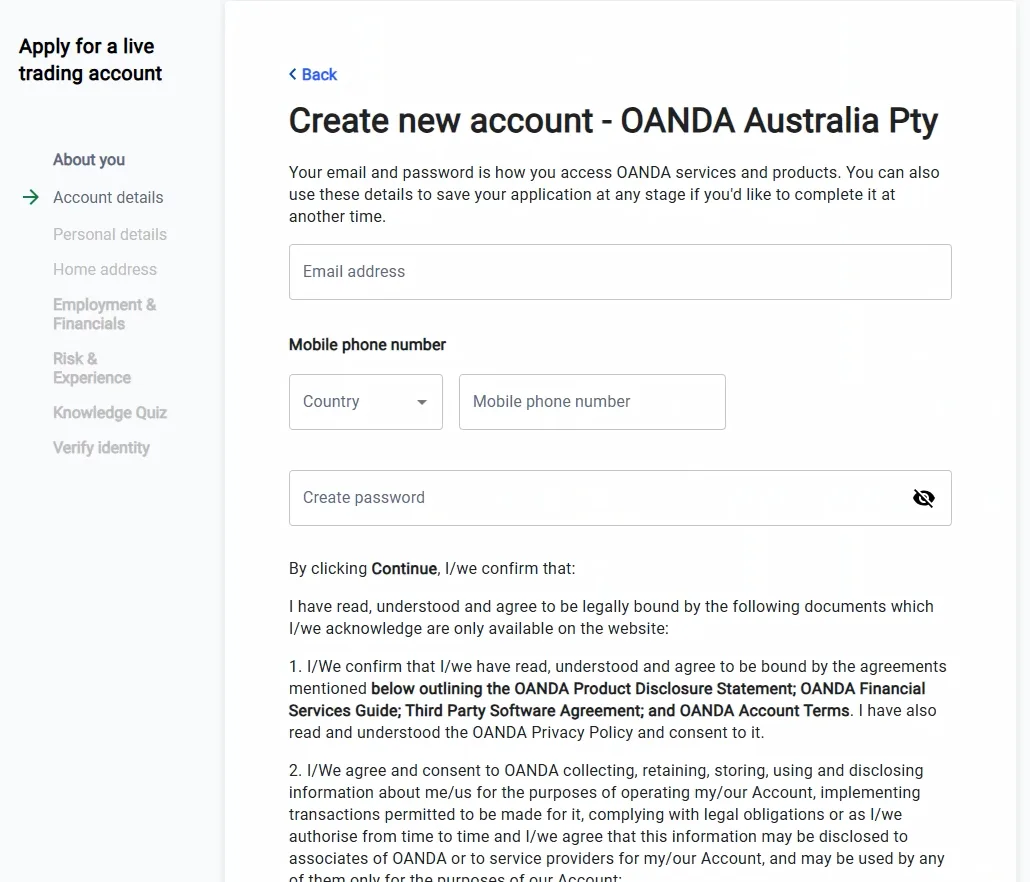
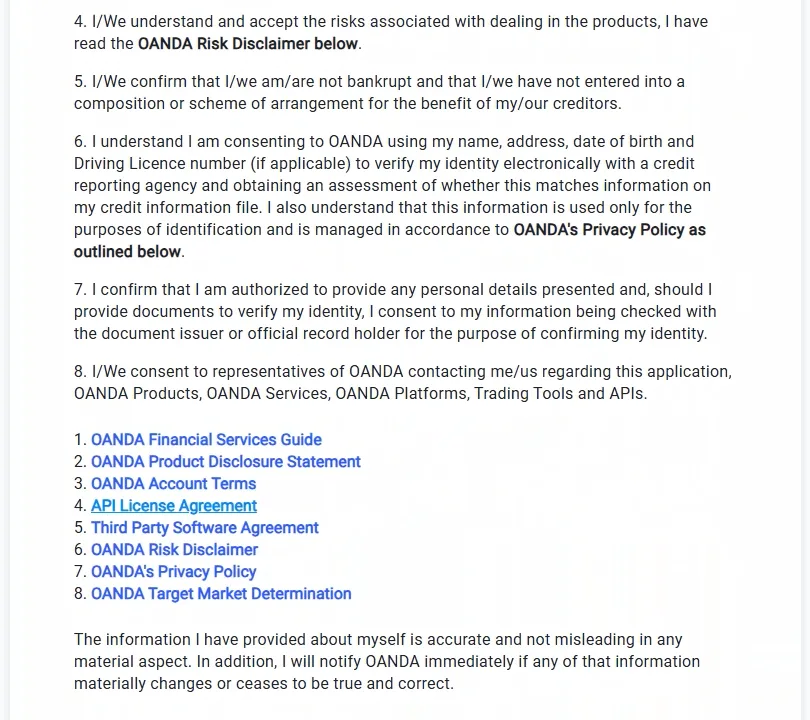
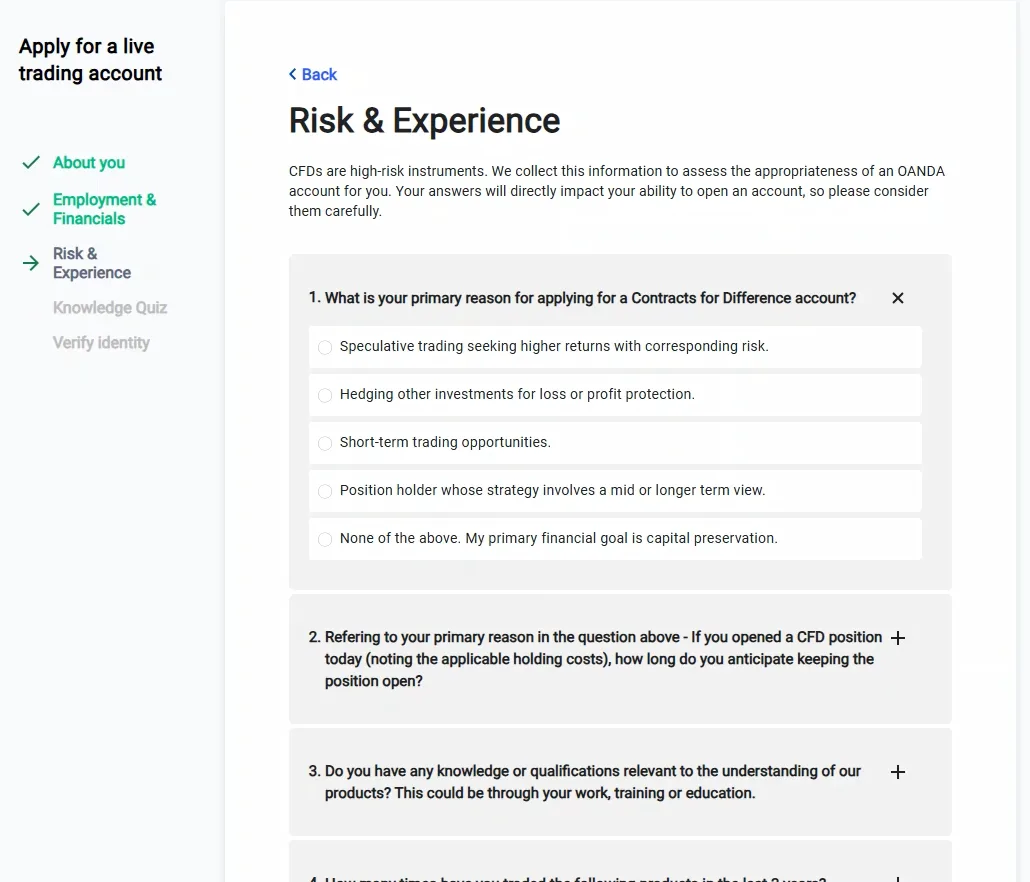
The form opens by confirming you live in Australia and says a demo account is created automatically alongside your live account. Seven stages follow: Account details, Personal details, Home address, Employment & Financials, Risk & Experience, Knowledge Quiz, Verify identity. You supply an email, mobile number and password, and the consent lets OANDA check your name, address, date of birth and driving licence number with a credit reporting agency, with eight legal documents on the screen. Your name as per ID, date of birth, nationality and tax residency come next, then your address via a search box or manual entry, then employment status, job title, industry, source of trading funds, annual income, savings and net wealth. The Risk & Experience stage warns that your answers directly impact your ability to open an account, covering your reason for a CFD account, expected holding period, relevant knowledge and trading frequency. A quiz follows before identity.
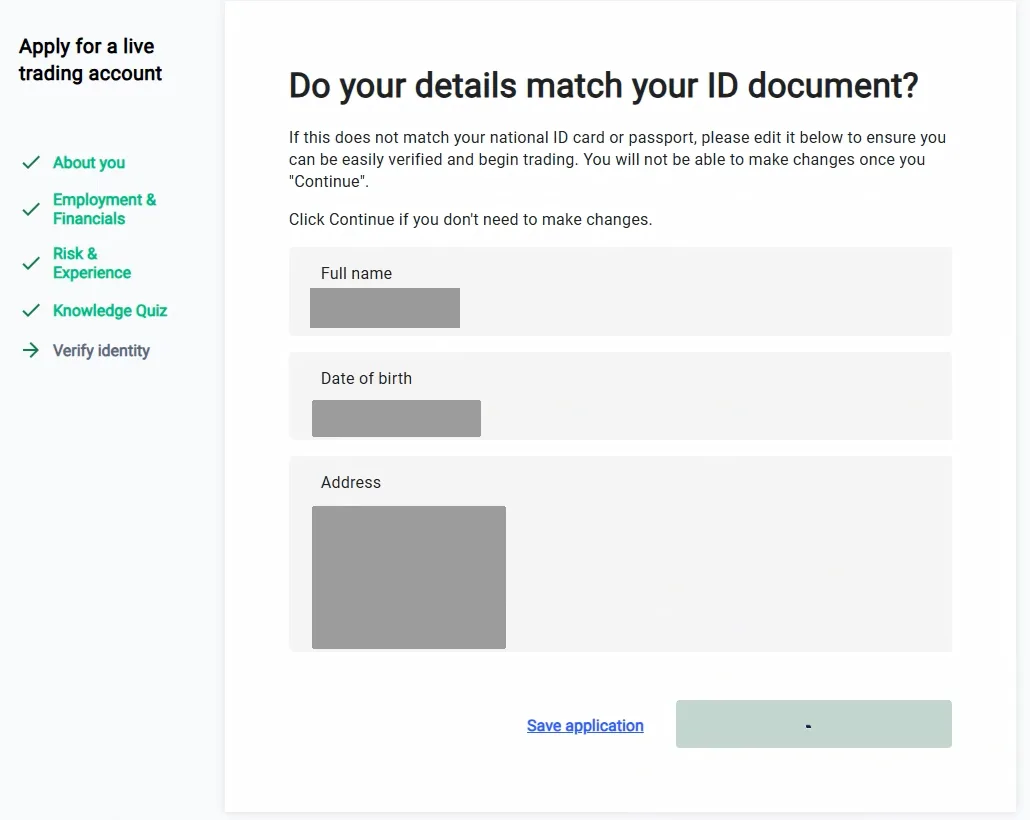
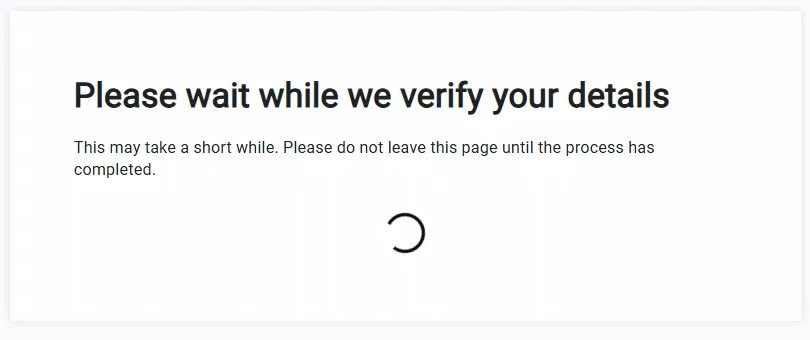
Identity turns on a screen asking whether your details match your ID, showing name, date of birth and address and warning they cannot be changed after Continue. A wait screen follows, then approval. No document upload or selfie step appears in the frames, and Noam’s notes record no manual ID or proof-of-address upload. Funding appeared only after approval, in the approval email, the approved screen and the dashboard status with its three ticked steps. The frames show the wait and the result, so I cannot tell you which agency responded or what it matched, and the consent says you may be asked for documents if your details do not match.
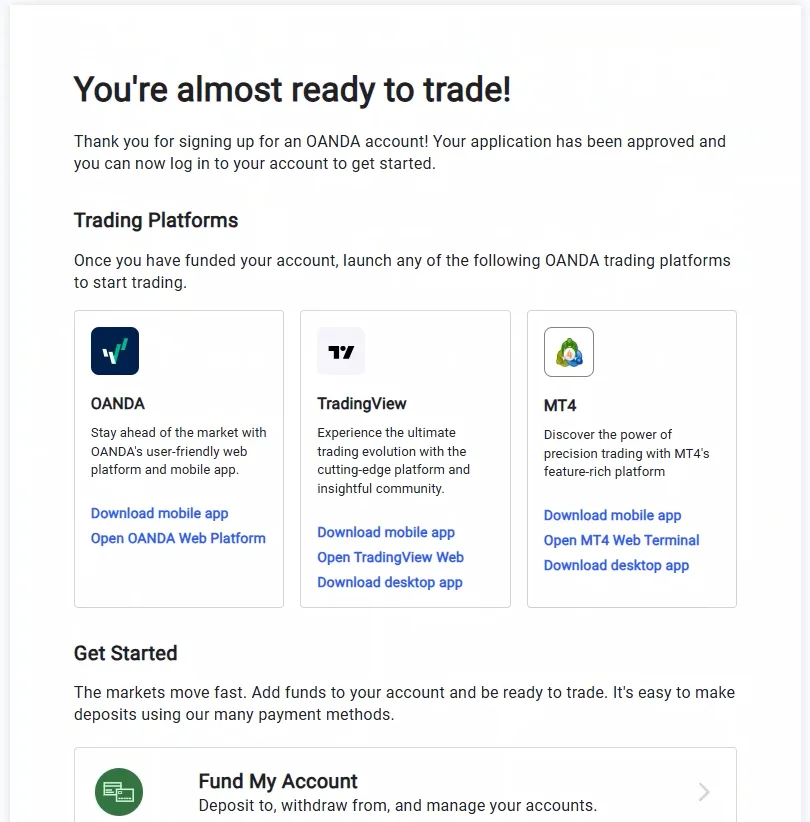
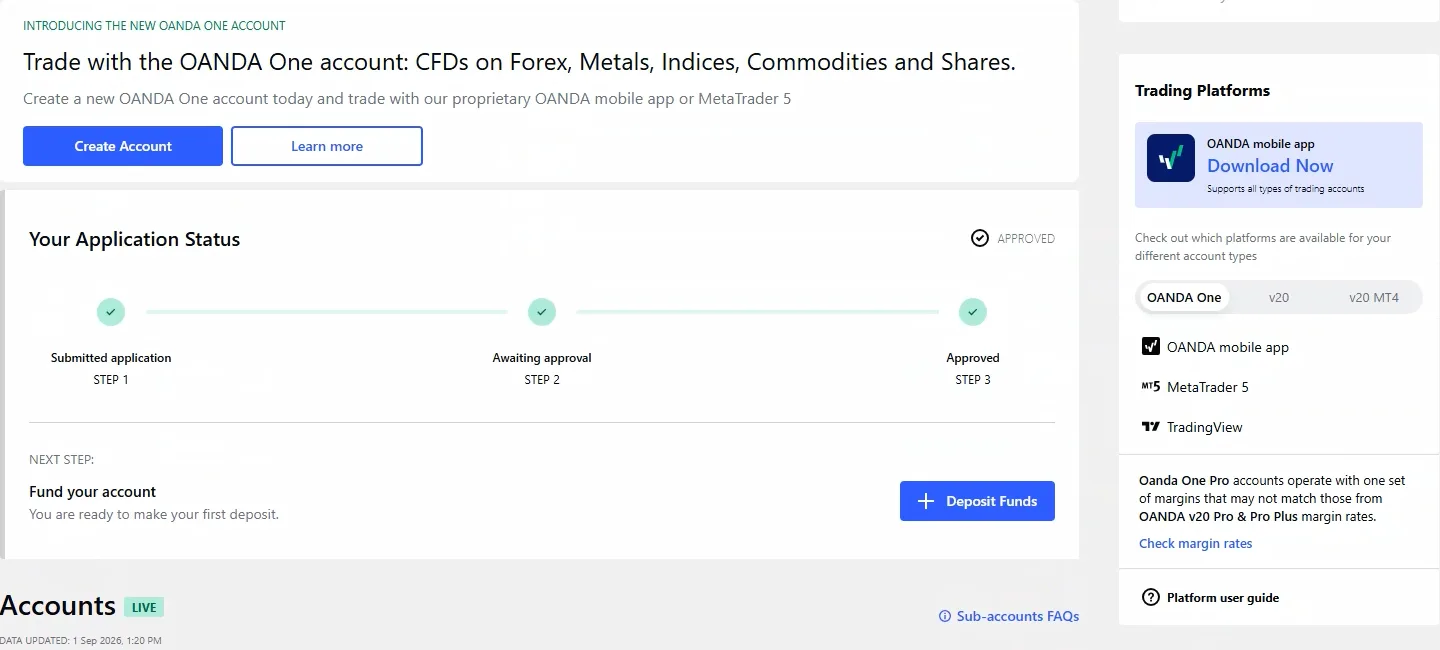
The approved screen offered three platforms for this account, OANDA’s own web platform and app, TradingView and MT4, and said to fund the account first. The dashboard carried a banner introducing “the new OANDA One account” and a platform toggle between OANDA One, v20 and v20 MT4, with TradingView listed under OANDA One. Noam’s notes call this one of the cleaner flows he has tested, because approval came before funding. What you can trade comes next.
OANDA account types and minimum deposit
OANDA account types number six across three pricing models, with a minimum deposit of A$0 on the Standard account. Premium tiers are gated on balance rather than deposit.
| Account | Pricing model | Min deposit | Best for |
|---|---|---|---|
| Standard | Spread-only, no commission | A$0 | Casual and occasional forex traders |
| Raw | Raw spreads from 0.0 plus A$3.50 per side, A$7.00 round turn | Not published | Active traders wanting commission pricing |
| Premium Spreads | Spread-only from 0.2 pips, no commission | A$10,000 balance or US$30m+ volume | Higher-balance traders |
| Premium Commission | From 0.0 pips plus A$2.75 per side, A$5.50 round turn | A$10,000 balance or US$30m+ volume | Higher-balance, cost-focused traders |
To reach the Premium tiers, the A$10,000 account balance test applies over the first 30 days for new clients or the last 60 days for existing ones. The unlimited demo account is a different story: it carries A$100,000 in virtual funds and is featured in our demo account comparison.
Professional tiers and swap-free
The two professional tiers, both onshore under ASIC, are where leverage jumps significantly. Professional lifts leverage to 200:1 on selected forex pairs and indices and 100:1 on gold, plus a hedging account, a relationship manager and subsidised tool subscriptions. Professional Plus goes further: 300:1 on selected forex pairs and indices, 200:1 on gold, 100:1 on oil and 10:1 on Bitcoin, with volume-based rebates. I’d only recommend these if you meet the criteria and understand the increased risk.
OANDA does run a swap-free account, though not one an Australian resident can open, confirmed with the desk in July 2026. The swap-free product exists on the group’s global sites, so it is easy to assume it carries across to the Australian entity, but the Australian entity does not offer it and a Sharia-compliant requirement cannot be served here; I would not open an account expecting that product to appear.
OANDA trading platforms
OANDA offers five trading platforms: OANDA Trade on web, desktop and mobile, MT4, MT5, native TradingView execution, and a REST and streaming API.
The Australian entity excludes cTrader, which is the one gap to flag for traders who prefer that environment.
OANDA Trade (proprietary)
OANDA Trade is the in-house platform and shows years of refinement: charting is clean, order types are properly integrated, and the OANDA research and currency data sit inside the interface. The platform carries guaranteed stop-loss orders, a real risk-management edge MT4, MT5 and TradingView do not offer here and a feature that alone makes OANDA Trade worth a look if you hold positions through news events.
MetaTrader and TradingView
For traders coming from MT4, it’s available on the Standard account and suits legacy expert advisors. MT5 adds multi-asset support, which is a step beyond MT4’s forex and CFD focus. The TradingView integration is native, not a charting link, so a Pro or Premium subscriber connects an eligible OANDA account and places orders straight from the charts. That platform integration is among the strongest features on this page.
API access and mobile
The OANDA REST and streaming API is one of the better-known retail-accessible APIs in forex. It has been used for years by algorithm developers, powering custom dashboards and bespoke risk tooling, and the documentation is solid. On the mobile side, OANDA Trade mobile and the MetaTrader mobile apps are both supported, with biometric login on iOS and Android in OANDA Trade.
OANDA markets and instrument counts
OANDA markets and instrument counts stop under 150 instruments across seven asset classes, with 70 plus forex pairs carrying the range, leaving you with the narrowest instrument selection of the raw-account brokers covered here.
| Asset class | Count | Note |
|---|---|---|
| Forex | 70+ pairs | All the standard AUD crosses |
| Indices | ASX 200 plus the major global indices | Not a deep list |
| Commodities | Gold, silver, WTI, Brent, natural gas, a handful of softs | Metals and energy carry the class |
| Bond CFDs | Limited list | Includes US Treasuries |
| Cryptocurrencies | Limited offering | The thinnest class on the menu |
| Share CFDs | Narrow | No direct ASX share investing |
| ETFs | Limited list | ETF CFDs only |
The narrow range is a decision rather than an oversight. OANDA is a currency specialist and the list reflects that priority, a respectable focus, but you need to know what you are not getting.
What you don’t get matters as much as what you do. Share CFD coverage is narrow next to CMC Markets, IG Markets or Interactive Brokers, and there is no direct ASX share investing at all. The crypto range is limited, so if you’re shopping specifically for crypto, this is the wrong place. I’d only use OANDA for forex and metals.
Gold and metals
Gold and silver trade as XAU/USD on every pricing tier. The Raw account commission of A$3.50 per side covers metals as well as forex, which is handy. The ASIC retail cap on gold is 20:1. We haven’t measured metals spreads in our capture, so no tested gold spread appears here.
OANDA leverage and margin under ASIC rules
OANDA leverage for Australian retail clients is capped at 30:1 on major forex pairs, with lower caps on minors, indices, commodities and cryptocurrency. That’s the standard ASIC regime, and it applies across all OANDA retail accounts.
These leverage caps come from ASIC’s product intervention order, extended to 23 May 2027. So the caps are 30:1 on major forex pairs, 20:1 on minor pairs, gold and major indices, 10:1 on commodities other than gold, 5:1 on share CFDs and 2:1 on crypto assets. They apply at every ASIC broker, not just OANDA.
Across Standard, Premium and Raw pricing, the leverage caps are identical, so your tier choice affects the spread but never the leverage. The only way to go above the retail ceiling is through the two professional account tiers, which reach 200:1 and 300:1 on selected forex pairs and indices.
The retail margin close-out rule is set at 50% of equity. That means ASIC requires every CFD issuer to close your positions once equity falls below half the total initial margin on all open positions. Positions cannot be netted against each other to reduce that figure, and a gapping market can close a position below the 50% level. The full mechanics are in the mechanics of leverage.
OANDA customer support
Phone, live chat and email provide support 24 hours a day, Monday to Friday Sydney time. It closes across the weekend, which is a limitation to note if you tend to trade over the weekend.
Live chat replied in roughly 90 seconds during Australian business hours. Three support channels including a phone line is the full set, and the desk rates at the top of the categories here. That’s a solid response time.
The weekend support closure is the counterweight, and it’s listed in the cons. IG Markets runs 24/7 where OANDA does not, and that matters if you’re holding positions over a weekend. A margin question on a Saturday waits until Monday here. That’s something to consider carefully.
Support language coverage is English only on the Australian desk. That’s narrower than the seven languages at IC Markets, but it matches most of the local field. If you need multilingual support, this is a point to note.
The support quality lifts the category rating rather than the hours do. Agents handle platform and API questions competently, a level of competence rare at a retail broker: an API question at most brokers reaches a queue that cannot answer it.
OANDA research, tools and education
Eight components make up the research, tools and education suite. It’s split between a beginner education stack and a currency research suite built on the broker’s own data heritage. The real-time spread data is the standout.
Education content
- Beginner course covering forex, CFDs and technical analysis basics
- Webinar series with the OANDA in-house analysts
- Glossary of trading terms and an introductory guide to the OANDA Trade interface
- YouTube channel with regular forex analysis and platform walkthroughs
Market research
- MarketPulse, the in-house forex news and analysis hub
- Currency converter and historical rate data
- Real-time spread data published openly on the OANDA website
- Economic calendar and news feed integrated into OANDA Trade
The published real-time spread data is the unusual research item. Most brokers publish an advertised from-rate and nothing else, where OANDA exposes live figures a client can check independently. That’s a transparency position, not a marketing one.
That education stack is one reason why OANDA leads our beginner forex brokers in Australia guide. I’d point a new trader straight to it.
What traders say about OANDA
| Rating site | Rating | Based on | Who rated | Captured |
|---|---|---|---|---|
| Trustpilot | 3.5 out of 5 | 1,235 reviews | Worldwide | September 2026 |
| App Store | 4.65 out of 5 | 1,090 ratings | Australia only | August 2026 |
| TradingView | 4.6 out of 5 | 32,873 ratings | Worldwide | September 2026 |
Each row above is a public rating of OANDA taken from a rating site, dated to the month its figure was captured. An App Store rating counts ratings left on Apple's Australian App Store only, while a Trustpilot figure counts reviews and a TradingView figure counts ratings from anywhere in the world. A site with no row has no rating for OANDA, withholds it, cannot be matched to OANDA with confidence, or we have not captured it yet.
How OANDA compares to Pepperstone and Fusion Markets
OANDA compares to Pepperstone and Fusion Markets as a trade-off between regulation and price, with OANDA Raw sitting at 0.44 pips across the eight-pair basket in the July 2026 capture.
Pepperstone came in at 0.46 pips in our May to June 2026 capture, and Fusion Markets at 0.09 pips in our September 2026 capture. Commission is A$7.00 round turn for OANDA, A$7.00 at Pepperstone and A$4.50 at Fusion Markets.
For the closest peer, see the Pepperstone review. Pepperstone carries five platforms against five here, measured 0.10 pips on EUR/USD against 0.20, and charges the same commission. I’d compare them side by side if platform breadth and TradingView are your priorities.
Fusion Markets undercuts both on commission at A$4.50 round turn and measured tighter across the basket, but the regulatory reach, with dual ASIC and CFTC registration, is what neither rival matches and is the reason this page rates where it does on trust. You are paying a small cost premium for a regulatory profile that is genuinely hard to find.
Put OANDA next to any of the other 31 ASIC-regulated brokers we cover.
OANDA Fusion Markets Middle of the measured field
OANDA's measured 0.44 pips and Fusion Markets' measured 0.09 pips straddle the middle broker's 0.4.
OANDA's measured 0.2 pips and Fusion Markets' measured 0.01 pips straddle the middle broker's 0.1.
OANDA's measured 0.99 pips sits 0.01 below the middle broker's 1.0; Fusion Markets' 0.83 pips sits 0.17 below it.
OANDA's A$7.00 matches the middle broker's A$7.00; Fusion Markets' A$4.50 sits A$2.50 below it.
Fusion Markets' A$57.84 a month sits A$67.79 under the middle broker's A$125.63; OANDA's A$132.77 sits A$7.14 over it.
OANDA's A$141.23 sits A$1.42 below the middle broker's A$142.65; Fusion Markets' A$118.40 sits A$24.25 below it.
OANDA and Fusion Markets both come to A$0 on this row, A$50 below the middle broker's A$50.
OANDA runs MT4, MT5, TradingView, Own platform; Fusion Markets runs MT4, MT5, cTrader, TradingView.
OANDA holds AFSL 412981; Fusion Markets holds AFSL 385620.
OANDA's 92 / 100 sits 17 above the middle broker's 75; Fusion Markets' 91 / 100 sits 16 above it.
OANDA's 3.5 / 5 and Fusion Markets' 4.8 / 5 straddle the middle broker's 4.3.
OANDA's 4.65 / 5 sits 0.11 above the middle broker's 4.54; Fusion Markets' 4.71 / 5 sits 0.17 above it.
OANDA and Fusion Markets both come to 4.6 / 5 on this row, 0.1 above the middle broker's 4.5.
OANDA's 5,670 sits 4,320 above the middle broker's 1,350; Fusion Markets' 2,950 sits 1,600 above it.
Capture: September 2026 · AUD/USD 0.7010 (25 Sept 2026) · field: the measured field varies by row, from 16 to 24 brokers, of 32 reviewed.
Bars run lowest to highest across the measured field; the tick marks the middle broker.
| If you value… | Consider |
|---|---|
| Tightest forex spreads | Pepperstone or IC Markets |
| Broader product range | CMC Markets or IG Markets |
| Direct ASX shares plus CFDs | CMC Markets |
| Beginner-focused platform | Plus500 or eToro |
| API access on a multi-asset account | Interactive Brokers |
| Lower spreads on a Standard account | Eightcap (1.0 pip EUR/USD standard average) |
Should you open an OANDA account?
I’d recommend OANDA for currency traders who want a forex specialist with dual ASIC and CFTC regulation, native TradingView and a documented API, across under 150 instruments. If you want the tightest raw pricing or a broad multi-asset range, you’re better served elsewhere.
Two groups of trader gain clear value from an OANDA account. The licence stack reaches a regulatory profile almost no retail broker matches, which is a strong safety net. The platform range covers native TradingView execution and a REST API with years of community use behind it, so developers and chart-driven traders will find it appealing.
On the other side, two groups should look past an OANDA account. Cost-first traders find the Raw basket at 0.44 pips in our July 2026 capture against 0.09 pips at Fusion Markets in our September 2026 capture, on a dearer commission. Multi-asset traders find under 150 instruments where CMC Markets prices 12,000 plus. If you fall into either group, I’d keep looking.
In the 2026 scoring among leading ASIC-regulated forex brokers, OANDA ranks second, carried there by trust and service rather than by price, which in my view is the right trade-off for the right trader.
FAQs
Is OANDA a trustworthy broker?
How do I withdraw money from OANDA?
What leverage does OANDA offer in Australia?
How much money do I need to start trading on OANDA?
Does OANDA offer TradingView trading in Australia?
Does OANDA have an API for algo trading?
Does OANDA charge an inactivity fee?
Is OANDA better than Pepperstone for Australian forex traders?
Testing log
| Record | Detail |
|---|---|
| Review published | 16 May 2026 |
| Last content change | 27 September 2026 |
| Spread capture | Raw account, 0.2 pips EUR/USD, 0.44 pips eight-pair average |
| Verification | OANDA AU published spread data reviewed 10 July 2026; live AUD v20 MT4 account opened with electronic identity verification and funded by Visa with A$200 on 1 September 2026 |