




What MultiBank Group costs per trade
MEASUREDMonthly spread cost converts pips to dollars using the EUR/USD pip value as the proxy for the 8-pair average, footnoted on-page. AUD pip value A$14.27 per standard lot at AUD/USD 0.7010 (25 Sept 2026).
At 10 standard lots per month on Standard accounts, MultiBank Group costs approximately A$213.98 in spread costs. Rates as of Fri 25 Sep 2026, 5pm New York close.
Trading CFDs and forex carries a high level of risk and may not be suitable for all investors. Read the relevant Product Disclosure Statement before opening an account.
Our verdict on MultiBank Group
I'd call MultiBank Group a credible mid-tier pick rather than a top-three one, and the draw for you is regulatory breadth. The Australian arm, MEX Australia Pty Ltd, holds ASIC AFSL 416279, current since 20 March 2012, and the group adds BaFin in Germany, CySEC in Europe, the SCA in the UAE and MAS in Singapore, plus offshore BVI, CIMA and VFSC registrations. Only a handful of the 32 brokers in this Australian set match that spread of oversight.
The local presence and the ASIC licence read as genuine, and the broker's centre of gravity sits in Dubai rather than Sydney or Melbourne. That shows in the range you can trade: the Australian entity carries forex, metals, indices and spot energy, and the share CFDs, crypto and bonds behind the group's 20,000 plus instrument headline belong to entities the AFSL does not cover. On measured raw spreads the ECN account averaged 0.40 pips across eight pairs, ninth tightest of the raw accounts we tested, where IC Markets and Fusion Markets price tighter.
Pros
- I'd value ASIC AFSL 416279 current since 20 March 2012, alongside BaFin, CySEC, SCA and MAS across the group.
- The ECN account you can open measured 0.40 pips across eight pairs, ninth tightest of the raw accounts we tested.
- You get MT4 across desktop, mobile and the Web Terminal, plus MAM accounts for managed trading.
- Support runs 24/7 and multilingual on phone, live chat and email, answering in under two minutes in testing, which I'd want if you trade outside business hours.
- I'd use the eight funding methods including PayID, BPAY and crypto, most of them at A$0.
Cons
- The Standard account you can open measured 1.5 pips on EUR/USD and 1.61 pips across eight pairs, well wide of the raw leaders.
- I'd flag MT4 only on the Australian entity, with no MT5, no cTrader and no TradingView.
- You can trade four asset classes at the Australian entity: no share CFDs, no crypto and no bonds under AFSL 416279.
- I'd watch the US$60 annual inactivity fee, and the ECN commission rate is not published at all.
- Less brand recognition and less Australian-rooted than CMC Markets, IG Markets or Pepperstone.
MultiBank Group score breakdown
4/5 · Great
The overall CFB Score comes from the full methodology, more than 100 data points per broker.
How is our rating calculated?Is MultiBank Group safe? ASIC AFSL 416279
MultiBank Group’s Australian entity, MEX Australia Pty Ltd, holds ASIC AFSL 416279, current since 20 March 2012, and the group adds five further licences including BaFin in Germany at Tier 1. This global regulatory stack provides substantial cover.
ASIC regulation and global licences
AFSL 416279 is held with the Australian Securities and Investments Commission, and the licence is in good standing. The Australian entity also holds an AUSTRAC digital currency exchange registration numbered 100724469, which acts as a secondary safeguard.
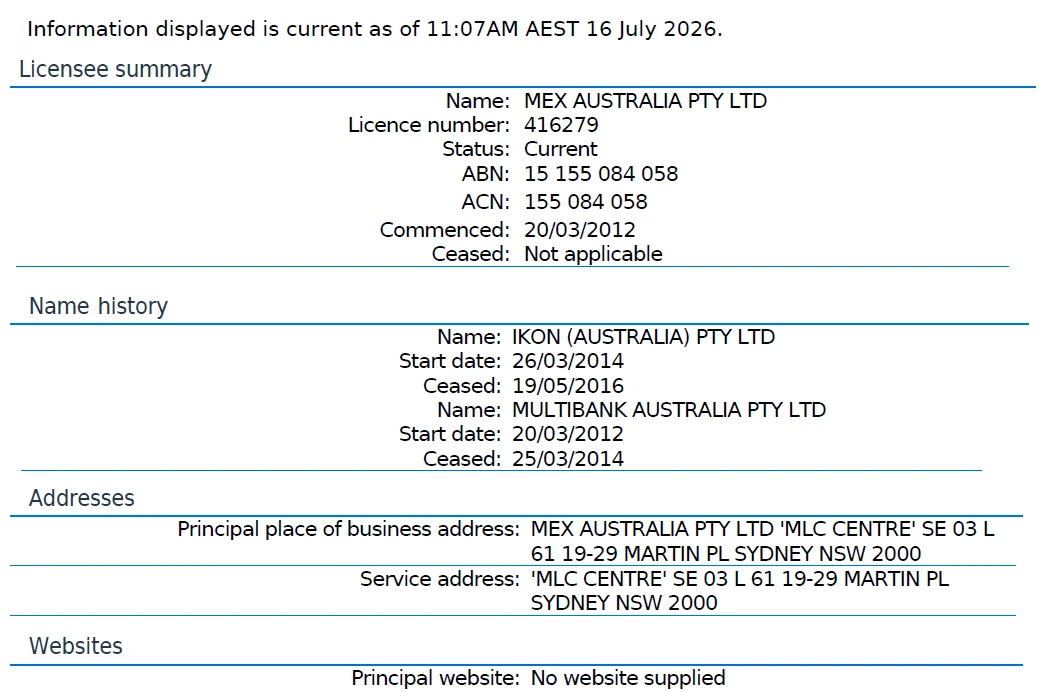
The group licence stack holds six entries:
- ASIC, Australia, Tier 1
- BaFin, Germany, Tier 1
- CySEC, Cyprus, EU
- SCA, United Arab Emirates
- MAS, Singapore
- BVI FSC, CIMA and VFSC, offshore
The BaFin licence is the one that matters most of those. I’d point you to it because it is Tier 1 and it is rare among brokers available to Australian retail clients, which is the whole basis of the trust rating on this page.
History and ownership
Founded in California in 2005 by Naser Taher, the parent group is headquartered in Dubai today. The parent history runs twenty-one years behind the brand, and the Australian licence covers fourteen of them. That balance belongs in any view of local presence.
Public reviews
How popular is MultiBank Group in Australia?
MultiBank Group is searched too rarely in Australia for month-on-month change to be meaningful: 260 branded searches in August 2026, 27th of 32. Search interest measures attention, not quality; the score above is the review verdict.
- 260
- Brand searches, August 2026
- n/a below 1,000
- vs July 2026
- 120
- Login searches
- 0.1%
- Share of all broker searches
Source: Google search volume, Australia, August 2026. How this is measured
What other review sites say
MultiBank Group's iOS app rates 5.00 out of 5 from 4 ratings on the Australian App Store (September 2026), listed as MultiBank-Plus: Invest & Trade.
Third-party rating coverage of the Australian arm is thinner than for the larger Australia-focused brokers, which tracks the entity’s size here rather than anything about the service. The rating comparison above renders only the figures held against a capture, so the scope can be trusted.
Before depositing, confirm MultiBank Group holds AFSL 416279 using the site's guide to checking a broker on ASIC's register.
MultiBank Group client money protection and AFCA membership
MultiBank Group client money protection runs through segregated accounts at an Approved Australian Bank, with AFCA hearing claims up to A$1,263,000 and awarding compensation up to A$631,500, caps worth understanding before you fund.
Client money accounts sit separate from company funds. ASIC requires negative balance protection on retail CFD accounts, so a retail account cannot lose more than the money in it. I’d treat the Compensation Scheme of Last Resort’s boundary as the real limit: it pays up to A$150,000, only for personal advice, securities dealing and credit, and forex and CFD trading sit outside it.
The licence boundary matters more here than at a single-entity broker. Those protections attach to AFSL 416279 and to MEX Australia, not to the MultiBank brand, so the group’s offshore entities sit outside them entirely. That boundary is worth checking before you assume cover. The field comparison sits in the list of the safest CFD brokers in Australia, and the mechanism in the guide to negative balance protection in Australia.
A practical licence test is simple. If you open an account under AFSL 416279, it carries the AFCA route and the client money rules, and an account opened with a group entity elsewhere carries neither. I’d insist on the first one.
MultiBank Group at a glance: 17 key facts
MultiBank Group opens the Standard account from a US$50 minimum deposit under ASIC AFSL 416279, current since 20 March 2012, held by the Australian entity, MEX Australia Pty Ltd. The 17 key facts below work as a first screen.
The table covers the entity, the regulator stack and the fee schedule.
| Item | Detail |
|---|---|
| Australian regulator | ASIC, AFSL 416279, current since 20 March 2012 |
| Australian entity | MEX Australia Pty Ltd (ACN 155 084 058), trading as MultiBank Group AU |
| Other regulators | BaFin (Germany, Tier 1), CySEC (EU), SCA (UAE), MAS (Singapore), plus offshore BVI, CIMA and VFSC |
| Year founded | 2005 (California, USA originally); Dubai HQ today |
| Headquarters | Dubai, United Arab Emirates; AU operations via MEX Australia |
| Trading platforms | MT4 desktop, MT4 mobile, MT4 Web Terminal, MAM |
| Account types | Standard, ECN |
| Minimum deposit | US$50 (Standard), A$1,000 (ECN) |
| Maximum retail leverage | 30:1 (forex majors), per the ASIC product intervention order |
| Spreads, ECN (eight-pair basket) | 0.40 pips measured average, May to June 2026 |
| Spreads, Standard (EUR/USD) | 1.5 pips measured average, May to June 2026 |
| ECN commission | Per-lot rate varies by account tier and is not published; see the MultiBank PDS |
| Funding methods (AU) | Visa, Mastercard, BPAY, PayID, bank transfer, Skrill, Neteller, crypto |
| Inactivity fee | US$60 per year |
| Negative balance protection | Yes (mandatory under ASIC) |
| AFCA member | Yes |
| Demo account | Free |
| Customer support | 24/7 phone, live chat, email; multilingual |
Those two minimum deposit rows sit in two different currencies on purpose, because the broker’s own account pages denominate them that way.
MultiBank Group ECN and Standard spreads, measured
MultiBank Group ECN measured 0.40 pips across the eight-pair basket over May to June 2026, while the Standard account measured 1.5 pips on EUR/USD and 1.61 pips across the same basket, a gap worth noticing before you choose an account.
The spread capture window was run by Noam Korbl through rolling 24-hour samples on IceFX SpreadMonitor from a London VPS, the same rig used across the lowest spread brokers in Australia comparison, so the MultiBank Group ECN and Standard spreads sit on the same basis as every other broker in that table. The basket figure ranked ninth tightest of the raw accounts tested at 0.40 pips, which I rate as credible but not elite.
I’d treat the broker’s own per-pair averages as advertised figures rather than measured ones:
| Pair | MultiBank advertised average (pips) |
|---|---|
| EUR/USD | 0.1 |
| USD/JPY | 0.3 |
| AUD/USD | 0.4 |
| USD/CAD | 0.4 |
| GBP/USD | 0.5 |
| NZD/USD | 0.7 |
| USD/CHF | 0.8 |
That gap between the two sets is the point that matters. The advertised figure of 0.1 pips on EUR/USD is a house number on a house methodology, and the 0.40 pip basket is what a rolling capture returned across eight pairs through full sessions including the thin hours. I’d lean on the measured figure, not the advertised one.
What it costs to trade with MultiBank Group
MultiBank Group does not publish the ECN commission rate, and the 0.40 pip measured basket is the only cost figure that stands on its own in what it costs to trade.
The full cost cannot be totalled on this page, and that missing number is needed before you fund an account.
| Account | Basket average, May to June 2026 (pips) | Commission, round turn |
|---|---|---|
| MultiBank ECN | 0.40 | Per-lot, tier-dependent, unpublished |
| MultiBank Standard | 1.61 | None |
| IC Markets Raw | 0.15 | A$9.00 |
| Fusion Zero | 0.36 | A$4.50 |
| Pepperstone Razor | 0.46 | A$7.00 |
I treat the unpublished commission rate as a genuine gap rather than a formatting quibble. The commission table lists brokers publishing one flat rate, and this one stays out of it, so you cannot compare total cost against the field before funding an account.
The Standard account carries the whole cost in the quote instead, and at 1.5 pips on EUR/USD it runs wider than CMC Markets on the same pair over the same window and considerably wider than the major commission-free brokers, which is the cost of simplicity.
Other fees AU traders should check
- Overnight swap rates apply on positions held past 5 PM New York time, direction-dependent.
- The inactivity fee runs US$60 per year after a dormant period, reset by a single trade.
- Currency conversion applies to any instrument outside the account base currency.
- Withdrawal fees vary by method rather than running flat.
MultiBank Group funding methods and withdrawal times
MultiBank Group funding methods number eight, five of them at A$0, from instant card payments to bank transfer in one to two business days, a spread built for quick funding.
Deposit methods (AU clients)
| Method | Fee | Speed |
|---|---|---|
| Visa / Mastercard | A$0 | Instant |
| PayID | A$0 | Same day |
| BPAY | A$0 | Next business day |
| Bank transfer | A$0 | 1 to 2 business days |
| Skrill / Neteller | Method-dependent | Instant |
| Crypto (selected) | Network fee | Network-dependent |
Eight funding methods is a wide menu, and the Australian rails that matter are all present: PayID and BPAY both settle without a card network in the middle, and that local speed is the value here.
Withdrawals
The withdrawal fee varies by method rather than running flat, which is worth checking against the deposit rail before you fund. Withdrawals must return by the same source as the deposit where possible, under anti-money-laundering rules, so the outbound cost depends on the method.
Account opening
Account opening runs online and AUSTRAC-compliant, and most Australian applications clear within 24 to 48 hours unless the documents need a second look.
MultiBank Group account types and minimum deposit
MultiBank Group account types number two, with a minimum deposit of US$50 on Standard and A$1,000 on ECN, denominated that way by the broker’s own account pages, making the Standard account the first choice if you are starting small.
| Account | Pricing model | Min deposit | Best for |
|---|---|---|---|
| Standard | Spread-only, no commission | US$50 | Casual or beginner traders |
| ECN | Tighter spreads plus per-lot commission, rate per the PDS | A$1,000 | Active forex traders |
The two accounts carry the same markets on two pricing models. Standard is the cheaper way in, so nothing stops you starting there and moving across once volume justifies the commission. That is the move to make.
MAM accounts sit separate from a retail account decision. They sit alongside both for managed trading rather than forming a third retail tier, and they are covered in their own section above.
Minimum deposit
The Standard minimum deposit is US$50 and the ECN minimum deposit is A$1,000, per the MEX Australia account pages and PDS, checked 17 July 2026. Both accounts carry a free demo, and that demo is worth using before you commit. The field comparison sits in the demo account comparison.
MultiBank Group trading platforms
MultiBank Group trading platforms number one on the Australian entity, MetaTrader 4, across three builds: desktop, mobile and the browser-based Web Terminal, a short list.
MetaTrader 4
The MT4 build runs on Windows, on macOS through a wrapper, and on mobile, with expert advisors supported throughout, but that single platform choice is the sharpest limitation on this page, and it matters before you open an account, because MT5 and the proprietary MultiBank Plus terminal are offered by other group entities rather than by the ASIC-regulated Australian one.
MT4 Web Terminal
If you do not need expert advisors, the MT4 Web Terminal runs in the browser with nothing to install, and it suits that use case. The platform charting and order entry work as they do on the desktop build, with the automation layer absent, which is acceptable for quick access.
What is missing
The platform list excludes MT5, cTrader and TradingView entirely on this entity. If you want any of the three, the platform gap forces a move to a different broker, because none can be added to an account under AFSL 416279. That is a hard constraint.
MultiBank Group MAM accounts and copy trading
MultiBank Group offers MAM accounts that let one manager trade a master account, with allocations flowing through to linked client accounts on an agreed split.
No proprietary social feed exists alongside them, which suits only a trader who understands the manager relationship.
I rate the MAM structure as the substantial half of the copy offering. A managed account under it is a legal arrangement between you and the manager rather than a subscription, and the allocations settle automatically across the linked accounts.
MetaTrader Signals covers the lighter case, where a trader mirrors a provider’s trades through the standard MetaQuotes feed. That platform works the same way here as at any MT4 broker, so it differentiates nothing.
The copy trading platform gap is the absence of a proprietary social feed of the kind eToro is built around, and the copy trading comparison covers who does it properly. If you want to browse and follow individual traders, the platform carries nothing beyond the Signals marketplace, and that comparison is the right route before choosing.
MultiBank Group markets and instrument counts
MultiBank Group markets and instrument counts run to four asset classes on the Australian entity: forex, gold and silver, indices and spot energy, a narrow map.
| Asset class | Count | Note |
|---|---|---|
| Forex | Not published | Major and minor pairs including AUD crosses |
| Gold and silver | Not published | Metals CFDs on both accounts |
| Indices | Not published | ASX 200 plus the major global benchmarks |
| Energy | Not published | Spot oil and gas CFDs |
| Share CFDs | None at the AU entity | Held by other MultiBank entities |
| Crypto CFDs | None at the AU entity | Held by other MultiBank entities |
| Bonds | None at the AU entity | Held by other MultiBank entities |
The group markets itself on a 20,000 plus instrument headline, and that number belongs to entities other than the ASIC-licensed one, so it reads as a group statistic rather than an Australian one. The class range you can trade here stops at four, and the CFD product categories comparison covers where they sit against the field.
No per-class instrument figure is published for the Australian entity, so the table above states what is tradeable rather than a number nothing supports. Share CFDs, cryptocurrency CFDs and bonds are all absent under this licence, and if your shortlist turns on any of the three, this broker is out. That is an early rule-out.
Gold and metals
I rate the metals range as the group’s heritage and the Australian entity’s real strength, pricing gold and silver CFDs on both accounts. No tested gold spread has been captured here, so the 0.40 pip ECN forex average stays the only measured cost figure on this page. The retail leverage caps apply to gold at 20:1, and if you trade gold, that cap matters. The metals markets are compared in the guide to gold and precious metals CFDs.
Indices and energy
The index range covers the ASX 200 plus the major global benchmarks, and no count is published for it. The energy markets carry spot oil and gas on both accounts at the ASIC 10:1 retail cap. Neither range is deep, which is consistent with the entity’s narrow overall coverage. If you want deep indices or energy, look elsewhere, and the comparison sits in the guide to the index CFD set.
MultiBank Group leverage and margin under ASIC rules
MultiBank Group leverage and margin hold at the ASIC retail caps of 30:1 on major forex pairs across both accounts, with no Australian professional tier above them, so the cap is the one you should plan around.
ASIC caps retail CFD leverage at 30:1 on major forex pairs, 20:1 on minor pairs, gold and major indices, 10:1 on commodities other than gold, 5:1 on share CFDs and 2:1 on crypto assets. The caps come from a product intervention order extended to 23 May 2027, so they apply at every ASIC broker rather than at MultiBank Group alone, and I’d treat that as the floor and ceiling for your leverage here.
The offshore leverage figure of 500:1 sits with a non-ASIC group entity rather than the ASIC licensee, MEX Australia Pty Ltd (AFSL 416279), confirmed July 2026. Reaching it means leaving AFSL 416279, and the AFCA route and the ASIC client money rules leave with it, so none of it applies to the licence this review scores, and I’d avoid that trade-off if you value the local protections.
This retail margin rule requires every CFD issuer to close a retail client’s positions once account equity falls below half the total initial margin on all open positions. Positions cannot be netted against each other to cut that figure, and a gapping market can close a position below the 50% level. That rule is worth understanding before you size a position. The margin trade-off is set out in how leverage multiplies exposure and compared across the field in brokers that offer high leverage.
MultiBank Group customer support
MultiBank Group customer support runs 24 hours a day, seven days a week on phone, live chat and email, and the desk is multilingual, a real convenience.
The service stack answered in under two minutes on live chat during peak windows in testing. The service stack runs to three channels including a phone line, and the round-the-clock cover puts the hours ahead of the several brokers in this coverage that close across the weekend, which matters if you trade weekends.
Its multilingual desk range fits the group’s client base rather than its Australian one. The service stack answers a Sydney or Melbourne client at the same desk as a Dubai or Frankfurt one, which scores as a strength on availability and a mild weakness on local context.
The service stack is why support rates high on this page. The desk hours and the channel range are both at the front of the field, and neither is a close call.
MultiBank Group research, tools and education
MultiBank Group research, tools and education run to five components, doing the job without being a reason on their own to open an account, which is mid-range.
The research stack covers daily market commentary, an economic calendar, a webinar series, trading guides covering MT4 and platform basics, and Autochartist integration on selected accounts, so the essentials are covered, which is adequate.
Five research components is mid-field. The Autochartist research integration is the one that adds something a chart package does not, generating pattern and volatility alerts across the traded instruments automatically, so it is the tool to use if you want alerts without building a custom setup.
The account-tier condition on Autochartist is worth noting before you sign up for it, because the tool sits on selected accounts rather than on every one. Nothing in the stack is proprietary, so the whole offering is available in some form at most brokers in this coverage.
Webinar series and trading guides both target platform mechanics rather than strategy, so they suit someone new to MT4 rather than new to markets. The research calendar is the standard third-party feed every broker in this coverage carries, which is table stakes.
What traders say about MultiBank Group
| Rating site | Rating | Based on | Who rated | Captured |
|---|---|---|---|---|
| App Store | 5.00 out of 5 | 4 ratings | Australia only | September 2026 |
Each row above is a public rating of MultiBank Group taken from a rating site, dated to the month its figure was captured. An App Store rating counts ratings left on Apple's Australian App Store only, while a Trustpilot figure counts reviews and a TradingView figure counts ratings from anywhere in the world. A site with no row has no rating for MultiBank Group, withholds it, cannot be matched to MultiBank Group with confidence, or we have not captured it yet.
How MultiBank Group compares to Pepperstone and IC Markets
MultiBank Group compares to Pepperstone and IC Markets as a regulator-stack win against a platform and transparency loss. MultiBank Group measured 0.40 pips across eight pairs in the May to June 2026 capture, against Pepperstone at 0.46 pips.
IC Markets averaged 0.15 pips across the same eight pairs in that same May to June 2026 capture. MultiBank Group also sits on a commission rate it does not publish, so you are weighing its costs on spreads alone against both rivals.
Pepperstone brings five platforms, a measured execution figure and a published A$7.00 round-turn rate. IC Markets brings a much tighter basket and a deeper product range, so those are the better route when those are your priorities.
What MultiBank Group holds against both is the BaFin Tier-1 licence alongside ASIC, and the MAM structure for managed trading, and that edge carries weight.
Put MultiBank Group next to any of the other 31 ASIC-regulated brokers we cover.
MultiBank Group ThinkMarkets Middle of the measured field
MultiBank Group's measured 0.4 pips matches the middle broker's 0.4; ThinkMarkets' 0.45 sits 0.05 above it.
MultiBank Group's measured 0.1 pips matches the middle broker's 0.1; ThinkMarkets' 0.16 sits 0.06 above it.
MultiBank Group's measured 1.5 pips sits 0.5 above the middle broker's 1.0; ThinkMarkets' 1.1 pips sits 0.1 above it.
ThinkMarkets charges A$7.00 on round-turn commission; MultiBank Group carries no figure, commission rate not published.
ThinkMarkets comes to A$134.19 on raw account cost at ten standard lots a month; MultiBank Group carries no figure, commission rate not published.
MultiBank Group's A$213.98 sits A$71.33 above the middle broker's A$142.65; ThinkMarkets' A$156.92 sits A$14.27 above it.
ThinkMarkets opens at A$0 on the minimum deposit; MultiBank Group carries no figure, minimum published in US dollars, not converted on this row.
ThinkMarkets: the $0 minimum applies to Standard and ThinkTrader accounts; ThinkZero raw pricing requires AUD 500.
MultiBank Group runs MT4; ThinkMarkets runs MT4, TradingView.
MultiBank Group holds AFSL 416279; ThinkMarkets holds AFSL 424700.
MultiBank Group's 81 / 100 sits 6 above the middle broker's 75; ThinkMarkets' 80 / 100 sits 5 above it.
Neither MultiBank Group nor ThinkMarkets carries a figure on the Trustpilot rating, no Trustpilot profile captured.
ThinkMarkets' 4.54 / 5 matches the middle broker's 4.54; MultiBank Group's 5 sits 0.46 above it.
ThinkMarkets rates 4.6 / 5 on the TradingView broker rating; MultiBank Group carries no figure, no TradingView broker profile.
MultiBank Group's 260 sits 1,090 below the middle broker's 1,350; ThinkMarkets' 350 sits 1,000 below it.
Capture: September 2026 · AUD/USD 0.7010 (25 Sept 2026) · field: the measured field varies by row, from 16 to 24 brokers, of 32 reviewed.
Bars run lowest to highest across the measured field; the tick marks the middle broker.
| If you value… | Consider |
|---|---|
| Tightest forex spreads | IC Markets or Pepperstone |
| Broadest product range | CMC Markets or IG Markets |
| Melbourne-founded broker | Pepperstone or GO Markets |
| Direct ASX shares plus CFDs | CMC Markets |
| Beginner-focused platform | Plus500 or eToro |
| A published commission rate | Fusion Markets |
Should you open a MultiBank Group account?
MultiBank Group suits a trader drawn to the MAM structure or the group’s metals heritage, on ECN pricing that measured 0.40 pips across eight pairs. The account fit breaks for almost any generalist need, which is served better elsewhere than by a MultiBank Group account.
Two groups of trader gain clear value from a MultiBank Group account, and the fit places you in one of them. The licence stack reaches BaFin Tier-1 oversight alongside ASIC, which very few brokers available to Australian clients match. The MAM structure supports managed trading arrangements the retail platforms do not.
Two groups should pass on a MultiBank Group account. The range stops at four asset classes with no share CFDs, no crypto and no bonds. The Standard account measured 1.5 pips on EUR/USD, and the ECN commission rate is not published, so you cannot compare total cost before funding.
MultiBank Group ranks eighth among the leading ASIC-regulated forex brokers on the 2026 scoring, carried there by the regulator stack rather than by pricing or range. I’d put it at eighth for that reason. A free demo account runs both accounts, so you can test it before committing.
FAQs
Is MultiBank Group legit?
How do I withdraw money from MultiBank Group?
What leverage does MultiBank Group offer in Australia?
What is the minimum deposit for MultiBank Group?
Does MultiBank offer MT4 and MT5?
What is the difference between the Standard and ECN accounts?
Does MultiBank charge an inactivity fee?
How does MultiBank compare to Pepperstone or IC Markets?
Testing log
| Record | Detail |
|---|---|
| Review published | 16 May 2026 |
| Last content change | 27 September 2026 |
| Spread capture | ECN account, 0.1 pips EUR/USD, 0.4 pips eight-pair average |
| Capture window | May to June 2026 |
| Verification | Pricing page and PDS reviewed 8 July 2026 |