




What GO Markets costs per trade
MEASUREDMonthly spread cost converts pips to dollars using the EUR/USD pip value as the proxy for the 8-pair average, footnoted on-page. AUD pip value A$14.27 per standard lot at AUD/USD 0.7010 (25 Sept 2026).
Raw saves A$24.17 a month at this volume
At 10 standard lots per month on Raw accounts, GO Markets costs approximately A$104.22 in spread and commission costs. Rates as of Fri 25 Sep 2026, 5pm New York close.
Trading CFDs and forex carries a high level of risk and may not be suitable for all investors. Read the relevant Product Disclosure Statement before opening an account.
Our verdict on GO Markets
The Australian financial services licence behind GO Markets, AFSL 254963, has been continuously in force since 10 March 2004, a run only a handful of the 32 brokers in our Australian shortlist can match. That longevity matters to me, because most of this category is five to ten years old, or the local arm of an overseas operator. An unbroken licence counts for something.
Raw pricing with A$6.00 round-turn commission makes the GO Plus+ account competitive on cost, I'd say. Our September 2026 capture put EUR/USD at 0.09 pips with commission added separately, and the all-in cost across the eight-pair basket of 0.81 pips sits between Fusion Markets and IC Markets in that capture, though not at the very tightest end of the Australian set. Brand awareness sits a tier below CMC Markets, IG Markets and Pepperstone, but the Australian credentials are genuine.
Pros
- AFSL 254963 has been current since 10 March 2004, one of the longest unbroken Australian licences in our coverage.
- Our live capture from May to June 2026 put GO Plus+ at 0.10 pips on EUR/USD and 0.24 pips across eight pairs, with A$6.00 round-turn commission.
- You get five platform routes on a single account: MT4, MT5, cTrader, TradingView and the GO TradeX mobile app.
- 24/5 multilingual support covering four languages, including Mandarin, Arabic and Vietnamese.
- A$0 inactivity fee no matter your balance or how long you leave the account dormant.
Cons
- The Standard account measured 0.9 pips on EUR/USD in our May to June 2026 capture, a huge gap from the 0.10 pips on GO Plus+. I would not touch the Standard account for that reason.
- The share CFD range is narrower than the multi-asset specialists, and they publish no instrument count, so you cannot compare the breadth.
- Customer support runs 24/5, not 24/7, so you lose access across the weekend.
- The only proprietary platform, GO TradeX, is mobile-only with no desktop build, which is a gap if you want a tailored desktop experience.
GO Markets score breakdown
4/5 · Great
The overall CFB Score comes from the full methodology, more than 100 data points per broker.
How is our rating calculated?Is GO Markets safe? ASIC AFSL 254963
GO Markets Pty Ltd holds ASIC AFSL 254963, current since 10 March 2004, and the entity has stayed continuously licensed for more than two decades.
It is one of the longest unbroken Australian CFD licences in our coverage. That licence continuity is the main safety signal.
ASIC regulation and global licences
GO Markets Pty Ltd, ABN 85 081 864 039, holds AFSL 254963 with the Australian Securities and Investments Commission. Few Australian CFD brokers have carried a single licence that long without a break. I would value that unbroken licence run over a wider global licence set. For you, the licence is the detail that matters more than the group’s global reach.
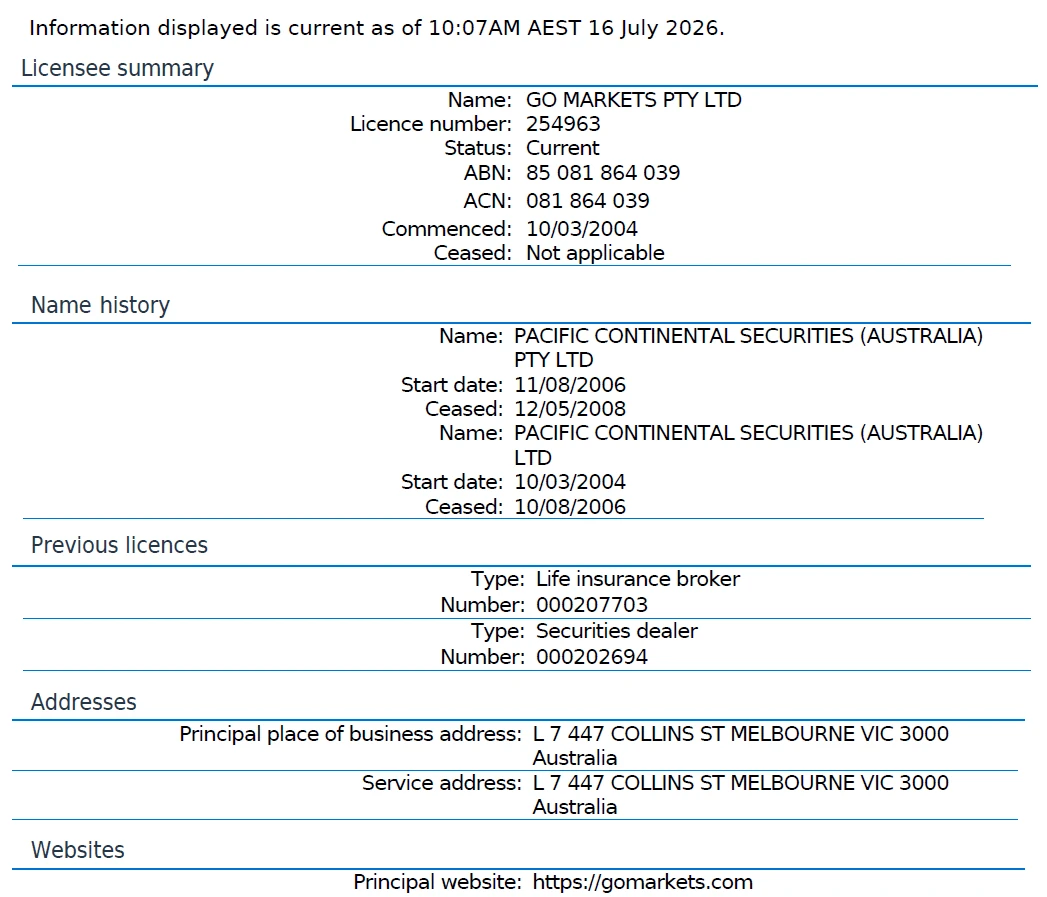
The licence stack holds three further entries:
- CySEC (Cyprus, EU), Tier 1
- FSC Mauritius, Tier 3 offshore
- FSCA (South Africa), Tier 2
Despite that licence run, the trust rating sits mid-range. I’ll state the reasons plainly: the group carries a Tier 3 Mauritius entity, the public review base is smaller than what larger brands attract, and the industry awards cover the group rather than the Australian entity specifically. For you, the trust rating is lower because those risks sit on the same licence.
History and ownership
The entity was registered in 2000 and has traded as GO Markets in Melbourne since 2006, staying privately held and Australian-headquartered the whole time. The parent group has collected Investment Trends awards for execution quality and customer satisfaction over those years, though the awards are group-wide rather than specific to the ASIC entity. I’d view the Melbourne history as a stability signal.
Before depositing, confirm GO Markets holds AFSL 254963 using the site's guide to checking a broker on ASIC's register.
GO Markets client money protection and AFCA membership
GO Markets runs its client money protection through segregated accounts at an Approved Australian Bank, with mandatory negative balance protection and AFCA membership carrying disputes at no cost to you.
AFCA hears claims up to A$1,263,000 and awards compensation up to A$631,500. For you, the practical cap to remember is the AFCA compensation limit of A$631,500. Separately, the Compensation Scheme of Last Resort pays at most A$150,000, and only for personal advice, securities dealing and credit, never forex or CFD trading. Client money accounts are separate from company funds. The retail standard is set out in the guide to negative balance protection on retail accounts.
One account carve-out matters on the wholesale tier, and it’s unusual enough to state precisely. GO Professional clients sit outside the retail protections, and what replaces the mandatory guarantee is a discretionary once-off negative balance protection capped at A$100,000. That protection is a goodwill policy rather than a regulatory entitlement. For you, the distinction matters because a discretionary cap can be declined, where the mandatory retail protection cannot.
Public reviews
GO Markets holds a Trustpilot rating of 4.2 out of 5 from 747 reviews, which Trustpilot labels great, captured September 2026. The profile has been claimed by the broker since September 2019.
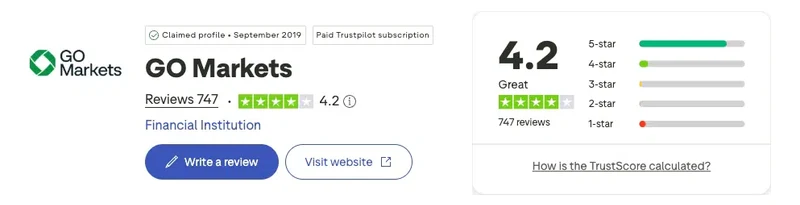
Public rating panels carry the third-party scores for this broker, built on fewer reviews than CMC Markets, IG Markets or Pepperstone attract, which reflects brand size rather than service quality. Those public ratings also cover the group as a whole rather than the ASIC entity specifically. The recurring praise you’ll see covers stability, deposit and withdrawal speed, and helpful onboarding.
How popular is GO Markets in Australia?
Of the 32 brokers we review, GO Markets holds 15th place for search interest in August 2026, on 1,670 branded searches from Australia. Search interest measures attention, not quality; the score above is the review verdict.
- 1,670
- Brand searches, August 2026
- +21.9%
- vs July 2026
- 270
- Login searches
- 0.9%
- Share of all broker searches
Source: Google search volume, Australia, August 2026. How this is measured
What other review sites say
GO Markets' iOS app rates 5.00 out of 5 from 6 ratings on the Australian App Store (September 2026), listed as GO Markets cTrader.
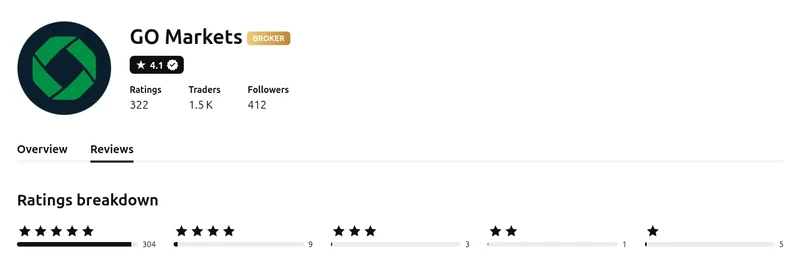
TradingView users rate GO Markets 4.1 out of 5 from 322 ratings (September 2026). 1.5K TradingView users have connected a GO Markets account.
GO Markets at a glance: 17 key facts
GO Markets Pty Ltd holds ASIC AFSL 254963, current since 10 March 2004, and the 17 key facts in the table below cover the entity, three further regulators and the fee schedule.
You can start with no minimum deposit and five platform routes.
| Item | Detail |
|---|---|
| Australian regulator | ASIC, AFSL 254963, current since 10 March 2004 |
| Australian entity | GO Markets Pty Ltd (ABN 85 081 864 039) |
| Other regulators | CySEC (Cyprus), FSC Mauritius (Tier 3 offshore), FSCA (South Africa) |
| Year founded | Entity registered 2000; trading as GO Markets since 2006, Melbourne |
| Headquarters | Level 22, 600 Bourke Street, Melbourne VIC |
| Trading platforms | MT4, MT5, cTrader, TradingView, GO TradeX (mobile app) |
| Account types | Standard, GO Plus+ (RAW + commission) |
| Minimum deposit | None. GO Markets suggests around A$200 as a working starting balance |
| Maximum retail leverage | 30:1 (forex majors), ASIC-capped |
| EUR/USD spread (May to June 2026 avg) | 0.10 pips (GO Plus+) / 0.9 pips (Standard) |
| GO Plus+ commission | A$6.00 per round-turn standard lot (A$3.00 per side) |
| Funding methods (AU) | Visa, Mastercard, PayPal, Skrill, bank transfer, BPAY, Google Pay, Apple Pay, Osko, PayID |
| Inactivity fee | A$0 |
| Negative balance protection | Yes (mandatory under ASIC) |
| AFCA member | Yes |
| Demo account | Free |
| Customer support | 24/5, multilingual (English, Mandarin, Arabic, Vietnamese) |
Three dates in that table tell different stories. I’d read them as registration in 2000, licence commencement in 2004, and brand launch in 2006. For you, the licence date is the one to weigh.
GO Markets GO Plus+ pricing, measured
GO Markets spreads measured 0.09 pips on EUR/USD and 0.31 pips across the eight-pair basket on the GO Plus+ account in the September 2026 capture.
The capture ran over 48 hours from 22 to 24 September 2026, with Noam Korbl logging prices through CFB-SpreadLogger from a London VPS. For you, that means the cost estimate rests on a live measurement rather than a broker’s advertised number.
| Pair | GO Plus+ avg spread (pips, May to June 2026) | + commission equivalent | Total cost |
|---|---|---|---|
| EUR/USD | 0.1 | 0.39 | 0.49 |
| AUD/USD | 0.1 | 0.39 | 0.49 |
| GBP/USD | 0.2 | 0.39 | 0.59 |
| USD/JPY | 0.1 | 0.39 | 0.49 |
| EUR/GBP | 0.3 | 0.39 | 0.69 |
That 0.31 pip basket average in our September 2026 capture put GO Markets fifth tightest of the 11 raw accounts we tested in the lowest spread brokers in Australia rankings, and in the lowest commission forex brokers comparison ACY Securities, Axi, Fusion Markets and Vantage all charge less than the A$3.00 per-side rate. I’d cite the basket figure rather than any single pair. For you, the practical point is that the rank reflects what the site measured, not a broker’s quote.
Standard account, spread-only pricing
The Standard account measured 0.9 pips on EUR/USD in our May to June 2026 capture, with no commission, a spread that is mid-pack for an Australian standard tier and nine times the 0.10 pips GO Plus+ measured in that same capture, so a casual trader gains little by avoiding the commission line and an active one simply pays more elsewhere in the cost.
What it costs to trade with GO Markets
GO Markets charges A$6.00 in round-turn commission on GO Plus+ to trade one standard lot of EUR/USD, and the all-in cost to trade with GO Markets lands at 0.52 pips in the September 2026 capture.
The all-in figure applies at the capture’s pip value, and I’d compare it across brokers rather than the commission alone.
That commission converts to roughly US$4.27 per round turn, or about 0.43 pips of commission equivalent on EUR/USD at the capture’s rate of A$1.4038 per US dollar, and when added to the 0.09 pip EUR/USD spread we measured from 22 to 24 September 2026 it puts the all-in cost at 0.52 pips, with IC Markets Raw and Pepperstone Razor both charging more commission per lot.
The commission is where this broker competes rather than the spread, and it is the line to watch. ACY Securities, Fusion Markets and Axi undercut it at A$3.00, A$4.50 and A$4.50 round turn, and Vantage sits just below at A$5.00, while every other raw account in this coverage charges A$7.00 or more.
Other fees AU traders should check
- Overnight swap rates apply on positions held past 5 PM New York time, direction-dependent.
- Currency conversion applies to any instrument denominated outside the account base currency.
- GO Markets charges no withdrawal fee on any method, bank transfer included, though a payment provider or bank may charge its own fee.
- No inactivity fee applies at any balance or duration.
GO Markets funding methods and withdrawal times
GO Markets does not charge to deposit or withdraw through its funding methods.
Your payment provider may still apply a fee, which means the amount credited to your trading account could be lower. There is no cap at all on how much you can deposit into your trading account.
Deposit methods (AU clients)
| Method | Deposit time | Confirmed by |
|---|---|---|
| Visa / Mastercard | Up to 1 hour | GO Markets’ deposits page |
| PayPal | Instant | GO Markets’ deposits page |
| Skrill | 1 to 2 hours | GO Markets’ deposits page |
| Bank transfer | 1 to 2 business days | GO Markets’ deposits page |
| BPAY | 1 to 2 business days | GO Markets’ deposits page |
| Google Pay | Not published | GO Markets support, and our funded test |
| Apple Pay | Not published | GO Markets support |
| Osko | Not published | GO Markets support |
| PayID | Not published | Our own account only |
The timed figures are sourced from GO Markets’ deposits page accessed 15 September 2026; the four methods without a published time were confirmed by GO Markets support on the same date, and Google Pay funded the live account opened for this review once.
Withdrawals
GO Markets does not charge you to withdraw, and your money returns by the same route it arrived. When you deposit by card, the withdrawal goes back to that card, which is standard anti-money-laundering practice.
The time it takes to receive your funds, however, is not settled. GO Markets’ own deposits page lists a withdrawal time of 1 business day for almost every method. On the same day, its support desk quoted 3 to 5 working days for cards, 1 to 2 for bank transfer, and 1 to 3 for other methods, while an email from the broker said to allow 1 to 3 business days. I regard the longer figures as the safer planning number when three different timelines come from the same broker in one day. I’d suggest anyone depending on a fast card withdrawal confirm the current timing with GO Markets before funding an account.
Account opening
According to Noam’s records, he opened a live individual account on 25 August 2026. You choose Individual, Company/Trust/SMSF, or Joint accounts, then sign up with Google or an email address. The email path asks for basic details, a six-digit verification code, and a password.
The application form splits into Personal details, Trading preferences, Suitability assessment, and Identity verification; the portal initially estimated four minutes thirty seconds. You can verify your identity with a driver’s licence, Medicare card, or passport.
Under trading preferences you pick a platform, account type, and base currency. MT5 is recommended, MT4 is also available; TradingView, cTrader, and GO TradeX accounts require a separate link. Both Standard and Plus accounts were offered, but the form did not explain the difference. I would want to know what I am choosing between before I commit.
The suitability assessment collects your financial and employment information, trading experience across asset classes, and relevant qualifications or training. Legal terms and acknowledgements follow.
The Identity verification screen showed two messages at once. A green progress ring on the left displayed “Progress 100%” and “Estimated time remaining: About 1 minute”, with all four stages completed. On the right, a tick icon and “Submitted for Manual Review” appeared, with “Your materials have entered manual review process, please wait patiently”. GO Markets’ note states, “All new users must complete KYC electronic authentication before initiating a transaction.”
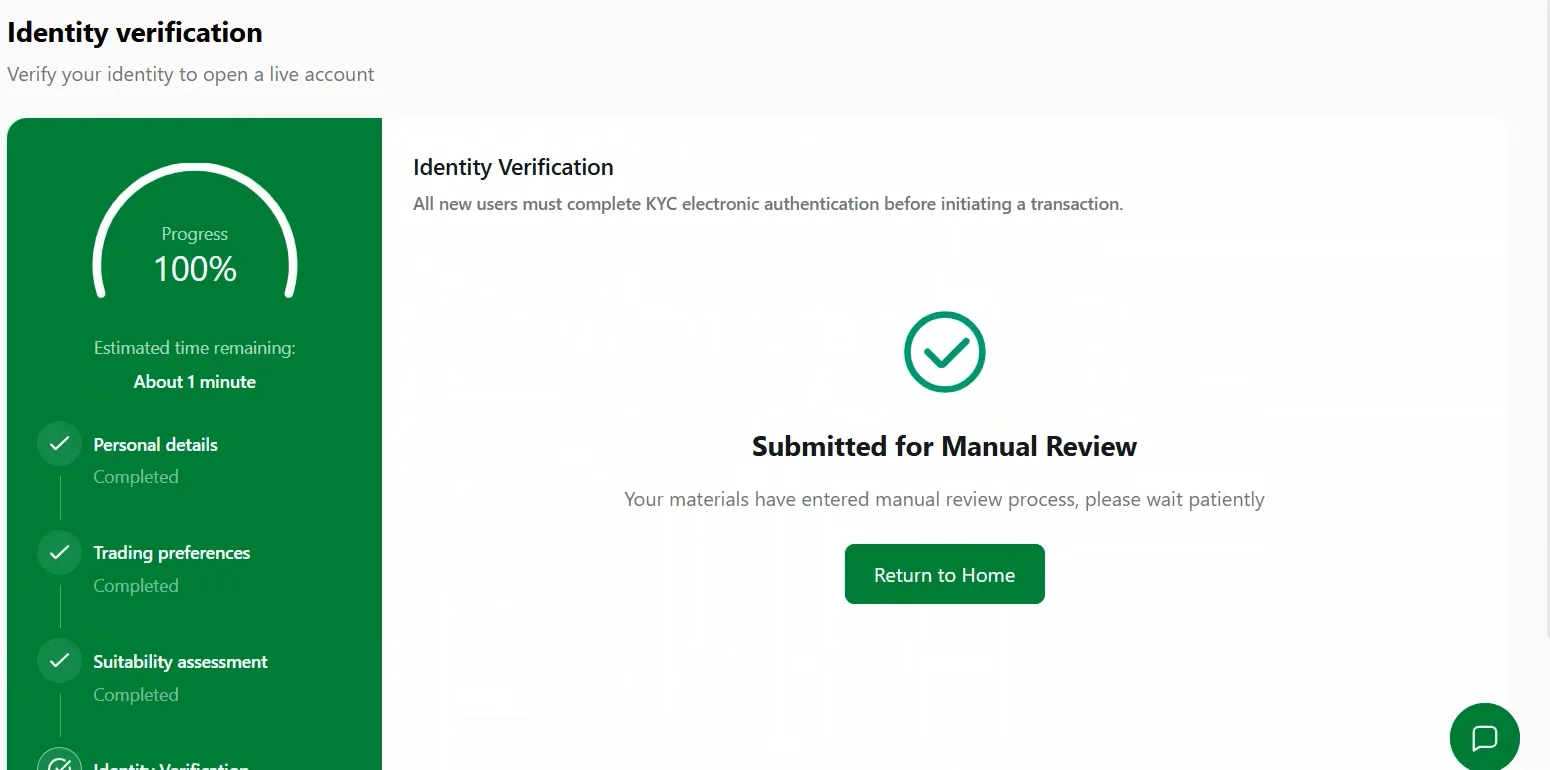
Noam started his registration at 12:26 pm AEST, submitted the application at about 12:33 pm, and received verification approval at 3:04 pm the same day. Total time from start to approved live account was 2 hours 38 minutes, with 2 hours 31 minutes in manual review.
While completing the form, Noam observed browser autofill placing information into wrong fields, so entries needed checking and correcting by hand. I find that kind of misplacement properly annoying because it turns a time-saver into extra work.
In my view, the application is quick and the progress tracker makes the stages clear. The estimated-time display is the weak point: “about 1 minute” beside a manual-review notice gives two conflicting messages, and the review took more than two hours.
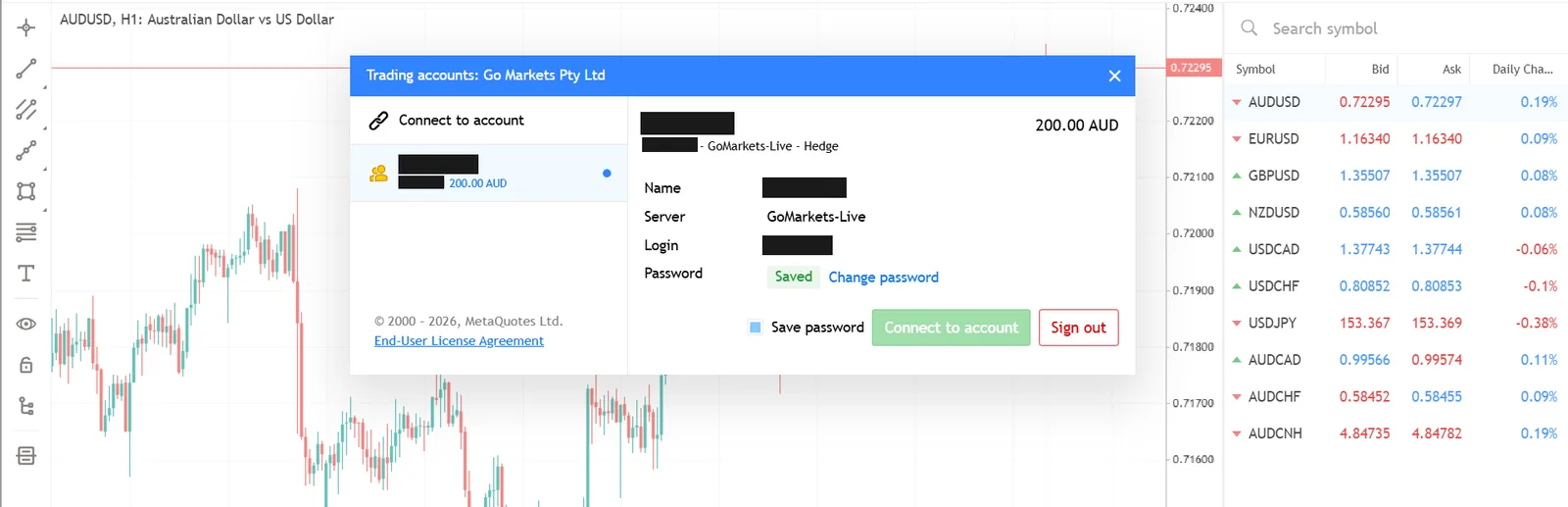
GO Markets account types and minimum deposit
GO Markets account types are two for retail clients, the Standard and the GO Plus+, and both carry an A$0 minimum deposit. For you, that means no deposit is required to open either retail account.
| Account | Pricing | Min deposit | Best for |
|---|---|---|---|
| Standard | Spread-only, no commission | None | Casual traders, beginners |
| GO Plus+ | Tighter spreads plus A$6.00 round-turn commission | None | Active forex traders |
The GO Plus+ tier carries the raw spreads plus commission and earns the cost rating on this page. Standard rolls the cost into a spread that measured 0.9 pips on EUR/USD in our May to June 2026 capture. For you, the account choice turns on whether cost visibility matters more than headline spread.
GO Professional
GO Professional is a separate tier rather than the standard raw account, and eligible clients must apply for it because the higher leverage comes only after an eligibility review. Approval lifts leverage through a Dynamic Margin schedule reaching 500:1 on forex, stepping down in the pre-weekend window, and comes with the discretionary A$100,000 negative balance protection covered above.
Minimum deposit
Neither retail account imposes a minimum deposit. GO Markets suggests an initial deposit of around A$200, and I’d read that for what it is: enough margin to size positions sensibly, not a gate you have to clear. Nothing stops an account opening on less, and the free demo account covers every platform before any deposit at all.
GO Markets trading platforms
You get five platform routes with GO Markets: MT4, MT5, cTrader, TradingView and the proprietary GO TradeX mobile app, all on a single account.
MetaTrader 4 and MetaTrader 5
MT4 runs on desktop, web and mobile with full expert advisor support, and the GO WebTrader branding is the MetaTrader web platform rather than a separate product. MT5 covers the same forex products plus indices, share CFDs and commodities natively, and I’d suggest it as the better choice if you’re starting fresh.
cTrader and TradingView
The cTrader platform is available to Australian clients alongside the MetaTrader builds, and carries the copy layer covered below. I’d consider cTrader a genuine alternative to the MetaTrader terminals. TradingView access lets you trade a GO Markets account directly from TradingView charts on web, iOS and Android.
GO TradeX and copy trading
GO TradeX is the proprietary app on iOS and Android, and it is mobile-only with no desktop build, which is the one gap in an otherwise complete platform list and the part I cannot get past. Copy trading runs through cTrader Copy Trading plus the Signals service built into both MetaTrader builds, with Signal Centre premium feeds as a paid add-on. The copy account carries no proprietary social feed of the eToro kind, so you pick a strategy provider inside cTrader rather than following a broker-run network. A free VPS for active traders and the MetaTrader Genesis platform add-on sit alongside. Every platform carries an iOS and Android app with biometric login.
GO Markets markets and instrument counts
Covering six asset classes, the instrument range is led by 50 plus forex pairs. The broker publishes no instrument count for the other five.
| Asset class | Count | Note |
|---|---|---|
| Forex | 50+ pairs | AUD majors and minors, the deep end of the range |
| Indices | Not published | ASX 200 plus the major global indices |
| Share CFDs | Not published | ASX, NYSE, NASDAQ and LSE names |
| ETFs | Not published | ETF CFDs across global benchmarks |
| Commodities | Not published | Gold, silver, oil, gas, softs |
| Cryptocurrencies | Not published | CFDs only, 2:1 retail cap |
We’re stating the absent instrument counts rather than estimating them. GO Markets publishes an instrument count for forex only, so the table reports the coverage the Australian product list names rather than a number we cannot check.
Share CFDs
The share CFD selection spans ASX, NYSE, NASDAQ and LSE names, and the range trails the multi-asset specialists. Every equity position is a CFD, so if you want direct ASX share investing, I’d point you to CMC Markets or Interactive Brokers instead. The share CFD class is compared in the share CFD market guide.
Gold and index CFDs
Across commodities, the range covers gold, silver and the energy contracts next to the ASX 200 and the global index majors, under the ASIC 20:1 retail cap on gold and major indices. GO Markets publishes no tested gold spread, so we quote none here.
GO Markets leverage and margin under ASIC rules
At GO Markets, retail leverage tops out at 30:1 on major forex pairs, with lower caps on minors, indices, commodities and cryptocurrency.
ASIC caps retail CFD leverage at 30:1 on major forex pairs, 20:1 on minor pairs, gold and major indices, 10:1 on commodities other than gold, 5:1 on share CFDs and 2:1 on crypto assets. The caps come from a product intervention order extended to 23 May 2027, so they apply at every ASIC broker, not just at GO Markets.
Both retail accounts carry those caps identically, so the account split changes the commission model, not the leverage. The GO Professional tier is the only route above the retail ceiling, reaching 500:1 on forex under a Dynamic Margin schedule that steps down in the pre-weekend window.
Retail margin close-out sits at 50%. ASIC requires every CFD issuer to close your positions once account equity falls below half the total initial margin on all open positions. Positions cannot be netted against each other to reduce that figure, and a gapping market can close a position below the 50% level. The leverage mechanics are set out in what leverage means for your margin.
GO Markets customer support
Customer support is available 24 hours a day Monday to Friday Sydney time, by phone, live chat and email, across four languages.
Support covers English, Mandarin, Arabic and Vietnamese, which is unusual for a broker of this size and reflects the Australian client base, not an international one. Mandarin and Vietnamese in particular map to communities under-served by the larger Australian desks.
Three support channels including a phone line is the full set. The support hours, not the channels, hold the service rating down, because the desk closes across the weekend where IG Markets, Plus500 and Capital.com all run 24/7.
A funding or margin question raised on a Saturday waits until Monday morning, which matters more if you hold positions over the weekend than if you flatten on Friday.
The desk is staffed from Melbourne, not routed to an offshore pool, which is the trade-off: shorter hours, local agents.
GO Markets research, tools and education
Six components make up the research, tools and education: daily analysis, webinars, a beginner library, Signal Centre feeds, an economic calendar and regular podcast content.
- Daily market analysis published to the GO Markets blog
- Webinars run by in-house analysts
- Beginner education library covering forex, CFDs and technical analysis
- Signal Centre premium signal feeds
- Economic calendar
- Regular podcast and YouTube content
Six research components is a mid-tier stack in our coverage, strong on the basics and lighter than the CMC Markets Morningstar-backed feed or the Pepperstone Trading Central integration.
One of the six research items carries a charge rather than being free to every client, because the Signal Centre premium feeds are a paid add-on. The remaining five are available on any funded account, and the in-house webinar programme is the part that separates this stack from brokers that publish a blog and stop there.
What traders say about GO Markets
| Rating site | Rating | Based on | Who rated | Captured |
|---|---|---|---|---|
| Trustpilot | 4.2 out of 5 | 747 reviews | Worldwide | September 2026 |
| App Store | 5.00 out of 5 | 6 ratings | Australia only | September 2026 |
| TradingView | 4.1 out of 5 | 322 ratings | Worldwide | September 2026 |
Each row above is a public rating of GO Markets taken from a rating site, dated to the month its figure was captured. An App Store rating counts ratings left on Apple's Australian App Store only, while a Trustpilot figure counts reviews and a TradingView figure counts ratings from anywhere in the world. A site with no row has no rating for GO Markets, withholds it, cannot be matched to GO Markets with confidence, or we have not captured it yet.
How GO Markets compares to Pepperstone and Fusion Markets
GO Markets compares to Pepperstone and Fusion Markets as a three-way split on spread, commission and scale, at 0.31 pips on A$6.00 round turn in the September 2026 capture.
The eight-pair basket in that capture put Fusion Markets at 0.09 pips on A$4.50, while Pepperstone ran 0.46 pips on A$7.00 in our May to June 2026 capture.
GO Markets measured tighter than both on the basket and sits between them on commission. What it gives up is scale, brand depth and research: Pepperstone carries five platforms, a measured execution figure and a far deeper research stack.
Fusion Markets undercuts the commission, and both brokers open an account on nothing at all. The licence run since 2004 is the counterweight, and it’s genuine rather than a marketing line.
Put GO Markets next to any of the other 31 ASIC-regulated brokers we cover.
GO Markets Blueberry Markets Middle of the measured field
GO Markets' measured 0.31 pips sits 0.09 below the middle broker's 0.4; Blueberry Markets' 0.36 pips sits 0.04 below it.
GO Markets' measured 0.09 pips and Blueberry Markets' measured 0.13 pips straddle the middle broker's 0.1.
GO Markets' measured 0.9 pips and Blueberry Markets' measured 1.2 pips straddle the middle broker's 1.0.
Blueberry Markets' A$7.00 matches the middle broker's A$7.00; GO Markets' A$6.00 sits A$1.00 below it.
GO Markets' A$104.22 sits A$21.41 below the middle broker's A$125.63; Blueberry Markets' A$121.36 sits A$4.27 below it.
GO Markets' A$128.39 a month sits A$14.26 under the middle broker's A$142.65; Blueberry Markets' A$171.18 sits A$28.53 over it.
GO Markets' A$0 and Blueberry Markets' A$100 straddle the middle broker's A$50.
GO Markets runs MT4, MT5, cTrader, TradingView; Blueberry Markets runs MT4, MT5, TradingView, cTrader.
GO Markets holds AFSL 254963; Blueberry Markets holds AFSL 535887.
GO Markets and Blueberry Markets both come to 78 / 100 on this row, 3 above the middle broker's 75.
GO Markets' 4.2 / 5 and Blueberry Markets' 4.5 / 5 straddle the middle broker's 4.3.
GO Markets' 4.5 / 5 and Blueberry Markets' 5 / 5 straddle the middle broker's 4.54.
GO Markets' 4.1 / 5 sits 0.4 below the middle broker's 4.5; Blueberry Markets' 4.3 / 5 sits 0.2 below it.
GO Markets' 1,670 and Blueberry Markets' 670 straddle the middle broker's 1,350.
Capture: September 2026 · AUD/USD 0.7010 (25 Sept 2026) · field: the measured field varies by row, from 16 to 24 brokers, of 32 reviewed.
Bars run lowest to highest across the measured field; the tick marks the middle broker.
| If you value… | Consider |
|---|---|
| Tightest forex spreads | Pepperstone or IC Markets |
| Broader product range | CMC Markets or IG Markets |
| Lower commission per lot | Fusion Markets |
| Beginner-focused platform | Plus500 or eToro |
| Direct ASX share investing | CMC Markets or Interactive Brokers |
Should you open a GO Markets account?
GO Markets suits active traders who want raw-cohort pricing at 0.09 pips measured on EUR/USD in our September 2026 capture across five platform routes. Traders who would sit on the Standard account, or who weight brand depth and research, are served better elsewhere than by a GO Markets account.
Two groups get clear value, in my view. Cost-first traders reach a A$6.00 round turn that undercuts both larger rivals, Pepperstone at A$7.00 and IC Markets at A$9.00. History-first traders reach an unbroken Australian licence dating to 2004, which almost nothing else in this field matches.
The two groups that should look past it, in my opinion, are casual traders on the Standard account paying 0.9 pips on EUR/USD in our May to June 2026 capture where the field prices tighter. Cost-first traders on the GO Plus+ account still pay A$6.00 round turn where Fusion Markets charges less.
GO Markets ranks twelfth among the top Australian forex brokers on the 2026 scoring. The free demo covers every platform, so you can test the stack before any money is committed.
FAQs
Is GO Markets safe for Australian traders?
How do I withdraw money from GO Markets?
What leverage does GO Markets offer in Australia?
What is the minimum deposit for GO Markets?
Standard or GO Plus+, which account should I open?
Does GO Markets offer MT4 and MT5 in Australia?
Is GO Markets better than Pepperstone or IC Markets?
Does GO Markets charge an inactivity fee?
Testing log
| Record | Detail |
|---|---|
| Review published | 16 May 2026 |
| Last content change | 27 September 2026 |
| Spread capture | GO Plus+ account, 0.09 pips EUR/USD, 0.31 pips eight-pair average |
| Capture window | September 2026 |
| Verification | Live account pricing captured (AUD/USD, 5 July 2026); live AUD MT5 Plus account (****0651) funded by Google Pay with A$200 in Australian dollars on 2 September 2026 |