
Summary of stop losses for Australian retail traders
The short version:
- A stop loss is a pending order that closes a position automatically when the price hits a pre-set level
- Three working types: hard stop (fixed price), trailing stop (follows favourable moves), guaranteed stop loss order (GSLO) (broker honours the level even on a gap)
- AU brokers offering GSLOs: CMC Markets, IG Markets, easyMarkets, Plus500, Trade Nation. Most ECN/STP brokers (IC Markets, Pepperstone, FP Markets, Fusion Markets) don’t offer GSLOs.
- ASIC’s mandatory negative balance protection acts as a final backstop on retail accounts but it’s not a substitute for a real stop
- Position sizing is the other half of the equation: standard rule is risk no more than 1% to 2% of account equity per trade
The single biggest reason I see retail forex accounts blow up isn’t bad signals. It’s no stop, or a stop set on emotion rather than account maths. ASIC’s retail leverage cap reduces some of the damage but doesn’t replace good trade management.
Position Size Calculator
Lots to trade for your balance, risk and stop distance
Rates as of Fri 25 Sep 2026, 5pm New York closeRange window: 20 trading days to 25 Aug 2026
A 30-pip stop at 0.23 lots risks A$98.43, which is 0.98% of your balance.
Your 30-pip stop is 57% of EUR/USD's average daily range, measured at 52.4 pips over the 20 trading days to 25 Aug 2026. The same A$100.00 risk with a stop the full width of that range sizes to 0.13 lots.
Range is the average of daily high-to-low over the stated window, computed from our dataset of daily bars (5pm New York day boundary). Metals are excluded: no standard pip convention exists for them. Sizing is rounded down so the risk figure is never exceeded.
0.23
standard lots
- Risk amount (1% of A$10,000)A$100.00
- Pip value at 1.00 lotA$14.27
- Stop distance30 pips
Sizing a trade around the stop, 25 September 2026. If I were risking 1% of a A$10,000 account with a 30-pip stop on EUR/USD, the position size would be 0.23 lots, putting A$98.43 at risk if the stop is hit. The stop distance and the risk budget together fix the position size. Widen the stop and the size must come down to keep the same dollar risk. Change any figure above to size your own trade.
What a stop loss actually is
A stop loss is a pre-set instruction to close your position once the market trades at or through your chosen price. You set it when you open the trade, or attach it later from the order ticket.
If you’re long EUR/USD at 1.0850 with a stop at 1.0820, the broker closes the position automatically the next time price prints at or below 1.0820. The platform watches the price feed and triggers the order whether or not you are at the screen.
The stop is filled at market when triggered, and that’s an important detail. In a fast-moving market the actual fill can be worse than the stop price set. That’s slippage, and it’s how a stop-market order works, not a broker error.
Stop loss versus take profit
A stop loss caps the downside on a trade. A take profit (TP) locks in the upside at a target price. Both are pending orders. Most platforms let traders bracket the trade at entry: long position, stop below, take-profit above. The trade then runs to whichever level hits first. We use brackets routinely on swing trades.
The three types of stop loss
Hard stop (the standard one)
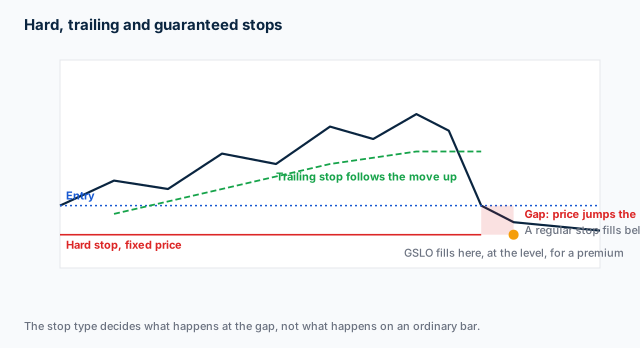
The diagram shows the entry, a hard stop at a fixed price, a trailing stop following the move up, and a gap through the stop level. A regular order fills below the level; a guaranteed stop fills at it, for a premium.
A hard stop is a fixed price: set it and forget it. It fills at market when triggered, with potential slippage on fast-moving prints. This is the default stop type on every Australian retail platform: MT4, MT5, cTrader, TradingView, and the proprietary platforms (CMC Next Generation, IG web platform, Plus500 WebTrader, eToro, Mitrade).
The hard stop is what most traders mean when they say “stop loss”. It’s the type referenced in every position-sizing formula in this guide.
Trailing stop
A trailing stop follows a winning trade, locking in profit as the market moves favourably. Set the trail distance in pips (or points, or as a percentage). As the market moves favourably, the stop level ratchets up to maintain that distance. When the market moves against the position, the stop stays where it last ratcheted to.
Worked example. You’re long EUR/USD at 1.0850 with a 30-pip trailing stop. Your initial stop sits at 1.0820. Price runs to 1.0900. The trailing stop ratchets up to 1.0870 (30 pips below the new high). Price falls to 1.0870 and stops you out. You’ve locked in 20 pips instead of taking the original stop.
Trailing stops suit trend-following strategies that need to ride a move without giving back too much. They’re not great for chop, where the trail can get clipped on noise before the move materialises.
Most AU platforms support trailing stops natively. MT4 and MT5 trail client-side (the platform must be running for the stop to update), while cTrader trails server-side, which I prefer because it doesn’t depend on a computer staying on.
Guaranteed stop loss order (GSLO)
A GSLO is the only stop that protects against gap risk. With a hard stop, if the market gaps over your stop level (over a weekend, or after a major news print), your fill is wherever liquidity returns, which can be far worse than the stop. With a GSLO, the broker guarantees execution at exactly the level you set, even if the gap is huge.
The catch: GSLOs cost a premium. Pricing models vary by broker.
| AU broker | GSLO available | Pricing model |
|---|---|---|
| CMC Markets | Yes | Premium charged only if GSLO triggered, refunded if not |
| IG Markets | Yes | Premium charged at order placement, refunded if not triggered |
| easyMarkets | Yes (default on every trade) | Built into spread (no separate fee) |
| Plus500 | Yes (called “Guaranteed Stop”) | Wider spread on the trade |
| Trade Nation | Yes | Premium added to spread when GSLO selected |
| Pepperstone | No (regular stops only) | n/a |
| IC Markets | No (regular stops only) | n/a |
| FP Markets | No (regular stops only) | n/a |
| Fusion Markets | No (regular stops only) | n/a |









The pattern is consistent across the AU industry, and it’s worth knowing if you hold positions overnight. Market-maker and hybrid brokers (CMC, IG, easyMarkets, Plus500, Trade Nation) offer GSLOs because they’re internalising the gap risk anyway. Pure ECN/STP brokers (IC Markets, Pepperstone, FP Markets, Fusion Markets, Global Prime) typically don’t offer them, because the model passes orders through to liquidity providers and there’s no mechanism to honour a fill price the underlying market didn’t print. Fusion Markets and Global Prime operate under the same licensee, FMGP Trading Group Pty Ltd (AFSL 385620).
GSLOs are most worth considering for positions you hold over the weekend, around major scheduled news (US NFP, RBA rate decisions, FOMC), and on illiquid pairs prone to gapping. For intraday majors, regular stops are usually fine. If GSLO availability drives your choice, compare the top forex brokers in Australia on stop tools and cost.
Mental stops are not stops
Skip this section if you’ve already worked it out; pay attention if you haven’t.
A “mental stop” is a level decided in the trader’s head where they’ll close the trade, but no actual order is placed. The intention is to manage exits manually based on price action.
We strongly recommend against this. The reasons:
- You can’t watch every chart all the time, and the market doesn’t wait
- Under stress (after a losing streak, around news, or when the position is bigger than you’d usually take), discipline collapses
- “Just one more pip” is the most expensive sentence in retail trading
- Internet, power, or platform outages mean you can’t manage the trade even if you want to
Use a real stop. Every time. The minor inconvenience of setting the order is dwarfed by the protection it provides. We’ve seen too many AU traders blow accounts in 2024 and 2025 on mental stops that didn’t survive the moment of truth.
How to size a stop loss in AUD
This is where most retail traders get it wrong. I set my stop based on price structure (where the trade thesis is invalidated), and then I size the position so the dollar loss fits how much I can afford to lose if that level is hit.
The order of operations:
- Decide the dollar risk per trade (e.g. 1% of account)
- Identify the stop level (based on chart structure, ATR, or fixed pip distance)
- Calculate the pip distance from entry to stop
- Position size = dollar risk / (pip distance × pip value)
Before placing the trade, use our profit and loss calculator to check the dollar outcome of any entry, stop and exit combination.
Our forex position size calculator runs steps 3 and 4 at current exchange rates, rounded down to the 0.01-lot step brokers accept.
A worked AUD example
An AUD 1,000 account with a 1% risk per trade puts AUD 10 at risk per trade.
A long EUR/USD entry at 1.0850, with the recent swing low at 1.0820, puts the stop at 1.0815 (5 pips below the swing low). That’s 35 pips of stop distance.
Let me put that in AUD terms for you. A pip on a mini lot (10,000 units) of EUR/USD is worth roughly USD 1, which at AUDUSD 0.65 (illustrative rate) comes out to about AUD 1.54 per pip in my working.
Run the numbers yourself and you get: Position size = AUD 10 / (35 pips × AUD 1.54 per pip) = 0.185 mini lots. That’s how the formula lands on a dollar amount you can trade.
That’s a micro lot (1,000 units) of EUR/USD, give or take. Most AU brokers allow fractional lot sizes from 0.01 lots upward, so the position can be dialled to the exact risk parameters.
Skipping the maths and opening a full mini lot would put the effective risk on the same 35-pip stop at AUD 53.90, or 5.4% of the account. Two losing trades in a row is over 10% drawdown. That’s the territory where the recovery maths starts hurting (see drawdown).
Where to actually put the stop
Three common methods, used in combination:
- Support/resistance, set the stop just beyond the most recent swing high (for short positions) or swing low (for long positions). The trade thesis is broken if price clears that level.
- ATR (Average True Range), set the stop at 1× to 2× the 14-period ATR away from entry. ATR scales the stop to current volatility, so the stop’s wider in fast markets and tighter in quiet ones.
- Fixed pip distance, simpler, less adaptive, but works for systematic strategies. Common defaults: 20 pips for scalping, 50 pips for intraday, 100+ pips for swing.
The structure-based stop is usually the most defensible because it ties the exit to a price level that genuinely invalidates the trade idea. I prefer them for that reason. ATR-based stops are second. Fixed-pip stops are third because they ignore volatility, but they’re easy to backtest.
Common stop-loss mistakes
Stops too tight (whipsaw)
Setting a 5-pip stop on a major pair where the spread alone is 1 pip and intraday noise is 8 to 12 pips guarantees getting stopped out on flow that has nothing to do with the trade idea. The whipsaw pattern: stop hit, market reverses immediately, trade thesis was actually right, and the trader is out.
The fix: the stop distance should always exceed the natural noise level for the pair and timeframe. If the 5-minute ATR on EUR/USD is 8 pips, the stop has to be wider than 8 pips or the trader pays entry costs to be stopped on noise.
Stops too wide (oversized loss)
The opposite problem. The stop sits 200 pips away because “the trade has room to breathe”, but the position size wasn’t reduced to compensate. Now a single losing trade is 8% to 15% of account equity. Three of those in a row and the account is in serious drawdown.
The fix is the position-sizing formula above. Wider stop, smaller position. Always.
Moving the stop further away from price
The cardinal sin. The trade goes against the position, the stop is about to hit, and the trader moves the stop further out “to give it more room”. That turns a defined-risk trade into an undefined-risk trade. The original trade thesis was invalidated, but the trader stayed in.
This is one of those rules I insist on. The fix: never move a stop further from price. By all means, move it closer (to lock in profit, or break-even after the trade has moved your way), but never further away. If the trade idea has changed and a wider stop is genuinely justified, what I would want you to do is close the trade and re-enter with new parameters from a clean basis.
Not having a stop at all
The “I’ll just watch it” approach. Discussed above, but it bears repeating. ASIC-regulated retail accounts have negative balance protection and the 50% margin close-out as backstops, but those are catastrophic-loss safeguards, not normal trade management. I’d never rely on that as a substitute for a stop. The close-out triggers when account equity falls to 50% of margin used, by which point the account has already taken a substantial drawdown.
How ASIC’s leverage cap interacts with stops
Here’s the regulatory reality you are trading under. Australian retail traders are capped at 30:1 leverage on major forex pairs under ASIC’s Product Intervention Order.
Because the cap only applies to guaranteed stops, it doesn’t reduce the importance of stops. Where it lands for you is the opposite, actually. It makes stops more important. Here’s why.
Under the cap, the position size a trader can open relative to their account is large but not extreme. On a AUD 1,000 deposit at that cap, the maximum notional EUR/USD exposure is roughly AUD 30,000. A 50-pip move against that position, without a stop, is roughly AUD 230 of unrealised loss, which is 23% of the account.
The 50% margin close-out kicks in only at the regulatory threshold, not before. By the time it triggers, the account is already deep into drawdown territory. A real stop, set at a price level that invalidates the trade thesis, fires much earlier and at a much smaller loss.
ASIC’s protections are floor-level. The stop is the operational tool. Don’t confuse the two. Our guide to negative balance protection in Australia sets out exactly what that floor covers, and our guide to the safest forex brokers in Australia scores brokers on the protections behind it.
I’ve found that a stop is the single highest-leverage habit in retail trading, and it only works alongside sizing and a realistic view of drawdown. For the wider picture, start at our forex education hub.
FAQs
What's the best stop-loss strategy for forex trading?
Are guaranteed stop loss orders worth the cost?
Does negative balance protection mean I don't need a stop loss?
How tight should a stop loss be on EUR/USD?
Will my broker honour a stop-loss during a flash crash?
Can I use the same stop-loss strategy for scalping, day trading, and swing trading?
Related pages
About the author

Justin co-founded CompareForexBrokers in 2014 and has traded forex since 1998. Based in Melbourne, he has tested every ASIC-regulated broker on this site personally and has written for Forbes, Kiplinger, Finance Magnates, the Australian Financial Review and The Age. He holds a Bachelor of Commerce (Honours) and a Master of Marketing from Monash University. Justin is the co-founder and CEO of CompareForexBrokers.