
Summary of broker models for Australian traders
The summary:
- A market maker broker takes the other side of client trades and profits from the spread, mark-up, and (in the B-book model) client losses
- An ECN/STP broker passes orders straight through to liquidity providers and profits from commission and the broker mark-up on raw spreads
- A hybrid broker (most large AU names) runs an A-book / B-book split, internalising small or losing flows and routing larger or winning flows to liquidity providers
- AU pure market makers: Plus500, eToro, easyMarkets, Trade Nation (markup-pricing models)
- AU pure ECN/STP: IC Markets, Pepperstone (Razor), FP Markets, Fusion Markets, Eightcap RAW, Global Prime. Fusion Markets and Global Prime operate under the same licensee, FMGP Trading Group Pty Ltd (AFSL 385620).
- AU hybrids: CMC Markets, IG Markets, Vantage, AvaTrade, OANDA, ThinkMarkets
- ASIC permits the market maker model. The conflict of interest is addressed through the Product Intervention Order, PDS disclosure, and best execution obligations under the Corporations Act
The market maker model isn’t inherently bad. I read it as a different commercial structure with different incentives, transparently regulated by ASIC.
How a market maker actually works
When you click buy on EUR/USD, the broker sells EUR/USD from its own book. When you click sell, the broker buys it from you. That’s the market maker model: quoting a two-sided price (bid and ask) and standing ready to take either side of the trade.
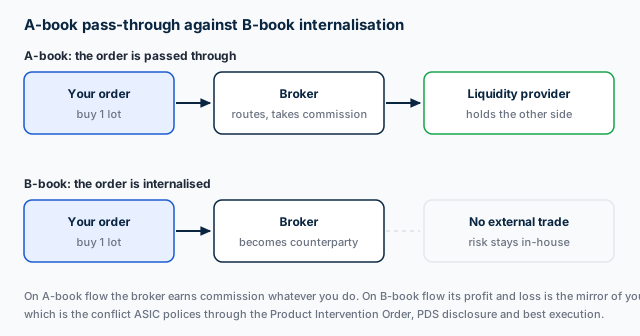
The diagram shows the same order taking two routes: passed through to a liquidity provider on the A-book, where the broker earns commission whatever the outcome, and internalised on the B-book, where the broker’s P&L is the mirror of the P&L you hold, which is the leg I would watch most closely.
The broker’s profit on the trade comes from three sources:
- The spread between bid and ask
- Any mark-up the broker adds above the underlying interbank price
- The net P&L on the broker’s open position, if it doesn’t immediately hedge
This is the part that makes people uncomfortable, and I understand why. If the broker doesn’t hedge the position with a liquidity provider, the broker’s P&L is the inverse of the client’s P&L. The client loses, the broker wins. The client wins, the broker loses. That’s the ‘B-book’ arrangement, and it sets up a structural conflict of interest.
What I find reassuring is that modern market makers manage that conflict through net-position hedging. The broker doesn’t care about any one client’s P&L. It cares about the aggregate exposure across all clients and hedges the residual into the interbank market. Individual client outcomes wash out in the aggregate.
Why the market maker model exists
Three reasons it persists despite the conflict-of-interest optics:
- Cost efficiency at small lot sizes. Routing a 0.01 lot order to an interbank liquidity provider is uneconomic. The market maker absorbs the order on its own book and saves the cost.
- Tight spreads on liquid pairs. A market maker with sufficient flow can quote tighter spreads than the underlying interbank market because it’s averaging across thousands of small orders.
- Instant execution. There’s no third-party liquidity provider in the chain, so fills are deterministic. ECN brokers can have variable slippage on larger orders.
For retail sizes you trade on liquid majors, the market maker model often delivers the cleaner experience. The trade-off is the conflict of interest, which is what regulation manages.
A no-commission account tells you where the broker’s revenue sits, not which model it runs. Mark-up pricing turns up well outside the pure market makers, so it’s not a reliable tell on its own. FXCM’s Standard account carries no commission line at all, which puts the whole cost in the spread regardless of what happens to the order behind it.
A-book vs B-book vs hybrid
A-book (STP / DMA / ECN models)
The broker passes the client order you place through to a liquidity provider (banks, prime brokers, or an aggregated liquidity pool). The broker’s profit is the commission and any mark-up on the raw spread. The broker has no position. Client profit and broker profit aren’t directly correlated. I would call that the cleanest commercial arrangement available.
A-book models you’ll see in Australia:
- STP (Straight Through Processing), order passed to a single liquidity provider
- DMA (Direct Market Access), order placed directly into the underlying market (more common in equity than forex)
- ECN (Electronic Communications Network), order matched against a pool of liquidity providers and other clients
If you’re trading retail, ECN and STP are functionally similar. The order isn’t internalised by the broker.
B-book (the pure market maker model)
Under the pure B-book model, the broker takes the other side of the trade you place and keeps it on the broker’s book. No external hedge. The broker’s P&L is the inverse of the client’s P&L. This is the historic ‘bucket shop’ model. ASIC permits it but requires extensive disclosure.
No large AU broker runs a pure B-book on every order. Even brokers that primarily market-make (Plus500, easyMarkets) hedge net residual exposure into the interbank market.
Hybrid (A-book / B-book split)
The reality is that most large AU brokers internally segment the client flow you send, even if their marketing language varies. The PDS often makes the split detectable.
- Profitable, sophisticated, or large clients, routed A-book to liquidity providers, because the broker doesn’t want to take the other side
- Smaller, less sophisticated, losing clients, kept on the B-book, because aggregated retail flow is a positive expected-value position for the broker
How the split works is dynamic and based on the broker’s internal flow analysis. It’s disclosed in the PDS, though you sometimes need to read between the lines.
Australian broker model classifications
The model classifications below reflect the dominant operating mode at each broker, as I see it. Most large names run hybrid splits, and the line between ‘primarily market maker’ and ‘primarily ECN/STP’ is sometimes thin.
Pure / primary market maker brokers (AU)
| Broker | Model | Pricing |
|---|---|---|
| Plus500 | Pure market maker | Spread-only, no commission |
| eToro | Pure market maker | Spread-only, no commission on forex |
| easyMarkets | Pure market maker | Spread-only, GSLO baked into spread |
| Trade Nation | Market maker (fixed spread) | Fixed spread, no commission |
I see these brokers profiting primarily from the spread and the broker’s net P&L on internalised positions. None advertise commission-based ECN access. The PDS at each is explicit that the broker is the counterparty to trades you place.
Pure / primary ECN/STP brokers (AU)
| Broker | Model | Pricing |
|---|---|---|
| IC Markets | ECN (cTrader, MT4/MT5 Raw) | Raw spreads + AUD 9 commission per round-turn lot |
| Pepperstone | ECN (Razor account) | Raw spreads + AUD 7 commission per round-turn lot |
| FP Markets | ECN (Raw account) | Raw spreads + AUD 7 commission per round-turn lot |
| Fusion Markets | STP (Zero account) | Raw spreads + AUD 4.50 commission per round-turn lot |
| Eightcap | ECN (Raw account) | Raw spreads + AUD 7 commission per round-turn lot |
| Global Prime | STP / NDD | Raw spreads + commission |
For anyone comparing Raw and Standard accounts, these are the AU brokers that built their commercial proposition on no-dealing-desk execution. The Standard accounts at most of these brokers (no commission, wider spread) are usually B-book; the Raw / ECN accounts (raw spread, commission) are A-book to liquidity providers. Our ECN forex brokers guide ranks these no-dealing-desk accounts side by side.
Hybrid AU brokers
| Broker | Model | Notes |
|---|---|---|
| CMC Markets | Hybrid (Next Generation) | A-book and internalisation; PDS discloses model |
| IG Markets | Hybrid | A-book/B-book split disclosed in PDS |
| Vantage | Hybrid | RAW and Standard accounts route differently |
| AvaTrade | Hybrid | Market maker pricing on most retail accounts |
| OANDA | Hybrid | Mixed model with proprietary liquidity |
| ThinkMarkets | Hybrid | Standard/RAW split |
For most retail traders the hybrid model is what you’re actually trading on, regardless of the broker’s marketing language.
The conflict of interest and how ASIC manages it
I’ve been following ASIC’s approach to market making, and the headline concern is that the broker profits when you lose. ASIC has been alive to this since the early 2000s and has built a regulatory framework around it.
The Product Intervention Order
The Product Intervention Order from ASIC (in force since 29 March 2021, extended to 23 May 2027) directly addresses the most damaging consequences of the market-maker model.
- Retail leverage caps starting at 30:1 on major forex pairs and stepping down by asset class, with the full tier ladder set out in our guide to ASIC regulation, reduce the magnitude of catastrophic losses
- 50% margin close-out prevents accounts drifting to zero (and therefore to the broker)
- Mandatory negative balance protection caps the trader’s downside at zero
- Ban on cash bonuses and inducements removes the incentive to deposit against your own interest
What I find notable is the absence of a per-broker loss disclosure. ASIC proposed issuer-specific risk warnings in Consultation Paper 322 and confirmed it would not require them, so unlike the UK and EU there is no Australian figure for you to compare broker by broker. ASIC publishes the sector number instead: 68% of retail CFD investors lost money in the 2024 financial year (REP 828, published 20 January 2026). David Levy confirmed that figure against the published report.
Product Disclosure Statement (PDS) requirements
Every CFD provider must publish a Product Disclosure Statement (PDS) and a Target Market Determination (TMD), as required by ASIC. The PDS must disclose, among other things, details that help you clarify the broker’s model.
- Whether the broker acts as principal (counterparty) or agent
- How the broker’s revenue is generated
- The conflict of interest the broker faces
- Best execution policy
- Order routing and execution venues
- Risks of the product
To understand a broker’s commercial model, the most reliable method is reading the PDS. The marketing copy on the broker’s home page is sometimes ambiguous. The PDS is legally required to be specific, so that is the document to trust.
Best execution obligations
Under the Corporations Act and ASIC’s Regulatory Guide 265 on best execution, an Australian broker must take reasonable steps to obtain the best outcome for the order you place given its characteristics. Best outcome is usually price, but also includes speed, likelihood of execution, and total cost.
The best execution obligation applies regardless of whether the broker is acting as principal or agent. So even if a broker is a market maker and principal to the trade, it can still meet best execution by quoting fair prices and not deliberately filling you at worse-than-market levels.
AFCA dispute resolution
If a broker has acted unfairly against you (slippage well outside market norms, requote patterns, deliberate stop-hunting), the Australian Financial Complaints Authority (AFCA) is the no-cost external dispute resolution scheme available. Every ASIC-regulated broker must be an AFCA member. Determinations are binding on the broker up to a defined monetary limit.
How to tell which model your broker uses
Three reliable methods:
Read the PDS
Every ASIC-regulated broker publishes a Product Disclosure Statement on its website (usually in the footer under ‘Legal’ or ‘Documents’). The section you should look for covers the broker’s role:
- “We act as principal to your trades”, market maker (the broker is the counterparty)
- “We act as agent for your trades”, STP (the broker passes orders through)
- Mixed language about routing some orders to liquidity providers and internalising others, hybrid
Check the account types
A broker offering separate ‘Standard’ (no commission, wider spread) and ‘Raw / ECN / Pro’ (raw spread, commission) accounts is typically running:
- B-book on the Standard account (broader spread is the broker’s mark-up plus internalisation profit)
- A-book on the Raw / ECN account (commission is the broker’s revenue, spread passes to LPs)
Brokers offering only one account type with no commission and no raw alternative are typically pure market makers, which I’d treat as a strong signal when you’re comparing (Plus500, eToro, easyMarkets, Trade Nation).
Check the account statement language
Once you’ve opened a live account, the trade confirmation language is sometimes a giveaway:
- “Counterparty: [Broker entity]”, market maker
- “Counterparty: [Liquidity provider]” or LP-specific tickers, STP/ECN
- Counterparty varies by trade, hybrid
Pros and cons of each model
Market maker pros and cons
Pros:
- Tighter spreads on liquid majors at small position sizes
- Instant execution, no third-party liquidity hops
- Lower or no commission on retail-sized accounts
- Useful for clients trading micro lots where ECN routing is uneconomic
Cons:
- Structural conflict of interest (broker profits when client loses, in B-book scenarios)
- Slippage and requote patterns can be opaque
- Less suitable for high-frequency or large position-size strategies
ECN/STP pros and cons
Pros:
- No structural conflict of interest on the routed flow
- Genuine raw spreads on liquid majors (often 0.0 to 0.2 pips on EUR/USD)
- Better suited for scalping, EAs, and large position sizes
- More transparent execution model
Cons:
- Commission per trade adds up on small sizes
- Variable slippage on larger orders or thin liquidity windows
- Standard (non-raw) accounts at the same broker often run B-book under the hood
For most AU retail traders trading small lot sizes on majors, the difference between models in net trading cost is small. Active scalpers, EA users and larger-position traders usually find the ECN model’s advantages outweigh the commission cost. Comparing the options in our roundup of the highest-rated forex brokers in Australia is where I’d start.
Which model suits is ultimately a cost question, so I’d settle it with numbers rather than principle. Our guide to ECN forex brokers in Australia covers the routed side, our guide to fixed spread forex brokers in Australia covers the market-made alternative, and our broker cost calculator totals spread against commission at a trader’s own monthly volume.
Execution model matters most to strategies that trade often, which in practice means automated ones. For anyone running an EA, our page on expert advisors (EAs) for forex trading in Australia covers what an EA needs from a broker. For the wider picture, start at our forex education hub.
FAQs
What is a market maker in forex?
Are market maker brokers legal in Australia?
What's the difference between A-book and B-book?
Which AU brokers are pure ECN/STP?
Is a market maker broker bad for traders?
How do I check if my broker is a market maker?
Related pages
About the author

Justin co-founded CompareForexBrokers in 2014 and has traded forex since 1998. Based in Melbourne, he has tested every ASIC-regulated broker on this site personally and has written for Forbes, Kiplinger, Finance Magnates, the Australian Financial Review and The Age. He holds a Bachelor of Commerce (Honours) and a Master of Marketing from Monash University. Justin is the co-founder and CEO of CompareForexBrokers.