
What the 30:1 cap means for Australian traders
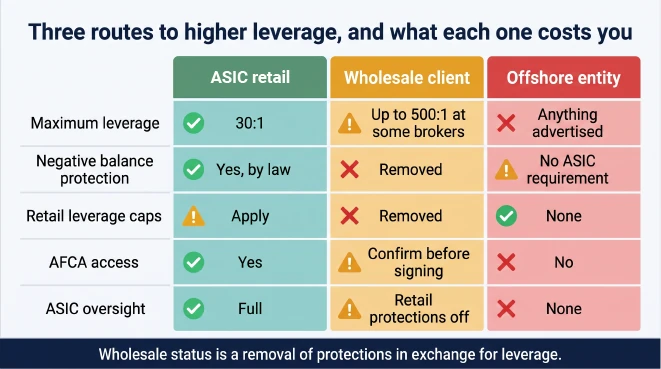
Where the number comes from decides what you lose to get it. Retail classification carries the ASIC caps, identical at every ASIC-regulated broker, with negative balance protection and access to AFCA if something goes wrong. Wholesale classification removes the cap, and removes negative balance protection with it, so a gap through your stop can take the account below zero and leave you owing the broker. Offshore entities are a third category again: no Australian cap, no ASIC cover, no AFCA. The leverage number is the same in all three places. What differs is who carries the loss.
Searching for a high-leverage broker leads to a clean but unsatisfying answer: the number is set by regulation, not by the broker. Every ASIC-regulated broker applies the same retail cap. In my view, the real question is what each route to more leverage actually costs you in protection, and whether it is worth wanting at all.
The retail leverage ladder
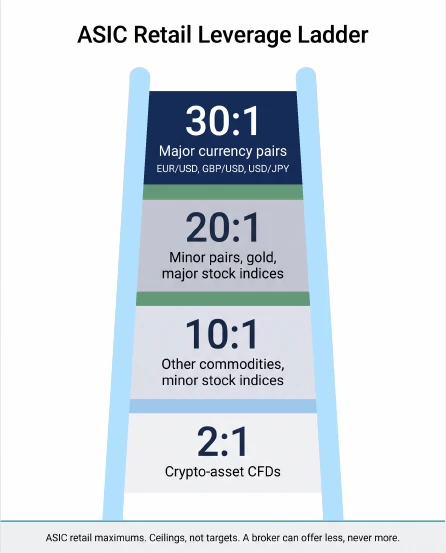
ASIC’s product intervention order sets the retail maximums by asset class:
- 30:1 on major currency pairs (for example EUR/USD, GBP/USD, USD/JPY).
- 20:1 on minor currency pairs, gold and major stock indices.
- 10:1 on other commodities and minor stock indices.
- 5:1 on shares and other assets.
- 2:1 on crypto-asset CFDs.
These are hard ceilings, not targets. A broker can offer less, never more, to a retail client. The full tier list and how it is enforced sit on our ASIC regulation page.
Why ASIC capped it
The cap is a response to measured losses. Before the intervention order, retail CFD exposure could reach 500 times the deposit, and ASIC’s reviews found most retail clients lost money. David Levy checked the FY2024 figures against ASIC’s published data: about 68% of retail CFD investors in Australia lost money, more than $458 million in total including roughly $73 million in fees. What I keep coming back to is that higher leverage did not make those clients more profitable; it made losses larger and faster. The 30:1 cap limits how much exposure a given deposit can carry, which is the single most direct lever on the size of a retail loss.
A worked example in AUD
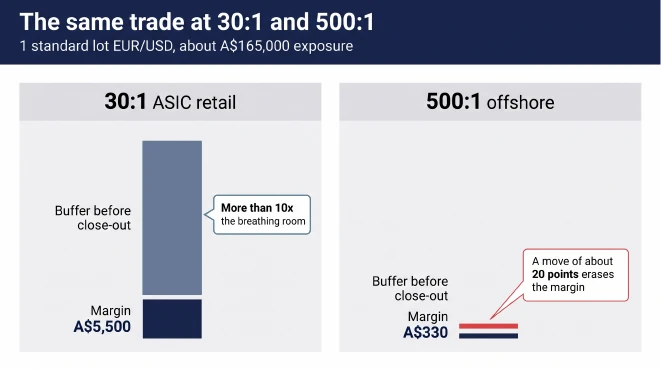
Leverage cuts both ways, and the second way is the one that matters. At 30:1, one standard lot of EUR/USD, roughly A$165,000 of exposure, ties up about A$5,500 in margin. At an offshore 500:1, the same lot needs only about A$330. That looks like efficiency until the market moves against the position: at 500:1 a move of around a fifth of a percent, roughly 20 points on EUR/USD, erases that margin and triggers close-out, while at 30:1 you have more than ten times the breathing room. To my mind, high leverage does not increase an edge; it shortens the distance between a normal market wobble and a closed-out account.
The figures above are the static half of the picture. I find the dynamic half more instructive: below, the same position is walked down to the point ASIC’s rule fires, so the close-out sits for a balance and a size you choose rather than for the one we picked.
The wholesale route: what you forfeit
The legal way past 30:1 is to be reclassified as a wholesale (or professional) client. According to each broker’s Australian terms read on 30 September 2026, Pepperstone’s wholesale Professional account offers up to 500:1 on forex majors, Global Prime’s wholesale Professional account up to 500:1, and Axi’s wholesale Elite account up to 400:1, against the 30:1 ASIC cap that applies to retail clients on major forex pairs. The eligibility test is set in the Corporations Act and is genuinely high, and the important part is what reclassification removes, not what it adds:
- Negative balance protection is gone, so a bad gap can leave you owing more than you deposited.
- The retail leverage caps no longer apply, which is the point, and the risk.
- Some external-dispute and compensation access can be affected, so confirm your AFCA position before you sign.
My summary is blunt: wholesale status is a removal of protections in exchange for leverage. For a trader who genuinely qualifies and understands the trade-off it is a legitimate choice; for anyone chasing leverage without that understanding it is the most expensive box you can tick. The eligibility criteria and the statutory test are covered on the ASIC regulation page, and per-broker wholesale terms should be confirmed against each broker’s own disclosure.
The offshore route: why “500:1 ASIC broker” is misleading
The other way to reach high leverage is to open an account with a broker’s offshore entity. This is where the marketing gets slippery. What I find slippery is that a brand can be ASIC-regulated in Australia and, under the same name, operate an entity in a low-oversight jurisdiction that offers far higher leverage. An Australian steered onto that offshore entity trades with no 30:1 cap, no mandatory negative balance protection and no AFCA access. A listing that shows an ASIC logo next to 500:1 for retail clients is describing one of those two things: a wholesale account or an offshore entity. It is never the ASIC retail entity, which is capped at 30:1. Confirm on ASIC’s register which entity holds your account before funding.
Reducing risk at any leverage
The cap limits the ceiling; your risk is set by position sizing under it. The levers that actually control downside are the same at 30:1 as at 2:1:
- Position sizing. Risk a small, fixed fraction of the account per trade, so a run of losses cannot end the account.
- Stops, and where it matters guaranteed stops. A guaranteed stop-loss order holds your exit price through a gap, for a fee, which ordinary stops cannot.
- Using less than the maximum. The cap is a ceiling. Trading well inside it is what separates a durable account from a margin call.
Moneysmart’s guidance on CFD risk is a plain-English companion to this, and worth reading before deciding leverage is a feature worth needing more of.
FAQs
What is the maximum forex leverage in Australia?
Can I get higher than 30:1 leverage in Australia?
Why did ASIC cap leverage at 30:1?
Are 500:1 ASIC brokers real?
Related pages
About the author

Justin co-founded CompareForexBrokers in 2014 and has traded forex since 1998. Based in Melbourne, he leads the site's research, and has written for Forbes, Kiplinger and Finance Magnates, while the Australian Financial Review has cited CompareForexBrokers research. He holds a Bachelor of Commerce (Honours) and a Master of Marketing from Monash University. Justin is the co-founder and CEO of CompareForexBrokers.