
All sections on this page
Is forex trading legal in Australia?
Yes, forex trading is legal in Australia when you use a provider that holds an Australian financial services licence, and ASIC regulates the market, generally treating margin FX as a type of CFD. Overseas providers without an AFS licence fall outside Australian consumer protections, including access to AFCA, the Australian Financial Complaints Authority, according to Moneysmart. Confirm a provider holds its AFS licence with the step-by-step ASIC register check, which also covers the imposter warning signs to watch for.
Why ASIC matters for AU retail traders
Australia regulates CFD and forex providers through the Australian Securities and Investments Commission. Every broker we cover holds an Australian Financial Services Licence (AFSL). Since 29 March 2021, retail clients have had a hard cap on leverage, mandatory negative balance protection, banned cash bonuses, and margin close-out at 50% of initial margin. None of those protections apply if you sign up with an offshore-only broker, and that should be treated as a dealbreaker.
The full regulatory backdrop, from the Product Intervention Order caps to AFCA and the CSLR’s limits, lives on our ASIC leverage caps guide, so we won’t repeat it here in full. For the purposes of this education library, the key point to take away is that everything you read on these pages is framed for the ASIC retail context. The numbers, examples and broker references all assume trading under the PIO.
How much money do you need to start forex trading in Australia?
Minimum deposits at the brokers we cover run from $0 to A$200, or US$200 where the broker quotes US dollars, according to our broker data, September 2026. Pepperstone, CMC Markets and OANDA publish a $0 minimum. Your deposit has to cover the margin on each position and leave room for the position to move against you before ASIC’s 50% close-out applies.
Can you trade forex with $100?
Yes, A$100 meets the published minimum at every broker we cover except Forex.com, easyMarkets, Fortrade, ACY Securities and IC Markets. One micro lot of AUD/USD, 1,000 units, needs A$33.33 in margin at 30:1, a third of the account, and ASIC’s close-out rule requires the broker to close the trade, at the latest, once equity falls below A$16.67 (half the margin). A$100 therefore limits you to micro lots and leaves little room for the position to move against you.
Is $500 enough to trade forex?
Yes, A$500 meets the published minimum at every broker we cover. A mini lot, 10,000 units of AUD/USD, needs A$333.33 in margin, two thirds of the account, so micro lots are the realistic size, as the table below shows. I suggest risking 0.5% to 1% of the account per trade with a hard stop, which on A$500 is A$2.50 to A$5 per trade. To compare brokers suited to a first account, see our guide to the best forex brokers for beginners.
| Position size | Units of AUD/USD (value in A$) | Margin at 30:1 | Close-out once equity falls below | Margin as a share of A$100 | Margin as a share of A$500 |
|---|---|---|---|---|---|
| Micro lot (0.01) | 1,000 | A$33.33 | A$16.67 | 33% | 7% |
| Mini lot (0.1) | 10,000 | A$333.33 | A$166.67 | More than the account | 67% |
| Standard lot (1.0) | 100,000 | A$3,333.33 | A$1,666.67 | More than the account | More than the account |
What is the best forex platform in Australia?
The best forex platform in Australia depends on which sense of the word you mean, the broker or the trading software. In the broker sense, I would choose an ASIC-regulated provider whose costs and account type fit how you trade, because spreads, commissions and execution matter more than any headline feature. The full comparison sits in our ranking of the best forex brokers in Australia.
In the software sense, MetaTrader 4 is the most widely offered trading software among the brokers we cover, followed by MetaTrader 5 and TradingView, while cTrader is offered by only a handful. Which one suits you depends on the tools you want, and our forex trading platforms comparison covers them.
Do forex traders pay tax in Australia?
Yes, forex traders pay tax. Under ATO ruling TR 2005/15, a gain from a CFD traded as part of a business, or in a commercial transaction with a profit-making purpose, is assessable income. A loss in the same circumstances is an allowable deduction. The ATO expects CFD gains and losses to be on revenue account most often, and a CFD entered into for recreation by gambling is the exception, giving no assessable gain and no deductible loss. For the trader or investor tests, how losses work, record keeping and converting results to Australian dollars, with a worked example, and GST, see our full guide to forex trading tax in Australia.
Foreign currency amounts must be converted for the tax return, and the ATO has used Reserve Bank of Australia exchange rates since 1 January 2020. We are not licensed to provide tax advice, so speak to a registered tax agent about your circumstances.
How forex trading works in Australia
Two Australian-specific facts shape every retail forex account on this site. I’d make sure you understand them before you fund a broker.
1. ASIC’s Product Intervention Order on CFDs (in force since 29 March 2021). Retail clients of any AFSL-holding CFD issuer get the same maximum leverage caps by asset class, tightest on cryptocurrency and loosest on major forex pairs. Negative balance protection is mandatory, so you can’t lose more than your account balance. Margin close-out triggers at 50% of initial margin. Cash bonuses and trading credits to retail clients are banned. ASIC does not require an issuer-specific loss percentage; it reported 68% of retail CFD investors losing money in the 2024 financial year (ASIC REP 828, published 20 January 2026), a reminder that the protections stop losses from exceeding the balance, not from losing the balance.
If a broker advertises 500:1 leverage in Australia, you’re either looking at an offshore entity (no ASIC protections) or the client has been classified as a wholesale client. The common wholesale tests under the Corporations Act require net assets of AUD 2.5 million or gross income of AUD 250,000 in each of the last two financial years, certified by a qualified accountant. Most retail traders aren’t wholesale and shouldn’t try to be. The leverage upside doesn’t outweigh the loss of segregated funds, AFCA and negative balance protection, and trading under a wholesale classification just for higher leverage is never worth it.
2. AFCA dispute resolution. Every ASIC-regulated broker on our reviews hub is a member of the Australian Financial Complaints Authority. AFCA is free for retail clients and binding on the broker up to AFCA’s monetary limits. If a broker freezes a withdrawal or you have a dispute about execution, the AFCA complaint path is the first stop. Trading losses themselves aren’t compensated. The Compensation Scheme of Last Resort, operating since April 2024, pays unpaid AFCA determinations only in personal financial advice, credit and securities dealing, so a complaint about a CFD or forex broker generally falls outside it. None of this insures the deposit. Segregated client funds at an Approved Australian Bank do most of the heavy lifting on broker-failure protection, and it’s always worth checking that the broker’s client money is held that way.
A few practical Australian touchpoints worth flagging for newer traders. The RBA cash rate matters because it drives the swap/rollover paid or earned on AUD-quoted positions. Sydney session opens at 7am AEST (8am AEDT during daylight saving), which makes Australia one of the few markets where trading the most liquid sessions in normal working hours is comfortable. Most ASIC-regulated brokers route to LD4 (London) or NY4 (New York) data centres rather than a Sydney point of presence, so a fast home internet connection matters more than physical proximity.
Five common mistakes new AU traders make
If I had to pick the five issues that show up most often in our inbox from AU retail traders, it’d be these.
1. Over-leveraging. ASIC caps you at 30:1 on majors. That doesn’t mean the full limit should be used. Effective leverage of 5:1 to 10:1 is what most experienced traders run, even when the cap allows more. Going to the limit on every trade turns small adverse moves into account-killing losses, so keeping effective leverage well inside that range is wise. Our leverage trading page works through the maths.
2. Ignoring spread costs. A 1.0-pip spread on EUR/USD looks tiny until you trade 50 round-turns a month. At one standard lot per trade, that’s around AUD 750 a month in spread alone, before commission. Active traders should price spreads explicitly when picking a broker. Running those numbers through our lowest spreads and lowest commissions guides before picking a broker is recommended.
3. Trading without a stop loss. “I’ll close it manually if it goes against me” is the most expensive sentence in retail trading. Markets gap. Phones die. Internet drops. A hard stop placed in the broker’s system is the only protection that survives all three, and trading without one is never advisable. The stop loss page covers placement, sizing and the trade-off between hard stops and guaranteed stops (the latter cost extra but protect through gaps).
4. Trading news without a strategy. RBA decisions, FOMC, US non-farm payrolls. These produce the biggest moves of the month and the worst execution conditions of the month. Spreads widen by 5x to 20x. Slippage is real. Without a tested approach (and a fixed-spread account or wide stop), you’re effectively donating to the broker. The lower-risk approaches in our signals and hedging pages are preferable.
5. Picking unregulated brokers. A broker offering 500:1 leverage with no AU office, regulated only in Vanuatu, SVG or the Seychelles, isn’t subject to ASIC protections. There’s no AFCA path if something goes wrong. There’s no segregated client funds requirement at an Approved Australian Bank. Negative balance protection isn’t mandatory. We cover this in detail on our reviews hub, and the practical answer is to stick to the 32 ASIC-regulated brokers on our shortlist.
Education topics covered
The child pages split into four groups. I’d read whichever group fits the gap in your current understanding.
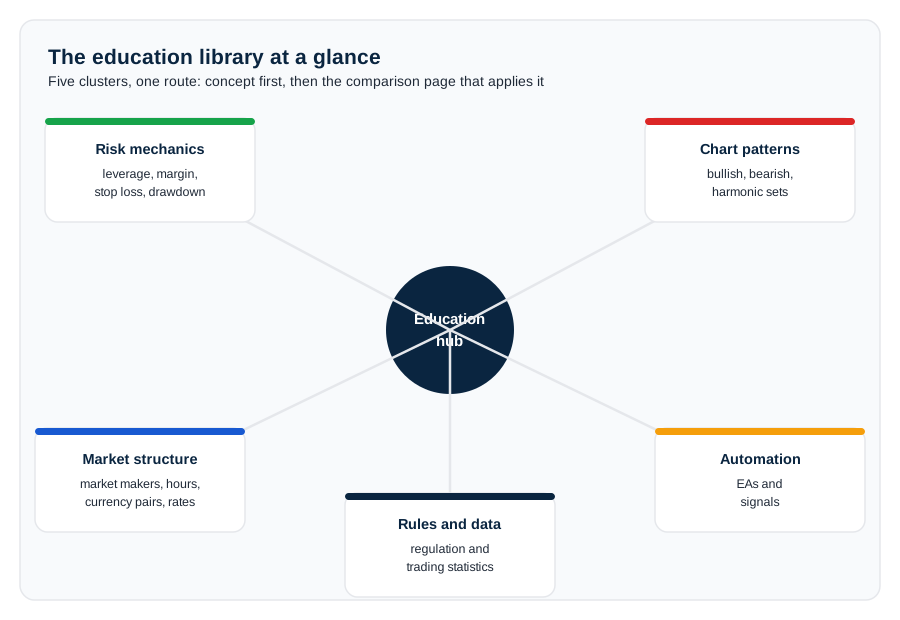
The diagram groups the library into five concept clusters around the hub: risk mechanics, chart patterns, market structure, automation, and rules and data. The four tables below are a different cut of the same pages, organised by reading stage rather than by subject, so the best view matches the gap being closed.
Foundations
The pages I’d want every new AU forex trader to read in order, before placing a real-money trade.
| Topic | What it covers |
|---|---|
| ASIC Regulation | What an AFSL actually protects. PIO leverage caps, negative balance protection, AFCA, the CSLR’s real limits. |
| Check a Broker | The register check, Moneysmart’s alert list and AFCA membership. How to spot an imposter firm. What a licence does and does not protect. |
| Forex Currency Pairs | Majors, minors, exotics. Why AUD/USD trades the way it does. Spread behaviour by pair. |
| Forex Margin | How brokers calculate margin requirement. Free margin vs used margin. Margin call vs stop-out. |
| Leverage Trading | The max-leverage rule. Effective leverage vs max leverage. Position-sizing examples in AUD. |
| Stop Loss | Hard stops, trailing stops, guaranteed stops. Where to place them and why “no stop” is the most expensive choice. |
| Drawdown | Peak-to-trough loss. Why a 50% drawdown needs a 100% gain to recover. Risk-of-ruin maths. |
| Interest Rates | RBA cash rate, FOMC, swap/rollover. How interest rate differentials drive the carry trade. |
| Market Maker | Dealing-desk vs no-dealing-desk execution. How an MM broker prices your trade. |
| CFD vs Stock | The legal and tax differences between trading a CFD on BHP and owning the share outright. |
| CFDs vs ETFs | When a CFD beats an ETF and when it does not, compared on cost, leverage, ownership and tax. |
| Forex Trading Tax | How the ATO taxes CFD gains and losses. Trader or investor, the loss rules, records and converting to Australian dollars, with a worked example, and GST. |
Strategy
Pages on the trading approaches AU retail traders most often ask about.
| Topic | What it covers |
|---|---|
| Chart Patterns | Bullish, bearish and harmonic patterns. How to identify, confirm and trade them. |
| Hedging Strategy | Direct hedge, multi-pair hedge, options-based hedge. When ASIC’s hedging rules apply. |
| Forex Signals | Manual signals, copy trading, signal services. How to evaluate a signal provider’s track record. |
The patterns page links out to dedicated guides on bullish patterns, bearish patterns, and harmonic patterns, so starting there makes sense if charting is the focus.
Tools
Pages on the platforms and automation tools used by Australian retail traders.
| Topic | What it covers |
|---|---|
| EA / Expert Advisors | What an MT4/MT5 EA is, how to install one, and which AU brokers tolerate scalping/news-trading EAs. |
| Automated and AI trading | Beyond EAs. cTrader Automate, MQL5 Marketplace, copy trading and full algorithmic frameworks, plus where AI actually sits in retail trading and its limits. |
If you’re considering an EA strategy, I’d pair these pages with our best ECN brokers guide. EAs and ECN execution go together.
Several of these topics come down to a number rather than a concept. Our forex calculators cover margin, position size, pip value, profit and loss, and monthly broker cost, each running on the same measured spread data as the reviews (the data Noam Korbl captures live), and running the numbers through them before committing to a broker is wise.
Markets
Pages on when and how the FX market moves.
| Topic | What it covers |
|---|---|
| Forex Market Hours | Sydney, Tokyo, London, New York sessions. Best hours for AU traders. DST changes. |
| Forex Trading Statistics | The honest numbers. Daily volume, retail success rates, broker loss percentages, demographic data. |
FAQs
Is forex trading a scam in Australia?
Is forex trading profitable for retail traders?
What's the best beginner forex strategy?
Can I trade forex full-time in Australia?
What's the difference between an EA and a forex signal?
Related pages
About the author

Justin co-founded CompareForexBrokers in 2014 and has traded forex since 1998. Based in Melbourne, he has tested every ASIC-regulated broker on this site personally and has written for Forbes, Kiplinger, Finance Magnates, the Australian Financial Review and The Age. He holds a Bachelor of Commerce (Honours) and a Master of Marketing from Monash University. Justin is the co-founder and CEO of CompareForexBrokers.