
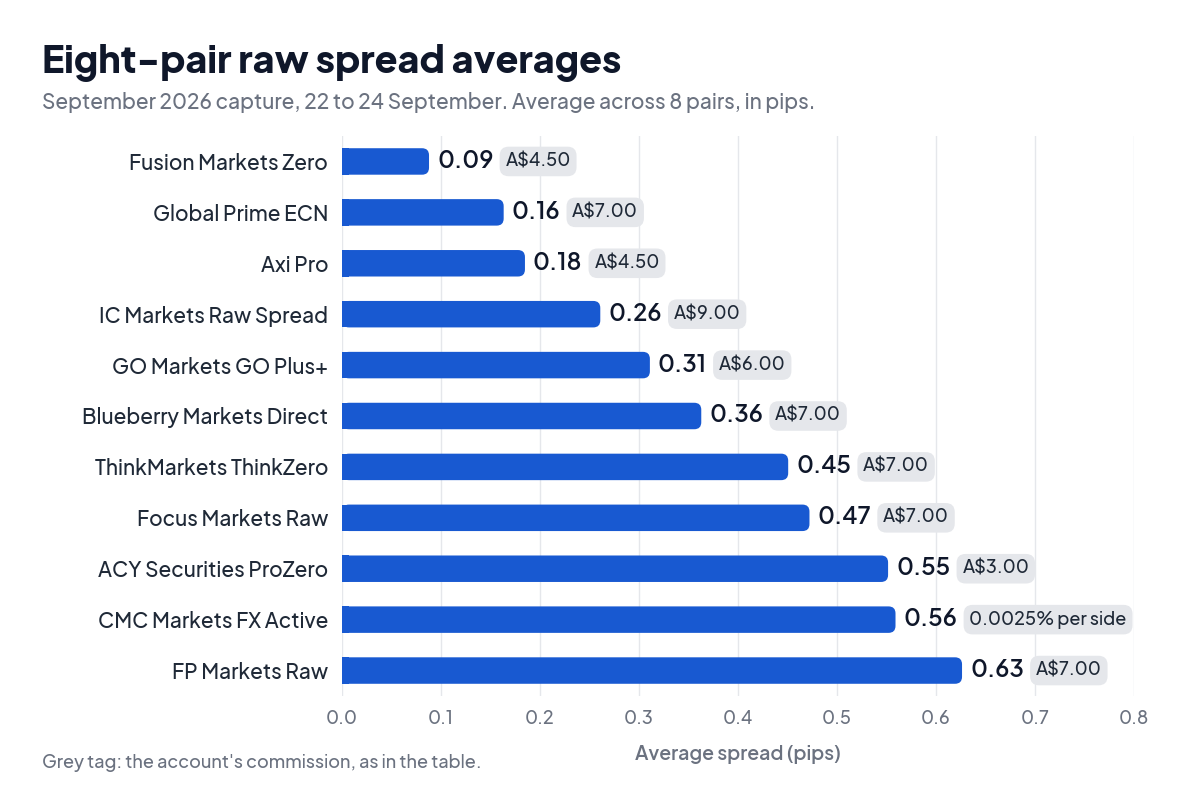
Fusion Markets Zero ranks first of the 19 ASIC accounts we measured in our September 2026 capture, averaging 0.09 pips across eight pairs, with Global Prime ECN at 0.16 and Axi Pro at 0.18 close behind. Below you get the full raw ranking, the all-in cost once commission is added, the standard accounts, and a dated block for brokers measured before this capture.
Quick verdict: lowest-spread raw accounts in Australia right now
I recommend Fusion Markets Zero first: it wins both the eight-pair raw average (0.09 pips) and the all-in cost (0.46 pips). Axi Pro is my pick when the worst minutes worry you more than the average, with a p95 of 0.34 pips, the narrowest of the top three, and 0.55 pips all-in. Global Prime ECN is second on spread, but its A$7.00 round turn drops it to third on all-in, behind Axi.
- Fusion Markets Zero: 0.09 pips eight-pair average, A$4.50 round turn.
- Global Prime ECN: 0.16 pips eight-pair average, A$7.00 round turn.
- Axi Pro: 0.18 pips eight-pair average, A$4.50 round turn.
- IC Markets Raw Spread: 0.26 pips eight-pair average, A$9.00 round turn.
- GO Markets GO Plus+: 0.31 pips eight-pair average, A$6.00 round turn.
- Blueberry Markets Direct: 0.36 pips eight-pair average, A$7.00 round turn.
- ThinkMarkets ThinkZero: 0.45 pips eight-pair average, A$7.00 round turn.
- Focus Markets Raw: 0.47 pips eight-pair average, A$7.00 round turn.
- ACY Securities ProZero: 0.55 pips eight-pair average, A$3.00 round turn.
- CMC Markets FX Active: 0.56 pips eight-pair average, commission 0.0025% of notional per side.
- FP Markets Raw: 0.63 pips eight-pair average, A$7.00 round turn.
This list covers the 11 raw accounts from our September 2026 capture, ranked on the eight-pair average. Standard accounts and brokers measured in earlier captures sit in their own tables below and are not ranked against these.
Raw spread is only half the ledger, and stopping at the spread prices the trade wrong. The same table shows the commission that completes each broker’s real cost, so the total is visible at a glance, and the broker you thought was cheapest on spread alone may not be the one I would open an account with once commission is added.
Raw account spreads: main table
Read the table across five columns: EUR/USD, the eight-pair average (the ranking key), the eight-pair p95, the round-turn commission, and the all-in cost that adds the commission in pips. The p95 is the average of each pair’s 95th-percentile minute, so treat it as how wide a typical pair’s worst minutes ran. I would ignore the spread column alone and judge accounts on the all-in cost, because that is what your account actually pays each round turn.
| Rank | Broker | EUR/USD | 8-pair avg | 8-pair p95 | All-in 8-pair | Visit broker | More details |
|---|---|---|---|---|---|---|---|
| 1 | #1 Lowest measured spread Fusion Markets0.09 pips eight-pair average, A$4.50 round turn Fusion Markets0.09 pips eight-pair average, A$4.50 round turn | 0.01 | 0.09 | 0.53 | 0.46 | Visit Fusion Markets | |
| |||||||
| 2 |  Global Prime0.16 pips eight-pair average, A$7.00 round turn Global Prime0.16 pips eight-pair average, A$7.00 round turn | 0.08 | 0.16 | 0.44 | 0.74 | Visit Global Prime | |
| |||||||
| 3 |  Axi0.18 pips eight-pair average, A$4.50 round turn Axi0.18 pips eight-pair average, A$4.50 round turn | 0.03 | 0.18 | 0.34 | 0.55 | Visit Axi | |
| |||||||
| 4 |  IC Markets0.26 pips eight-pair average, A$9.00 round turn IC Markets0.26 pips eight-pair average, A$9.00 round turn | 0.11 | 0.26 | 0.56 | 1.00 | Visit IC Markets | |
| |||||||
| 5 |  GO Markets0.31 pips eight-pair average, A$6.00 round turn GO Markets0.31 pips eight-pair average, A$6.00 round turn | 0.09 | 0.31 | 0.61 | 0.81 | Visit GO Markets | |
| |||||||
| 6 |  Blueberry Markets0.36 pips eight-pair average, A$7.00 round turn Blueberry Markets0.36 pips eight-pair average, A$7.00 round turn | 0.13 | 0.36 | 0.68 | 0.94 | Visit Blueberry Markets | |
| |||||||
| 7 |  ThinkMarkets0.45 pips eight-pair average, A$7.00 round turn ThinkMarkets0.45 pips eight-pair average, A$7.00 round turn | 0.16 | 0.45 | 0.92 | 1.03 | Visit ThinkMarkets | |
| |||||||
| 8 |  Focus Markets0.47 pips eight-pair average, A$7.00 round turn Focus Markets0.47 pips eight-pair average, A$7.00 round turn | 0.08 | 0.47 | 0.77 | 1.05 | Visit Focus Markets | |
| |||||||
| 9 |  ACY Securities0.55 pips eight-pair average, A$3.00 round turn ACY Securities0.55 pips eight-pair average, A$3.00 round turn | 0.16 | 0.55 | 3.15 | 0.80 | Visit ACY Securities | |
| |||||||
| 10 |  CMC Markets0.56 pips eight-pair average, commission 0.0025% of notional per side CMC Markets0.56 pips eight-pair average, commission 0.0025% of notional per side | 0.08 | 0.56 | 0.83 | 1.15 | Visit CMC Markets | |
| |||||||
| 11 |  FP Markets0.63 pips eight-pair average, A$7.00 round turn FP Markets0.63 pips eight-pair average, A$7.00 round turn | 0.30 | 0.63 | 1.09 | 1.21 | Visit FP Markets | |
| |||||||
Ranks use unrounded values, and a printed all-in is the printed spread plus the printed commission. Commission converts to pips at each pair’s own pip value per standard lot. CMC Markets FX Active prices commission on notional, so its all-in is computed pair by pair. Blueberry Markets’ and Focus Markets’ commission is the A$7.00 we measured on our live accounts, and the order held on both days of the capture.
Risk warning: CFDs are leveraged products and carry a high risk of loss. Most retail CFD accounts lose money. Review the broker's PDS and TMD before trading.
All-in cost: spread plus commission
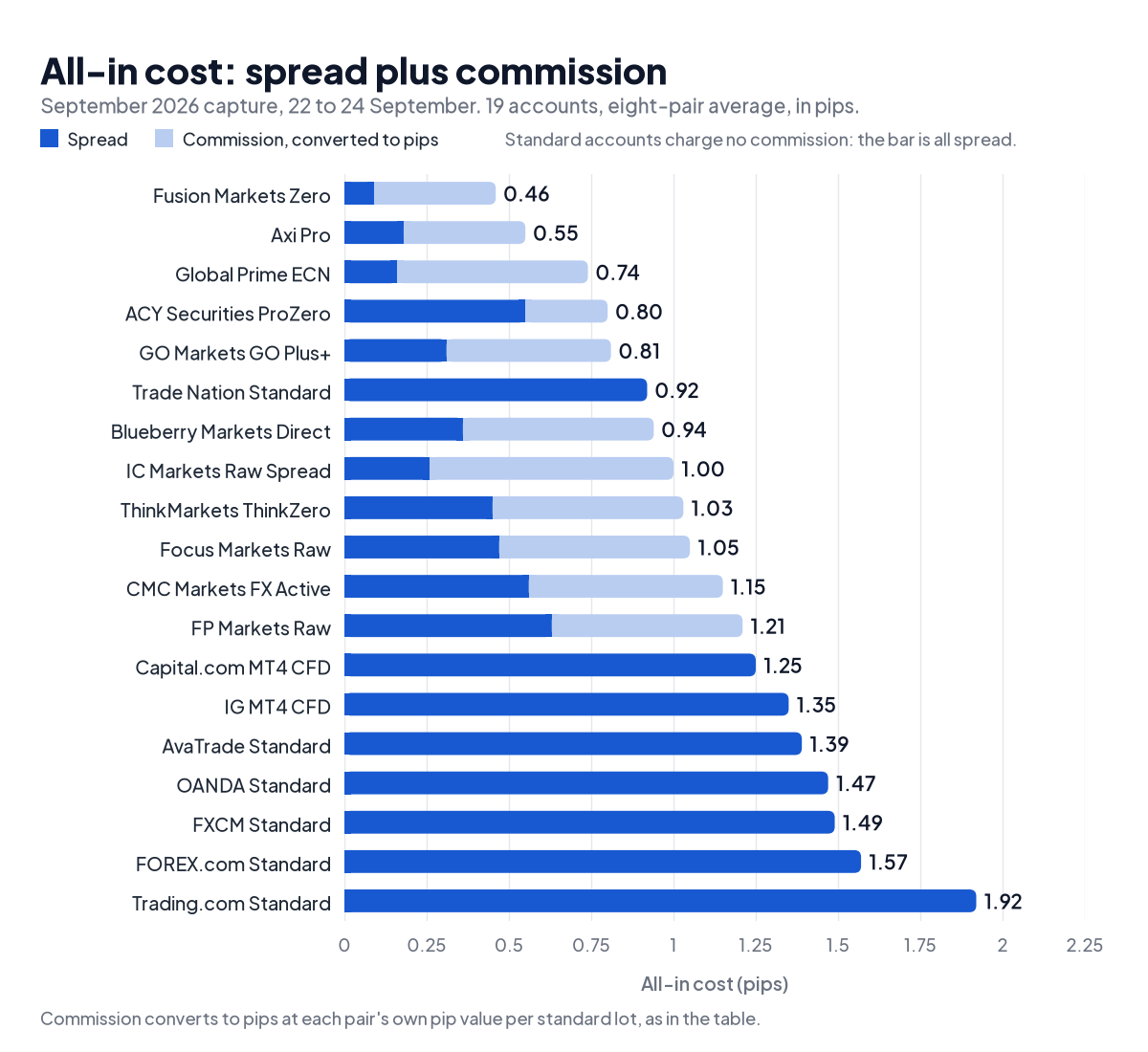
The all-in order differs from the spread order because each broker charges a different round-turn commission. Axi moves to second at 0.55 pips on its A$4.50 round turn, while Global Prime drops to third at 0.74 pips on A$7.00. ACY Securities’ A$3.00 round turn lifts it to fourth despite a 0.55 pip spread, and Trade Nation’s standard account at 0.92 pips with no commission costs less all-in than six raw accounts. I would sort any shortlist by this table, not the spread table, if you trade a commission account.
| Rank | Broker | Account | Type | 8-pair spread | Commission in pips, 8-pair | All-in 8-pair |
|---|---|---|---|---|---|---|
| 1 | Fusion Markets | Zero | Raw | 0.09 | 0.37 | 0.46 |
| 2 | Axi | Pro | Raw | 0.18 | 0.37 | 0.55 |
| 3 | Global Prime | ECN | Raw | 0.16 | 0.58 | 0.74 |
| 4 | ACY Securities | ProZero | Raw | 0.55 | 0.25 | 0.80 |
| 5 | GO Markets | GO Plus+ | Raw | 0.31 | 0.50 | 0.81 |
| 6 | Trade Nation | Standard | Standard | 0.92 | 0.00 | 0.92 |
| 7 | Blueberry Markets | Direct | Raw | 0.36 | 0.58 | 0.94 |
| 8 | IC Markets | Raw Spread | Raw | 0.26 | 0.74 | 1.00 |
| 9 | ThinkMarkets | ThinkZero | Raw | 0.45 | 0.58 | 1.03 |
| 10 | Focus Markets | Raw | Raw | 0.47 | 0.58 | 1.05 |
| 11 | CMC Markets | FX Active | Raw | 0.56 | 0.59 | 1.15 |
| 12 | FP Markets | Raw | Raw | 0.63 | 0.58 | 1.21 |
| 13 | Capital.com | MT4 CFD | Standard | 1.25 | 0.00 | 1.25 |
| 14 | IG | IG MT4 CFD | Standard | 1.35 | 0.00 | 1.35 |
| 15 | AvaTrade | Standard | Standard | 1.39 | 0.00 | 1.39 |
| 16 | OANDA | Standard | Standard | 1.47 | 0.00 | 1.47 |
| 17 | FXCM | Standard | Standard | 1.49 | 0.00 | 1.49 |
| 18 | FOREX.com | Standard | Standard | 1.57 | 0.00 | 1.57 |
| 19 | Trading.com | Standard | Standard | 1.92 | 0.00 | 1.92 |
Brokers measured before September 2026
These accounts were not in the September 2026 capture, except MultiBank Group, which was captured and not published, so each row keeps the figure from its own earlier capture, with the window in the last column. The rows are not ranked against the tables above because the May to June 2026 figures are IceFX SpreadMonitor tick medians from rolling 24-hour captures, a different statistic from the September quote-change-weighted average. I treat each row as a useful signpost for building your shortlist.
| Broker | Account | EUR/USD | 8-pair avg | Round-turn commission | Captured |
|---|---|---|---|---|---|
| Eightcap | Raw | not measured | 0.15 | A$7.00 | May to June 2026 |
| FOREX.com | RAW | 0.02 | 0.39 | A$7.00 | May to June 2026 |
| MultiBank Group | ECN | 0.10 | 0.40 | not published | May to June 2026 |
| OANDA | Raw | 0.20 | 0.44 | A$7.00 | July 2026 |
| Pepperstone | Razor | 0.10 | 0.46 | A$7.00 | May to June 2026 |
| Vantage | RAW ECN | 0.18 | 0.52 | A$5.00 | May to June 2026 |
| FXCM | Active Trader | 0.30 | 0.68 | wholesale clients only | May to June 2026 |
FXCM Active Trader is for wholesale clients only; Eightcap’s EUR/USD was not measured in that capture; MultiBank’s commission is not published. OANDA’s row is from a July 2026 capture with USD/CAD in place of USD/CHF.
Brokers not in the September capture
These brokers have no September 2026 figure, and the table gives the one reason for each. Most offer no MetaTrader account, which our logger runs on; easyMarkets was captured but its account sat outside its ASIC-licensed entity. I read the table as a checklist for your shortlist, so you know why a name you expected is missing.
| Broker | Why there is no September figure |
|---|---|
| easyMarkets | captured, but the account sat outside its ASIC-licensed entity, so it is not published |
| eToro | no MetaTrader account, which our logger runs on |
| Fortrade | not in this capture |
| Interactive Brokers | no MetaTrader account, which our logger runs on |
| Mitrade | no MetaTrader account, which our logger runs on |
| Plus500 | no MetaTrader account, which our logger runs on |
| TMGM | not in this capture |
| Totality | no MetaTrader account, which our logger runs on |
| Trading 212 | no MetaTrader account, which our logger runs on |
1. Fusion Markets Zero: tightest eight-pair raw average
Fusion Markets' Zero account runs an eight-pair raw average of 0.09 pips in our September 2026 capture, the smallest of the 11 raw accounts we measured, and it supports TradingView alongside MT4, MT5 and cTrader. Its all-in cost of 0.46 pips also leads the 19 accounts we ranked, with EUR/USD at 0.01 pips. It is my pick if you want tight spreads on TradingView, and there is no minimum deposit to hold you back. Both Fusion Markets and Global Prime are issued by FMGP Trading Group Pty Ltd under AFSL 385620.
Average spread
0.09 pips (8-pair raw average, September 2026) plus A$4.50 round turn
Trading platforms
MT4, MT5, cTrader, TradingView
Minimum deposit
A$0
Regulation
ASIC AFSL 385620
Why it ranks here
ASIC AFSL 385620 since 2011.
Pros & Cons
- Lowest all-in cost at 0.46 pips, on a A$4.50 round turn
- EUR/USD sat at exactly 0.0 in 95.7% of captured minutes
- No minimum deposit; four platforms including cTrader and TradingView
- Widest p95 of the top three at 0.53 pips
- Axi beat it on USD/JPY and EUR/JPY spreads
- A$4.50 round turn sits above ACY Securities' A$3.00
2. Global Prime ECN: second on the eight-pair raw average
Global Prime's ECN account took second on our eight-pair raw average at 0.16 pips in our September 2026 capture, but its A$7.00 round turn drops it to third all-in at 0.74 pips. I would weigh that commission before you commit, because it adds 0.50 pips on EUR/USD to every round turn you trade. Its p95 of 0.44 pips beats Fusion Markets' 0.53, so your worst minutes stay narrower. It shares its licensee, FMGP Trading Group Pty Ltd under AFSL 385620, with Fusion Markets.
Average spread
0.16 pips (8-pair raw average, September 2026) plus A$7.00 round turn
Trading platforms
MT4, MT5
Minimum deposit
A$0
Regulation
ASIC AFSL 385620
Why higher here? Spread Fit weights the measured raw spread, which lifts Global Prime above its #28 sitewide position. See the ranking method ↓
Why it ranks here
ASIC AFSL 385620 since 2011.
Pros & Cons
- Second-lowest eight-pair raw average at 0.16 pips
- Tighter tail than Fusion Markets, p95 0.44 against 0.53 pips
- No minimum deposit to open the ECN account
- A$7.00 round turn is why it falls to third all-in
- EUR/USD sat at 0.0 in only 0.1% of captured minutes
- MT4 and MT5 only, no cTrader or TradingView support
3. Axi Pro: third on the eight-pair raw average
Axi's Pro account ranks third on our eight-pair raw average at 0.18 pips in our September 2026 capture and second all-in at 0.55 pips, because its A$4.50 round turn undercuts Global Prime's A$7.00. Its p95 of 0.34 pips is the narrowest tail of the three, so your worst minutes stay close to the average. If you trade JPY pairs, Axi also ranked first among raw accounts on USD/JPY and EUR/JPY in the same capture.
Average spread
0.18 pips (8-pair raw average, September 2026) plus A$4.50 round turn
Trading platforms
MT4, MT5, Axi Trading Platform (web)
Minimum deposit
A$0
Regulation
ASIC AFSL 318232
Why higher here? Spread Fit weights the measured raw spread, which lifts Axi above its #26 sitewide position. See the ranking method ↓
Why it ranks here
ASIC AFSL 318232 since 2007.
Pros & Cons
- Second-lowest all-in cost at 0.55 pips on a A$4.50 round turn
- Lowest p95 of the top three at 0.34 pips
- Lowest USD/JPY and EUR/JPY spreads we measured in September 2026
- Rollover ran wide, 8.75 pips at the widest minute against Fusion Markets' 2.00 pips
- Third on the eight-pair raw average, behind Fusion Markets and Global Prime
- Platforms are MT4, MT5 and a web platform only
Standard account spreads: secondary table
The 8 standard accounts in the same September 2026 capture carry no commission, so the spread is the whole cost: what you see quoted is what you pay. Trade Nation leads at 0.92 pips across eight pairs (EUR/USD 0.43), which would place it sixth on the all-in table, ahead of six raw accounts once their commissions are added. I’d take a standard account seriously if you hate per-trade fees, since a single spread with no commission line makes your cost per trade easier to check before you open it.
| Rank | Broker | Account | EUR/USD | 8-pair avg | 8-pair p95 |
|---|---|---|---|---|---|
| 1 | Trade Nation | Standard | 0.43 | 0.92 | 1.06 |
| 2 | Capital.com | MT4 CFD | 0.74 | 1.25 | 1.44 |
| 3 | IG | IG MT4 CFD | 0.72 | 1.35 | 1.89 |
| 4 | AvaTrade | Standard | 0.86 | 1.39 | 1.90 |
| 5 | OANDA | Standard | 0.99 | 1.47 | 1.75 |
| 6 | FXCM | Standard | 0.85 | 1.49 | 1.77 |
| 7 | FOREX.com | Standard | 0.82 | 1.57 | 2.15 |
| 8 | Trading.com | Standard | 1.25 | 1.92 | 2.34 |
IG’s row is its MT4 CFD account measured in this capture; IG’s Forex Direct raw figures are IG’s own published numbers and are not listed as a measurement. CMC Markets’ standard account was not captured.
Lowest spread by currency pair
Fusion Markets ranked first among raw accounts on six of the eight pairs, and Axi ranked first on USD/JPY (0.08 pips) and EUR/JPY (0.25 pips) in our September 2026 capture. Trade Nation led the standard accounts on six pairs and beat every raw account all-in on USD/JPY. I suggest you start with the EUR/USD column, since it is the most liquid pair and the one brokers fight hardest on.
| Pair | Lowest raw spread | Lowest standard spread | Lowest all-in |
|---|---|---|---|
| EUR/USD | Fusion Markets 0.01 | Trade Nation 0.43 | Fusion Markets 0.33 |
| AUD/USD | Fusion Markets 0.01 | Trade Nation 0.55 | Fusion Markets 0.33 |
| GBP/USD | Fusion Markets 0.02 | Trade Nation 0.69 | Fusion Markets 0.34 |
| USD/JPY | Axi 0.08 | Trade Nation 0.58 | Trade Nation 0.58 |
| EUR/GBP | Fusion Markets 0.09 | Trade Nation 1.08 | Fusion Markets 0.33 |
| EUR/JPY | Axi 0.25 | Trade Nation 0.99 | Axi 0.75 |
| AUD/JPY | Fusion Markets 0.16 | Capital.com 0.89 | Fusion Markets 0.66 |
| USD/CHF | Fusion Markets 0.04 | OANDA 1.37 | Fusion Markets 0.30 |
How often raw spreads sit at exactly zero
Three raw accounts averaged exactly 0.0 on EUR/USD in more than 94% of minutes in our September 2026 capture: Axi at 96.0%, Fusion Markets at 95.7% and CMC Markets at 94.1%. Six raw accounts sat there in under 1% of minutes. My advice is to remember a zero spread is not a zero cost, because the commission is still there: 0.32 pips on EUR/USD at an A$4.50 round turn, 0.50 pips at A$7.00.
| Broker | Account | EUR/USD minutes at 0.0, both days | 22 to 23 Sep | 23 to 24 Sep |
|---|---|---|---|---|
| Axi | Pro | 96.0% | 96.1% | 95.8% |
| Fusion Markets | Zero | 95.7% | 96.1% | 95.2% |
| CMC Markets | FX Active | 94.1% | 94.7% | 93.4% |
| GO Markets | GO Plus+ | 30.8% | 30.8% | 30.8% |
| ACY Securities | ProZero | 29.0% | 36.2% | 21.8% |
| Focus Markets | Raw | 0.7% | 0.6% | 0.8% |
| Global Prime | ECN | 0.1% | 0.0% | 0.1% |
| Blueberry Markets | Direct | 0.0% | 0.0% | 0.0% |
| FP Markets | Raw | 0.0% | 0.0% | 0.0% |
| IC Markets | Raw Spread | 0.0% | 0.0% | 0.1% |
| ThinkMarkets | ThinkZero | 0.0% | 0.0% | 0.0% |
How we measure spreads
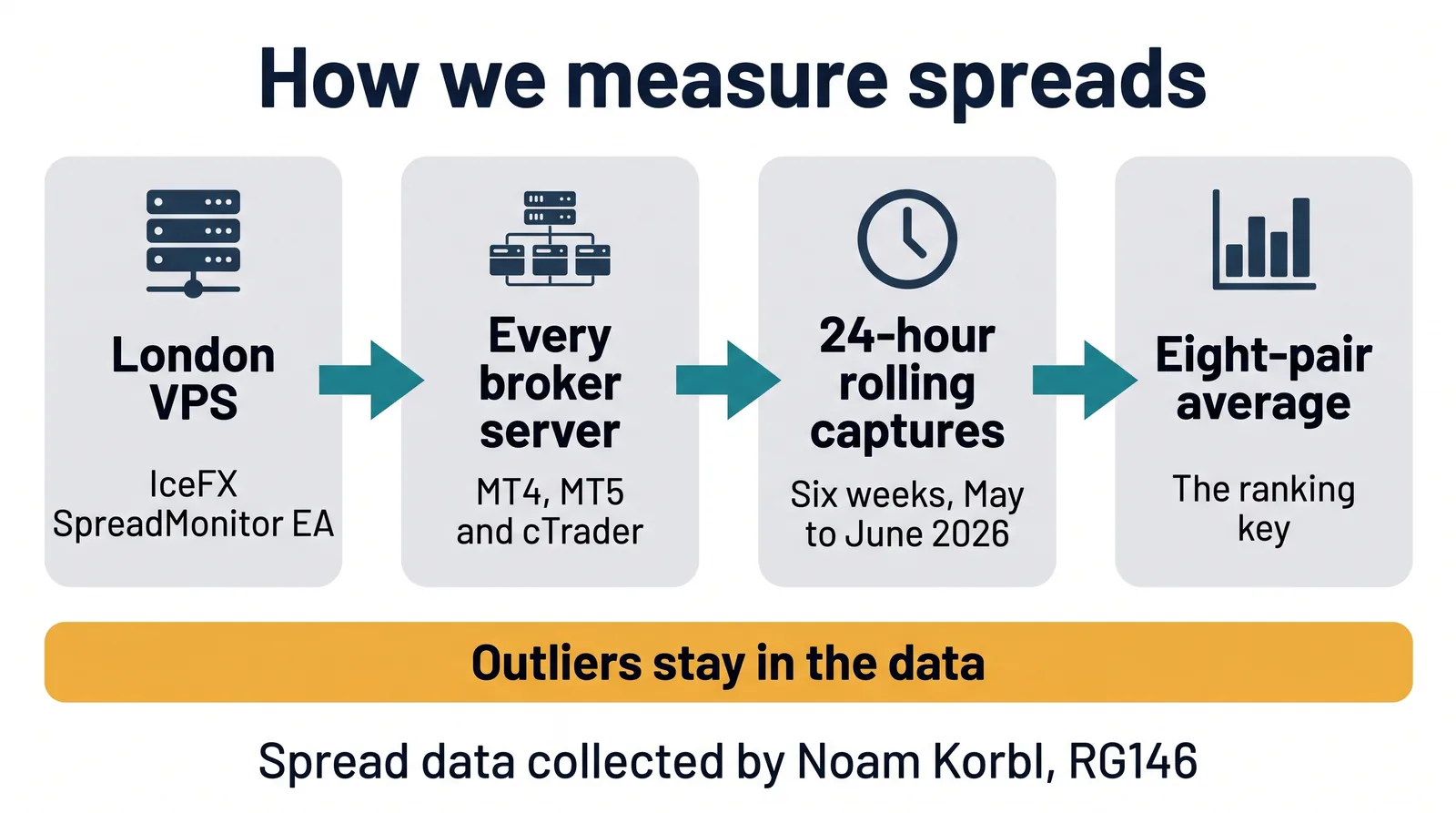
Noam Korbl ran our September 2026 capture, 48 hours from 2pm AEST on 22 September to 2pm AEST on 24 September 2026, using our own logger (CFB-SpreadLogger 1.1.0) on one MetaTrader terminal per broker, all on a single London VPS. It read each broker’s bid and ask once per second on a live account and kept one record per minute. From those minutes we publish the quote-change-weighted average and the p95, the level 95% of a pair’s minutes sat at or below.
- Window: 48 hours from 2pm AEST on 22 September to 2pm AEST on 24 September 2026, split into two 24-hour cycles at 2pm AEST.
- Tool: CFB-SpreadLogger 1.1.0 read bid and ask once per second on one MetaTrader terminal per broker, all on one London VPS, keeping one record per minute.
- Accounts: Each broker was measured on one live account; 21 captured, 19 published (11 raw, 8 standard) across 8 currency pairs.
- Statistics: The average is quote-change-weighted, so a quiet minute cannot outweigh a busy one; the p95 is the 95th percentile of a pair’s one-minute averages.
- Commission: Published from the broker’s rate card where one exists, converted to pips at each pair’s own pip value (A$14.04 on USD-quoted pairs, A$8.94 on JPY pairs).
- Coverage: Every published account covered at least 99.5% of the capture’s seconds; a minute with no fresh quote is skipped, never counted as zero.
- Exclusions: MultiBank Group and easyMarkets were excluded because their margin implied leverage above the 30:1 ASIC retail cap (about 100:1 and 300:1) and their terminal named a company other than the ASIC licensee.
Every minute counts, rollover and news included, so the p95 column shows you how wide a typical pair’s worst minutes ran, 0.53 pips at Fusion Markets and 3.15 at ACY Securities in our September 2026 capture. In my view that honesty matters: a broker you trade through at 7:00am deserves to be judged on those minutes, not only the quiet ones. Until this capture we published IceFX SpreadMonitor tick medians from rolling 24-hour captures over six weeks, a different statistic from the September average, which is why earlier figures carry their own window and sit in their own table rather than in the ranking.
Watch: Lowest spread forex brokers Australia.
For full details, see the methodology page.
Spread is half the cost: the other half is commission
The headline spread is a marketing number. What actually leaves your account is spread plus commission. Here’s the maths:
- No-commission account: total cost = spread (in pips)
- RAW account: total cost = spread + (commission / pip value)
Our forex broker cost calculator runs that spread-plus-commission total across all 32 ASIC brokers at a monthly volume, so the exact cost of a trading habit is visible before an account is funded, and the broker that looked cheapest on spread may cost you more once your actual lot count runs through the numbers. Our other free forex trading calculators cover margin and position size, and the pip value calculator converts one pip to AUD for any pair and lot size.
The same A$ commission costs a different number of pips on different pairs, because a pip is worth A$14.04 per standard lot on USD-quoted pairs, A$8.94 on JPY pairs and A$18.78 on EUR/GBP. I weigh commission in pips, not dollars, because that is the unit your spread already sits in, and the table converts each round turn so you can compare it against the spread beside it.
| Round-turn commission (AUD) | EUR/USD pips | USD/JPY pips | EUR/GBP pips |
|---|---|---|---|
| A$3.00 (ACY Securities) | 0.21 | 0.34 | 0.16 |
| A$4.50 (Axi, Fusion Markets) | 0.32 | 0.50 | 0.24 |
| A$6.00 (GO Markets) | 0.43 | 0.67 | 0.32 |
| A$7.00 (Blueberry Markets, FP Markets, Focus Markets, Global Prime, ThinkMarkets) | 0.50 | 0.78 | 0.37 |
| A$9.00 (IC Markets) | 0.64 | 1.01 | 0.48 |
The same A$7.00 round turn is 0.50 pips on EUR/USD but 0.78 on USD/JPY, so the same headline commission costs more on the yen pairs. The gap between A$4.50 and A$9.00, 0.32 pips on EUR/USD, is larger than the whole eight-pair spread gap between Fusion Markets (0.09 pips) and IC Markets (0.26 pips) in our September 2026 capture, which is why I would compare all-in cost, not spread alone.
Add the two together and the order changes. Fusion Markets is the lowest all-in cost among the brokers whose commission we can source, at 0.46 pips in our September 2026 capture once the A$4.50 round turn is converted to spread, against 0.55 at Axi.
For the commission-led view of the same accounts, see lowest commission forex brokers.
I start with the number one row and work down: the calculator opens on Fusion Markets Zero at 0.01 pips on EUR/USD with an A$4.50 round turn, one lot, from our September 2026 capture. Change the pair, lots, spread or commission to model your own trading and see what each account costs you.
When spreads widen, and how much it matters
Headline averages cover the calm hours. Real spreads move with liquidity. Here are the four windows I want you to know about:
News releases. Non-Farm Payrolls, FOMC, RBA, ECB, BoE: the major releases blow spreads out. The widest single one-second EUR/USD read at any raw account in our September 2026 capture was 12.00 pips, at FP Markets. Anyone trading through these events should model the worst-case spread, not the average, because what fills a stop is the spread at that second, not the spread planned on, and the fill you get at the print is the one that costs you real money.
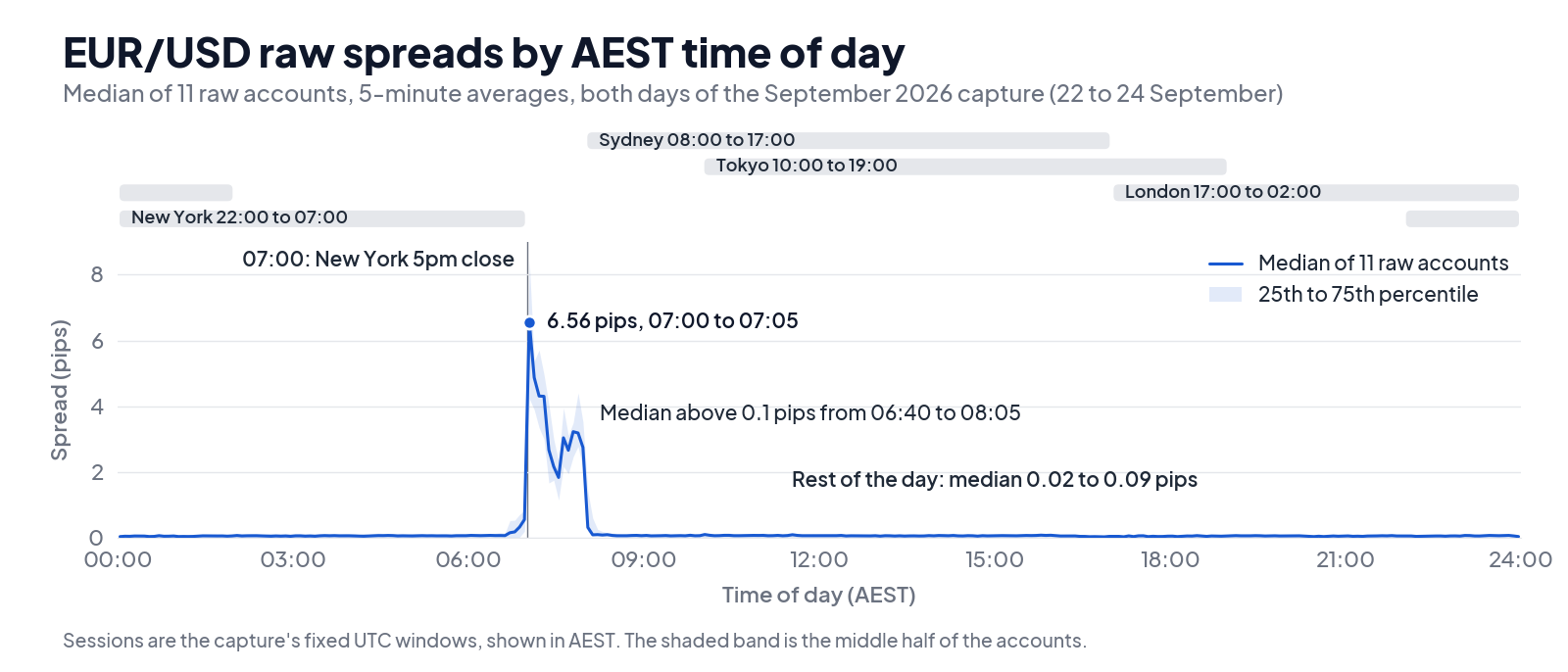
Asian session quiet. The handover between New York close and Tokyo open is thin in theory, but our September 2026 capture measured hourly median EUR/USD spreads of 0.06 pips at 5am and 0.07 at 6am AEST. The real widening came later, around the 7:00am New York close, with the median above 0.1 pips from 6:40 to 8:05am. For a trader who trades the Asian session regularly, the broker with the tightest London average may not be the one that serves best, and I would re-rank the shortlist by the spread you actually see at your desk time, not the one captured at a session you never trade.
Weekend gap-open. Sunday afternoon AEST, when forex reopens for the week, spreads sit wide while liquidity returns, and our September 2026 capture, which ran Tuesday to Thursday, holds no weekend reading to quantify it. Market orders at the open are best avoided, and a limit order placed before the open can fill at a price that looks nothing like Friday’s close, so the entry you thought you had locked in may already be underwater before the week begins.
During rollover, brief widening appears at every broker as banks recalculate swap. In our September 2026 capture the New York 5pm close fell at 7:00am AEST (8:00am AEDT from 4 October 2026, 9:00am from 1 November 2026), and the widening was not a 30-second affair: the median stayed above 0.1 pips from 6:40 to 8:05am, and the widest one-minute averages ran to 10.50 pips at GO Markets. If a stop sits near the market during that window, the extra pips come out of the account, and that is a cost I would not want to pay just because the broker is slow to recover. The swap charge itself depends on the interest rate differential between the two currencies in the pair.
Rollover in our September 2026 capture
The table below reads EUR/USD at every raw account from 6:55 to 7:10am AEST, where the New York 5pm close fell during our September 2026 capture, against each account’s whole-capture average. Fusion Markets held lowest at 0.17 pips on average; GO Markets averaged the widest at 4.25 pips and posted the widest minute, 10.50 pips. If you hold positions over the close, I would read this table before the headline average, because these are the minutes that fill your stops.
| Broker | Account | EUR/USD average, whole capture | EUR/USD average, 6:55 to 7:10am AEST | Widest one-minute average, 6:55 to 7:10am AEST |
|---|---|---|---|---|
| Fusion Markets | Zero | 0.01 | 0.17 | 2.00 |
| Global Prime | ECN | 0.08 | 1.80 | 5.66 |
| Axi | Pro | 0.03 | 1.48 | 8.75 |
| IC Markets | Raw Spread | 0.11 | 2.93 | 6.18 |
| GO Markets | GO Plus+ | 0.09 | 4.25 | 10.50 |
| Blueberry Markets | Direct | 0.13 | 1.99 | 5.32 |
| ThinkMarkets | ThinkZero | 0.16 | 4.03 | 8.65 |
| Focus Markets | Raw | 0.08 | 2.42 | 5.25 |
| ACY Securities | ProZero | 0.16 | 3.80 | 7.87 |
| CMC Markets | FX Active | 0.08 | 2.36 | 10.00 |
| FP Markets | Raw | 0.30 | 1.71 | 9.95 |
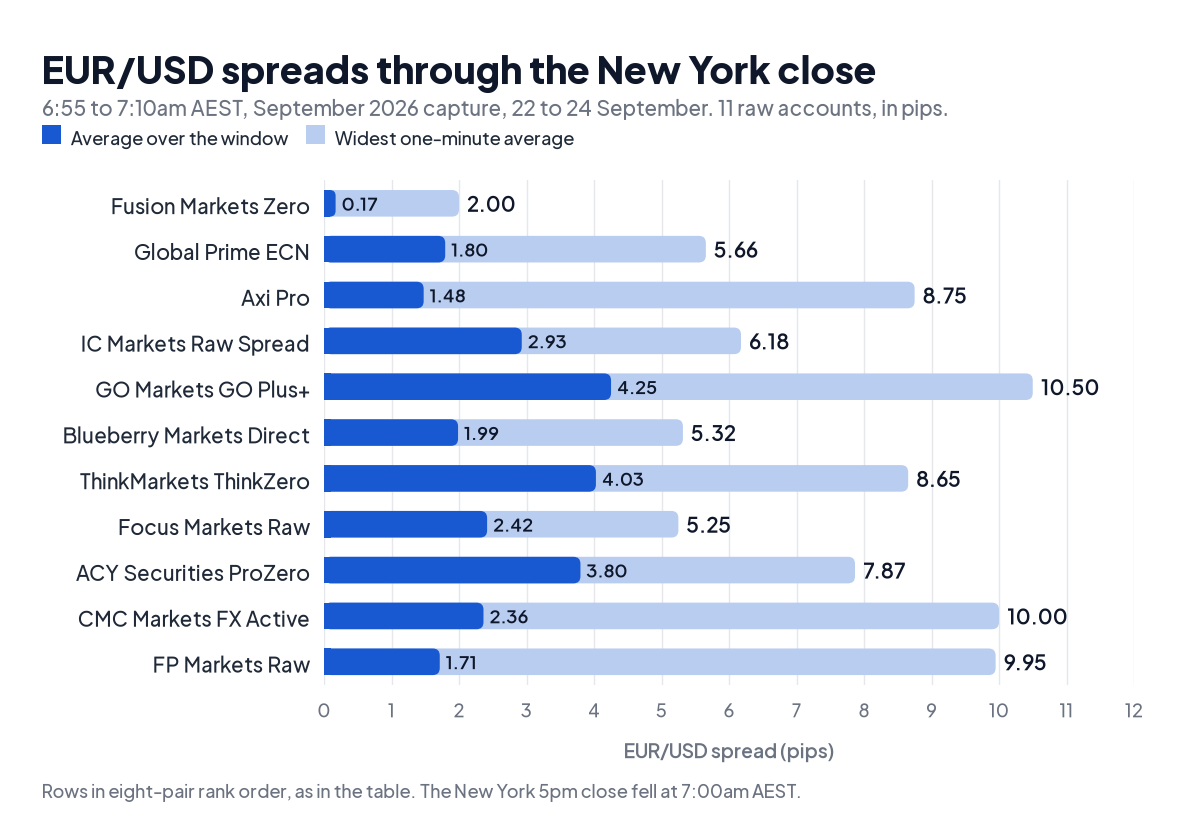
The point isn’t to avoid these windows. It’s to know they exist so a broker is not chosen based on a 5-second average that ignores them. When comparing two brokers and one publishes a maximum spread column while the other hides it, that is a signal about which one wants a trader to trade with eyes open, and I would take the broker that shows you the worst case over the one that hopes you never ask.
AUD-base account vs USD-base: what actually changes
Most ASIC-regulated RAW accounts let you choose your base currency. For AU traders, the two practical options are AUD or USD. Here’s the tradeoff:
AUD-base account. The balance, P&L and commission are in Australian dollars. Currency conversion is avoided when depositing from an Australian bank, which means the amount transferred is the amount that lands in the trading account, so what you send is what you trade with, no haircut taken on the way in. Commission is quoted in AUD (e.g. Pepperstone AUD 7 round-turn). Position sizing on AUD-quoted pairs feels native because the quote currency matches the base.
USD-base account. The balance and commission are in US dollars. At the rates in our September 2026 capture, a USD 7.00 round-turn commission works out to A$9.83, materially more than the A$7.00 payable on an AUD-base equivalent at the same broker, and that extra A$2.83 per round turn is a cost I cannot justify for a trader funding in Australian dollars. For a trader trading from Australia and funding in AUD, there is no reason to pay that conversion penalty. This account only makes sense for trading USD-quoted pairs almost exclusively, to avoid one layer of currency conversion on the P&L.
For most AU retail traders, AUD-base is the right choice. It delivers lower effective commission, no FX conversion on deposits and withdrawals, and native sizing on AUD pairs. What I cannot get past is the USD-base commission: at the rates in our September 2026 capture, paying an extra A$2.83 per round turn for the same trade at the same broker is a cost with no corresponding benefit for most Australian traders.
ASIC fee transparency: what brokers must disclose
ASIC’s design and distribution obligations and the Corporations Act require ASIC-licensed CFD brokers to publish a Product Disclosure Statement (PDS) that discloses the cost structure of every account. For RAW account spread disclosure, here’s what that means in practice, and why the PDS should be read before the marketing page, because the document you skip is the one that tells you what the broker is actually charging:
- Typical spread: the broker’s representative average for each instrument
- Maximum spread: the cap above which the broker won’t quote (rare in practice, but disclosed)
- Commission rates: round-turn cost per standard lot, by base currency
- Swap rates: overnight financing on long and short positions
- Currency conversion fees: where applicable
The PDS sits alongside a Target Market Determination (TMD), introduced under ASIC’s Design and Distribution Obligations regime in October 2021, which states the type of retail client the product is suited to. Both documents must be linked from the broker’s homepage and presented before an account is opened. Any broker that makes these hard to find is hoping they will not be read, and that reluctance is the signal I would pay most attention to before funding an account.
Where ASIC oversight matters in practice: if a broker quotes “0.0 pip spreads” in marketing but the PDS lists a typical EUR/USD spread of 0.3 pips, the marketing is non-compliant. AFCA has heard several complaints on this point, and in those cases the broker was required to refund the difference. The PDS is the document of record. It should be read before funding, and if the gap between the marketing and the PDS looks wide, taking the business elsewhere is the right move before the difference is learned the expensive way, because the refund you might get later does not cover the trades you lost in the meantime.
Compare brokers by the factor that decides it
Each shortlist below re-ranks the market for one decision factor, and my team has tested each one the same way as this page, so you can compare your chosen factor without rechecking the method.

The platform decides it
Rankings change once the trading software is fixed. Pick yours first, then compare.

Your strategy decides it
Execution speed, copy functionality and EA support separate these shortlists.

What you trade decides it
CFD shortlists re-ranked for the asset class you trade most.
FAQs
Which broker has the lowest forex spreads in Australia?
What is a RAW spread account?
Are 0.0 pip spreads real?
How much does spread cost me per trade?
Why do my spreads look wider than the broker's advertised spreads?
Does a tighter spread always mean a cheaper broker?
Which forex trading platform has the lowest spread?
Which forex pairs have the lowest spreads?
Related pages
About the author

Justin co-founded CompareForexBrokers in 2014 and has traded forex since 1998. Based in Melbourne, he has tested every ASIC-regulated broker on this site personally and has written for Forbes, Kiplinger, Finance Magnates, the Australian Financial Review and The Age. He holds a Bachelor of Commerce (Honours) and a Master of Marketing from Monash University. Justin is the co-founder and CEO of CompareForexBrokers.