















Why Australians need a different broker list
Most forex broker comparison sites are written for a global audience, and I would not rely on them for an Australian account. That works fine until you try to open an account from Sydney, Melbourne, Brisbane or Perth and discover the broker does not accept Australian clients, or worse, accepts them through an offshore entity with none of the protections ASIC provides.
ASIC licence only
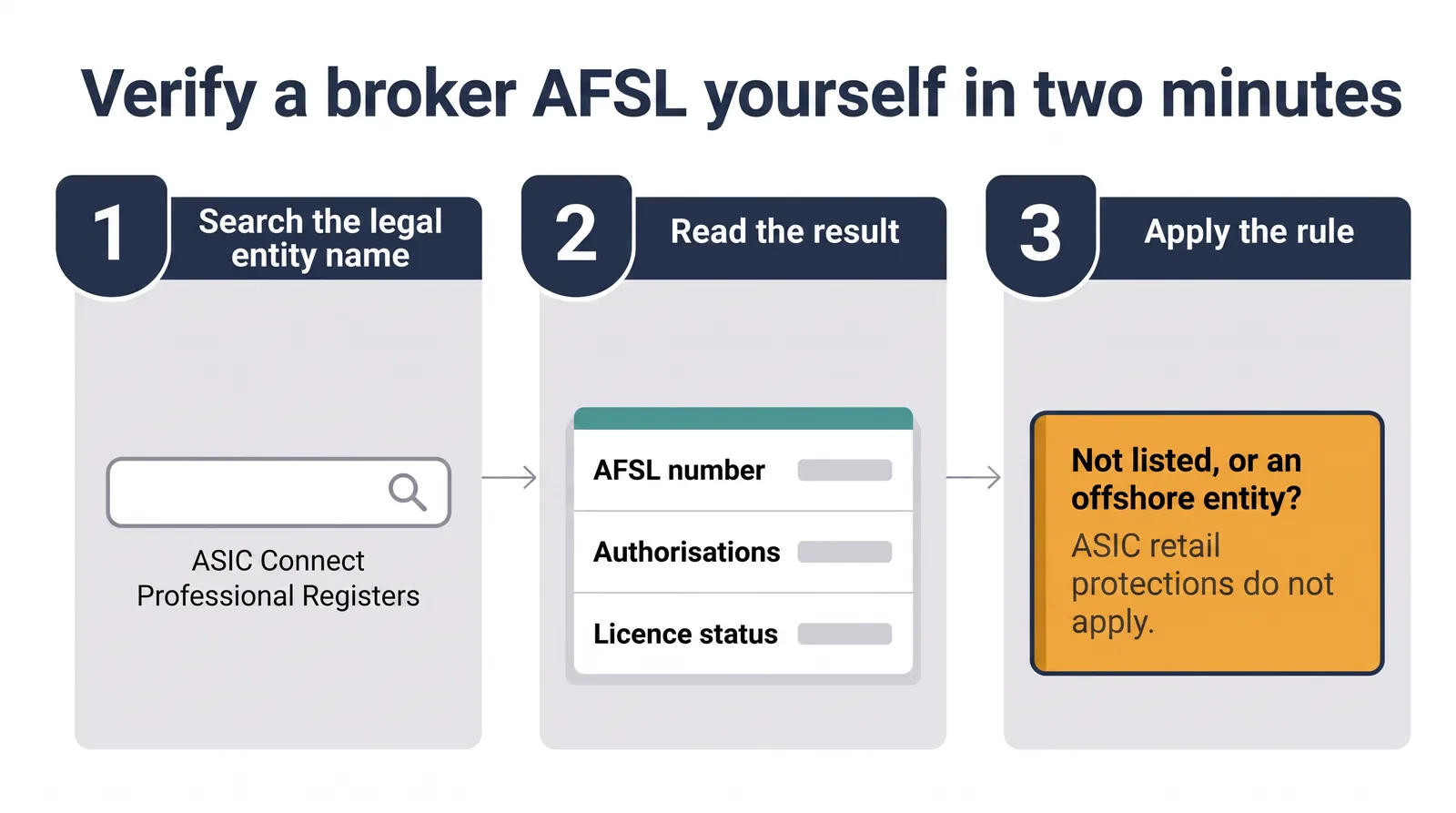
This site only covers brokers that hold an Australian Financial Services Licence (AFSL) issued by the Australian Securities and Investments Commission. That is a deliberate choice, and in my view it is the one filter that matters most for your money.
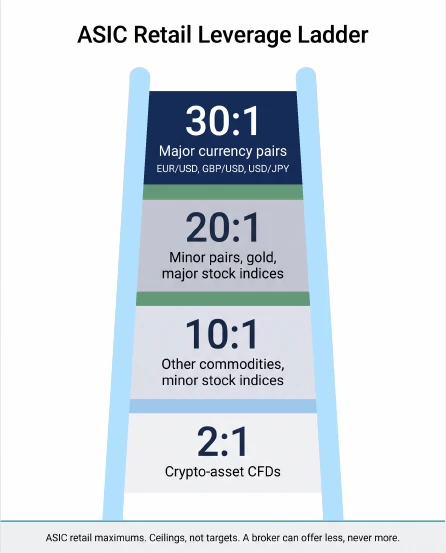
Leverage capped at 30:1
ASIC sets some of the toughest retail trading rules in the world, and I consider that a good thing. In practice, that means your leverage on major forex pairs is capped at 30:1, full stop.
October 2014
Founded in Melbourne
CompareForexBrokers launched at compareforexbrokers.com.au.
2019
Went global
As we expanded into international markets, the main site moved to compareforexbrokers.com.
June 2026
Back home
We relaunched the .com.au domain as a dedicated Australian site for ASIC-regulated brokers.
We have tested 28 of the 33 brokers we rank with our own funds on live accounts. Where a broker offers multiple entities globally, I would only consider the Australian ASIC-regulated entity, because that is the one that matters for the trading conditions you actually receive.
How we compare brokers
Each broker’s overall score is built from category sub-scores. The team has documented testing on funded live accounts, opened with our own money, at 28 of the 33 ranked brokers, and this public coverage was checked on 2 October 2026. I lead the research desk, while Noam Korbl runs the live spread and commission captures. No broker pays for placement. Some pay an affiliate commission when you open an account through the site, which is disclosed on every review and never affects scoring, and I would check that disclosure before opening an account.
Noam Korbl ran our latest capture across the full trading week of 5 to 9 October 2026, covering the Sydney, Tokyo, London and New York sessions.
5 to 9 October 2026 capture pairs: EURUSD AUDUSD GBPUSD USDJPY EURGBP EURJPY AUDJPY USDCHF
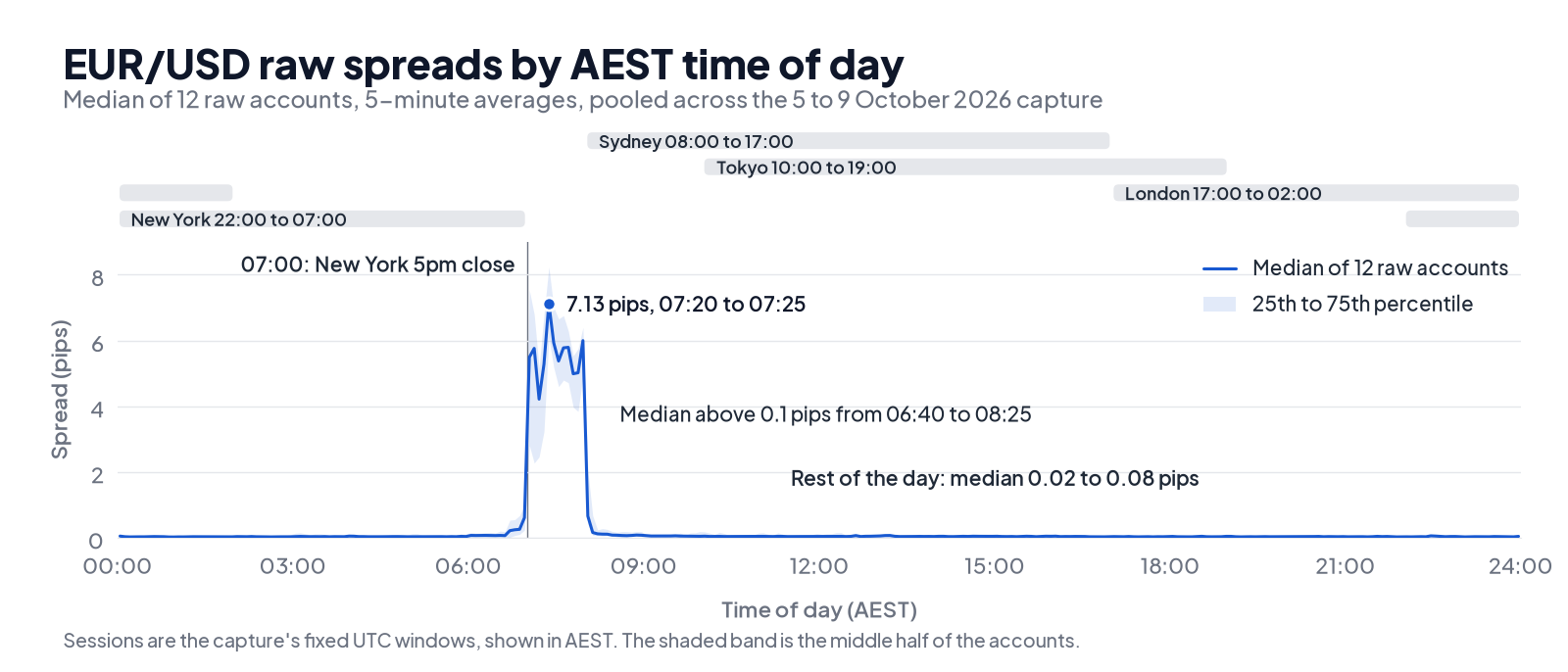
Spread testing
We log each broker’s bid and ask once per second with our own CFB-SpreadLogger 1.1.0 logger on MT4 and MT5, keep one record per minute, and the quote-change-weighted eight-pair average above is the ranking key on our spread tables. The Australian dollar pairs matter here because they reveal who is pricing for you, and I would watch them closely. Some global brokers price AUDUSD competitively for Australian clients; others widen it because it is not their core flow.
Trading experience rating
We rate the current Trading Experience category by desk assessment, not from category test logs. A reliable comparable benchmark would need dated order and fill logs recording account type, Australian entity, server and location, plus a written score mapping. Connection latency and order execution differ, so latency figures alone cannot rank brokers.
Read the full scoring methodology · Compare spreads by hour of day
ASIC rules every Australian retail trader should know
Under ASIC’s Product Intervention Order (in force since 29 March 2021), retail clients of any AFSL-holding CFD issuer get the same caps, and I would not look beyond that. Protection does not vary by broker.
If a broker advertises 500:1 to you, that means an offshore entity or a wholesale classification. The rules behind each cap are set out in how ASIC regulates forex brokers, and our high leverage brokers guide covers what sits above these caps.
On a retail account, you cannot lose more than your account balance. The flash crashes that wiped out small accounts in the EU pre-2018 produced these rules in the first place. Downside is capped at whatever has been deposited: no margin calls past zero. Brokers cannot offer cash bonuses or trading credits to entice deposits.
ASIC does not require Australian brokers to publish an issuer-specific loss percentage, so the reliable numbers are its own: 68% of retail CFD investors lost money in the 2024 financial year, more than $458 million including $73 million in fees (ASIC REP 828, published 20 January 2026). I would keep that figure in mind before you size a first deposit.
If something goes wrong, your dispute resolution path is the Australian Financial Complaints Authority, which is free for retail clients and binding on the broker up to AFCA’s monetary limits. Trading losses themselves are not compensated. Past the complaint path, the forex trading in Australia guide walks through ASIC’s rules and protections, the money a beginner needs, how the ATO treats gains, and the account opening steps.
Choosing a forex broker by market, platform and deposit
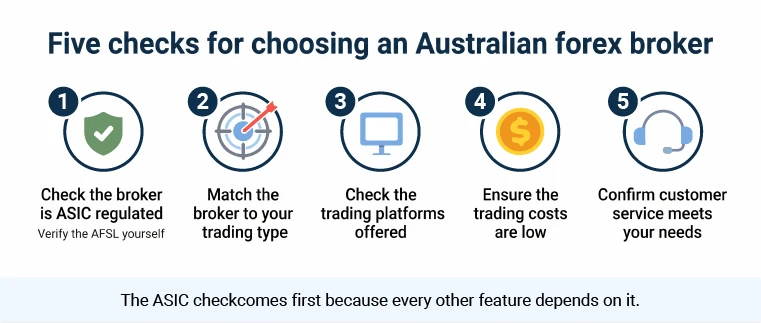
Three questions decide which of our guides you need. Pick the one that matches the job, not the broker with the most ads.
What do you want to trade?
A trader who only needs forex and a handful of indices will find almost any broker on this list adequate, and you can stop your search there. Someone who wants share CFDs, ETFs, treasuries or crypto CFDs faces a field that narrows fast. CMC, IG and Interactive Brokers are the broadest. Plus500 and eToro lean retail and lighter on niche markets.
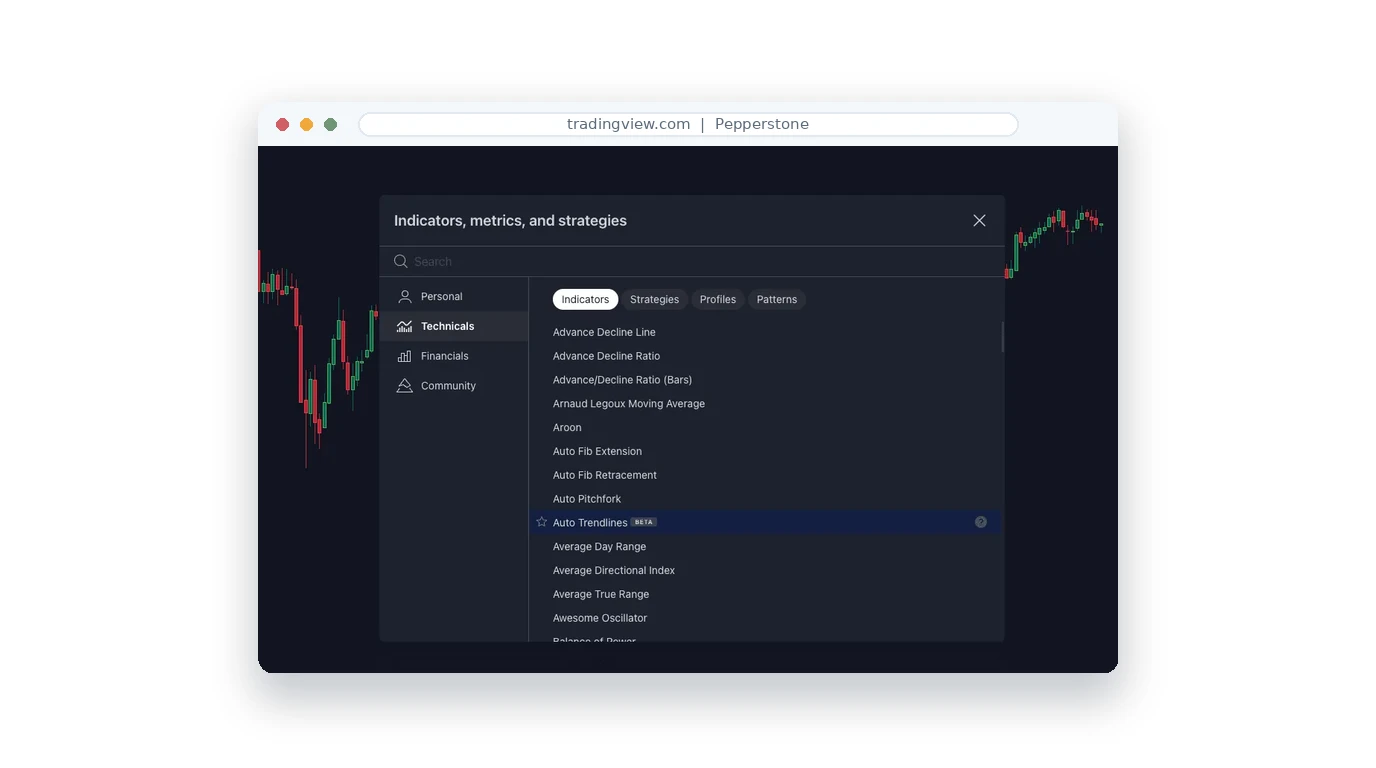
Which platform do you know?
MT4 still has the deepest broker support in Australia, and cTrader a smaller field. Native TradingView integration comes from a handful of brokers, Pepperstone and OANDA among them. Proprietary platforms like CMC's Next Generation suit traders who want one ecosystem, and I would not underestimate how much friction that saves you if consistency matters.
Best MT4 brokers Best MT5 brokers TradingView brokers All platforms
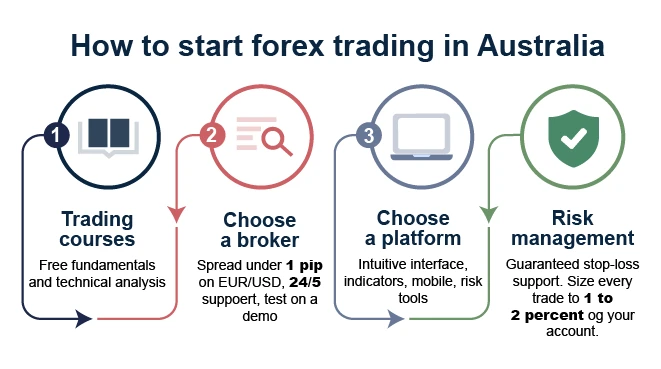
How much do you plan to deposit?
Several brokers list a $0 minimum (Pepperstone, OANDA, CMC, Fusion Markets, Trade Nation), though IG asks for A$100 by card, A$10 by BPAY or A$450 by EFT with proof of payment. Others sit at $100 to $200. Fund what can be afforded to lose. ASIC's risk warning is not a marketing line.
Best for beginners Lowest spreads ECN accounts Lowest commission
Our forex broker cost calculator works out what a trader’s own activity would cost across all 33 brokers, the testing itself is on our YouTube channel, and all 33 broker reviews carry the full detail.
Forex broker costs are spread plus commission
Spreads are the headline cost on a forex trade. Commission is added on RAW/ECN accounts. Add the two together to get your real cost, because quoting one without the other flatters the broker.
RAW accounts, EUR/USD
Mean of 12 accounts, 5 to 9 October 2026 capture
Standard accounts, EUR/USD
Mean of 8 accounts, 5 to 9 October 2026 capture
In our 5 to 9 October 2026 capture, the 12 raw accounts averaged a 0.12 pip EUR/USD spread plus 0.45 pips of commission, an all-in cost of 0.57 pips per standard lot round turn. The eight standard accounts averaged 0.83 pips all-in on EUR/USD in our 5 to 9 October 2026 capture, a gap of 0.26 pips, roughly A$3.70 on one standard lot at the capture’s pip value of A$14.24. Account type does not settle the cost by itself: in the same 5 to 9 October 2026 capture, all-in cost ranged from 0.32 to 0.74 pips on the raw accounts and 0.47 to 1.04 pips on the standard accounts, and the cheapest standard account undercut the mean raw account. I weigh the commission first, because 0.45 of the 0.57 pips is commission. Our hourly spread comparison sets any of the 20 published accounts side by side, hour by hour, from the same capture.
Forex broker comparison FAQs
How do you compare forex brokers in Australia?
How does CompareForexBrokers test brokers?
Forex broker reviews and trading guides
- Forex broker reviews
Individual assessments sit in the forex broker reviews, where ASIC-regulated brokers were checked with funded live accounts or desk research.
- Best forex brokers in Australia
The full ranking scores every ASIC-regulated broker on one methodology, so the forex broker comparison names which one suits you.
- Trading platforms in Australia
Choosing among MT4, MT5, cTrader and TradingView gets easier in the trading platform guide, which maps each terminal to its ASIC-regulated brokers.
The people behind the testing
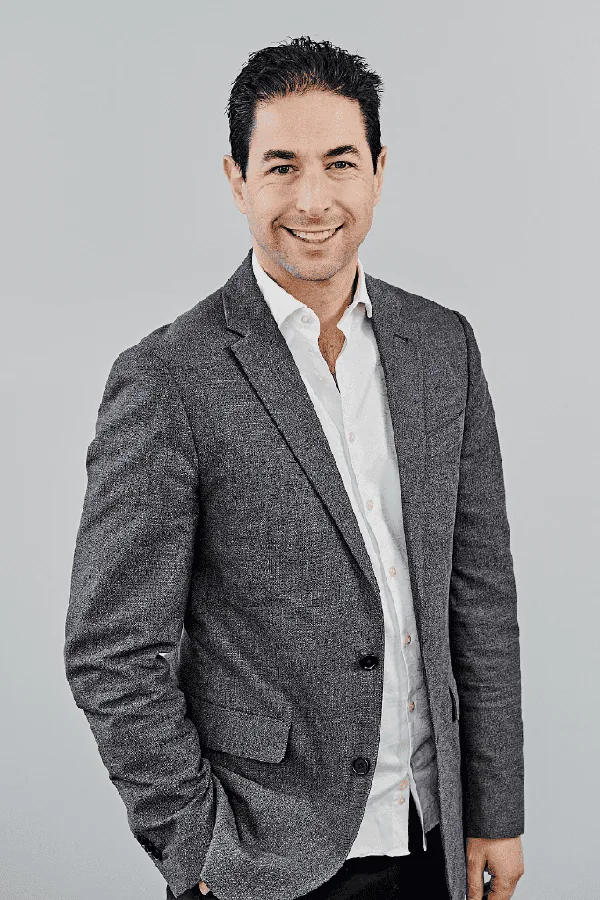
Co-founder and CEO
Justin co-founded CompareForexBrokers in 2014 and has traded forex since 1998. Based in Melbourne, he leads the site's research, and has written for Forbes, Kiplinger and Finance Magnates, while the Australian Financial Review has cited CompareForexBrokers research. He holds a Bachelor of Commerce (Honours) and a Master of Marketing from Monash University.

Co-founder and COO
Noam co-founded CompareForexBrokers in 2014 and has traded forex since the late 1990s. RG146-certified, he leads the education and trading-strategy content and runs the live spread and commission captures from Melbourne.