
Quick verdict: the best fixed spread brokers in Australia right now
I'd point you to Trade Nation as my best fixed spread forex broker in Australia in 2026, and I'd make that call because I'd put your cost first. My reasoning starts with your cost: EUR/USD fixed at 0.5 pips in the main session (published 17 July 2026). I'd also want you to see the $0 minimum deposit, because your starting balance should not lock you out. My score for the site is 79/100 (tested 26 June 2026), and I'd tell you that matters for your confidence in your broker and your account. If you want an alternative for your shortlist, I'd call easyMarkets my longest-running pick, but you should know you'd get 0.6 pips EUR/USD fixed on a published schedule. I'd score easyMarkets 32/100 site-wide, and I'd note that gap matters before you commit your money to your trade. I wouldn't want you to overlook it, and I'd keep it in mind.
Genuine fixed-spread picks
- Trade Nation: tightest genuine fixed spreads, EUR/USD 0.5 pips.
- easyMarkets: longest-running fixed-spread broker, 0.6 pips.
Spread-certainty alternatives (variable or markup pricing, but predictable day-to-day)
- Plus500: markup pricing that behaves like fixed.
- Mitrade: spread-only pricing, EUR/USD from 0.4 pips.
- IG Markets: no-commission standard account, 17,000+ markets.
- CMC Markets: tightest stable standard spread, from 0.5 pips.
- Forex.com: standard spreads from 0.2 pips, StoneX-backed.
Fixed pricing is a niche product in the ASIC-regulated market. Most large brokers (Pepperstone, IC Markets, CMC, IG, OANDA) run variable-spread RAW or commission accounts only, so two names cover the use case: Trade Nation (AFSL 422661) and easyMarkets (AFSL 246566). AvaTrade (AFSL 406684) is sometimes listed as a fixed-spread broker globally but its AU offering is largely variable. Plus500 (AFSL 417727) isn’t fixed in the strict sense but uses a markup-based model that behaves similarly day-to-day. Beyond genuine fixed pricing, three accounts posted the steadiest day-to-day pricing in our testing and stand as the closest alternatives: IG Markets, CMC Markets and Forex.com. For the broader ASIC market beyond fixed pricing, our guide to the top-rated forex brokers in Australia ranks every name we test.
Fixed spread broker comparison table
| # | Broker | Fixed spread? | EUR/USD typical | AUD/USD typical | Platforms | Visit broker | More details |
|---|---|---|---|---|---|---|---|
| 1 | #1 Top fixed-spread pick Trade Nation Trade Nation | Yesfull | 0.5 pips | 0.4 pips | TN Trader MT4 MT4 TradingView TradingView | Visit Trade Nation | |
| |||||||
| 2 |  easyMarkets easyMarkets | Yes (Web/App and TradingView) | 0.6 pips | 1.2 pips | easyMarkets web/appMT4 MT5TradingView MT5TradingView | Visit easyMarkets | |
| |||||||
| 3 |  AvaTrade AvaTrade | Mixed (semi-fixed on some accounts) | 0.86 pips (variable, measured September 2026) | 1.1 pips | MT4MT5AvaTradeGOWebTrader | Visit AvaTrade | |
| |||||||
| 4 |  Plus500 Plus500 | Markup model, not strictly fixed | 0.6 to 1.0 pips | Around 1.4 pips | Plus500 WebTraderapp | Visit Plus500 | |
| |||||||
All four hold an Australian Financial Services Licence and are members of the Australian Financial Complaints Authority (AFCA). Each is subject to ASIC’s Product Intervention Order, which caps retail leverage by asset class. What that means for an account is a hard limit on how much exposure can be taken, and that is a baseline protection worth having.
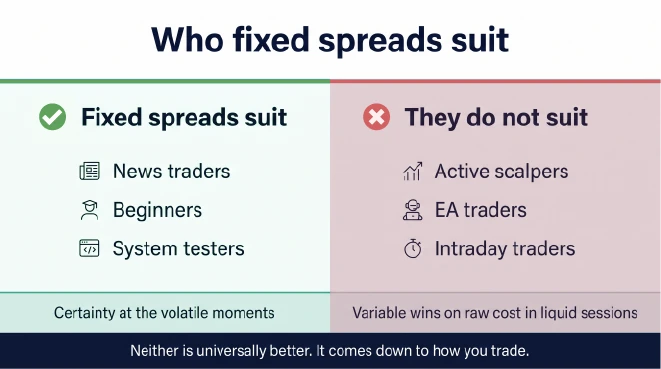
Who fixed spreads suit
- News traders who want pricing certainty around NFP, CPI, RBA cash rate decisions
- Beginners learning position sizing and risk-per-trade who don’t want a moving cost line
- System traders backtesting on a constant cost assumption
- Anyone who values predictability over absolute tightness during normal market hours
Who they don’t suit
- Active scalpers and EA traders chasing the lowest possible cost per trade
- High-frequency traders sensitive to a fraction of a pip during liquid sessions
- Traders running on a RAW or commission model already
CFD positions are leveraged, so your risk of loss is high. Most retail CFD accounts lose money, and you could be among them. Before you open a trade, you should review the broker's PDS and TMD, because your capital is exposed, your plan should include that check, and you need that protection for your own trading. Your decision should never skip that review, and your own risk is exactly what this warning targets, so you know what you are carrying.
Trade Nation: tightest fixed spreads in Australia
Trade Nation quotes the tightest fixed spreads available to Australian retail traders, EUR/USD from 0.5 pips and AUD/USD from 0.4 pips on its TN Trader platform (main session), unchanged during news and session opens, with no commission. Expert advisor users can switch to a separate variable-spread MT4 account, and TradingView runs on the same login. There is no minimum deposit and Trade Nation holds ASIC AFSL 422661. Alongside easyMarkets it is one of only two brokers in our coverage offering true fixed pricing.
Average spread
EUR/USD = 0.5
GBP/USD = 0.8
AUD/USD = 0.4
Trading platforms
TN Trader, MT4, TradingView
Minimum deposit
A$0
Regulation
ASIC AFSL 422661
Why higher here? Fixed Spread Fit weights fixed-quote reliability and pricing simplicity, which lifts Trade Nation above its #10 sitewide position. See the ranking method ↓
Pros & Cons
- ASIC AFSL 422661, plus FCA (UK), FSCA (South Africa) and SCB (Bahamas) regulation
- Fixed spreads from 0.5 pips on EUR/USD and 0.4 pips on AUD/USD in the main session, held through news
- $0 minimum deposit and $0 inactivity fee
- Fixed spreads, while predictable, are wider than top-tier RAW accounts in normal market conditions
- Product range of 1,000+ instruments is narrower than CMC's 12,000+ or IG's 18,000+
- MetaTrader and TradingView availability on the AU entity needs to be verified before account opening
Broker's Detail
Founded in 2014 and ASIC-regulated under AFSL 422661, Trade Nation is one of the few brokers offering genuine fixed spreads across major forex pairs and indices in Australia. The firm is the natural starting point when cost certainty during news is the non-negotiable.
The fixed-spread account quotes EUR/USD at 0.5 pips (main session) with no commission, holding through news events within the session. The proprietary TN Trader platform pairs with MT4 and native TradingView trading.
$0 minimum deposit with fee-free AU funding via PayID, BPAY, card and PayPal. Retail leverage capped at ASIC's maximum on major pairs. AFCA dispute coverage and negative balance protection standard.
Trade Nation spread table (TN Trader fixed quotes published 17 July 2026; MT4 figures and averages measured in our September 2026 test cycle):
| Pair | Trade Nation MT4 (measured avg) | Trade Nation TN Trader (published fixed, main session) | Avg of 8 measured standard accounts | Avg of 11 measured RAW accounts incl. commission |
|---|---|---|---|---|
| EUR/USD | 0.43 pips | 0.5 pips | 0.83 pips | 0.57 pips |
| AUD/USD | 0.55 pips | 0.4 pips | 0.87 pips | 0.63 pips |
| GBP/USD | 0.69 pips | 0.8 pips | 1.20 pips | 0.69 pips |
| USD/JPY | 0.58 pips | 0.6 pips | 1.14 pips | 1.01 pips |
| EUR/GBP | 1.08 pips | 0.5 pips | 1.44 pips | 0.64 pips |
easyMarkets: longest-running fixed-spread name in Australia
easyMarkets is the longest-running fixed-spread name available to Australian traders, quoting EUR/USD fixed at 0.6 pips and AUD/USD at 1.2 pips on its Web and App platform and on TradingView, with no commission. Those rates hold through news and session changes. It also offers guaranteed stop-loss orders on the Web and App platform and easyTrade, a capped-risk product where the maximum loss is set before entry. The minimum deposit is A$200 and easyMarkets holds ASIC AFSL 246566. Note that its MT4 and MT5 accounts run variable spreads rather than fixed.
Average spread
EUR/USD = 0.7
GBP/USD = 1.0
AUD/USD = 0.9
Trading platforms
easyMarkets web/app, MT4, MT5, TradingView
Minimum deposit
A$200
Regulation
ASIC AFSL 246566
Why higher here? Fixed-spread Fit weights genuine fixed pricing, and easyMarkets is one of only two true fixed-spread brokers on the AU shortlist, with guaranteed stops stacking extra certainty on top. That fixed pricing carries a premium over variable accounts, which is why it sits #32 sitewide. See the ranking method ↓
Pros & Cons
- ASIC AFSL 246566 since 26 March 2004
- Fixed spreads on all majors (rare in the AU market, only Trade Nation also offers true fixed pricing)
- Guaranteed stop-loss orders on the Web and App platform hold your exit price through a gap
- Base spreads wider than RAW accounts at IC Markets, Pepperstone, Fusion Markets
- USD 25 per quarter inactivity fee after three months, aggressive by AU standards
- Standard account is the only retail option; no commission-based RAW tier for active traders
Broker's Detail
Founded in 2001 (originally as easy-forex), easyMarkets is ASIC-regulated under AFSL 246566 and one of the few brokers offering genuine fixed spreads to AU clients alongside variable Raw pricing. That longevity matters because it tells a trader the model has survived multiple market cycles.
The Fixed account quotes EUR/USD at 0.6 pips with no commission, holding through news events (published schedule, 17 July 2026). Fixed pricing runs on the easyMarkets web and app and on native TradingView. MT4 and MT5 both run floating spreads, per easyMarkets' own Australian platform pages.
AUD 200 minimum deposit with fee-free AU funding via PayID, BPAY and card. Retail leverage capped at ASIC's maximum on major pairs. AFCA dispute coverage and negative balance protection standard.
easyMarkets spread table (fixed quotes from easyMarkets’ published schedule, 17 July 2026, set against our variable-account test averages; the ASIC entity publishes no per-pair table of its own):
| Pair | easyMarkets fixed spread | Avg of 8 measured standard accounts (September 2026) | Pepperstone Razor incl. comm. (May to June 2026) |
|---|---|---|---|
| EUR/USD | 0.6 pips | 0.83 pips | 0.55 pips |
| AUD/USD | 1.2 pips | 0.87 pips | 0.55 pips |
| GBP/USD | 1.0 pips | 1.20 pips | 0.65 pips |
| USD/JPY | 1.0 pips | 1.14 pips | 0.55 pips |
| EUR/GBP | 1.0 pips | 1.44 pips | 0.75 pips |
| EUR/JPY | 1.5 pips | 2.07 pips | 0.85 pips |
| AUD/JPY | 2.0 pips | 2.09 pips | 0.90 pips |
AvaTrade: primarily variable in Australia
AvaTrade markets fixed spreads in many of its global jurisdictions but the AU entity (Ava Capital Markets Australia, AFSL 406684) runs a primarily variable-spread model on its retail accounts in 2026. EUR/USD typically sits around 0.9 pips on a variable basis. Some account configurations and the AvaProtect feature add a fixed cost layer on top, but the underlying spread isn't fixed in the way it is at easyMarkets or Trade Nation. Anyone coming here expecting a guaranteed quote should check the current terms carefully.
Average spread
EUR/USD = 0.9
GBP/USD = 1.5
AUD/USD = 1.0
Trading platforms
MT4, MT5, AvaOptions, AvaSocial, AvaTradeGO, WebTrader
Minimum deposit
A$100
Regulation
ASIC AFSL 406684
Why higher here? Fixed-spread Fit rewards cost predictability. AvaTrade is primarily variable in Australia, but its standard EUR/USD spread held steady near 0.86 pips in our September 2026 capture and AvaOptions adds a genuine hedging route, which lifts it above its #27 sitewide position. See the ranking method ↓
Why We Recommend AvaTrade
Anyone considering AvaTrade specifically for fixed pricing should check the current PDS before opening. The product mix has shifted twice in the last three years, and that pace of change is worth being aware of before committing capital.
For the full review see the AvaTrade review.
Pros & Cons
- ASIC AFSL 406684 since 2011; Tier-1 regulators on three other continents
- AvaOptions platform offers real vanilla forex options, rare in Australia
- AvaSocial proprietary copy trading plus DupliTrade integration
- USD 50 inactivity fee after only three months, among the most aggressive in our coverage
- USD 100 administration fee after 12 months on top of the inactivity charge
- Standard account spreads (0.9 pips EUR/USD) wider than RAW brokers like Pepperstone and IC Markets
Broker's Detail
Dublin-headquartered AvaTrade has been ASIC-regulated under Ava Capital Markets Australia (AFSL 406684) since 2011. The group also holds licences with the FFAJ (Japan), CySEC (Cyprus), BVIFSC (BVI), FSCA (South Africa) and ADGM (UAE).
AvaTrade runs a Standard-only account model with no Raw/ECN tier. EUR/USD spreads sat at 0.86 pips with no commission in our September 2026 capture. The platform stack is the broadest of any broker in our shortlist: MT4, MT5, AvaOptions, AvaSocial, DupliTrade, AvaTradeGO and WebTrader.
$100 minimum deposit; fee-free AU funding via card, bank transfer and Skrill/Neteller. Note the aggressive fee schedule: USD 50 inactivity fee after three months idle, plus a USD 100 administration fee after twelve months. Retail leverage capped at ASIC's maximum on major pairs.
AvaTrade spread table (FX rows: September 2026 measured standard account; gold: indicative published pricing):
| Pair | AvaTrade Standard (measured avg pips) | Avg of 8 measured standard accounts |
|---|---|---|
| EUR/USD | 0.86 | 0.83 |
| AUD/USD | 0.98 | 0.87 |
| GBP/USD | 1.28 | 1.20 |
| USD/JPY | 1.36 | 1.14 |
| EUR/GBP | 1.31 | 1.44 |
| EUR/JPY | 1.86 | 2.07 |
| Gold (XAU/USD) | 0.30 | Not in capture |
Plus500: markup model, predictable but not fixed
Plus500 (AFSL 417727) doesn't publish a fixed spread but the broker's pricing model behaves more like a fixed spread than a RAW variable feed. The broker takes a market price and adds a stable markup that doesn't usually move with liquidity conditions. EUR/USD advertises across a 0.6 to 1.0 pip band.
Average spread
EUR/USD = 0.8
GBP/USD = 1.0
AUD/USD = 0.9
Trading platforms
Plus500 WebTrader, app
Minimum deposit
A$100
Regulation
ASIC AFSL 417727
Why higher here? Fixed Spread Fit weights fixed-quote reliability and pricing simplicity, which lifts Plus500 above its #16 sitewide position. See the ranking method ↓
Why We Recommend Plus500
This isn't technically fixed pricing, and that distinction matters. Plus500 reserves the right to widen during volatile conditions, and we've observed widening during major news on the platform in our testing. But day-to-day predictability is high. For a single broker for casual CFD trading with a stable cost base, Plus500 is in the running.
Pros & Cons
- ASIC AFSL 417727 since 2012; FTSE 250-listed parent (LSE:PLUS) for a strong trust profile
- WebTrader platform is the cleanest beginner CFD interface in our coverage
- Guaranteed Stop Loss Orders (GSLO) available, priced through a wider spread set when the position opens
- No MT4, MT5, cTrader or TradingView, proprietary platform only
- Forex pair count narrower than Pepperstone, IC Markets, OANDA
- Inactivity fee of USD 10/month kicks in after just 3 months (most AU brokers wait 6 to 12 months)
Broker's Detail
London Stock Exchange-listed (FTSE 250) and ASIC-regulated under AFSL 417727 since 2012, Plus500 operates a markup-pricing model on a proprietary platform with no MT4/MT5/cTrader.
Spreads are baked into the price (no commission). EUR/USD runs 0.6 to 1.0 pips typical. The platform is deliberately simple: a single account type, a clean trade ticket and 2,800+ CFD instruments. Guaranteed stop-loss orders are available for a small premium.
You need a $100 minimum deposit, and funding in AUD carries no fee from Plus500 via card, Google Pay, PayPal, BPAY and bank transfer. Retail leverage capped at ASIC's maximum on major pairs. AFCA dispute coverage and negative balance protection standard.
Plus500 spread table (Plus500 column: advertised typical ranges, not from our measured capture):
| Pair | Plus500 typical (pips) | Avg of 8 measured standard accounts (September 2026) |
|---|---|---|
| EUR/USD | 0.6 to 1.0 | 0.83 |
| AUD/USD | 0.7 to 1.2 | 0.87 |
| GBP/USD | 1.0 to 1.5 | 1.20 |
| USD/JPY | 0.8 to 1.2 | 1.14 |
| EUR/GBP | 1.2 to 1.8 | 1.44 |
Most stable variable spreads: the closest thing to fixed
No other ASIC broker in our 32-broker coverage offers genuine fixed spreads beyond Trade Nation and easyMarkets, so the next-best route to cost predictability is a variable account whose measured spread barely moves. Four names stand out. Our May to June 2026 captures ranked 19 standard accounts, and Axi and CMC Markets take the two most stable spots. Capital.com joins them for a consistently quoted markup model, the lowest deposit on this page and the widest instrument range, and Mitrade for spread-only pricing with no commission and optional guaranteed stops, though our captures could not measure it because it offers no MetaTrader or cTrader account. The September 2026 standard-account table on our lowest spread forex brokers guide includes neither of the two most stable accounts.
These accounts are not fixed, and they should never be treated as such. The quote can drift with liquidity, and it can widen in fast markets. What Axi, CMC Markets and Capital.com offer is pricing that held tight and steady across our May to June 2026 captures, which is the practical outcome most fixed-spread seekers are chasing.
| Broker | Pricing model | EUR/USD (Standard avg) | 8-pair Standard avg | Stability rank | AFSL | Min deposit | Platforms |
|---|---|---|---|---|---|---|---|
| Axi | Variable, most stable measured | 0.60 pips | 0.83 pips | #1 of 19 | 318232 | $0 | MT4 |
| CMC Markets | Variable, market maker | 0.50 pips | 0.89 pips | #2 of 19 | 238054 | $0 | Next Generation, MT4, TradingView |
| Mitrade | Variable, spread-only | 0.40 pips (advertised) | Not measured | Not ranked | 398528 | $100 | Mitrade WebTrader, app |
| Capital.com | Markup, spread-only | 0.70 pips | 1.40 pips | #14 of 19 | 513393 | $20 | Capital.com WebTrader, MT4, MT5, TradingView |
Figures come from our May to June 2026 IceFX SpreadMonitor captures, rolling 24-hour runs over six weeks on a London VPS collected by Noam Korbl, not our lowest spread brokers guide. The stability rank is the position among the 19 standard accounts by eight-pair average. Each of these four also holds an Australian Financial Services Licence and is an AFCA member.
CMC Markets: tightest stable standard spreads
CMC Markets earns a place on this tier for stability rather than fixed pricing. Its Standard account averaged 0.5 pips on EUR/USD and 0.89 pips across our eight-pair basket in the May to June 2026 capture, the second most stable of the 19 standard accounts we measured. The quote is variable, but it stayed tight and consistent with no separate commission.

Average spread
EUR/USD = 0.5 (Standard)
8-pair avg = 0.89
Stability #2 of 19
Trading platforms
Next Generation, MT4, TradingView
Minimum deposit
A$0
Regulation
ASIC AFSL 238054
Why higher here? Fixed Spread Fit weights fixed-quote reliability and pricing simplicity, which lifts CMC Markets above its #21 sitewide position. See the ranking method ↓
Why We Recommend CMC Markets
A market-maker model that aggregates 18 liquidity feeds is what produces that consistency, and it pairs with a $0 minimum deposit, ASIC AFSL 238054 held since 2004 and an LSE-listed parent. Traders who value predictability over the last fraction of a pip get a deep trust stack here. Guaranteed stop-loss orders on the Next Generation platform add the other half of cost certainty.
Pros & Cons
- ASIC AFSL 238054 since 2004, LSE-listed parent, and top marks for trust and market range in our scoring
- Standard account measured at 0.5 pips EUR/USD and 0.89 pips across eight pairs, second most stable of 19, with no commission
- $0 minimum deposit, plus guaranteed stop-loss orders on the Next Generation platform
- Pricing is variable, not fixed, and can widen when liquidity thins
- Overall 68/100 (#21 of 32), with weaker platform and customer-service scores than the market leaders
- Market-maker execution rather than a raw ECN feed
Broker's Detail
London-listed and ASIC-regulated under AFSL 238054 since 2004, CMC Markets runs a market-maker model on its Next Generation platform, with MT4 and native TradingView also supported.
The Standard account carries no commission and posted a 0.5 pip EUR/USD average and a 0.89 pip eight-pair average in our May to June 2026 IceFX SpreadMonitor captures, ranking second for stability among the 19 standard accounts measured in that window.
$0 is the account opening cost, and AUD funding is fee-free. Leverage is capped at ASIC's maximum on major pairs, and the account includes AFCA dispute coverage plus standard negative balance protection.
Axi: most consistent standard account we measured
Axi posted the single most stable standard account in our data, averaging 0.60 pips on EUR/USD and 0.83 pips across the eight-pair basket over the May to June 2026 window. No commission applies on that Standard account, and the minimum deposit is $0. For a variable feed, this is the closest thing to a fixed cost we measured, and it is the recommendation for anyone who wants that stability.

Average spread
EUR/USD = 0.6 (Standard)
8-pair avg = 0.83
Stability #1 of 19
Trading platforms
MT4
Minimum deposit
A$200
Regulation
ASIC AFSL 318232
Why higher here? Fixed Spread Fit weights fixed-quote reliability and pricing simplicity, which lifts Axi above its #26 sitewide position. See the ranking method ↓
Why We Recommend Axi
Axi has held ASIC AFSL 318232 since 2007 from a Sydney head office, and it trades on MT4 with full expert-advisor support. For traders using automated strategies, that MT4 support matters because the proprietary TN Trader platform on our number-one fixed-spread pick cannot offer it. So they get both fixed-style predictability and full EA capability here.
Pros & Cons
- Most stable standard account of the 19 we measured: 0.60 pips EUR/USD, 0.83 pips across eight pairs
- Spread-only Standard account with a $0 minimum deposit and no commission arithmetic
- ASIC AFSL 318232 since 2007, Sydney head office, with MT4 and expert-advisor support
- Variable pricing, not fixed, so the quote can move with liquidity
- No cTrader and no native TradingView on the AU entity
- Overall 62/100 (#26 of 32), with a weaker platform score than the leaders
Broker's Detail
Axi is ASIC-regulated under AFSL 318232 since 2007 and headquartered in Sydney. Its AU entity runs MT4 and MT5 but no cTrader and no native TradingView, so a strategy that relies on either of those means the search continues elsewhere.
The Standard account is spread-only and topped our standard-account stability table, averaging 0.60 pips on EUR/USD and 0.83 pips across eight pairs in the May to June 2026 capture. I'd steer a high-volume trader toward the Pro account, which offers commission-based raw pricing for higher-frequency traders.
AUD funding is fee-free and the account costs $0 to open. Leverage is capped at ASIC's maximum on major pairs, and the account includes AFCA dispute coverage and standard negative balance protection.
Mitrade: spread-only pricing with guaranteed stops
Mitrade advertises 0.4 pips on EUR/USD on a spread-only account with zero commission, and carries no stability rank here because our captures could not measure it, as Mitrade offers no MetaTrader or cTrader account. The optional guaranteed stop-loss orders and negative balance protection add a layer of certainty that, in my view, fixed-spread seekers value as much as the spread itself.

Average spread
EUR/USD = 0.4 (advertised)
8-pair avg = not measured
Stability: not ranked
Trading platforms
Mitrade WebTrader, app
Minimum deposit
A$100
Regulation
ASIC AFSL 398528
Why higher here? Fixed-spread Fit rewards a simple, predictable cost model. Mitrade prices spread-only with no commission and offers guaranteed stops, which lifts it above its #31 sitewide position. See the ranking method ↓
Why We Recommend Mitrade
The catch is scope. Trading costs scored 2 out of 10 in the full review, and the mobile-first proprietary platform is the only option, with no MT4, MT5, cTrader or expert advisors. Anyone who relies on those platforms will need to look elsewhere. Low entry pricing helps, at a $50 minimum deposit with fee-free PayID and BPAY funding.
Pros & Cons
- Spread-only pricing with no commission, EUR/USD advertised from 0.4 pips
- Optional guaranteed stop-loss orders plus negative balance protection for cost certainty on the risk side
- $50 minimum deposit with fee-free PayID and BPAY funding
- Trading costs scored 2 out of 10 in our full review
- No MT4, MT5 or cTrader and no expert advisors, the proprietary web and app platform is the only option
- Overall 42/100 (#31 of 32)
Broker's Detail
Mitrade is ASIC-regulated under AFSL 398528 and headquartered in Melbourne. It runs a spread-only model on its own mobile-first web and app platform, with no MetaTrader or cTrader support. Traders who depend on those platforms will need to factor that in.
The account carries no commission and Mitrade advertises EUR/USD from 0.4 pips. It sits outside our standard-account stability table because our captures run on MetaTrader and cTrader, which Mitrade does not offer. Optional guaranteed stop-loss orders and negative balance protection are the standout risk controls.
Starting costs $50, with fee-free PayID and BPAY funding. Leverage is capped at ASIC's maximum on major pairs, and the account includes AFCA dispute coverage as standard.
Capital.com: predictable markup pricing on a modern platform
Capital.com takes a different route to predictability. Rather than a fixed quote, it applies a markup that stayed consistently priced, averaging 0.74 pips on EUR/USD with no commission in our September 2026 capture. An eight-pair standard average of 1.25 pips ranks 2nd of the 8 standard accounts we measured; if consistency matters more to you than the tightest spread, this steady, transparent markup is worth a look.

Average spread
EUR/USD = 0.7 (Standard)
8-pair avg = 1.40
Stability #14 of 19
Trading platforms
Capital.com WebTrader, MT4, MT5, TradingView
Minimum deposit
A$20
Regulation
ASIC AFSL 513393
Why We Recommend Capital.com
What lifts Capital.com is the wider package. A $20 minimum is the lowest on this page, the platform spans 4,500-plus instruments, a range multi-market traders will find hard to ignore, and an FCA, ASIC and CySEC regulatory stack sits behind AFSL 513393. Its 82/100 is the strongest overall score among the eight brokers on this page, though the pricing is markup rather than genuinely fixed.
Pros & Cons
- Strongest overall score on this page at 82/100 (#7 of 32), with high platform, range and service marks
- Consistently priced markup at 0.7 pips EUR/USD, spread-only with no commission
- $20 minimum deposit, the lowest on this page, and 4,500-plus instruments across asset classes
- Markup pricing, not fixed, and its 1.40 pip eight-pair average is wider than the stability leaders on this tier
- Standard-account stability ranks 14th of 19, so it is chosen for consistency and range rather than raw tightness
- Dynamic model means the quote can still move with market conditions
Broker's Detail
Regulated by the FCA, ASIC and CySEC, Capital.com issues its AU CFDs under AFSL 513393 and runs its own WebTrader alongside MT4 and native TradingView, a platform spread I consider a real strength.
The spread-only account applies a markup with no commission and averaged 0.7 pips on EUR/USD in our capture, though a 1.40 pip eight-pair average places it 14th on our standard-account stability table. For a broad portfolio, the 4,500-plus instrument range is the real draw and matters more than the spread ranking.
The lowest minimum on this page is $20, the account opening cost, and AUD funding is fee-free. Leverage is capped at ASIC's maximum on major pairs, and the account includes AFCA dispute coverage as standard.
Why some traders prefer fixed spreads
Four reasons come up consistently when we survey AU traders who choose fixed-spread accounts.
Predictability around news. Variable spreads can blow out from 0.5 pips to 10 pips around major releases. NFP is the classic example. RBA cash rate decisions, US CPI, and ECB rate calls produce similar widening. A fixed-spread account holds the quote. For a news trader, the cost certainty matters, and that is the main reason to point a news trader toward a fixed-spread broker.
No widening during low-liquidity windows. The Sydney/Wellington open (around 7am AEDT) and the period between the New York close and Tokyo open often show wider variable spreads. Fixed quotes stay put, preventing unexpected slippage when you trade those sessions.
Easier risk calculations. When the spread is constant, a stop-loss distance and risk-per-trade are easier to plan. There is no need to add a buffer for spread variance. For traders learning position sizing, this is a real benefit. Fixed or variable, the pip value calculator shows what a pip is worth in AUD for the lot size planned.
Beginner-friendly mental model. Variable + commission accounts add cognitive load. A 0.6 pip fixed spread is easier to reason about than “0.10 pips plus AUD 7 commission per round-turn lot, equivalent to 0.56 pips at AUDUSD 0.66”. Both pricing models have a place, but the fixed model is simpler to start with, and I think that simplicity is why many new traders gravitate toward it. To check the fixed premium against a raw account, the forex broker cost calculator totals spread and commission per lot for both.
Fixed spread vs variable spread
| Feature | Fixed spread | Variable spread |
|---|---|---|
| Pricing during normal hours | Higher than tight RAW averages | Lower (often 0.0 to 0.3 pips on majors) |
| Pricing during news / volatility | Same as normal | Widens, sometimes dramatically |
| Predictability | High | Low |
| Best for | News traders, beginners, system testers | Active scalpers, EA traders, intraday traders |
| Slippage risk | Lower | Higher during fast markets |
| Cost transparency | Easy | Requires monitoring |
| Typical commission | None (built into spread) | Often charged separately on RAW accounts |
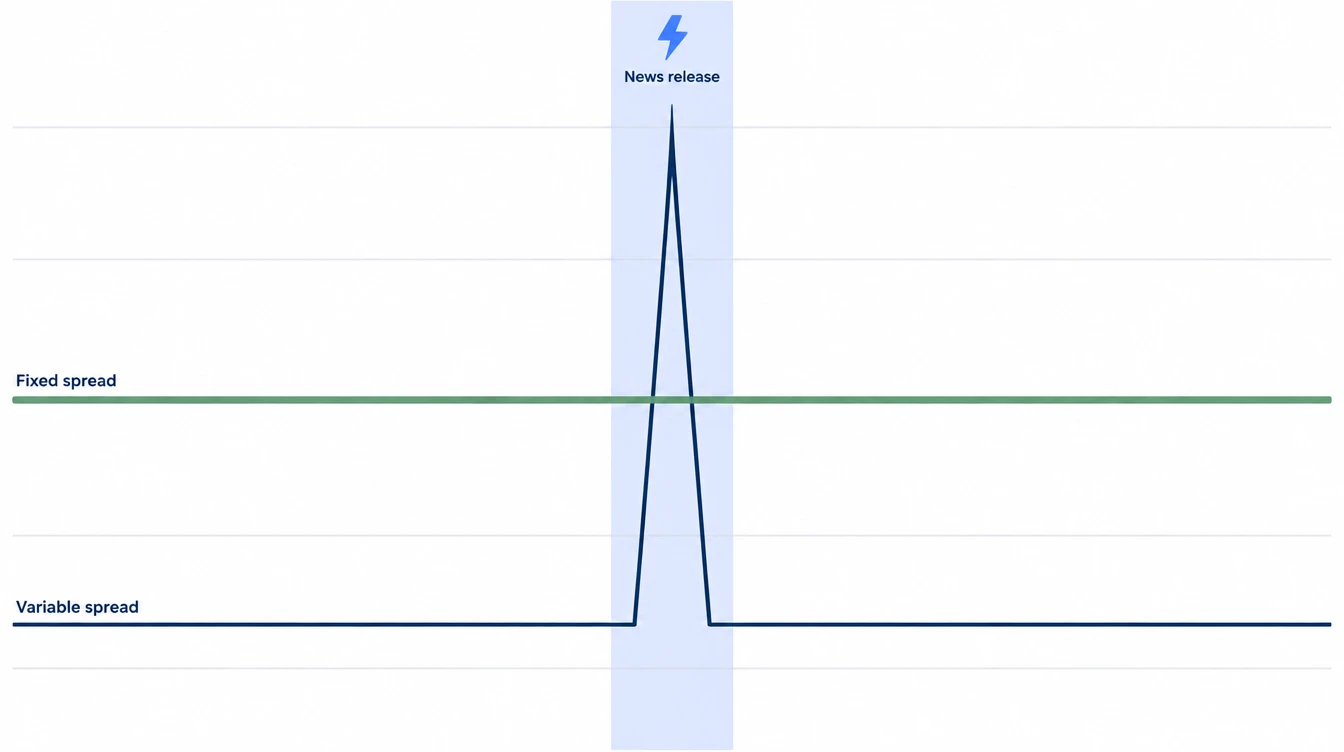
For most active traders, variable wins on raw cost during liquid sessions. For traders who value certainty, fixed wins around news and at session opens. Neither is universally better; it comes down to how you trade. Once you know which camp you’re in, I think the choice is straightforward.
When fixed spreads can hurt you
Fixed spreads are typically wider than variable averages once you strip out the news windows. If you trade during the London/New York overlap (8pm to 1am AEDT) when liquidity is deepest and variable spreads are tightest, you’re often paying more on a fixed account than on a RAW account, and on some pairs close to twice as much, a cost I’d want to factor in before choosing a fixed-spread broker.
Run the numbers. EUR/USD on Pepperstone Razor averages around 0.55 pips equivalent total cost. EUR/USD on easyMarkets fixed averages 0.6 pips. Placing 200 round-turn lots per month gives roughly:
- Pepperstone Razor: 200 lots x 0.55 pips x AUD 15.15 per pip = AUD 1,667
- easyMarkets fixed: 200 lots x 0.6 pips x AUD 15.15 per pip = AUD 1,818
An AUD 151/month difference at this volume. Scale that up and the fixed-spread premium adds up over a year. The trade-off is real, and it needs to be seen in dollar terms before deciding.
The fixed-spread premium at active-trader volume
200 round-turn lots of EUR/USD per month, before execution differences
A$100 per month more on the fixed account at this volume.
The other watch-out is execution. Some fixed-spread brokers reserve the right to reject or requote orders during fast markets rather than fill at the published quote. Read the order execution policy in the broker’s PDS before assuming the quote is binding in all conditions.
ASIC and fixed-spread regulation
ASIC permits both fixed and variable spreads under Australian Financial Services Licence rules, so from a regulatory standpoint you’re on equal footing. There’s no preference; what ASIC requires is fair pricing, accurate disclosure, and execution that matches what’s promised in the PDS.
The Product Intervention Order (in force since 29 March 2021, extended to 23 May 2027) applies equally regardless of pricing model, so the leverage cap and protections you get are the same whether you choose fixed or variable spreads. Australian retail traders are capped at 30:1 leverage on major forex pairs, with tighter limits by asset class set out in our ASIC forex regulation guide. Negative balance protection is mandatory. Margin close-out triggers at 50% of initial margin.
Both fixed-spread and variable-spread brokers are subject to:
- AFSL conditions issued by ASIC
- Margin close-out at 50% of initial margin, and mandatory negative balance protection
- AFCA membership for dispute resolution
- AUSTRAC reporting obligations
- Segregated client money rules under the Corporations Act
For anyone considering a fixed-spread broker, the regulatory protections are identical to any variable-spread broker on our reviews list. Checking the broker’s PDS for the execution policy is still worthwhile, but the framework is the same.
Compare brokers by the factor that decides it
Below, I've re-ranked the market for one decision factor. We tested each shortlist the same way as this page, so you can compare your options on an equal footing. I'd want you to use these shortlists as your same-method benchmark, because your next broker choice depends on it. I can't tell you which broker suits you, but I can confirm the method is consistent, so you can trust your comparison. I'd call that fair.

The platform decides it
Rankings change once the trading software is fixed. Pick yours first, then compare.

Your strategy decides it
Execution speed, copy functionality and EA support separate these shortlists.

What you trade decides it
CFD shortlists re-ranked for the asset class you trade most.
FAQs
Are fixed spreads better than variable spreads in Australia?
Which Australian broker has the lowest fixed spread?
Do fixed-spread brokers requote during news?
Can I trade EAs on a fixed-spread account?
Are fixed spreads safer for beginners?
What is the difference between fixed spreads and a market maker?
Which Australian brokers still offer true fixed spreads?
What is the closest alternative to a fixed spread?
Related pages
About the author

Justin co-founded CompareForexBrokers in 2014 and has traded forex since 1998. Based in Melbourne, he has tested every ASIC-regulated broker on this site personally and has written for Forbes, Kiplinger, Finance Magnates, the Australian Financial Review and The Age. He holds a Bachelor of Commerce (Honours) and a Master of Marketing from Monash University. Justin is the co-founder and CEO of CompareForexBrokers.