




What Forex.com costs per trade
MEASUREDMonthly spread cost converts pips to dollars using the EUR/USD pip value as the proxy for the 8-pair average, footnoted on-page. AUD pip value A$14.27 per standard lot at AUD/USD 0.7010 (25 Sept 2026).
Standard saves A$8.65 a month at this volume
At 10 standard lots per month on Raw accounts, Forex.com costs approximately A$125.63 in spread and commission costs. Rates as of Fri 25 Sep 2026, 5pm New York close.
Trading CFDs and forex carries a high level of risk and may not be suitable for all investors. Read the relevant Product Disclosure Statement before opening an account.
Our verdict on Forex.com
The headline tension I keep returning to is that Forex.com gives you one of the most heavily regulated retail forex brands in the world without the name recognition of CMC Markets, IG Markets or Pepperstone among Australian traders. Behind the brand sits StoneX Group, a NASDAQ-listed financial services firm trading as SNEX, which acquired the Forex.com parent GAIN Capital in 2020. In my view the result is a broker with eight regulators across the group, six of them Tier-1, a global volume base most rivals cannot match, and pricing that is competitive rather than cheap.
For Australian retail traders the pitch I would give is straightforward: ASIC AFSL 345646 oversight held since 31 May 2010, a A$150 minimum deposit, a Standard account pricing around 0.2 to 1.0 pips on EUR/USD depending on conditions, and a RAW Pricing account that measured 0.02 pips on EUR/USD before commission. Add MT4, MT5, the proprietary Web Platform and native TradingView, and you get a genuine alternative to the better-known names. What I do not see is a category Forex.com wins outright in this 32-broker set.
Pros
- What matters for you first is the licence depth: ASIC AFSL 345646 current since 31 May 2010, plus seven further regulators including CFTC and NFA, FCA, CySEC, Canadian Investment Regulatory Organization and MAS.
- I keep coming back to the measured spread: RAW Pricing hit 0.02 pips on EUR/USD and 0.39 pips across eight pairs, on A$3.50 per side.
- Your counterparty is a NASDAQ-listed parent in StoneX Group, with audited public-company financials.
- The 4,500+ tradeable instruments include 80+ forex pairs, plus treasuries and bond CFDs few AU brokers carry, which is what I would use to diversify away from spot FX.
- Four platform routes are open to you here: the proprietary Web Platform, MT4, MT5 and native TradingView execution.
Cons
- I would not call this cheap: the eight-pair basket measured 0.39 pips in our May to June 2026 capture, ninth tightest of the raw accounts we tested, against 0.15 pips at IC Markets Raw Spread in the same capture.
- The A$150 minimum deposit asks more of you than the A$0 at Pepperstone, CMC Markets and IG Markets.
- Plan for a US$15 monthly inactivity fee after 12 consecutive months without a trade, which you avoid only by trading or closing the account.
- If you want direct ASX share investing, you will not find it here, and no per-class instrument counts are published except forex.
- The support desk runs 24/5, so it closes across the weekend, with no copy trading product at all for you to fall back on.
Forex.com score breakdown
3.5/5 · Great
The overall CFB Score comes from the full methodology, more than 100 data points per broker.
How is our rating calculated?Is Forex.com safe? ASIC AFSL 345646
Forex.com holds ASIC AFSL 345646, current since 31 May 2010, through its Australian entity StoneX Financial Pty Ltd.
The group adds seven further licences across major jurisdictions, six of them Tier-1, a spread of regulators you should check before any trading spread.
ASIC regulation and global licences
The Australian entity holds AFSL 345646 with the Australian Securities and Investments Commission. The licence sits under StoneX Financial Pty Ltd, the rebadged GAIN Capital Australia entity following the 2020 acquisition. Confirm the licence name matches the account documents, because that AFSL entry is the one you want.
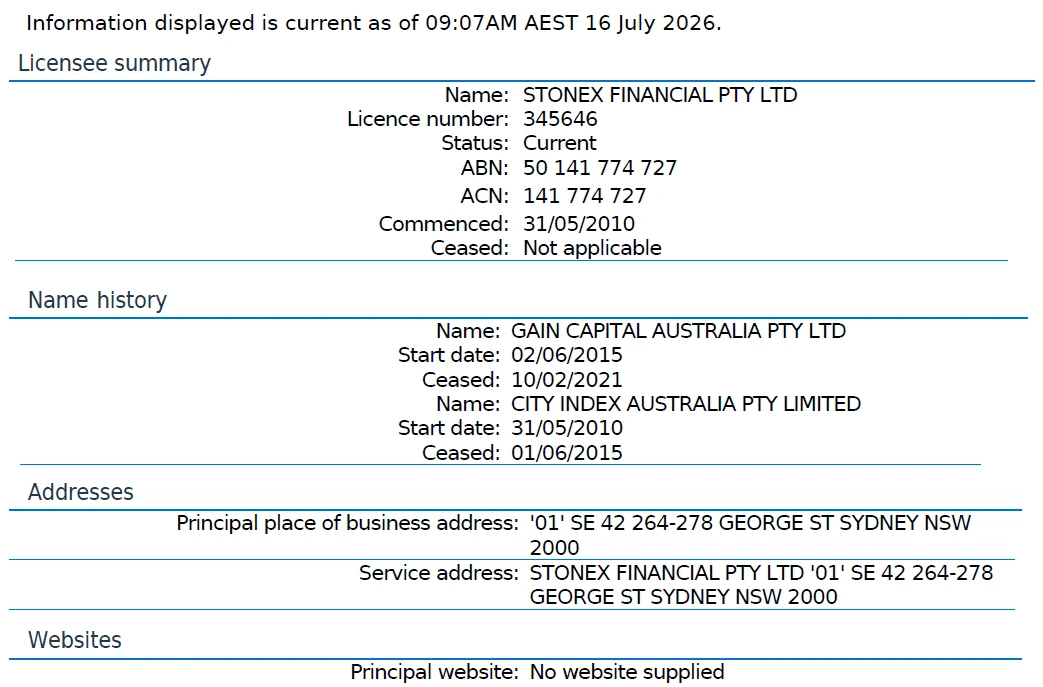
The licence stack holds seven further entries:
- CFTC and NFA (USA), Tier 1
- Financial Conduct Authority, UK, Tier 1
- Cyprus Securities and Exchange Commission, EU, Tier 1
- Canadian Investment Regulatory Organization, Tier 1
- Monetary Authority of Singapore, Tier 1
- Financial Services Agency of Japan, Tier 2
- Cayman Islands Monetary Authority, Tier 3 offshore
Eight regulators across major jurisdictions is a list very few retail brokers assemble, and it is why the trust rating sits near the top of the categories on this page. Australian clients are onboarded to the AFSL 345646 entity rather than to the US or offshore arms, so the ASIC rules govern your account.
Parent company and ownership
Parent company StoneX Group acquired GAIN Capital in mid-2020, and StoneX Group lists on NASDAQ as SNEX. The parent-company structure is the material point for you: StoneX publishes audited financials and regulatory filings that a privately held broker never has to show anyone.
Before depositing, confirm Forex.com holds AFSL 345646 using the site's guide to checking a broker on ASIC's register.
Forex.com client money protection and AFCA membership
Forex.com runs client money protection through segregated accounts at an Approved Australian Bank, with AFCA membership under member ID 19679 carrying disputes at no cost to the client.
I consider that table stakes for an ASIC broker, not a bonus.
Client money accounts sit separate from company funds. ASIC requires negative balance protection on retail CFD accounts, so a retail account cannot lose more than the money in it, and that is the protection I would want to see before trading. AFCA hears claims up to A$1,263,000 and awards compensation up to A$631,500. A claim about this broker’s CFD or forex trading never reaches the Compensation Scheme of Last Resort, which pays up to A$150,000 and only for personal advice, securities dealing and credit. The retail standard is set out in the guide to the negative balance protection mandate.
The member ID for this entity is the reference you should quote when lodging a complaint, and few Australian brokers publish one at all. I would keep that in a note if you ever need AFCA.
One account carve-out matters before you chase leverage. The Professional account classification surrenders the ASIC retail protections along with the leverage caps, and I would never trade under it without reading that trade-off twice.
Public reviews
FOREX.com holds a Trustpilot rating of 4.6 out of 5 from 2,479 reviews, which Trustpilot labels excellent, captured September 2026. The profile has been claimed by the broker since June 2018.
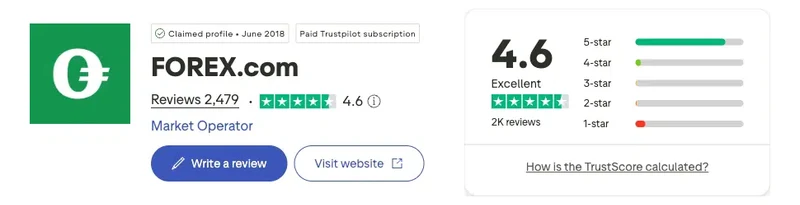
Recurring platform praise covers stability, the instrument range and fast funding. The fee schedules between the US, UK and Australian entities draw recurring confusion, alongside complaints about response time during off-peak hours, so the local schedule is the one to read rather than the group page.
How popular is Forex.com in Australia?
Forex.com is searched too rarely in Australia for month-on-month change to be meaningful: 220 branded searches in August 2026, 28th of 32. Search interest measures attention, not quality; the score above is the review verdict.
- 220
- Brand searches, August 2026
- n/a below 1,000
- vs July 2026
- 20
- Login searches
- 0.1%
- Share of all broker searches
Source: Google search volume, Australia, August 2026. How this is measured
What other review sites say
FOREX.com's iOS app rates 4.31 out of 5 from 39 ratings on the Australian App Store (September 2026), listed as FOREX.com: CFD Global Markets.
TradingView users rate FOREX.com 4.5 out of 5 from 14,256 ratings (September 2026). 189.6K TradingView users have connected a FOREX.com account. TradingView named FOREX.com its Best in Forex and CFD broker for North America 2025 and its Master of feedback winner 2024.
Forex.com at a glance: 17 key facts
Forex.com is licensed in Australia through StoneX Financial Pty Ltd, which holds ASIC AFSL 345646, current since 31 May 2010, and lists more than 4,500 instruments from a A$150 minimum deposit.
Covered in the table below, the 17 key facts span the entity, seven further regulators and the fee schedule, which is what you should check before anything else.
| Item | Detail |
|---|---|
| Australian regulator | ASIC, AFSL 345646, current since 31 May 2010 |
| Australian entity | StoneX Financial Pty Ltd (formerly GAIN Capital Australia) |
| Parent company | StoneX Group, NASDAQ:SNEX |
| Other regulators | CFTC/NFA (USA), FCA (UK), CySEC (Cyprus), CIRO (Canada), MAS (Singapore), FSAJ (Japan), CIMA (Cayman, offshore) |
| Year founded | 1999 (USA / UK); StoneX acquisition 2020 |
| Headquarters | New Jersey, USA; Australian office in Sydney |
| Trading platforms | Forex.com Web Platform (proprietary), MT4, MT5, TradingView (native), mobile |
| Account types | Standard, RAW Pricing, Direct Market Access (DMA) |
| Minimum deposit | A$150 |
| Maximum retail leverage | 30:1 (forex majors), ASIC-capped |
| Spreads, RAW Pricing (EUR/USD) | 0.02 pips measured, 0.39 pips across eight pairs, May to June 2026 |
| Spreads, Standard (EUR/USD) | 0.2 to 1.0 pips typical, advertised |
| Funding methods (AU) | Visa, Mastercard, BPAY, PayID, bank transfer |
| Inactivity fee | US$15 per month after 12 months |
| Negative balance protection | Yes (mandatory under ASIC) |
| AFCA member | Yes, member ID 19679 |
| Demo account | Free |
| Customer support | 24/5 phone, live chat, email |
The table rows for EUR/USD carry two figures and they are not versions of the same number. The first figure is a measured raw average and the second an advertised standard range, and the section below separates them so you can compare the two scopes.
Forex.com RAW Pricing and Standard spreads, measured
FOREX.com offers RAW Pricing with spreads of 0.02 pips on EUR/USD and 0.39 pips across the eight-pair basket, captured May to June 2026. Noam ran the live capture, and the commission is A$3.50 per side on AUD-denominated MetaTrader accounts.
The Standard account is a different product on a different basis, and the split must stay obvious. The Standard account prices spread-only with no commission on forex, indices and commodities, at an advertised 0.2 to 1.0 pips on EUR/USD depending on session. The measured raw figure of 0.02 pips and the advertised standard floor of 0.2 pips describe different accounts, so neither is a correction of the other.
| Pair | Forex.com Standard (typical pips) | AU industry avg (Standard) |
|---|---|---|
| EUR/USD | 0.2 to 1.0 | 1.1 |
| AUD/USD | 0.5 to 1.2 | 1.3 |
| GBP/USD | 0.7 to 1.3 | 1.4 |
| USD/JPY | 0.5 to 1.2 | 1.4 |
| EUR/JPY | 1.0 to 1.8 | 1.9 |
That 0.39 pip basket average ranked ninth tightest of the 17 raw accounts measured in our May to June 2026 capture, and the lowest spread brokers in Australia guide keeps that figure in its table of brokers captured before September 2026, which should frame your expectations. Share CFDs are the one Standard-account exception to the commission-free rule, with Australian equities carrying around 0.09%.
RAW Pricing commission
Commission on the Australian entity is quoted in Australian dollars, with the full round turn spelled out so you can see the cost before trading: A$3.50 per side, A$7.00 round turn, per standard lot on AUD-denominated MetaTrader accounts, or A$3.00 per side per A$100,000 on the Web Trader commission tier.
What it costs to trade with Forex.com
Forex.com charges A$7.00 in round-turn commission on RAW Pricing to trade one standard lot of EUR/USD, plus the measured spread. The all-in cost to trade with Forex.com typically lands around 0.7 to 0.9 pips equivalent.
That figure depends on session and volatility, and it is the number to write into your trading plan.
| Account | EUR/USD typical (incl. commission equivalent) |
|---|---|
| Forex.com RAW Pricing | 0.7 to 0.9 pips |
| CMC FX Active | 1.0 pip |
| Pepperstone Razor | 0.55 pips |
| IC Markets Raw | 0.6 pips |
| Fusion Zero | 0.6 pips |
That total pricing is competitive with CMC Markets FX Active and wider than Pepperstone Razor or IC Markets Raw. The raw account model works the same way here as across the field, and this broker sits mid-pack on it rather than leading, which is worth weighing before you chase the low headline.
Direct Market Access (DMA)
For traders who want institutional-style execution, the DMA account routes orders against direct market liquidity rather than the internal book. Its pricing structure differs from RAW Pricing and it does not suit casual traders. No tested latency or slippage figure is published for the DMA route here, so the routing model is the claim rather than the fill speed, and you should treat it as untested.
Other fees AU traders should check
- Overnight financing applies to positions held past 5 PM New York time, direction-dependent.
- Currency conversion applies to any instrument denominated outside the account base currency.
- The inactivity fee runs US$15 per month after 12 consecutive months without a trade.
- Withdrawals carry no fee on standard Australian methods.
- Share CFD commission runs around 0.09% on Australian equities, where forex, indices and commodities are commission-free on Standard.
- Guaranteed stop-loss orders are platform-dependent, available on the proprietary Web Platform and not on either MetaTrader build.
Forex.com funding methods and withdrawal times
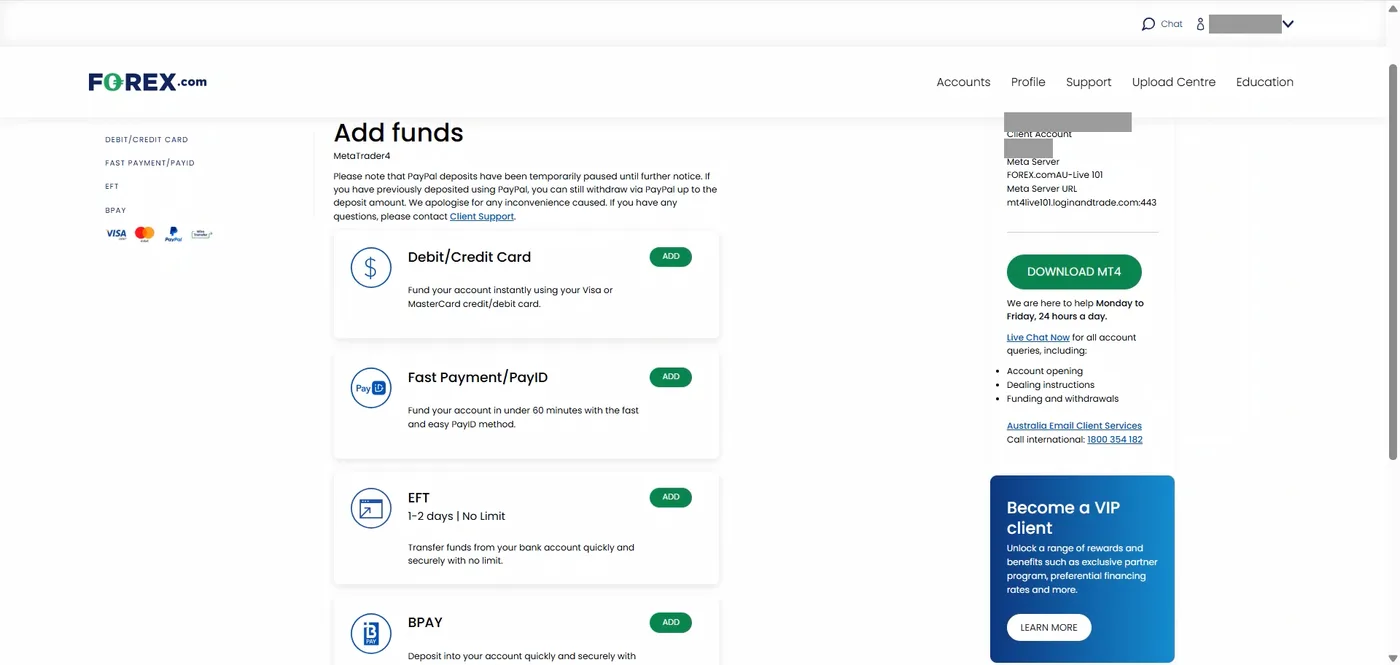
Forex.com offers four funding methods and all cost A$0, from card payments to bank transfer, which takes one to two business days.
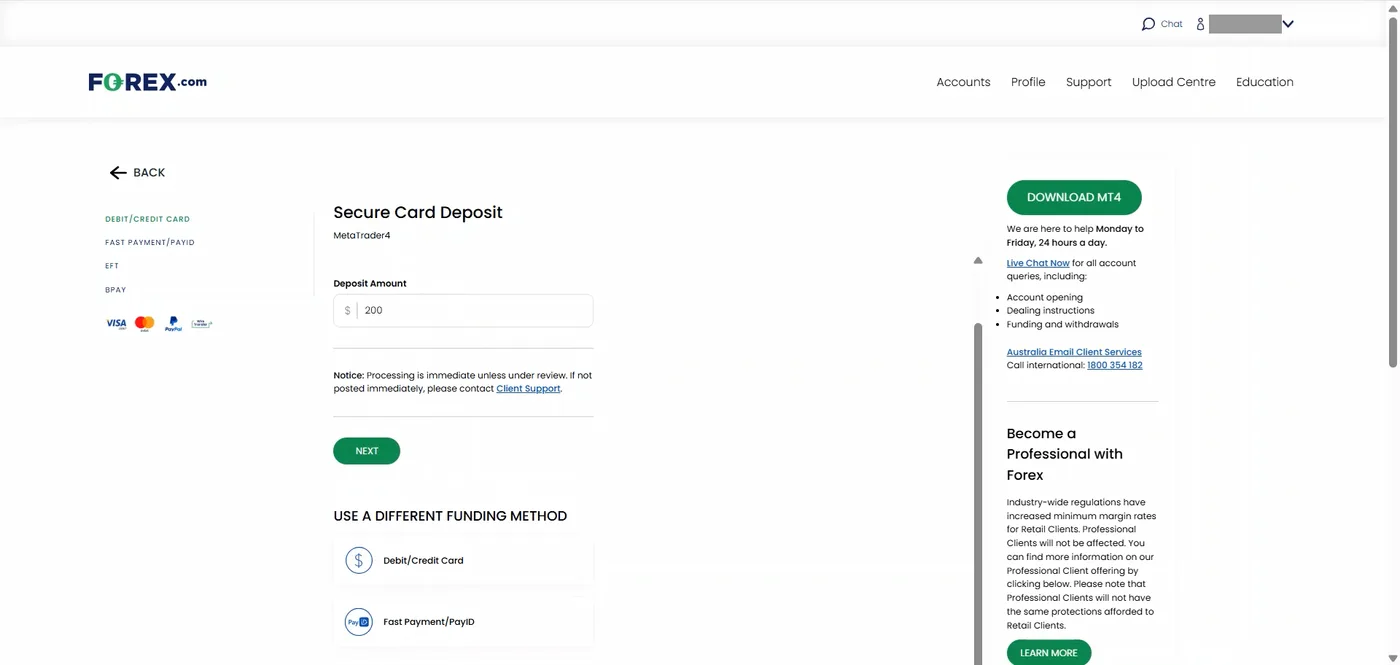
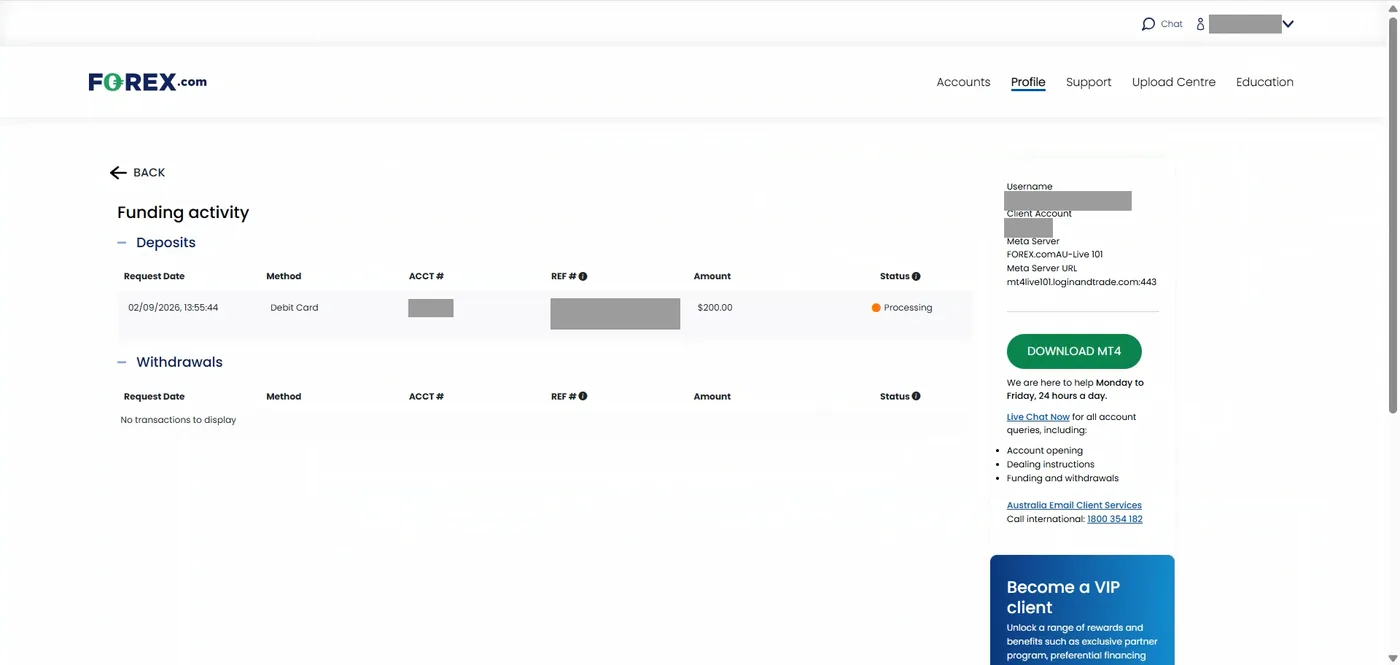
The portal says processing is “immediate unless under review”, and Noam’s A$200 card deposit in our test sat at Processing pending card images, so check that your bank rail is covered before you open an account.
Deposit methods (AU clients)
| Method | Fee | Speed |
|---|---|---|
| Visa / Mastercard | A$0 | Instantly (portal wording); Processing in our test, 2 September 2026 |
| PayID | A$0 | Under 60 minutes (portal wording) |
| BPAY | A$0 | Next business day |
| Bank transfer | A$0 | 1 to 2 business days |
Four funding methods is a narrow menu against the nine at ThinkMarkets, but the list covers the Australian rails that matter: PayID and BPAY both settle without a card network in the middle, and the local rails matter more than the count.
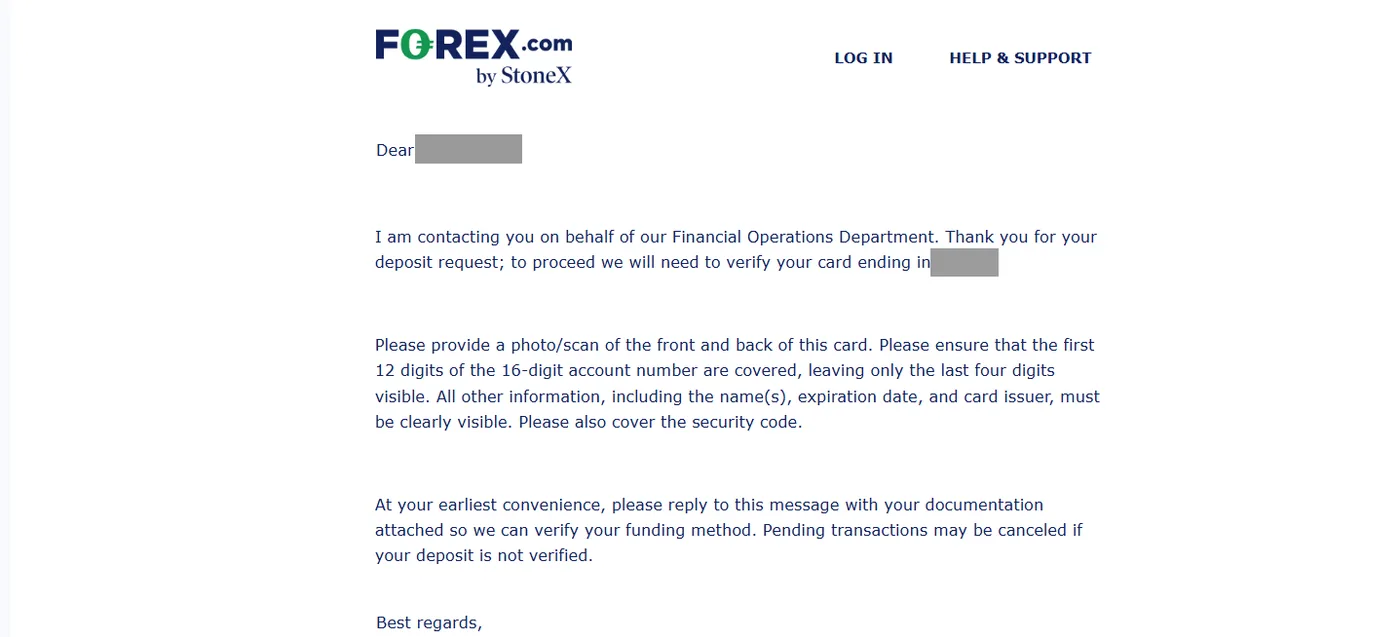
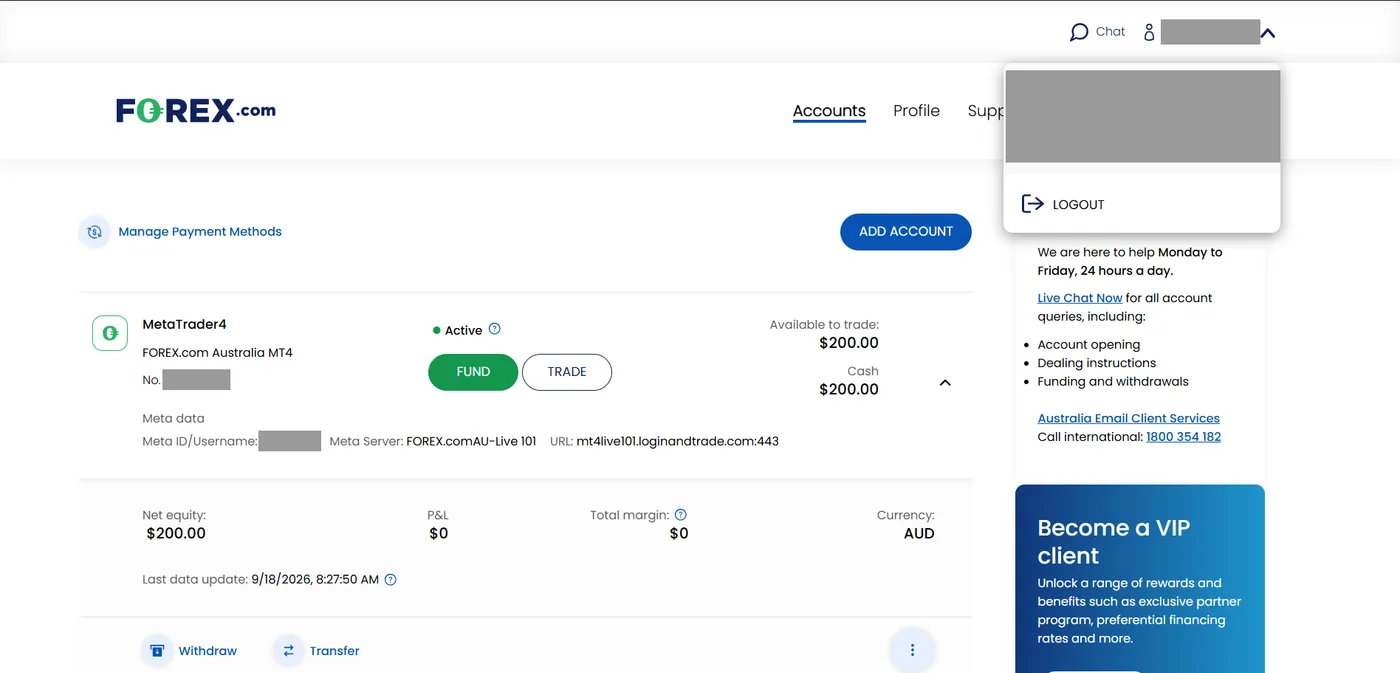
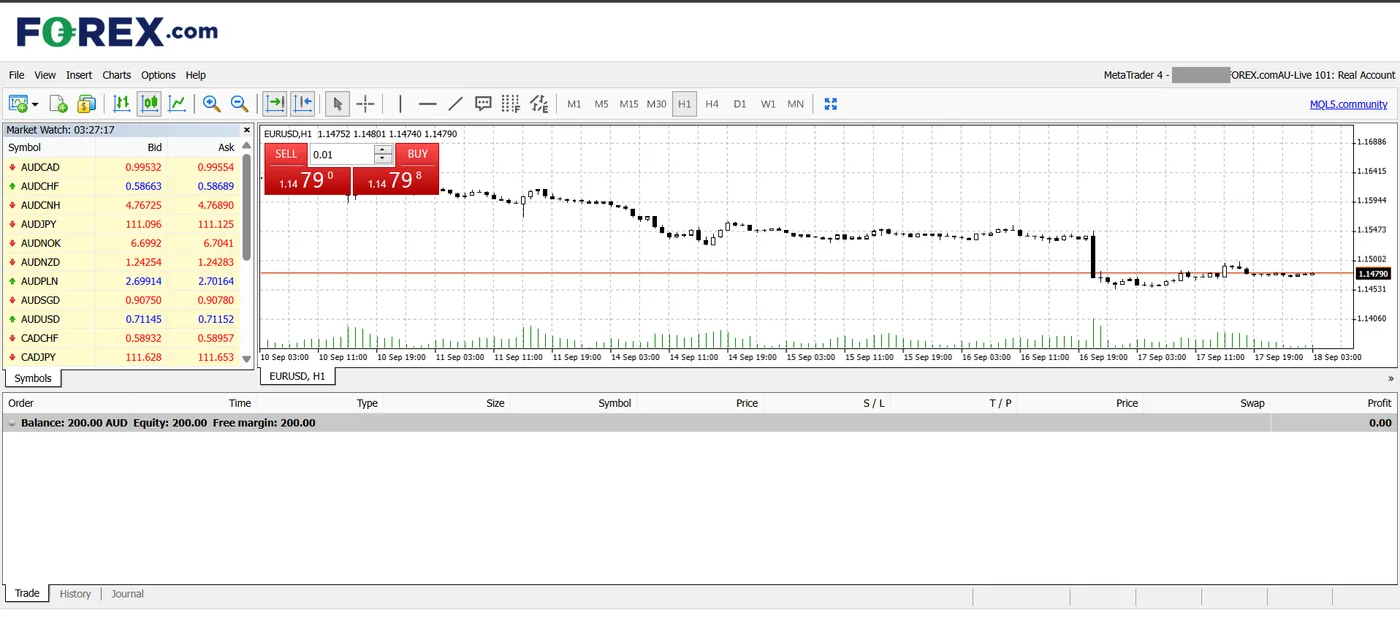
On 2 September 2026 Noam Korbl lodged a A$200 debit card deposit from the Add funds menu, which carried a notice that “PayPal deposits have been temporarily paused until further notice.” The Secure Card Deposit page stated “Processing is immediate unless under review. If not posted immediately, please contact Client Support”, and the Funding activity page showed the request at Processing from 13:55 AEST. I read the follow-up email from the Financial Operations Department, which asked for front-and-back card images with the first twelve digits and the security code covered, as the review branch of that wording in practice. It warned that “Pending transactions may be canceled if your deposit is not verified.” Our capture on 18 September 2026 showed “Available to trade $200.00” on the dashboard, with the credit time not captured. I would conclude from that gap only that the credit landed somewhere in the sixteen days, and treat the timing as unproven. In my view, “under review” is the phrase to plan around, because the card rail can turn into a document request, so keep your card handy if you fund this way.
Withdrawals
Withdrawals are fee-free on standard methods and must use the same channel as the deposit wherever available, following anti-money-laundering rules.
Account opening
The Forex.com application runs five stages online. Noam Korbl completed it at 12:23 AEST on 24 August 2026, ticking Standard CFD and Standard MT4 in the one form. Identity was an electronic licence or passport number, with no document upload and no selfie. The portal showed the MT4 account Active at once, and his record puts an approval notice at 3:21 pm on 26 August, a gap I read as the portal being ready ahead of the paperwork rather than a settled approval.
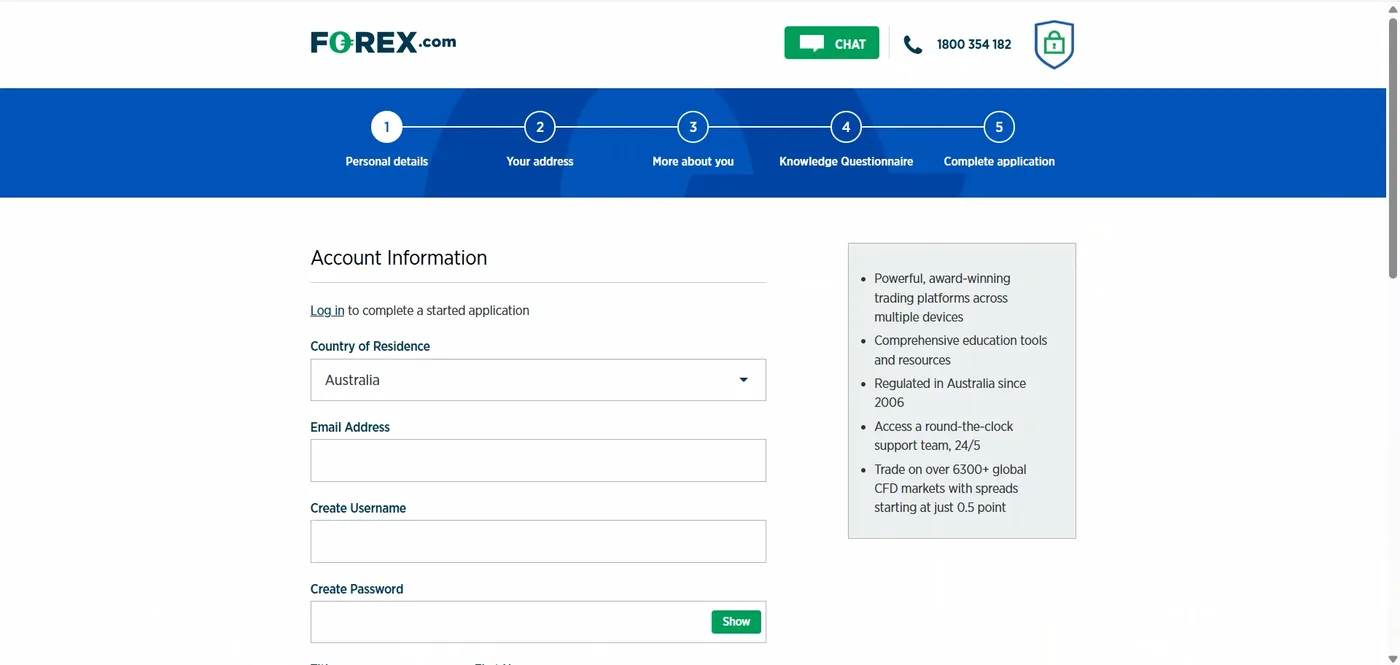
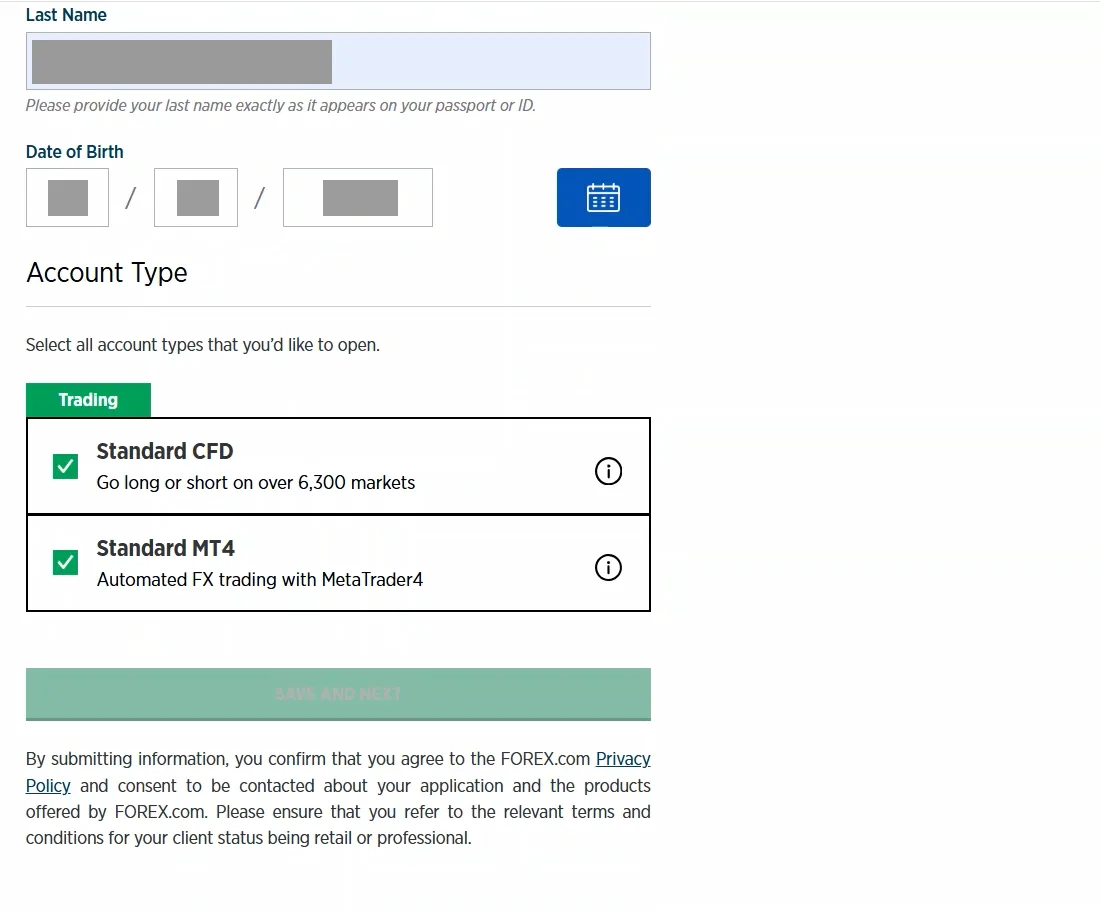
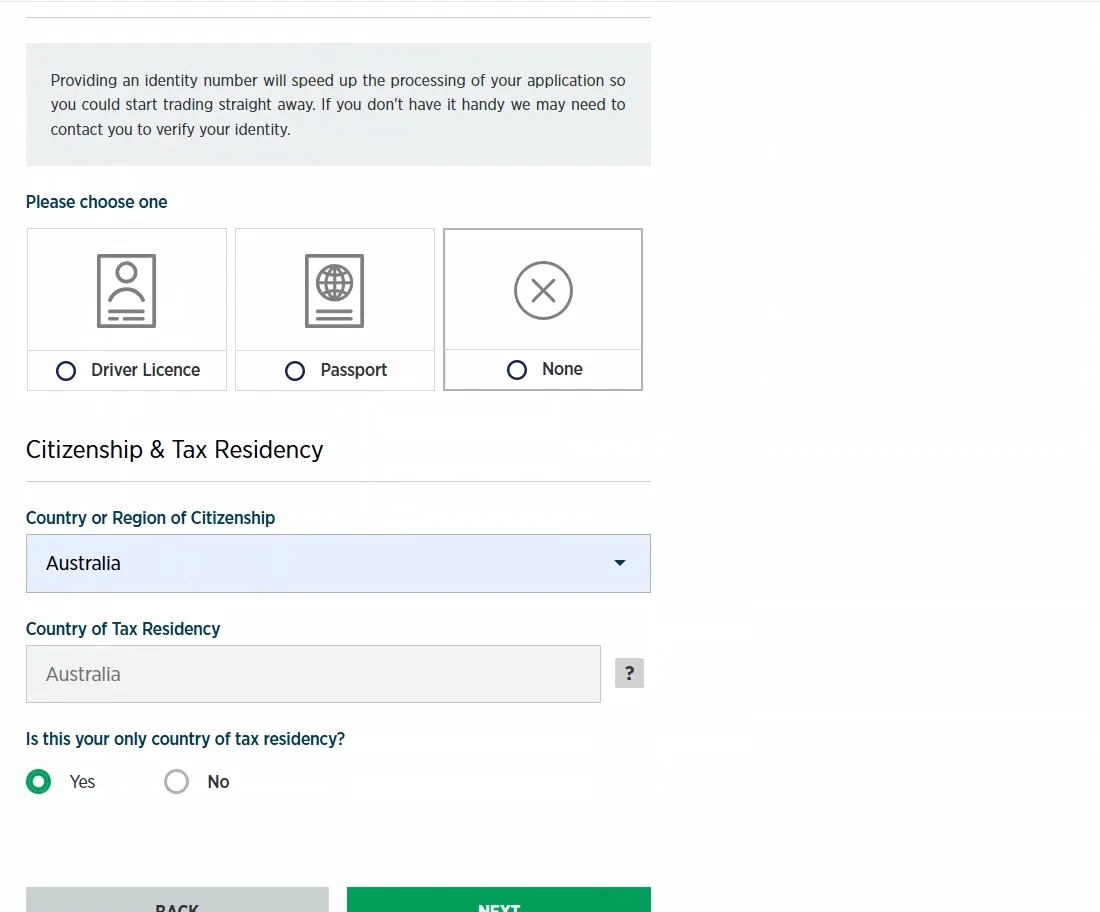
Stage 1 asks for your country of residence, email address, username and password, then your last name exactly as it appears on your passport or ID, plus your date of birth. The account-type screen offers two boxes, Standard CFD and Standard MT4, and you can tick both. Stage 2 collects your street, postcode, suburb and state, then identity under a notice that providing an identity number will speed up processing; you choose Driver Licence, Passport or None. Citizenship and tax residency follow, both Australia in our capture. Stage 3 opens with employment status under the appropriateness notice, then your financial details. The base currency arrives here, as two tiles, “AU$ - AUD” and ”$ - USD”, rather than beside the account choice, and Noam’s notes flag the placement as sitting oddly late. My reading of the None option is that it is the one costly choice, since the notice warns you may be contacted to verify your identity. He selected AUD. Annual salary, approximate net worth and the monthly trading amount complete the stage.
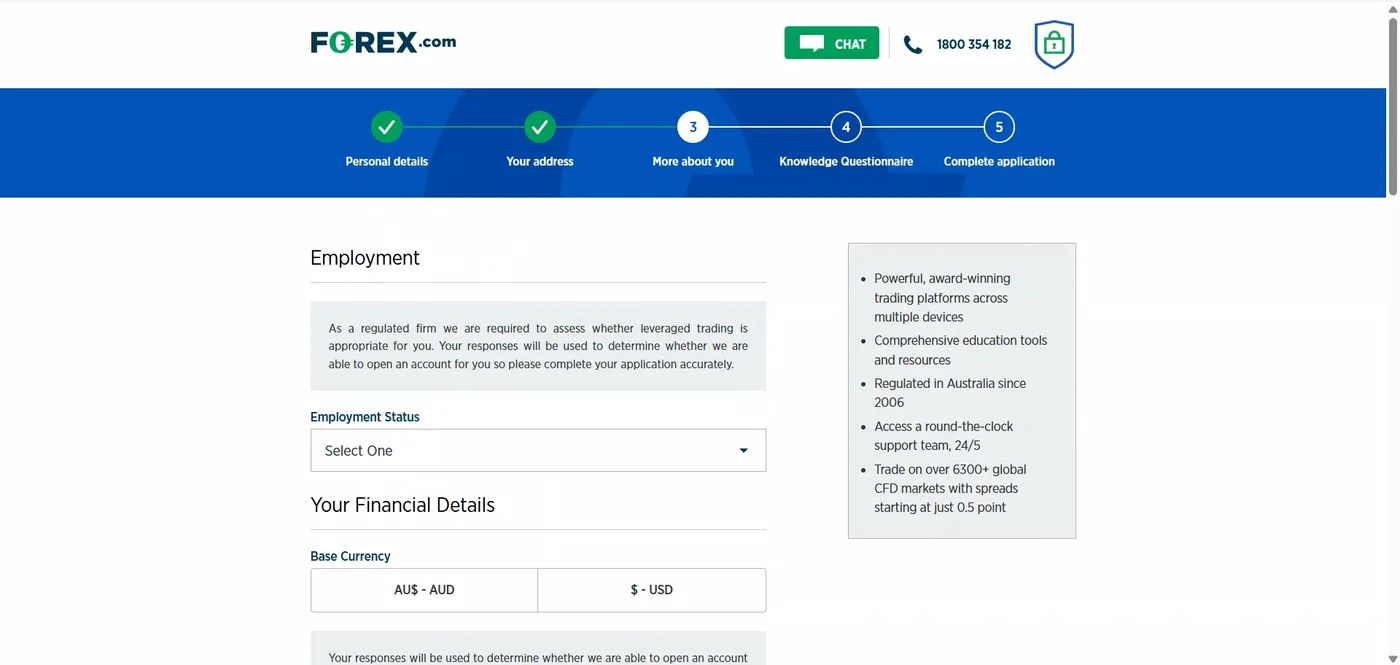
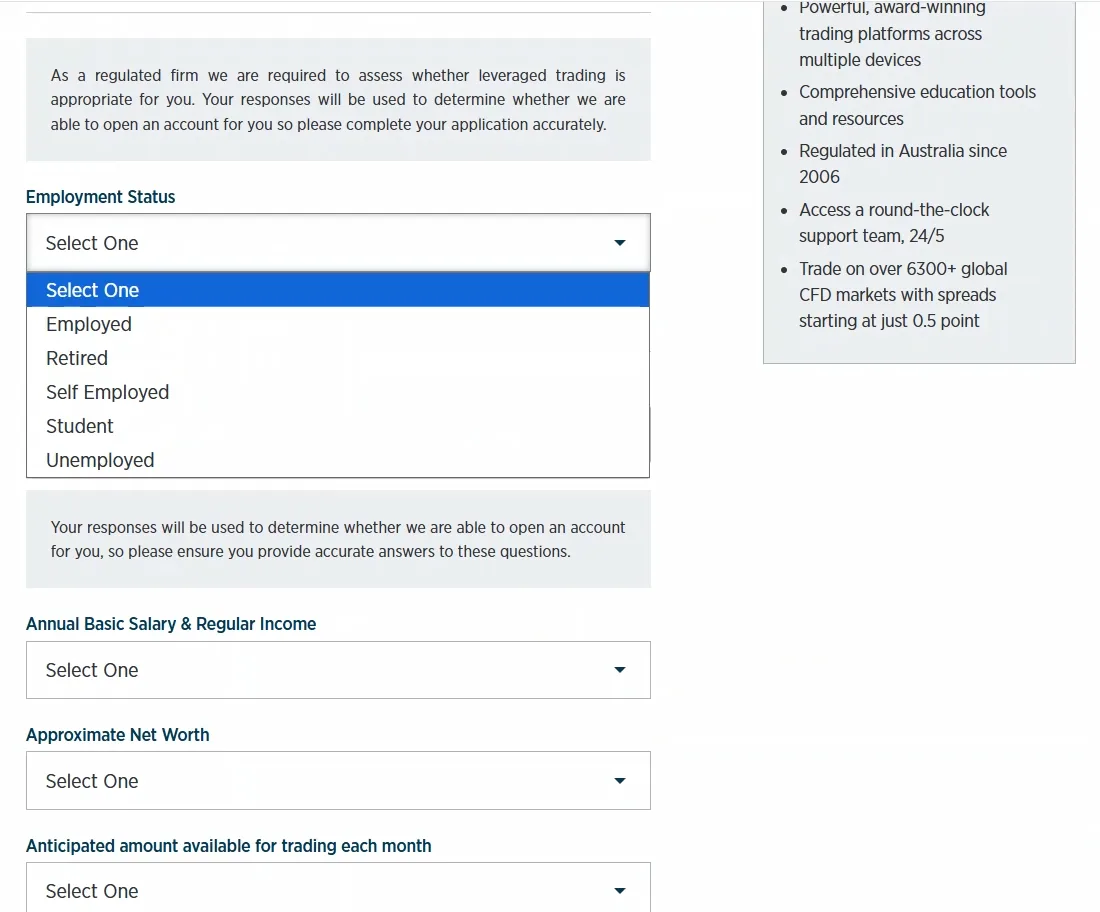
Suitability comes next: relevant experience or qualifications, risk tolerance, investment objective, and strategy, with options from speculation to hedging an existing portfolio. The CFD Knowledge Assessment asks applied questions; our capture shows two, one on the total margin for a short CFD on a stock at $80 per share with 20% margin, another on the unrealised result on 300 short contracts when the price falls to $45. I would revise the margin maths; a slip on a worked calculation could hold up your application. A marketing checkbox for market alerts precedes the declarations, which name StoneX Financial Pty Ltd, the ASIC licensee behind Forex.com. Processing reads “This can take up to 30 seconds”, then a green tick. At 12:23 AEST on 24 August 2026 the dashboard listed the MT4 account Active with FUND and TRADE buttons, Meta Server FOREX.comAU-Live 101, currency AUD.
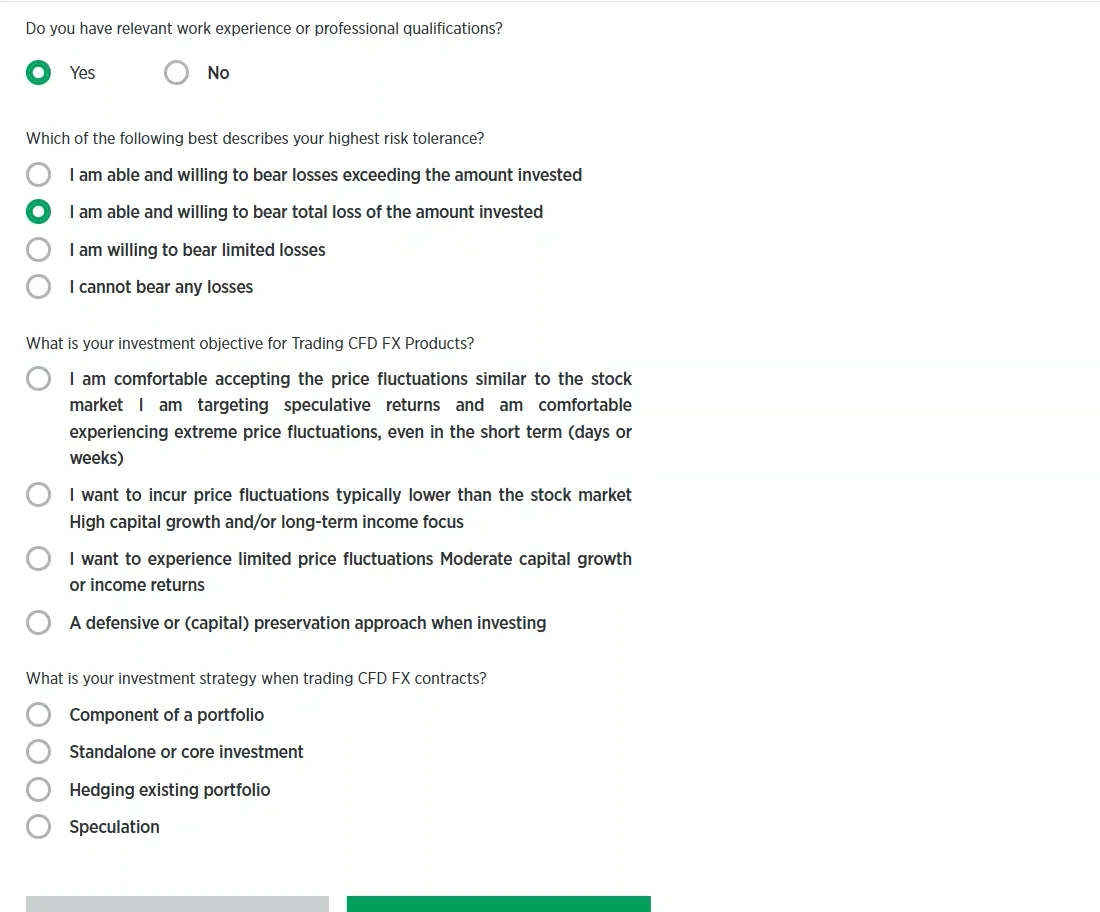
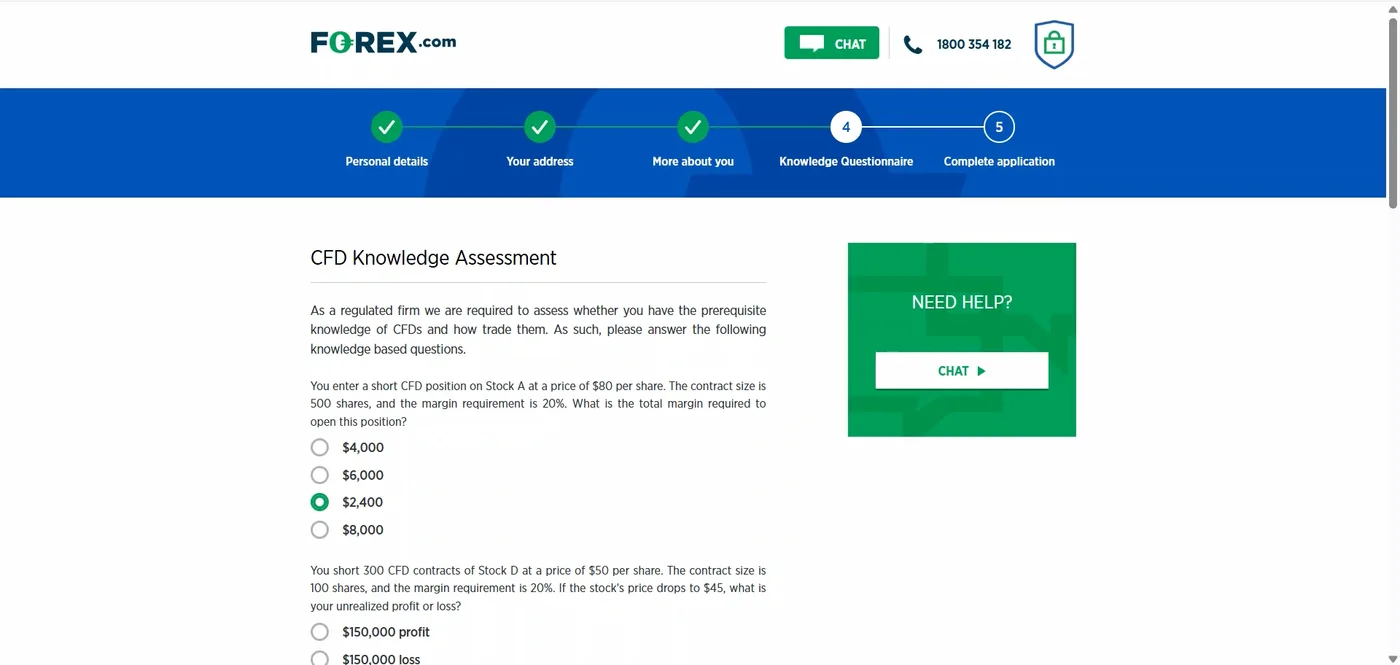
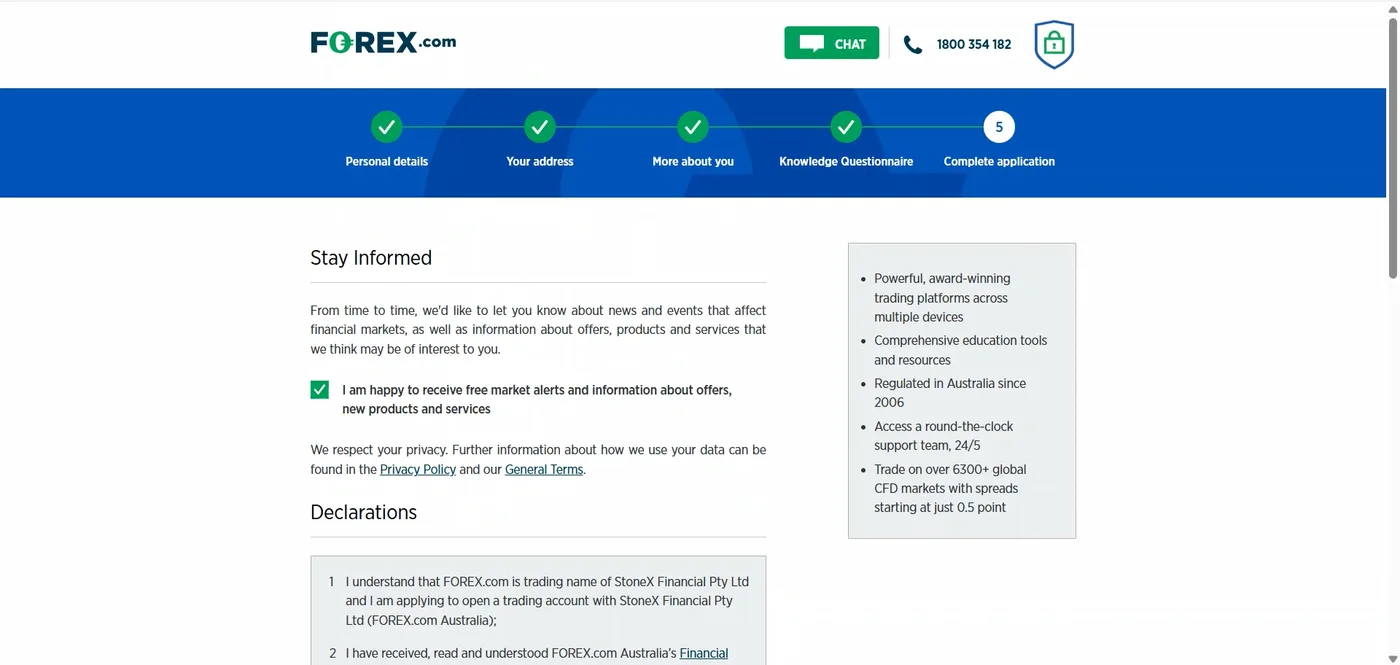
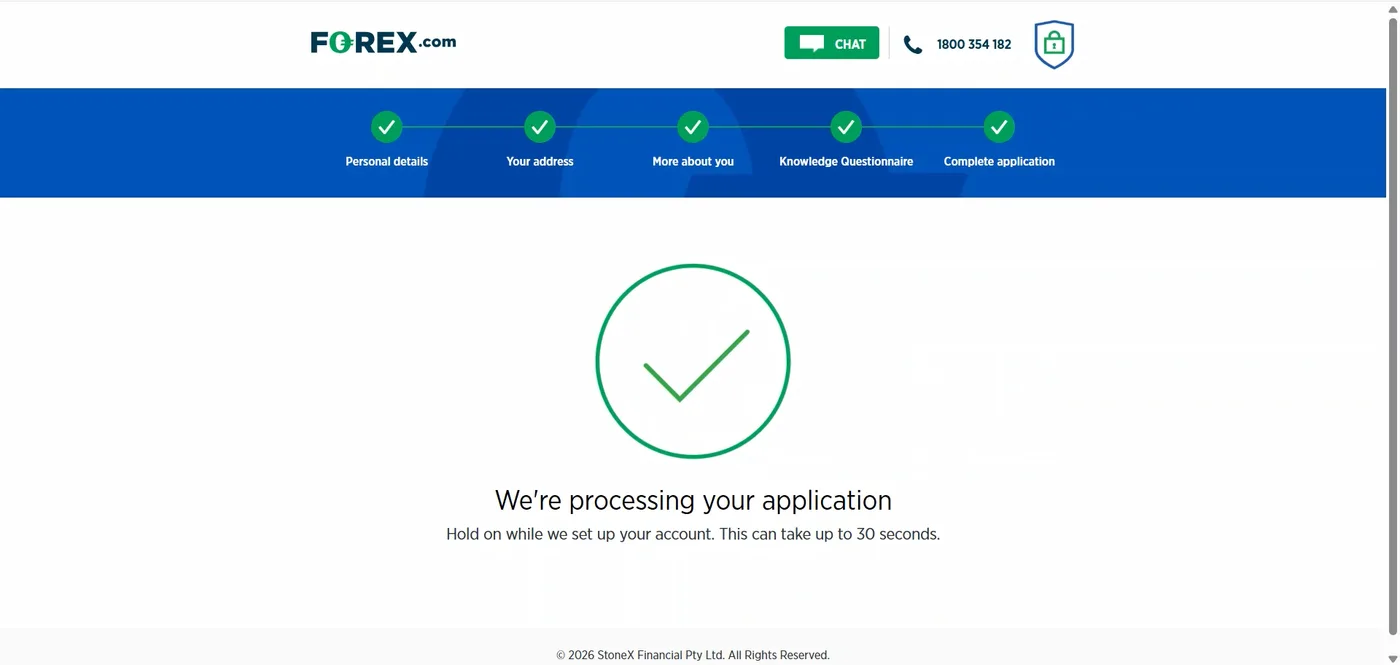
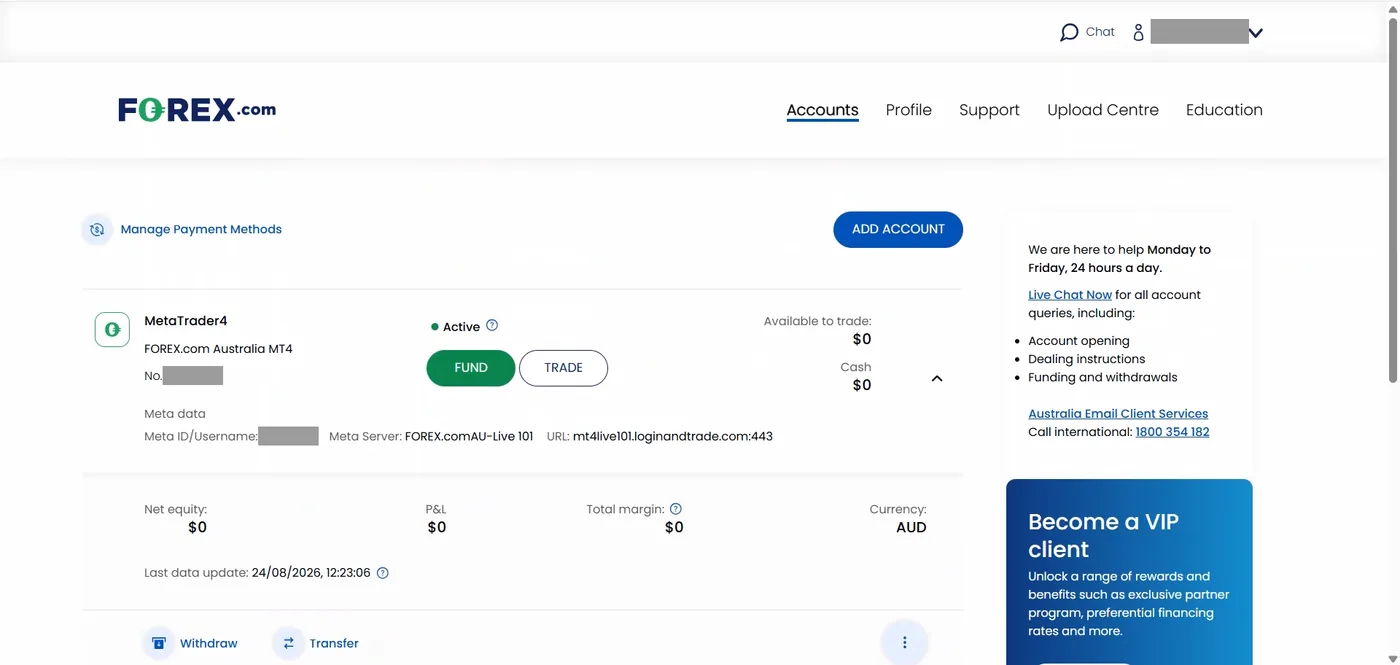
Two approval records sit side by side. The frame shows the account Active at 12:23 AEST on 24 August 2026; Noam’s record puts an approval notice at 3:21 pm on 26 August, with no frame of that notice. The page records both and makes no claim about how long approval takes. Noam’s assessment is that the form is efficient, the base currency arrives late, and the card deposit sat at Processing until card images were requested. My advice: have your licence or passport number ready, expect the currency choice in the financial section. Until the notice arrives, I would treat the Active status as provisional and hold your first deposit. The funding test sits in the funding section above.
Forex.com account types and minimum deposit
Forex.com account types number three, and the minimum deposit is A$150 on Standard and RAW Pricing, higher than the A$0 entry at Pepperstone and CMC Markets, a gap that new traders often mention as the first friction point.
| Account | Pricing model | Min deposit | Best for |
|---|---|---|---|
| Standard | Spread-only, no commission (share CFDs around 0.09%) | A$150 | Casual and multi-asset traders |
| RAW Pricing | Tighter spreads plus commission | A$150 | Active forex traders |
| Direct Market Access (DMA) | Institutional-style routing | Higher minimum, unpublished | High-volume and wholesale clients |
Standard and RAW Pricing are the same markets on two pricing models: Standard folds the cost into the spread, and RAW narrows the spread and bills a commission. The DMA account is a different product entirely, routed against direct market liquidity, and its minimum deposit is not published, so I would get the figure in writing before applying.
Professional account and swap-free
Eligible Australian traders can apply for a Professional account as Pro A for wholesale or Pro B for sophisticated clients, trading outside the ASIC retail caps at 200:1 on forex, indices and gold, 100:1 on other commodities and on bitcoin and ethereum, and 30:1 on share CFDs. The account eligibility test runs on A$2.5 million in net assets or A$250,000 in gross income for Pro A, or a sophisticated investor test for Pro B, so your classification determines the caps.
Forex.com runs a swap-free account at group level, and it is not available to Australian residents, confirmed with the desk in July 2026. The group site advertises the swap-free account without making the eligibility boundary obvious, so a Sharia-compliant requirement cannot be served here whatever that page shows, which I would treat as a hard constraint.
Minimum deposit
Minimum deposit, A$150, applies on both Standard and RAW Pricing. That minimum deposit is a low bar in absolute terms and still money down where Pepperstone and CMC Markets open an account on nothing at all, so your decision may come down to how much you want the regulatory depth behind that first transfer.
Forex.com trading platforms
Trading platforms at Forex.com number four: the proprietary Web Platform, MT4, MT5 and native TradingView execution. The platform list excludes cTrader entirely, so your choice is bracketed within those four.
Forex.com Web Platform (proprietary)
The Web Platform is the browser-based interface, carrying charting, technical indicators, news feeds and trade tickets with nothing to install. It holds up for a trader who would rather not touch MetaTrader at all, and it is the only platform here carrying guaranteed stop-loss orders.
MetaTrader 4 and MetaTrader 5
MetaTrader 4 runs for Australian clients with the full execution stack and suits legacy expert advisors. MetaTrader 5 matters because not every Australian broker provides both, supporting broader native asset classes across indices, stocks and futures, using MQL5 for newer expert advisors, and remaining the better choice for a trader building from scratch (MT5 guide).
TradingView and copy trading
Forex.com is one of a small group of ASIC-regulated brokers offering native TradingView trading, connecting a TradingView Pro or Premium account and executing directly from the charts. Pepperstone, OANDA and Eightcap are the other Australian brokers with that integration, so your charting setup can extend here. No dedicated copy or social trading product exists for Australian clients, and the closest substitutes are the TradingView community features and the MetaTrader Signals marketplace.
Forex.com markets and instrument counts
Forex.com markets and instrument counts reach more than 4,500 instruments across six asset classes, built around 80 plus forex pairs.
I would keep the treasury and bond CFD access in mind if you want rates exposure without an ETF wrapper, since few Australian brokers carry them.
| Asset class | Count | Note |
|---|---|---|
| Forex | 80+ pairs | The AUD majors and minors |
| Share CFDs | Not published | NYSE, NASDAQ, LSE, ASX and major EU exchanges |
| Indices | Not published | ASX 200, S&P/ASX SPI 200 and the major global indices |
| Commodities | Not published | Gold, silver, WTI and Brent crude, natural gas, softs |
| Cryptocurrencies | Not published | CFDs only, 2:1 retail cap |
| Treasuries and bonds | Not published | US T-Notes, German Bund, UK Gilts |
The treasuries row is the one most Australian brokers skip. The treasuries range gives a rates position on US T-Notes, the German Bund and UK Gilts without an ETF wrapper, though CMC Markets and IG Markets carry the deeper fixed-income feed, which I would check before assuming depth.
Worth stating plainly, the range gaps are no direct ASX share investing and no per-class instrument counts published for anything except forex. If you want ASX ownership, this is the wrong account.
Share CFDs
Within the 4,500 plus total, share CFDs cover NYSE, NASDAQ, LSE, ASX and the major EU exchanges. The equity markets coverage is broad rather than deep on the ASX side, with no direct ASX investing at all, so every position you hold is a CFD. Australian equities also carry the 0.09% commission noted above, where forex on the Standard account carries none. The share CFD markets are compared in the guide to global share CFD markets.
Forex.com leverage and margin under ASIC rules
Forex.com leverage and margin operate under the ASIC cap of 30:1 on major forex pairs, identical across the Standard, RAW Pricing and DMA tiers.
That cap is not a Forex.com choice; it is the same ASIC ceiling you meet at every Australian broker.
ASIC caps retail CFD leverage at 30:1 on major forex pairs, 20:1 on minor pairs, gold and major indices, 10:1 on commodities other than gold, 5:1 on share CFDs and 2:1 on crypto assets. The caps come from a product intervention order extended to 23 May 2027, so they apply at every ASIC broker, and I would treat leverage as a fixed boundary while comparing the rest.
The three retail account tiers carry those caps identically, so the choice changes the pricing model and never the leverage. The Pro A and Pro B account classifications reach 200:1 on forex, indices and gold, 100:1 on other commodities and major crypto, and 30:1 on share CFDs, which is one reason your eligibility test matters.
Retail margin close-out sits at 50%. For you, the practical consequence is that the rule requires every CFD issuer to close a retail client’s positions once account equity falls below half the total initial margin on all open positions, positions cannot be netted against each other to reduce that figure, and a gapping market can close a position below the 50% level. The margin mechanics are set out in how leverage changes risk.
Forex.com customer support
Forex.com customer support runs 24 hours a day, five days a week on phone, live chat and email, covering Sydney Monday morning through Saturday morning AEDT, hours worth marking against your own trading week.
Live chat replied in under two minutes during Australian business hours in testing, which I would call acceptable rather than fast. The service stack runs to three channels including a phone line, and the response time sits mid-field rather than leading. The channel range is the same set most Australian brokers carry, so the differentiator here is the hours rather than the coverage.
The service stack loses its weekend cover entirely, which is the main knock here. Pepperstone, IG Markets and Plus500 all run 24/7, and a client holding a weekend position at this broker waits until Monday. That margin question matters most for you if you carry leveraged exposure across the Sunday open, because it cannot wait two days for an answer.
On this page the licence stack separates from the desk hours: the regulatory profile is close to the strongest in this coverage while the service rating sits below it. The desk gap should not erase the regulatory win, but Sunday news still requires a plan.
Forex.com research, tools and education
Forex.com research, tools and education run to two stacks: a daily and weekly research desk publishing across forex, indices and commodities, which is the one to open first, and an education library covering beginner through intermediate material.
The research desk is the stronger half. The research bench at StoneX includes named analysts with public-facing track records, which is not true at every retail broker, where research often arrives unsigned or syndicated from a third party. The research feeds reach forex, indices and commodities daily, and the weekly note adds a macro view across the same three classes, which gives you a reason to check in even when not trading.
The education research library covers beginner forex basics, intermediate technical analysis, platform tutorials and webinars for a complete beginner. The research library suits a trader who already knows their way around a chart, and a complete beginner gets a gentler start at Plus500 or eToro.
No third-party integration such as Trading Central or Autochartist appears here, so the research is in-house rather than bundled, which is a reasonable trade given the analyst bench behind it, and a paid third-party feed should not be added to this page.
What traders say about Forex.com
| Rating site | Rating | Based on | Who rated | Captured |
|---|---|---|---|---|
| Trustpilot | 4.6 out of 5 | 2,479 reviews | Worldwide | September 2026 |
| App Store | 4.31 out of 5 | 39 ratings | Australia only | September 2026 |
| TradingView | 4.5 out of 5 | 14,256 ratings | Worldwide | September 2026 |
Each row above is a public rating of Forex.com taken from a rating site, dated to the month its figure was captured. An App Store rating counts ratings left on Apple's Australian App Store only, while a Trustpilot figure counts reviews and a TradingView figure counts ratings from anywhere in the world. A site with no row has no rating for Forex.com, withholds it, cannot be matched to Forex.com with confidence, or we have not captured it yet.
How Forex.com compares to CMC Markets and Pepperstone
Forex.com compares to CMC Markets and Pepperstone with a measured 0.39 pips across the eight-pair basket, against 0.46 at Pepperstone, on A$7.00 round turn at both.
Forex.com lists 4,500 instruments against 12,000 plus at CMC Markets. How Forex.com compares to CMC Markets and Pepperstone is a regulation win against a breadth and platform loss, which I would frame as a trade-off rather than a clear pick.
CMC Markets brings a broader product range, a stronger proprietary platform, a longer Australian history and integrated ASX stockbroking. Pepperstone brings five platforms, a measured execution figure and a A$0 minimum, so your choice depends on whether breadth or cost wins.
What Forex.com holds against both is the regulatory footprint and the listed parent, plus a DMA route neither offers at retail, a combination I would point to for an account where structure matters more than the last fraction of a pip.
Put Forex.com next to any of the other 31 ASIC-regulated brokers we cover.
Forex.com trading.com Middle of the measured field
Forex.com measures 0.39 pips on the raw eight-pair basket; trading.com carries no figure, no measured 8-pair raw average.
Forex.com measures 0.02 pips on raw EUR/USD; trading.com carries no figure, no single-pair EUR/USD figure on record.
Forex.com's measured 0.82 pips and trading.com's measured 1.25 pips straddle the middle broker's 1.0.
Forex.com charges A$7.00 on round-turn commission; trading.com carries no figure, no per-lot commission on record.
Forex.com comes to A$125.63 on raw account cost at ten standard lots a month; trading.com carries no figure, no measured 8-pair raw average.
Forex.com's A$116.98 a month sits A$25.67 under the middle broker's A$142.65; trading.com's A$178.32 sits A$35.67 over it.
trading.com's A$50 matches the middle broker's A$50; Forex.com's A$150 sits A$100 above it.
Forex.com runs MT4, MT5, TradingView, Own platform; trading.com runs MT5.
Forex.com holds AFSL 345646; trading.com holds AFSL 443670.
Forex.com's 73 / 100 sits 2 below the middle broker's 75; trading.com's 70 / 100 sits 5 below it.
Forex.com's 4.6 / 5 and trading.com's 3.8 / 5 straddle the middle broker's 4.3.
Forex.com's 4.31 / 5 and trading.com's 4.73 / 5 straddle the middle broker's 4.54.
Forex.com rates 4.5 / 5 on the TradingView broker rating; trading.com carries no figure, no TradingView broker profile.
Forex.com's 220 sits 1,130 below the middle broker's 1,350; trading.com's 110 sits 1,240 below it.
Capture: September 2026 · AUD/USD 0.7010 (25 Sept 2026) · field: the measured field varies by row, from 16 to 24 brokers, of 32 reviewed.
Bars run lowest to highest across the measured field; the tick marks the middle broker.
| If you value… | Consider |
|---|---|
| Tightest forex spreads | Pepperstone or IC Markets |
| Broader product range | CMC Markets or IG Markets |
| Direct ASX shares plus CFDs | CMC Markets |
| Native cTrader | Pepperstone or Fusion Markets |
| Native TradingView | Pepperstone, OANDA or Eightcap |
| Beginner-focused platform | Plus500 or eToro |
| Same listed-parent reassurance | Interactive Brokers |
Should you open a Forex.com account?
Forex.com suits traders who want a NASDAQ-listed parent and a three-tier account ladder running Standard, RAW and DMA, on RAW pricing that measured 0.02 pips on EUR/USD. If you filter on total cost or want ASX ownership, the fit breaks, and those traders are served better elsewhere than by a Forex.com account, so I would direct you away rather than force the fit.
Two groups of trader gain clear value from a Forex.com account, and I would put you in either bucket only if the match is exact. The licence stack reaches eight regulators and audited public-company filings, which almost nothing else in this field matches. The account ladder reaches a DMA route that is rare at retail and sits under the same Australian licence.
For two groups, the better move is to look past a Forex.com account, and you can find the better fit with a direct comparison. The basket figure runs 0.39 pips in our May to June 2026 capture, and IC Markets Raw Spread measured 0.15 pips in the same capture. Share investors find no ASX ownership and a 0.09% commission on Australian equities, which is the part I would not pay if ownership was the goal.
Forex.com ranks eighteenth among the highest-rated forex brokers in Australia on the 2026 scoring, held there by cost rather than by trust, where it rates near the top. A free demo account covers the Web Platform and both MetaTrader builds, which I would use to test the Web Platform before funding.
FAQs
Can Forex.com be trusted?
How do I withdraw money from Forex.com?
Who owns Forex.com?
What leverage does Forex.com offer in Australia?
What is the minimum deposit for Forex.com?
Standard or RAW Pricing, which one?
Does Forex.com offer MT5 in Australia?
Does Forex.com charge an inactivity fee?
Testing log
| Record | Detail |
|---|---|
| Review published | 16 May 2026 |
| Last content change | 27 September 2026 |
| Spread capture | RAW account, 0.02 pips EUR/USD, 0.39 pips eight-pair average |
| Capture window | May to June 2026 |
| Verification | AU costs verified from advertised schedules 5 July 2026; platform assessed across group entities; live AUD MT4 account, login ending 6431, opened by Noam Korbl on 24 August 2026 and funded by debit card with A$200 on 2 September, held at Processing pending card verification and available by 18 September |