
The most trusted ASIC brokers, ranked on safety
For safety specifically, OANDA is our top ASIC-regulated pick in 2026: it holds ASIC AFSL 412981 alongside five tier-1 licences including the hard-to-win US registration, segregates retail money at an Approved Australian Bank and belongs to AFCA. IG runs it close on its group's Australian history, dating from 2002 under IG Markets Limited, inside an LSE-listed group. No broker is risk-free, so read this as relative trust, not a guarantee.
A cost ranking is not what you will find here. This page ranks brokers on trust, not on cost or platform. The winner of our main best forex brokers guide is scored on overall value; here the basis is different: regulatory tenure, the regulator stack behind the Australian licence, listed-company governance, AFCA membership and client-money segregation. In my view, a broker can price keenly and still sit mid-table on trust, and vice versa.
- OANDA: best all-round safety. ASIC AFSL 412981 since 2012, plus FCA (UK), MAS (Singapore), CIRO (Canada) and a US registration, the widest tier-1 stack here; client money segregated, AFCA member.
- IG: best for longevity and listed-company governance. IG Australia Pty Ltd (AFSL 515106) has held its licence since 2020, and IG's Australian presence dates to 2002 under IG Markets Limited (AFSL 220440), inside an LSE-listed group answerable to UK-listed disclosure rules.
- Pepperstone: strongest trust profile among the ECN specialists. ASIC AFSL 414530 since 2013, backed by FCA, CySEC, BaFin and DFSA tier-1 authorisations.
- CMC Markets: best listed-company governance with a long record. ASIC AFSL 238054 since 2004 and listed on the London Stock Exchange (LSE:CMCX), with FCA, BaFin, MAS and CIRO licences.
- IC Markets: best Australian-owned ECN. Sydney-headquartered under AFSL 335692 since 2009, with segregated client money and AFCA membership.
How we score broker trust
The main broker scores on this site weight costs, platforms and range. For this page we isolate the trust component and rank on it directly, using signals you can verify from the brokers our team tracks:
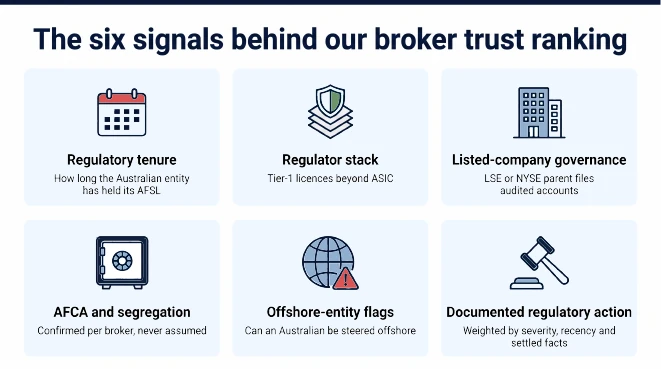
- Regulatory tenure. How long the Australian entity has continuously held its AFSL. A licence held since 2004 has survived two decades of ASIC supervision.
- Regulator stack. Tier-1 licences held by the group beyond ASIC (FCA, MAS, BaFin, CIRO and a US registration). More tier-1 oversight means more independent scrutiny.
- Listed-company governance. A parent listed on the LSE or NYSE files audited accounts and continuous-disclosure notices, an accountability layer a private company does not carry.
- AFCA membership and segregation. Every ASIC broker must belong to AFCA and hold retail money in segregated trust accounts, but we confirm each broker’s status rather than assume it.
- Offshore-entity flags. Whether the brand also runs an offshore entity that an Australian could be steered onto, forfeiting ASIC protection.
- Documented regulatory action. A regulatory action against the Australian licensee lowers its trust score in proportion to how serious it is, how recent it is, and how settled the facts are. A live, contested proceeding weighs less than a proven finding, and an interim order that ASIC revoked once the broker fixed the problem is disclosed on that broker’s review without moving the score. We only score actions documented against a named licensee, which is why the unnamed sector breach described below is not treated as evidence for or against any individual broker.
One note on enforcement history. In January 2026 ASIC reported that more than half of the 52 CFD issuers it reviewed had breached the product intervention order, and it did not name them. That is why I do not claim any broker is enforcement-clean. We rank on the positive, verifiable signals above and disclose confirmed regulatory actions on the individual review pages where they exist.
ASIC regulation, and how to verify a licence yourself
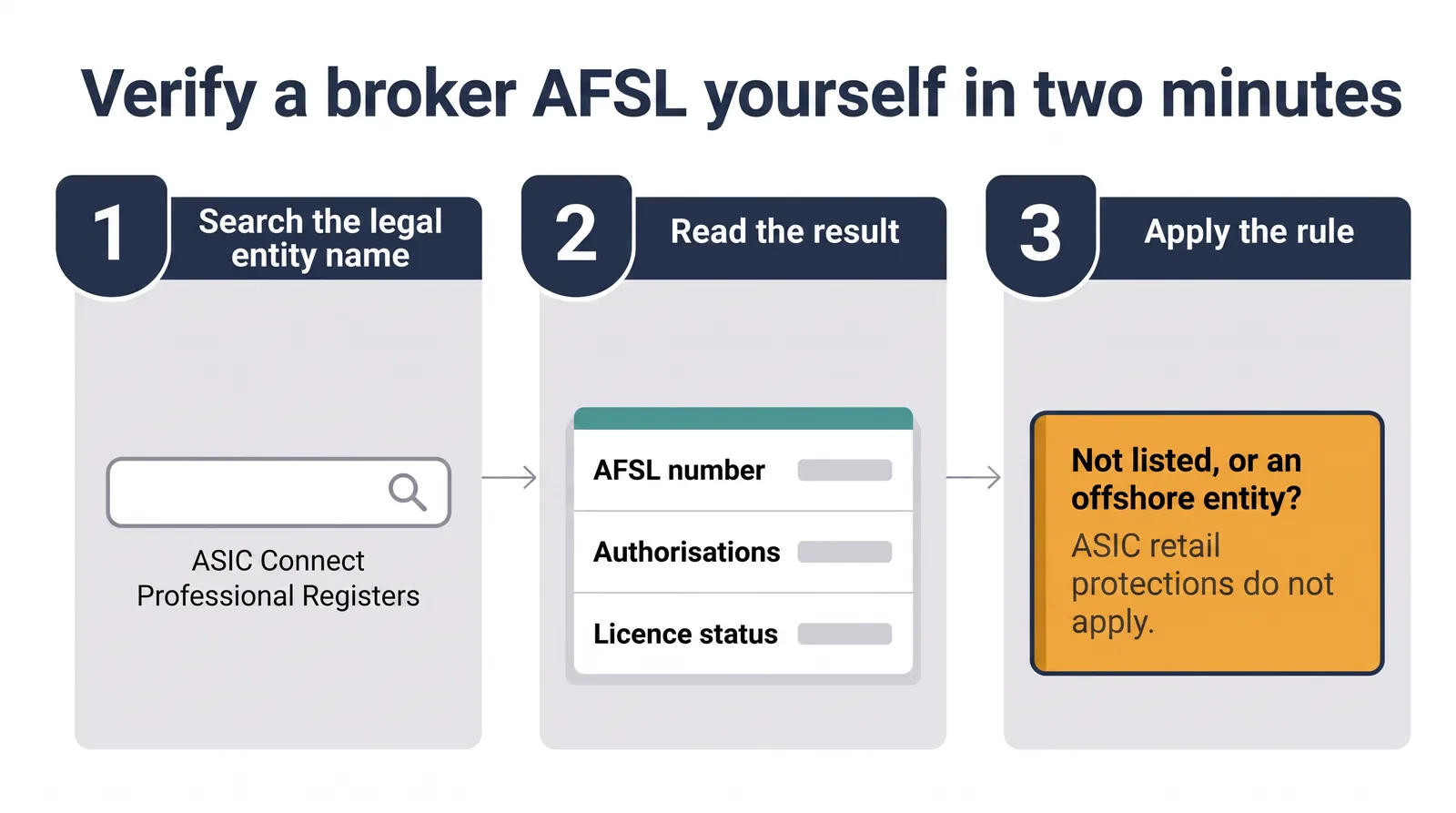
The check I would want every trader to run before funding an account takes two minutes and costs nothing. Search the broker’s legal entity name on ASIC’s professional register. What comes back tells you the AFSL number, the authorisations attached to it, and the licence status. If the company you are asked to open an account with is not listed, or turns out to be an offshore entity, ASIC’s retail protections do not apply to that account.
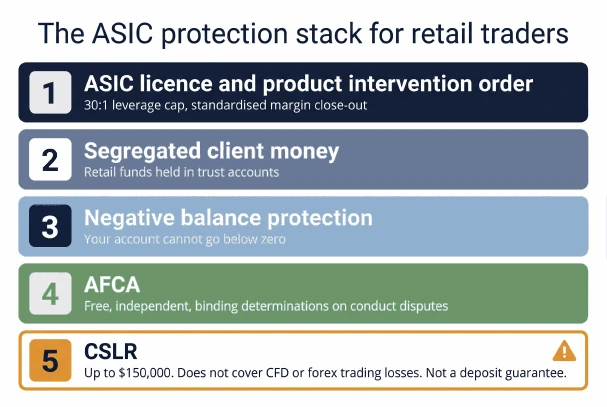
ASIC’s product intervention order sets the retail protections that come with an AFSL: a 30:1 leverage cap on major currency pairs, mandatory negative balance protection, and a standardised margin close-out. In my view, you gain these protections by trading with an ASIC broker, rather than features an individual broker chooses to offer.
Client-money segregation
An ASIC-regulated broker must hold retail client money in segregated trust accounts at an Approved Australian Bank, kept apart from the firm’s own operating funds. In an insolvency, segregation improves the chance that client money is identifiable and recoverable. It is a meaningful protection, but I would state it accurately: segregation does not guarantee full recovery, and it does nothing to protect money you lose trading. Moneysmart’s guidance on CFD risk is a useful plain-English reference here.
The 30:1 cap and margin close-out as protections
Before most retail accounts can blow up, two mechanisms fire. Your deposit can only carry as much exposure as the 30:1 major-pair leverage cap allows. The margin close-out rule requires the broker to start closing positions once account equity falls to 50% of the total initial margin across open trades. Both exist to slow the speed at which a retail account can lose money. Neither makes trading safe; they cap the mechanics, not the market risk, a distinction I would keep in view.
Negative balance protection
For retail clients, negative balance protection means a losing position cannot take the account below zero: if the market gaps past your stop, the broker resets the balance to zero at no cost to you. Because it is mandatory for ASIC retail clients, it is not a feature one broker gives and another withholds. It also has a hard limit worth understanding, because the traders most exposed are often the ones who opted out of it. We cover exactly how it works, and who loses it, on the negative balance protection page.
AFCA dispute resolution, explained
Every ASIC broker must be a member of the Australian Financial Complaints Authority. AFCA is free for consumers and independent of the broker. If you have a dispute you cannot resolve with the broker directly, you can escalate it to AFCA, which can make a determination the broker is bound to follow. Competitors tend to name AFCA and leave it there; the practical point is that AFCA handles conduct disputes, such as a broker mishandling an order, a funding error or a misleading term, not ordinary trading losses.
CSLR: what it does and does not cover
This is the most misunderstood safety signal, so we state it precisely. The Compensation Scheme of Last Resort pays compensation of up to $150,000 to consumers who hold an unpaid AFCA determination against certain personal-advice, credit or securities-dealing firms that cannot pay. It does not compensate money lost trading CFDs or forex, and it is not a deposit guarantee. If you read “government-backed compensation scheme” on a broker’s marketing, I would not read it as cover for trading losses, because it is not.
Offshore versus ASIC: the real scam signal
The clearest warning sign is the entity behind the account, but no trust score fully captures it. A broker can be ASIC-regulated in Australia and, under the same brand, run an offshore entity in a low-oversight jurisdiction. An Australian steered onto that offshore entity, often with the lure of higher leverage, trades with no 30:1 cap, no mandatory negative balance protection and no AFCA access. Before you fund any account, I would confirm on ASIC’s register that it is with the Australian AFSL holder, not an overseas affiliate. We never label a named company a scam; we tell you which entity you are actually dealing with and let the register speak.
Trustpilot and reputation
I treat public review scores as one input, not the headline. Trustpilot and similar sites capture sentiment, which is useful for spotting patterns in withdrawals or support, but they are gameable and skewed by recency. You should weigh them alongside the verifiable signals above, the AFSL and its tenure, the regulator stack, segregation and AFCA, rather than in place of them.
FAQs
Who is the safest forex broker in Australia?
How do I check if a forex broker is regulated by ASIC?
Does the government compensate forex trading losses in Australia?
Is my money safe if an Australian forex broker collapses?
Are offshore brokers with 500:1 leverage safe for Australians?
What is the safest trading platform in Australia?
Related pages
About the author

Justin co-founded CompareForexBrokers in 2014 and has traded forex since 1998. Based in Melbourne, he leads the site's research, and has written for Forbes, Kiplinger and Finance Magnates, while the Australian Financial Review has cited CompareForexBrokers research. He holds a Bachelor of Commerce (Honours) and a Master of Marketing from Monash University. Justin is the co-founder and CEO of CompareForexBrokers.