




What Capital.com costs per trade
MEASUREDMonthly spread cost converts pips to dollars using the EUR/USD pip value as the proxy for the 8-pair average, footnoted on-page. AUD pip value A$14.27 per standard lot at AUD/USD 0.7010 (25 Sept 2026).
At 10 standard lots per month on Standard accounts, Capital.com costs approximately A$105.56 in spread costs. Rates as of Fri 25 Sep 2026, 5pm New York close.
Trading CFDs and forex carries a high level of risk and may not be suitable for all investors. Read the relevant Product Disclosure Statement before opening an account.
Our verdict on Capital.com
Capital.com is the most polished mid-market CFD broker tested in Australia, and my recommendation for traders who want a modern proprietary platform without paying up for the IG Markets or CMC Markets product range. The WebTrader is genuinely well built, with a clean order ticket, fast charts and a sensible mobile app. Native TradingView integration is mature rather than a half-finished bolt-on. Holding FCA, ASIC and CySEC licences at once gives Capital.com a Tier-1 regulatory profile newer entrants do not have.
The trade-offs are real. Capital.com only landed in Australia in 2021, so the AFSL record is shorter than the CMC Markets, IG Markets or Pepperstone equivalents. The broker runs no cTrader, which rules it out for a strategy locked into that platform. Against Plus500, eToro or Mitrade, and for a trader who wants better charting and a TradingView pipeline, Capital.com is the place I would start.
Pros
- You get ASIC AFSL 513393 current since 16 June 2021, plus FCA (UK), CySEC (Cyprus) and SCB (Bahamas), a Tier-1 regulatory stack.
- A 4,500+ instrument line-up across forex, indices, commodities, shares and crypto.
- Five platform routes you can choose from: WebTrader, MT4, MT5, native TradingView execution and API access.
- A$20 minimum deposit and no inactivity fee, confirmed in the AU PDS dated 20 February 2026.
- 24/7 multilingual support on phone, live chat, email and WhatsApp, with our testing getting 90-second chat replies.
Cons
- No cTrader; the stack is WebTrader, MT4, MT5 and TradingView only.
- Our capture measured the standard account at 0.7 pips on EUR/USD and 1.4 pips across eight pairs, 14th of 19 standard accounts.
- AU licence dates only from 16 June 2021, shorter than CMC Markets, IG Markets, Pepperstone or IC Markets.
- No direct ASX share investing; every equity position is a CFD.
- Guaranteed stop-loss orders run on the proprietary platform only, not on MT4 or MT5.
Capital.com score breakdown
4/5 · Great
The overall CFB Score comes from the full methodology, more than 100 data points per broker.
How is our rating calculated?Is Capital.com safe? ASIC AFSL 513393
Capital.com holds ASIC AFSL 513393, current since 16 June 2021, through Capital Com Australia Pty Ltd, and the group adds three further licences including Tier-1 FCA and CySEC oversight.
The Australian entity sits inside a group with multiple Tier-1 regulators, which adds oversight beyond ASIC alone and gives you a safety case broader than a standalone local licence. The FCA licence carries the most weight globally among those additional licences.
ASIC regulation and global licences
AFSL 513393 is held by Capital Com Australia Pty Ltd with the Australian Securities and Investments Commission. The register records the licence as current since 16 June 2021, and no public ASIC enforcement action or imposed licence condition appears since. The licence can be verified on the ASIC register, and the clean record since 2021 is, in my view, a point in its favour. For you, that clean record means the regulator has not raised any red flags. What stands out to me in a newer licence is the absence of any sign of regulatory friction, and none appears here.
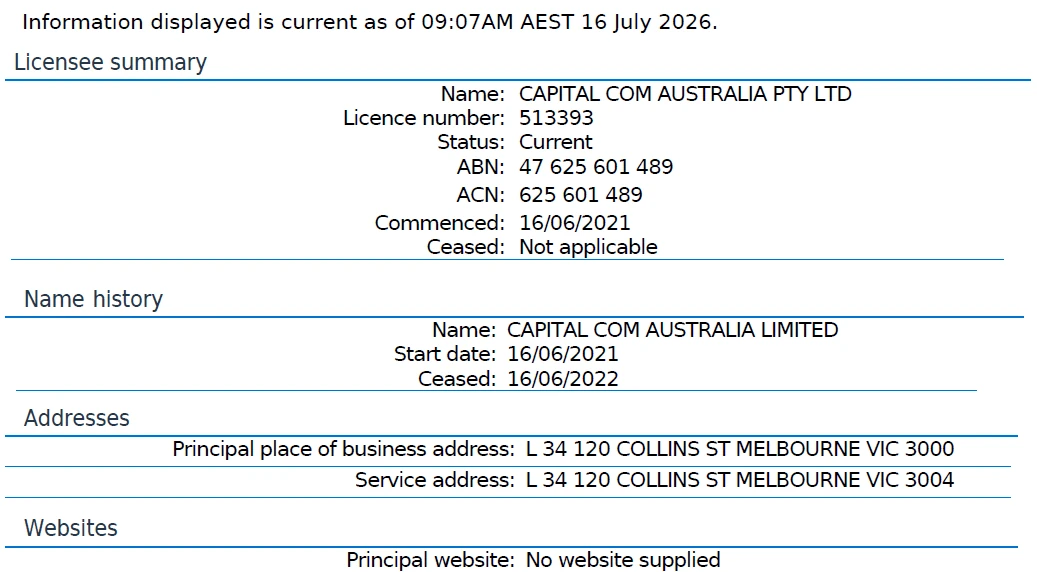
The licence stack holds three further entries:
- Financial Conduct Authority, UK (Tier 1)
- Cyprus Securities and Exchange Commission (Tier 1, MiFID II)
- Securities Commission of the Bahamas (Tier 3, used for offshore wholesale clients)
That FCA, CySEC and ASIC stack puts Capital.com in the same Tier-1 bracket as Plus500, eToro and Pepperstone. The five-year Australian licence record is the honest limitation: the regulatory quality is high and the local track record is short, and the trust rating reflects the second point rather than the first, so the local history is still being written and should be weighed against a broker with a longer ASIC track record before placing full confidence here.
Australian clients qualifying for higher leverage do not need the Bahamas entity, because the Professional classification runs under the ASIC entity itself.
History and ownership
Capital.com was founded in 2016 with operations split between London and Cyprus, and has scaled quickly since launch. The Australian office sits at Level 15, 357 Collins Street, Melbourne, a real office in a prime location that is not a shell, and that local presence alongside global scale signals genuine commitment rather than a regulatory box-tick.
Before depositing, confirm Capital.com holds AFSL 513393 using the site's guide to checking a broker on ASIC's register.
Capital.com client money protection and AFCA membership
Capital.com holds client money in segregated accounts at an Approved Australian Bank, with mandatory negative balance protection and AFCA membership under member ID 46705.
Money sits in a separate account, and losses cannot exceed deposits, which is the minimum expected from any ASIC broker. The AFCA membership with a published ID is a small but genuine transparency point.
Segregated accounts keep client money separate from company funds. AFCA hears claims up to A$1,263,000 and awards compensation up to A$631,500 at no cost. What the Compensation Scheme of Last Resort covers is narrow: up to A$150,000 for personal advice, securities dealing and credit, with forex and derivatives trading, CFDs included, outside its scope. The retail standard is set out in the guide to how ASIC protects against negative balances. The key protection is that AFCA can award compensation at no cost. The detail I keep returning to is that the scheme’s scope stops short of CFD trading, so it does not stand behind a CFD account at all.
One account carve-out matters before you chase leverage. The Professional classification surrenders the ASIC product intervention order protections entirely, negative balance protection included.
The published AFCA member ID is a small but genuine transparency point because it can be cross-checked on the AFCA website in seconds, giving quick verification that the membership is real. Most Australian brokers state AFCA membership without the number, which makes the claim harder to verify independently, and that detail shows this broker is not hiding behind vague claims.
Public reviews
Capital.com holds a Trustpilot rating of 4.6 out of 5 from 15,070 reviews, which Trustpilot labels excellent, captured September 2026. The profile has been claimed by the broker since May 2018.
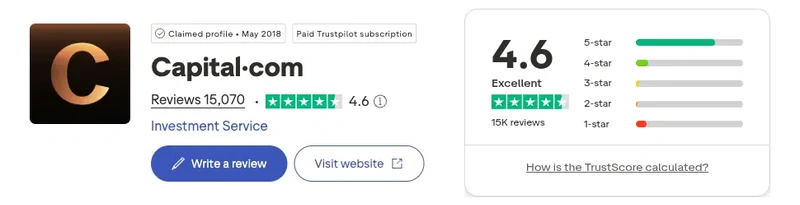
In public reviews, recurring platform praise covers the interface and the education tooling. The most consistent withdrawal complaint covers slower verification where account funding came from multiple sources. Funding from several cards or bank accounts means a longer verification step before the first withdrawal. The reviews show the platform experience is the strong suit, and the withdrawal friction is the one area where a speed bump can appear.
How popular is Capital.com in Australia?
Capital.com is searched too rarely in Australia for month-on-month change to be meaningful: 750 branded searches in August 2026, 22nd of 32. Search interest measures attention, not quality; the score above is the review verdict.
- 750
- Brand searches, August 2026
- n/a below 1,000
- vs July 2026
- 120
- Login searches
- 0.4%
- Share of all broker searches
Source: Google search volume, Australia, August 2026. How this is measured
What other review sites say
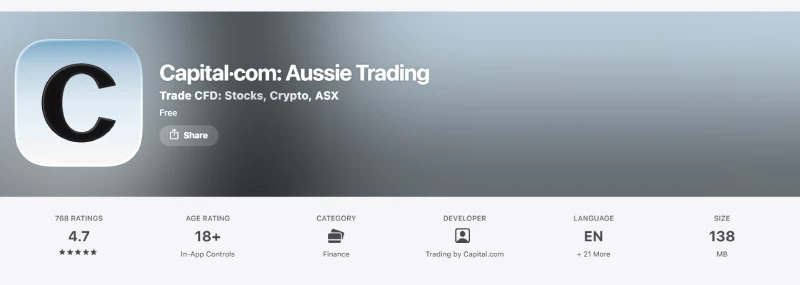
Capital.com's iOS app rates 4.71 out of 5 from 768 ratings on the Australian App Store (August 2026), listed as Capital·com: Aussie Trading.
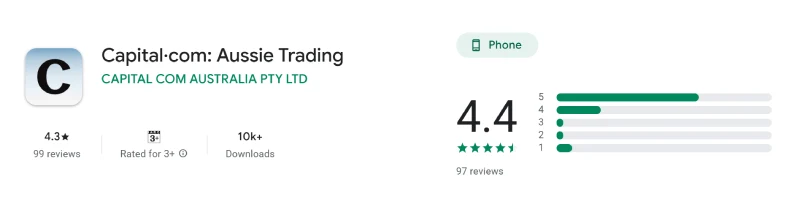
Android users rate Capital.com's Android app 4.3 out of 5 from 99 reviews worldwide on Google Play (August 2026), listed as Capital·com: Aussie Trading.
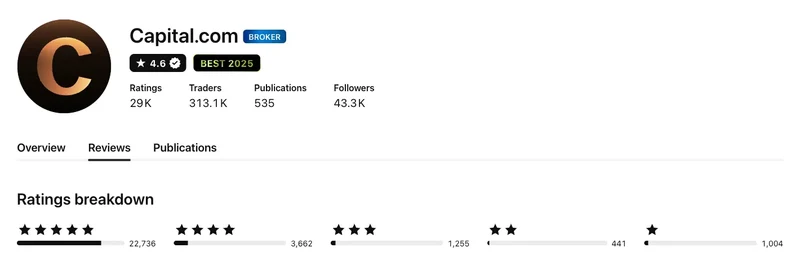
TradingView users rate Capital.com 4.6 out of 5 from 29,098 ratings (September 2026). 313.1K TradingView users have connected a Capital.com account. TradingView named Capital.com its Best in Forex and CFD broker for the Middle East 2025 and its Best broker for the Middle East 2024.
Capital.com at a glance: 17 key facts
Capital.com holds ASIC AFSL 513393 through Capital Com Australia Pty Ltd and lists more than 4,500 instruments from a A$20 minimum deposit. The 17 key facts below cover three further regulators and the fee schedule.
That entry point sits alongside the key facts in the table below, and together they signal a serious retail offering rather than a minnow.
| Item | Detail |
|---|---|
| Australian regulator | ASIC, AFSL 513393, current since 16 June 2021 |
| Australian entity | Capital Com Australia Pty Ltd |
| Other regulators | FCA (UK, Tier 1), CySEC (Cyprus, Tier 1), SCB (Bahamas, offshore wholesale) |
| Year founded | 2016, London / Cyprus; AU operations since 2021 |
| Headquarters | London, UK; AU office in Melbourne |
| Trading platforms | Capital.com WebTrader (web + iOS + Android), MetaTrader 4, MetaTrader 5, TradingView (native), API access |
| Account types | Retail CFD and Professional (Wholesale), both under the ASIC entity |
| Minimum deposit | A$20 |
| Maximum retail leverage | 30:1 (forex majors), ASIC-capped |
| EUR/USD spread | 0.7 pips measured, standard account (dynamic pricing, no published fixed spread) |
| Pricing model | Markup-based, no separate commission on the retail account |
| Funding methods (AU) | Visa, Mastercard, PayPal, Apple Pay, Google Pay, BPAY, PayID, bank transfer |
| Inactivity fee | A$0 |
| Negative balance protection | Yes (mandatory under ASIC) |
| AFCA member | Yes, member ID 46705 |
| Demo account | Free, unlimited |
| Customer support | 24/7 via phone, email, live chat and WhatsApp |
The A$20 entry and the A$0 inactivity fee are the two rows to read first. The sections below price the rest. Those two numbers, in my view, remove the biggest friction points for a beginner, and for you they mean you can open a live account, leave it idle for six months while learning on a demo, and return to find every dollar still there.
Capital.com standard-account spreads
Capital.com measured 0.74 pips on EUR/USD in the team’s September 2026 capture, and standard-account spreads ran 1.25 pips across the eight-pair basket, placing the account 2nd of 8 standard accounts benchmarked.
No separate commission applies on the retail account, so the cost per trade is the spread alone. That simplicity is the account’s real selling point for you, because the cost appears in the quote and the trader is done.
Capital.com provides no fixed EUR/USD spread; it prices on a single-tier markup model with dynamic spreads, so the table below carries typical observed spreads rather than official minimums. In my view, that approach gives you a truer picture of the cost you are likely to face, not a headline number that rarely appears in live conditions.
| Pair | Capital.com standard (typical pips) | AU industry avg (Standard) |
|---|---|---|
| EUR/USD | 0.7 | 1.1 |
| AUD/USD | 0.7 | 1.3 |
| GBP/USD | 0.8 | 1.4 |
| USD/JPY | 0.7 | 1.4 |
| EUR/GBP | 0.9 | 1.4 |
| EUR/JPY | 1.2 | 1.9 |
| AUD/JPY | 1.3 | 2.1 |
Those figures beat the Australian standard-account average on all seven pairs above and sit above the raw commission accounts at IC Markets, Pepperstone and Fusion Markets, so a standard-account trader gets better-than-average spreads on those pairs while still paying more than a raw account trader. The full spread field is set out in the lowest spread brokers in Australia rankings, and the gap to raw accounts is best measured against a trader’s weekly volume before dismissing the account outright.
What it costs to trade with Capital.com
Capital.com charges 0.74 pips to trade one standard lot of EUR/USD in the team’s September 2026 capture, and nothing in commission, so the cost to trade with Capital.com is the spread alone.
Pepperstone’s Razor account measured 0.51 pips all in in our May to June 2026 capture, a different window and a different statistic, so I read the two figures side by side rather than as a direct race. I keep returning to that gap because it compounds fast once your weekly lot count climbs.
| Account | EUR/USD typical (incl. commission equivalent) |
|---|---|
| Capital.com Retail | 0.74 pip (September 2026) |
| CMC Standard | 0.50 pip |
| Pepperstone Razor | 0.51 pip |
| IC Markets Raw | 0.75 pip (September 2026) |
| Fusion Zero | 0.33 pip (September 2026) |
September 2026 totals convert commission at our capture’s A$14.04 pip value, Pepperstone’s total is its May to June 2026 all-in, and Capital.com and CMC Standard carry no commission. The markup-only pricing is rarely the cheapest path for an active trader: five to ten trades a week costs little here, while 30 or more on majors costs materially more than a raw account would, and the extra spread adds up quickly once volume climbs.
Other fees AU traders should check
- Overnight swap rates apply on positions held past 5 PM New York time, direction-dependent.
- Currency conversion applies to instruments denominated outside the account base currency.
- Withdrawals cost A$0 on standard methods.
- No inactivity fee applies. The Capital.com Australia PDS dated 20 February 2026 confirms that inactive accounts attract no charge.
- Guaranteed stop-loss orders are available on selected instruments with the premium charged only on trigger, and they run on the proprietary platform only.
Capital.com funding methods and withdrawal times
Capital.com offers six funding methods, all at A$0, from instant card and wallet payments to bank transfer in one to two business days.
Withdrawals carry no fee on standard methods and go back to the same source as the deposit wherever available.
Deposit methods (AU clients)
| Method | Fee | Speed |
|---|---|---|
| Visa / Mastercard | A$0 | Instant |
| PayPal | A$0 | Instant |
| Apple Pay / Google Pay | A$0 | Instant |
| PayID | A$0 | Same day |
| BPAY | A$0 | Next business day |
| Bank transfer | A$0 | 1 to 2 business days |
The deposit menu is stronger than most ASIC brokers tested here. Apple Pay and Google Pay funding suits a phone-first client, and PayPal remains uncommon at Australian CFD brokers. Depositing via Apple Pay or Google Pay takes seconds from a phone, and PayPal provides a familiar payment rail that many brokers do not offer. In my view, Capital.com’s real edge is Apple Pay and Google Pay, and PayPal is a further option on the deposit menu.
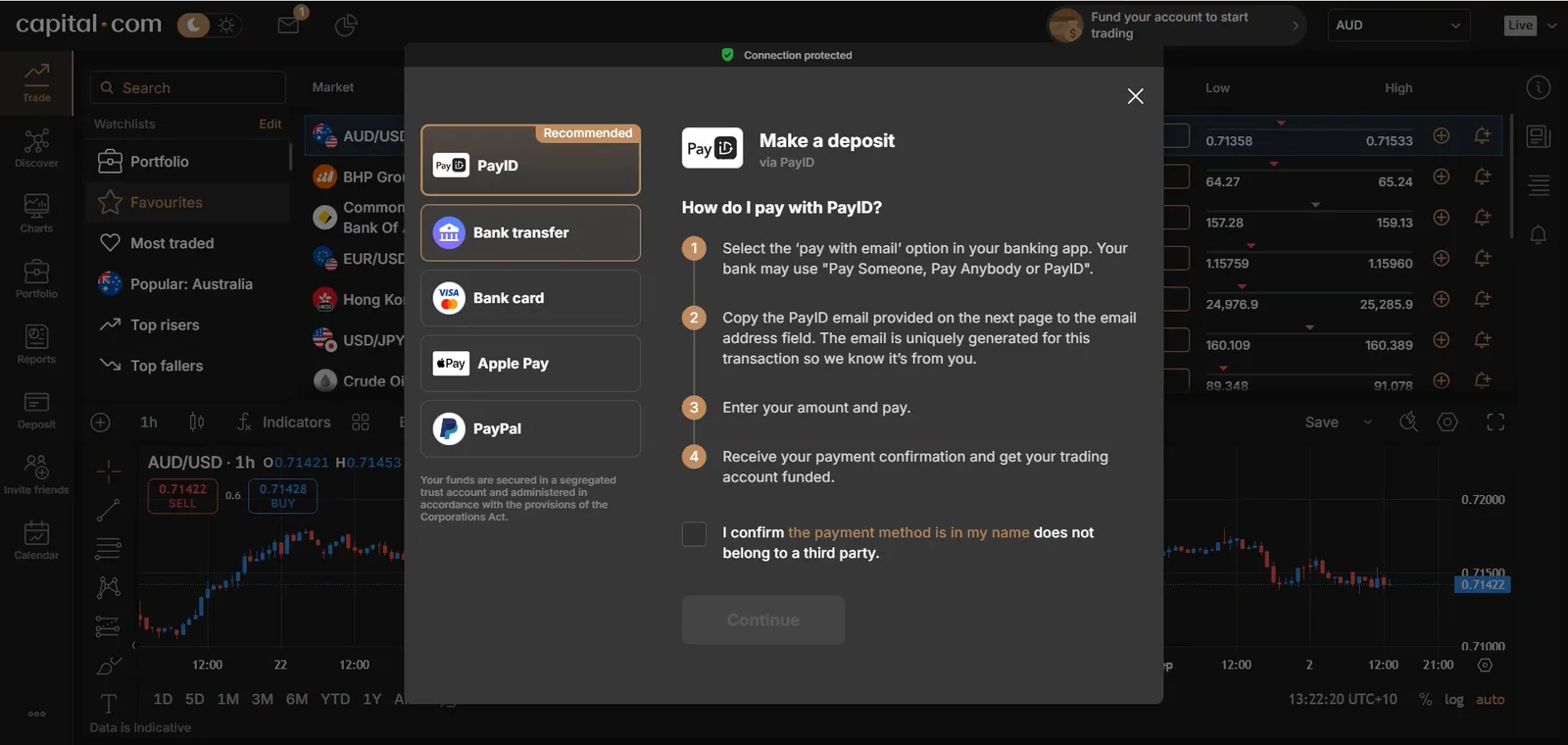
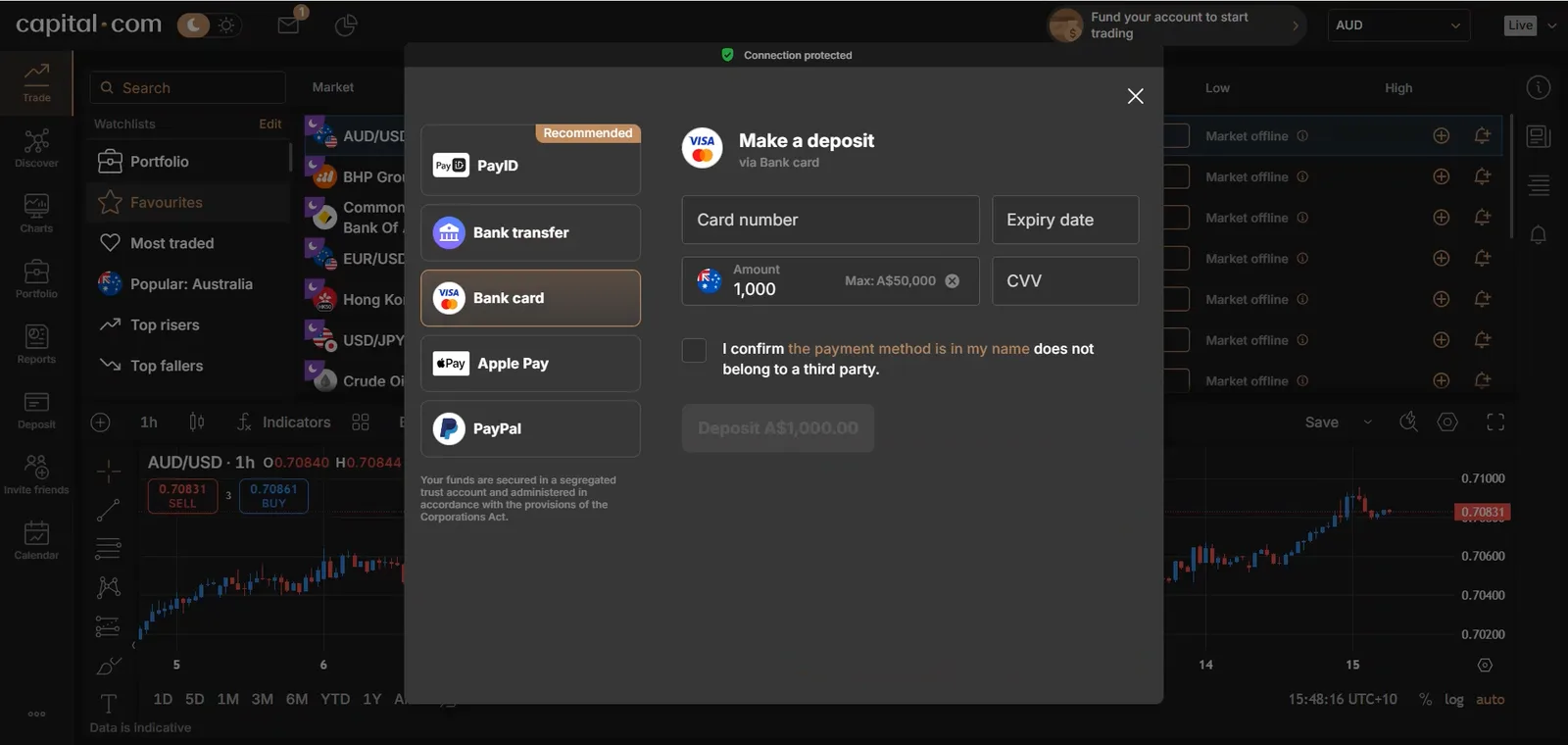
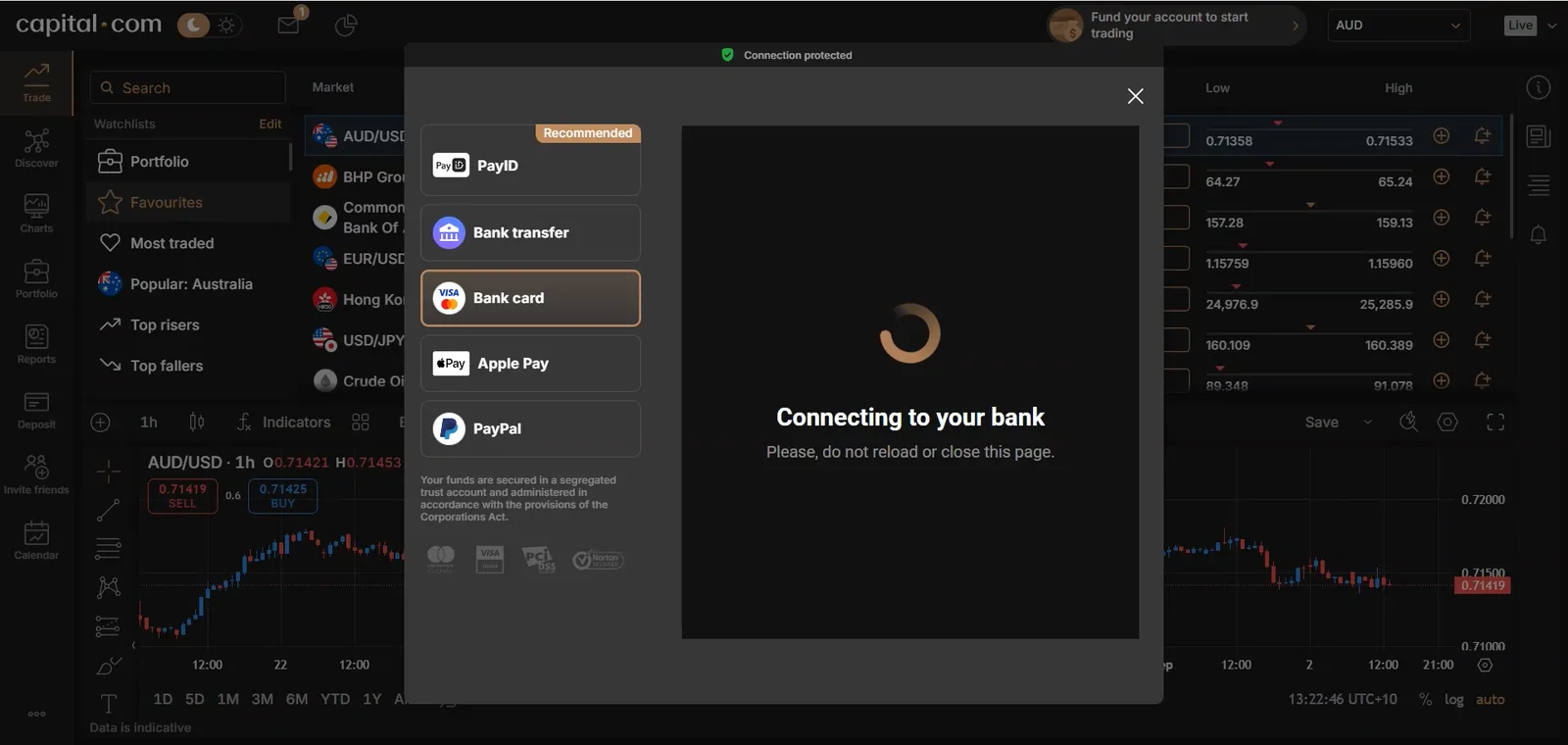
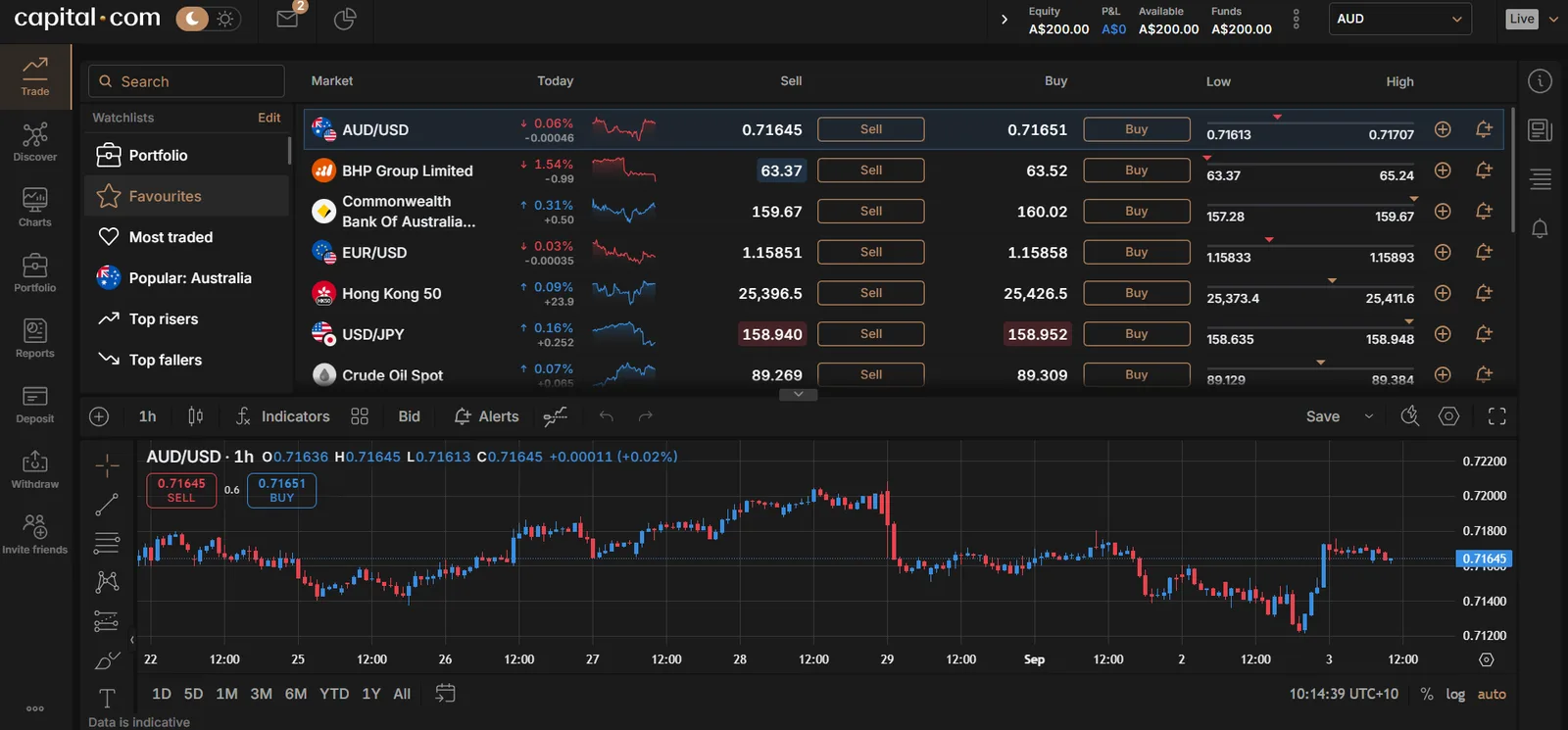
The AU deposit menu Noam captured during our September 2026 testing showed PayID carrying a “Recommended” ribbon, and it works by paying by email from an Australian banking app to an address uniquely generated for each transaction. Bank card deposits are capped at A$50,000 on the captured AUD account, and the card form asks only for card number, expiry date and CVV. A checkbox requires you to confirm the payment method is in your own name and does not belong to a third party before the deposit button unlocks. Noam Korbl deposited A$200 by bank card from inside the live platform, and the funds credited immediately, showing as equity, available and funds, all A$200.00.
Withdrawals
Withdrawals cost A$0 on standard methods. Anti-money-laundering rules require withdrawals to use the same source as the deposits wherever available. Once verification is complete, you can pull funds back to the same card or wallet used to deposit.
Account opening
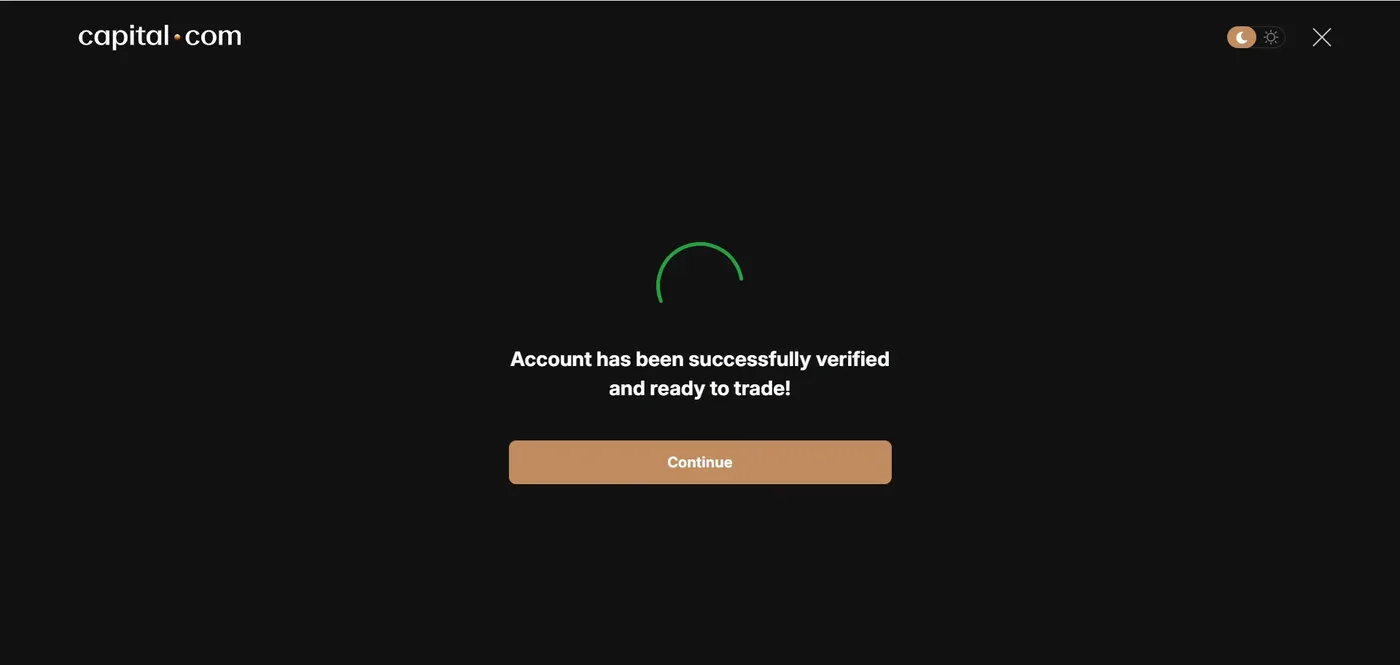
Capital.com opens Australian accounts online with Capital Com Australia Pty Ltd, the ASIC licensee (AFSL 513393), and Noam Korbl, who leads our capture programme, took one application from sign-up to fully verified in 3 hours 26 minutes on 16 August 2026. He signed up at 15:35 that Sunday and the account was ready to trade by 19:01. That is what this single application took, and it is the only one our capture measured, so I would treat it as a guide to the process rather than a promise about timing.
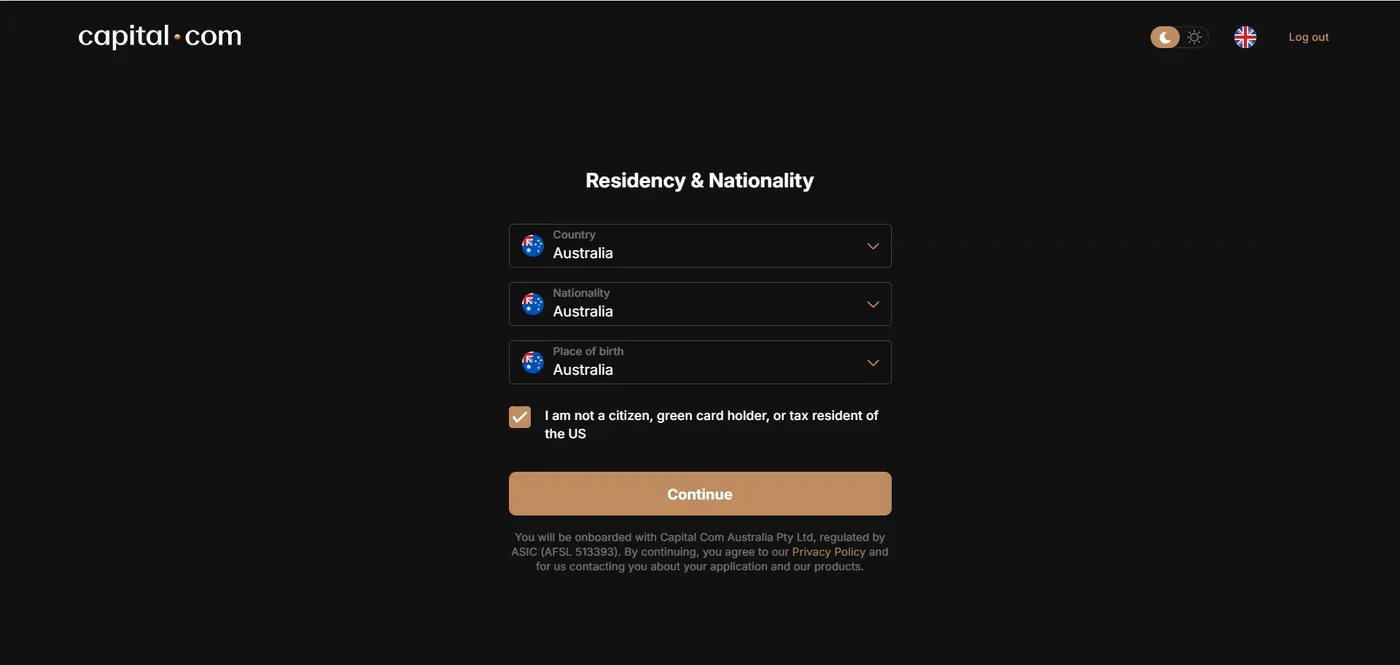
The application asks your residency, nationality and place of birth, with a declaration that you are not a US citizen, green card holder or US tax resident. You then type your address into a form with a postcode lookup, verify your email and an Australian +61 phone number, and answer questions on your trading experience over the past three years, your gross annual income and your risk appetite. A short CFD knowledge assessment follows, then a screen showing the Risk Disclosure Statement, Hedging Counterparty Policy, Target Market Determination, Cookies Policy and Deceased Estate Policy. Then comes a “Verifying your data” step of a few seconds, ending with “Account has been successfully verified and ready to trade!”.
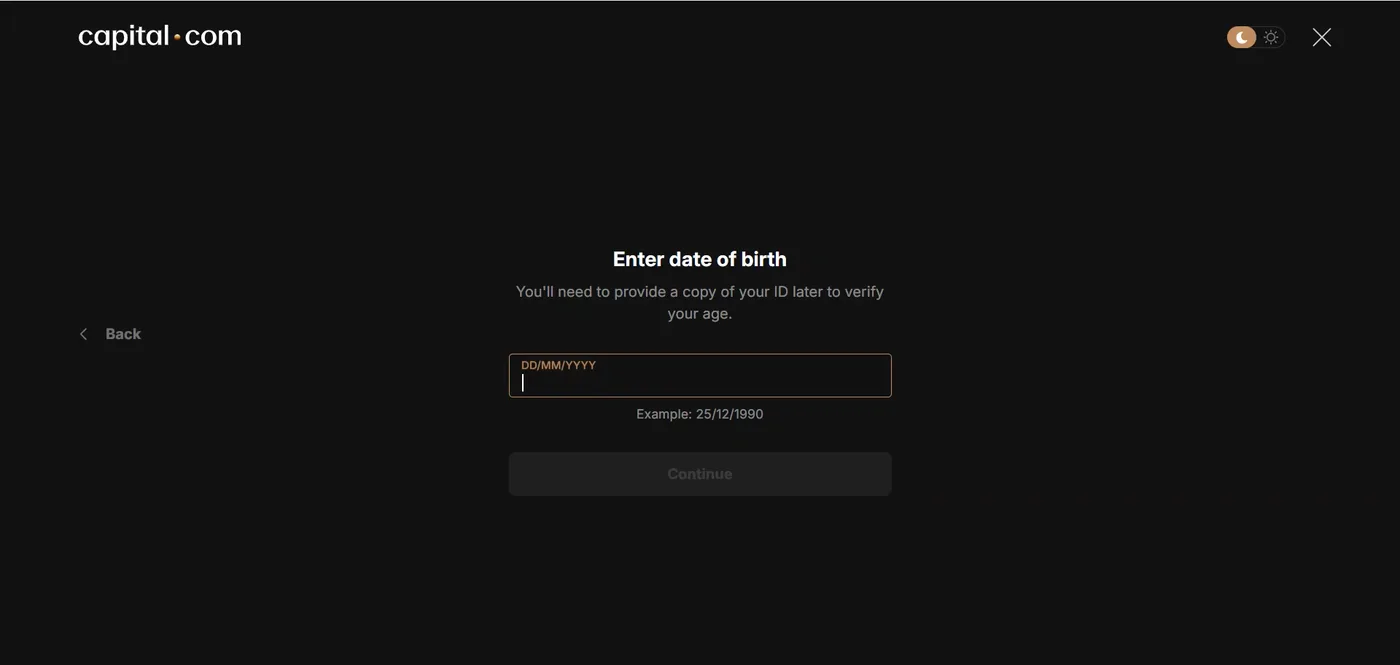
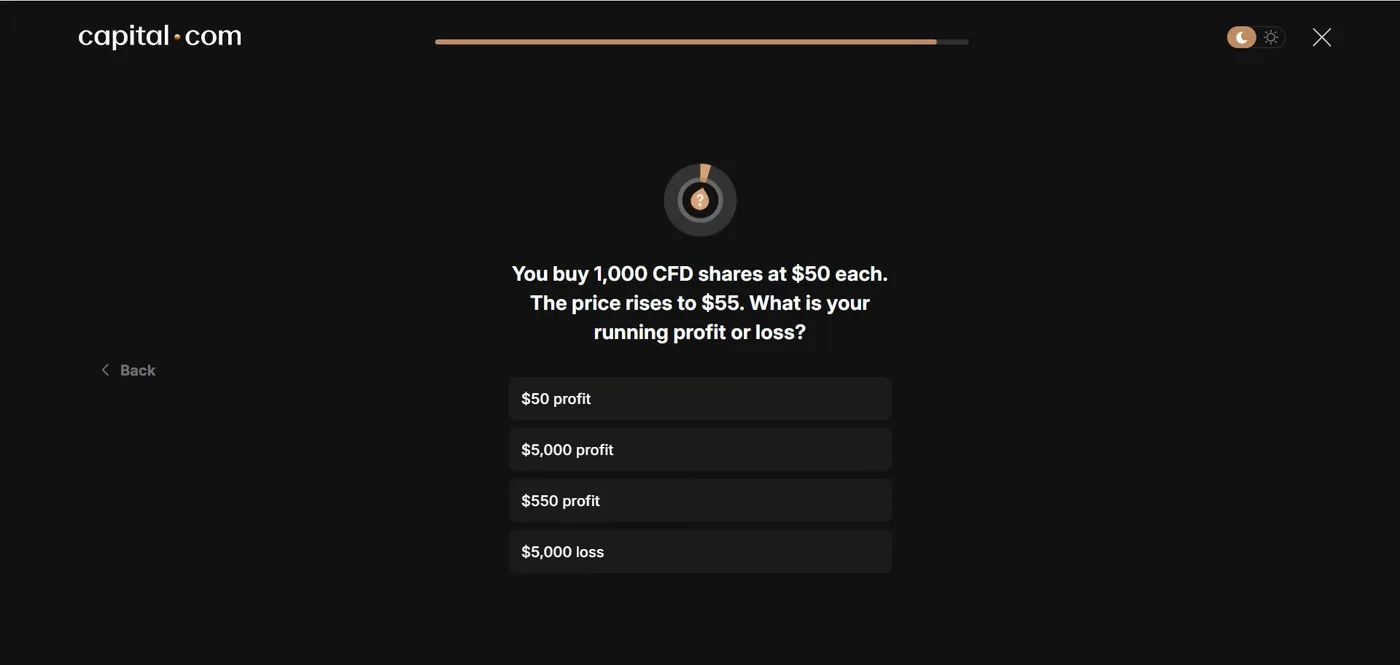
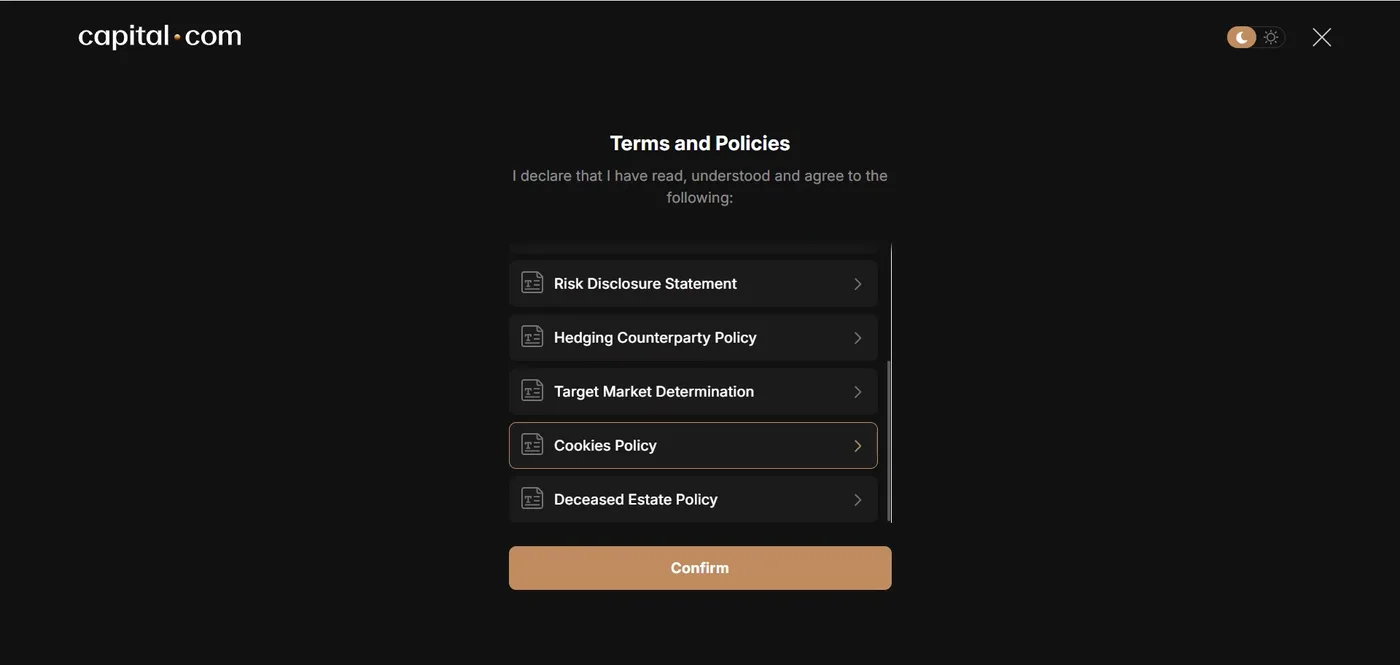
One limit deserves plain words. The application states that a copy of your ID is required, and the screen ties that to verifying your age, but the captured frames show no document upload stage and no indication of how the check was completed. Because of that gap, I cannot tell you what proof you will be asked for or how it is checked.
Capital.com account types and minimum deposit
Capital.com account types number two, and the minimum deposit is A$20 on the retail account.
| Account | Pricing model | Min deposit | Best for |
|---|---|---|---|
| Retail CFD | Spread-only, no commission | A$20 | Most retail traders |
| Professional (Wholesale) | Spread-only with monthly cash rebates, higher leverage | Eligibility criteria apply | Experienced high-volume traders |
Both accounts sit under the ASIC-regulated entity. The Professional account is not an offshore route, being a Wholesale Client classification under the Corporations Act held with the same AFSL 513393 entity, which is a materially better structure than the offshore arms several competitors use because qualifying as a Professional client keeps the account under the same Australian entity with no move to an offshore subsidiary with weaker protections.
Professional (Wholesale) account
Qualifying as a Professional client lifts retail caps to 500:1 on forex, indices and commodities, 100:1 on crypto and 33:1 on share CFDs. Professional clients also earn monthly cash rebates in 5%, 10% and 20% tiers, with Australian volume thresholds set ten times higher than the UK equivalents. The eligibility caps run through a Sophisticated Investor certificate or the wealth test of A$2.5 million in net assets or A$250,000 in gross income. The account catch is the loss of the product intervention order protections. Meeting the wealth or certificate threshold lifts the leverage caps and adds rebates, but the retail protections that cap leverage and guarantee negative balance protection are forfeited. The volume thresholds for rebates are ten times the UK levels, which makes the rebate tiers harder to reach as an Australian trader.
Minimum deposit
The A$20 minimum deposit covers fractional positions on most majors at retail leverage caps, sitting above the A$0 at CMC Markets and Pepperstone while undercutting the rest of the field. Capital.com runs a swap-free account at group level but not for Australian residents, confirmed with the desk in July 2026, so any mention of it on the global site does not apply. A trader needing a swap-free account for religious reasons will have to look elsewhere, because the Australian entity does not offer it. This was confirmed directly with the desk, and it is a limitation that might catch a trader who has read about the swap-free option on the global site.
Capital.com trading platforms
Capital.com lists five routes in total across its trading platforms: the proprietary WebTrader, MT4, MT5, native TradingView execution and API access.
cTrader is excluded on the Australian entity, so cTrader users will need to look elsewhere; the native TradingView integration and the proprietary WebTrader are the routes that set this broker apart from the field.
Capital.com WebTrader (proprietary)
The WebTrader platform is what this broker is built around, and in my judgment it is the strongest argument for choosing it over Plus500 or Mitrade. The clean order ticket offers one-click trading and server-side stops, 75+ technical indicators on a fast charting engine, sentiment and trader-positioning data on each instrument, an AI layer flagging bias patterns over time, multi-watchlist layouts, and native iOS and Android apps with biometric login. The web-based build behaves identically on Windows, macOS and Linux with no install. Setting up on any device and trading with the same tools is a real advantage for you when switching between desktop and phone.
The WebTrader runs no third-party expert advisors, so an algorithmic trader uses the MetaTrader builds instead.
MetaTrader 4 and MetaTrader 5
MT4 carries the full forex, index and major commodity range, and MT5 is available to Australian clients as well. Share CFDs and crypto are WebTrader-only, so traders work from a narrower instrument list on MetaTrader. Guaranteed stop-loss orders are also absent from both MetaTrader builds, which is the more consequential limitation. Relying on MT4 or MT5 means losing access to share CFDs, crypto and guaranteed stops, so you need to weigh whether the platform familiarity is worth the narrower range. The missing guaranteed stop-loss is what I cannot get past for a risk-conscious trader.
TradingView and API
The native TradingView trading at Capital.com places it in a small group of Australian-regulated brokers that can connect a TradingView account and execute inside the chart. That integration matches what Pepperstone, OANDA and Eightcap offer rather than the webhook workarounds some brokers ship, and for a trader already charting on TradingView it can justify the account alone because executing without leaving the chart removes the friction of switching platforms. API access is also available to Australian clients for automation and market data, which makes the integration feel like a first-class feature rather than a clunky bridge and may tip the decision for a TradingView user.
Capital.com markets and instrument counts
Capital.com markets and instrument counts reach more than 4,500 instruments across seven asset classes, including 3,000 plus share CFDs and 130 plus forex pairs.
| Asset class | Count | Note |
|---|---|---|
| Forex | 130+ pairs | Major and minor AUD crosses (AUD/USD, AUD/JPY, AUD/NZD, AUD/CAD, AUD/CHF) |
| Share CFDs | 3,000+ | ASX, NYSE, NASDAQ, LSE, EU exchanges |
| Indices | 25+ | ASX 200, S&P 500, NASDAQ, FTSE 100, DAX |
| Commodities | 30+ | Gold, silver, WTI and Brent crude, natural gas |
| Cryptocurrencies | 100+ | CFDs only, 2:1 retail cap |
| ETFs | 250+ | ETF CFDs |
| Thematic baskets | Curated | Stocks grouped by theme (AI, EVs, cannabis) |
Thematic baskets are the row worth pausing on. These baskets package a group of stocks around one theme and trade as a single CFD position, and no other broker in this Australian coverage offers them. A theme like AI or renewable energy can be traded by you as a single position here and nowhere else in this coverage. In my view, the thematic baskets are the most original feature in the instrument list, and they give you a way to express a macro view without picking individual stocks.
The range gaps are worth stating plainly: no direct ASX share investing, no fixed income at the depth CMC Markets offers, and no spread betting, which is a UK-only product. The absence of direct ASX investing is the most limiting gap because a strategy needing ownership of ASX shares or deep fixed income will require a second broker, which forces a split across accounts.
Share CFDs and crypto
Capital.com lists 3,000 plus share CFDs across ASX, NYSE, NASDAQ, LSE and the EU exchanges, with no direct ASX ownership route, so every equity position is a CFD and you will need a different broker entirely if you want ownership. The share CFD class is compared in the guide to share CFDs versus ASX investing. You have to look elsewhere for holding shares directly. The all-CFD equity model is fine for short-term trading, but in my view it is a dead end for holding shares for the long term.
The crypto range runs 100 plus CFDs at the ASIC 2:1 retail cap, one of the wider line-ups in this cohort, as contracts on the price rather than coins you own. You can trade crypto price moves, but the underlying coin is never held, and the 2:1 leverage cap limits your exposure. The breadth of the crypto CFD list is interesting, but, in my view, the 2:1 cap means you are trading with very little leverage anyway.
Capital.com leverage and margin under ASIC rules
Capital.com leverage and margin operate under a maximum retail leverage of 30:1 on major forex pairs, with lower caps on minors, indices, commodities and cryptocurrency.
The 30:1 cap is a regulatory floor that applies across Australian brokers rather than a Capital.com choice, so it is best compared across brokers rather than judged on this broker alone.
ASIC caps retail CFD leverage at 30:1 on major forex pairs, 20:1 on minor pairs, gold and major indices, 10:1 on commodities other than gold, 5:1 on share CFDs and 2:1 on crypto assets. The caps come from a product intervention order extended to 23 May 2027, so they apply at every ASIC broker rather than at Capital.com alone, and they are a protective measure rather than a weakness of this broker.
The single retail account carries those caps in full, and the Professional tier is the only route past them, reaching 500:1 on forex, indices and commodities, 100:1 on crypto and 33:1 on share CFDs. That jump to 500:1 is significant but comes with the loss of retail protections, so it is a trade-off to weigh carefully.
Margin close-out for retail sits at 50%. ASIC requires every CFD issuer to close a retail client’s positions once account equity falls below half the total initial margin on all open positions, positions cannot be netted against each other to reduce that figure, and a gapping market can close your position below the 50% level. The leverage tier structure is set out in leverage ratios explained. A sharp move against your position can trigger a close-out faster than you expect, and gapping markets can leave your account below the 50% level. The 50% close-out rule is, in my view, a blunt instrument that protects the broker as much as you, and it is worth understanding before you trade.
Capital.com customer support
Capital.com customer support runs 24 hours a day, seven days a week, on phone, email, live chat and WhatsApp, with live chat replying in 90 seconds during Australian business hours.
That 90-second response is faster than most brokers tested and means a human can be reached almost instantly during the day, while WhatsApp keeps the conversation on a phone and gives confidence traders will not be left waiting.
Four support channels including WhatsApp is the broadest coverage tested at an ASIC-regulated broker. The WhatsApp channel in particular is rare in this field, and it suits the mobile-first audience the platform targets because messaging support puts help on the app a trader already uses, which is a feature more brokers should adopt.
Agent knowledge of platform features was strong in testing, and on Australian tax treatment agents correctly defer to a registered accountant rather than answering.
English, Spanish, Italian, German, French, Polish, Arabic, Mandarin, Russian and Vietnamese make up the language range. Ten languages on a 24/7 desk reflects the international group behind the Australian entity, and it is the widest language coverage in this cohort. If your first language is among those ten, support is available without switching to English. The Vietnamese and Arabic support is what I find the most valuable, because those languages are rarely offered by Australian brokers.
The weekend cover is the part that separates this desk from the Australian norm. CMC Markets and Plus500 both close at the weekend where this desk does not, and a funding or margin question you raise on a Saturday is answered the same day. Trading over the weekend or needing to fix a deposit issue on a Sunday means you wait no time at all. Weekend support is a genuine edge for anyone who manages trades outside business hours, and it is the one feature that I think might keep a trader from switching to a cheaper broker.
Capital.com research, tools and education
Capital.com research, tools and education cover five in-platform components alongside the standalone Investmate app: written analysis, a Reuters feed, an economic calendar, sentiment indicators and pattern recognition.
All five are embedded in the platform, so traders can check sentiment and calendar events without leaving the trade ticket.
- Daily and weekly written market analysis
- Reuters news feed
- Economic calendar
- Sentiment indicators on each instrument
- Pattern recognition signals on selected instruments
The research stack is solid without being the deepest in the market. CMC Markets and IG Markets carry deeper third-party integrations through Morningstar and Trading Central, and neither is matched here, so traders who rely on third-party analyst ratings will find more depth at those brokers and may outgrow this research if they need institutional-grade analysis.
Capital.com’s strength is the built-in AI layer rather than the breadth of third-party feeds. Sentiment data and pattern recognition sit inside the order ticket rather than in a separate research tab, and in my view that design choice suits you if you check a view at the point of entry rather than reading a morning note. The data you need to confirm a trade is right there when you are about to pull the trigger, which can speed up your decision-making.
The standalone education app is where this broker separates from the Australian field entirely, and it gets its own section below.
Capital.com Investmate education app
Capital.com runs the Investmate education app on iOS and Android, with structured lessons across forex, CFDs, technical analysis and behavioural finance. An AI layer flags trading bias from live account behaviour.
You work through the lessons at any pace, and the app draws on your actual trading data to call out patterns you might miss. The AI feedback is based on your real trades, not a generic quiz, which in my view makes it far more relevant.
That behavioural feedback is what makes the app unusual. The app calls out patterns you rarely see in yourself, such as overtrading after a loss or cutting winners too short, drawing those flags from your own account rather than from a generic lesson plan. The behavioural feedback is the feature that I think sets Investmate apart from every other education app, because it addresses the psychological side of trading that most courses ignore.
No equivalent tool exists at any other ASIC-regulated broker in this coverage. The education stack at most brokers is a library you read once, where Investmate is a feedback loop that keeps working while your account trades. Your learning does not stop after the first week; it evolves with your trading. No other broker in this coverage has anything close, which makes Investmate a genuine moat in my view.
The Investmate app is, in my view, reason enough for a new trader to keep a funded Capital.com account even where the main trading happens elsewhere. It is also the feature that earns this broker a place on the best forex brokers for beginners list. You can keep a small balance here just for the feedback loop. That alone justifies a minimum deposit for you, even if your trading happens elsewhere.
What traders say about Capital.com
| Rating site | Rating | Based on | Who rated | Captured |
|---|---|---|---|---|
| Trustpilot | 4.6 out of 5 | 15,070 reviews | Worldwide | September 2026 |
| App Store | 4.71 out of 5 | 768 ratings | Australia only | August 2026 |
| TradingView | 4.6 out of 5 | 29,098 ratings | Worldwide | September 2026 |
Each row above is a public rating of Capital.com taken from a rating site, dated to the month its figure was captured. An App Store rating counts ratings left on Apple's Australian App Store only, while a Trustpilot figure counts reviews and a TradingView figure counts ratings from anywhere in the world. A site with no row has no rating for Capital.com, withholds it, cannot be matched to Capital.com with confidence, or we have not captured it yet.
How Capital.com compares to Pepperstone and CMC Markets
Capital.com compares to Pepperstone and CMC Markets on spread and instrument range, measuring 0.74 pips on EUR/USD in the September 2026 capture and listing 4,500 instruments.
Pepperstone’s Razor account measured 0.51 pips all in in our May to June 2026 capture, and CMC Markets lists 12,000 plus instruments. This is a platform-against-price and platform-against-breadth trade. The decision comes down to whether you value the platform experience more than the lowest cost or the widest range.
Pepperstone wins the cost comparison outright and carries five platforms including cTrader, so it is the pick where raw cost is the priority. CMC Markets wins the range comparison and adds direct ASX share investing, which no CFD-only broker can match, so it is the pick where ASX shares are needed; the comparison is clear-cut on those dimensions and Capital.com does not try to win either.
What Capital.com holds against both is the A$20 entry, the Investmate feedback loop and a WebTrader that reads more modern than either rival’s proprietary build, so the A$20 entry lowers the barrier to start and the WebTrader’s modern feel may sway a trader tired of clunky legacy platforms.
Put Capital.com next to any of the other 31 ASIC-regulated brokers we cover.
Capital.com MultiBank Group Middle of the measured field
MultiBank Group measures 0.4 pips on the raw eight-pair basket; Capital.com carries no figure, no measured 8-pair raw average.
MultiBank Group measures 0.1 pips on raw EUR/USD; Capital.com carries no figure, no single-pair EUR/USD figure on record.
Capital.com's measured 0.74 pips and MultiBank Group's measured 1.5 pips straddle the middle broker's 1.0.
Neither Capital.com nor MultiBank Group carries a figure on round-turn commission: Capital.com, no per-lot commission on record; MultiBank Group, commission rate not published.
Neither Capital.com nor MultiBank Group carries a figure on raw account cost at ten standard lots a month: Capital.com, no measured 8-pair raw average; MultiBank Group, commission rate not published.
Capital.com's A$105.56 a month sits A$37.09 under the middle broker's A$142.65; MultiBank Group's A$213.98 sits A$71.33 over it.
Capital.com opens at A$20 on the minimum deposit; MultiBank Group carries no figure, minimum published in US dollars, not converted on this row.
Capital.com runs MT4, MT5, TradingView, Own platform; MultiBank Group runs MT4.
Capital.com holds AFSL 513393; MultiBank Group holds AFSL 416279.
Capital.com's 82 / 100 sits 7 above the middle broker's 75; MultiBank Group's 81 / 100 sits 6 above it.
Capital.com rates 4.6 / 5 on the Trustpilot rating; MultiBank Group carries no figure, no Trustpilot profile captured.
Capital.com's 4.71 / 5 sits 0.17 above the middle broker's 4.54; MultiBank Group's 5 / 5 sits 0.46 above it.
Capital.com rates 4.6 / 5 on the TradingView broker rating; MultiBank Group carries no figure, no TradingView broker profile.
Capital.com's 750 sits 600 below the middle broker's 1,350; MultiBank Group's 260 sits 1,090 below it.
Capture: September 2026 · AUD/USD 0.7010 (25 Sept 2026) · field: the measured field varies by row, from 16 to 24 brokers, of 32 reviewed.
Bars run lowest to highest across the measured field; the tick marks the middle broker.
| If you value… | Consider |
|---|---|
| Tightest forex spreads | Pepperstone or IC Markets |
| Broader product range | CMC Markets or IG Markets |
| Direct ASX shares plus CFDs | CMC Markets |
| Beginner-focused platform | Plus500 or eToro |
| Copy trading | eToro |
| cTrader | Pepperstone, IC Markets or Fusion Markets |
Should you open a Capital.com account?
Capital.com suits traders who want a modern platform stack across 4,500 plus instruments from a A$20 minimum deposit. Filtering on total cost, or wanting direct ASX ownership, points you to better options elsewhere than a Capital.com account. The platform stack is the reason to choose Capital.com, and where that is not your priority, ruling it out is quick.
A pair of trader groups gain clear value from a Capital.com account. Platform-led traders reach a WebTrader and a native TradingView pipeline that few Australian brokers match. New traders reach the A$20 entry, no inactivity fee and the Investmate behavioural layer. If you fall into either group, the account earns its keep.
Two groups should look past a Capital.com account: active cost-first traders, who pay a markup where Pepperstone Razor prices 0.51 pips all in and would be better served by a raw-spread broker, and share investors, who get CFDs and no ownership route at all and would be better served by a multi-asset platform.
Capital.com ranks seventh among the highest-rated forex brokers in Australia on the 2026 scoring. The free demo runs WebTrader in full, so you can test the platform case before any deposit. Opening a demo lets you test the WebTrader and Investmate without risking a dollar. That is the smartest next step I can recommend, because the platform experience is the main reason to choose this broker.
FAQs
Is Capital.com trustworthy?
How do I withdraw money from Capital.com?
What leverage does Capital.com offer in Australia?
What is the minimum deposit for Capital.com?
Does Capital.com offer MT5 or cTrader?
Does Capital.com offer TradingView trading?
Does Capital.com charge an inactivity fee?
What is Investmate?
Testing log
| Record | Detail |
|---|---|
| Review published | 16 May 2026 |
| Last content change | 27 September 2026 |
| Spread capture | MT4 CFD account, 0.74 pips EUR/USD |
| Capture window | September 2026 |
| Verification | AU costs verified from the published schedule 6 July 2026; platform assessed across group entities |