
The deposit a broker locks to hold a leveraged position is margin. For Australian retail clients, leverage on major pairs has been capped at 30:1 since ASIC’s 2021 product intervention order. When the margin level falls to 50 percent, the broker must begin closing positions, and negative balance protection is mandatory; the 50 percent floor is the level I would keep in view.
Worked example on the ASIC retail floor, at a position size you choose. Pip value converted at Rates as of Fri 25 Sep 2026, 5pm New York close. Brokers apply the close-out differently once the 50 percent floor is reached, and some notify earlier; this models the regulatory minimum, not any one broker. ILLUSTRATIVE POSITION
What margin is in three lines
Margin is the deposit committed to open and maintain a leveraged position. It’s not a fee; it’s collateral locked while the trade is live and released when the position closes. ASIC requires Australian retail brokers to close out positions when account equity falls to 50% of initial margin used (brokers may trigger earlier), and to provide negative balance protection so retail accounts can’t go below zero. Our guide to negative balance protection in Australia covers exactly how that floor works and the one situation that removes it.
Three core formulas drive everything on the rest of this page:
- Initial margin = Position size / Leverage ratio
- Free margin = Equity − Used margin
- Margin level (%) = (Equity / Used margin) × 100
The margin level figure on the trading platform is the number I’d keep an eye on. When it falls toward 50%, the account is approaching ASIC’s close-out trigger and the broker will start liquidating positions.
Margin Calculator
Margin required under ASIC leverage caps
Rates as of Fri 25 Sep 2026, 5pm New York close
A 0.30-lot EUR/USD position needs A$1,623.25 margin at the ASIC 30:1 cap.
A$1,623.25
margin required
- Notional valueA$48,697.57
- ASIC leverage cap for major forex pairs30:1
- Margin rate3.33%
- Close-out floor (50% of margin)A$811.63
Initial margin on a 0.30-lot EUR/USD position, 25 September 2026. That’s A$48,698 of exposure. At the 30:1 major-pair cap, the margin rate is 3.33%, so initial margin is A$1,623.25 and ASIC’s 50% close-out floor sits at A$811.63 of equity. Change the pair, lot size or account currency above to run your own numbers.
What margin is in plain terms
Margin is what is put down to open a leveraged trade; the broker provides the rest of the position size, secured by the account equity, and that is the part I would treat as locked rather than spent.
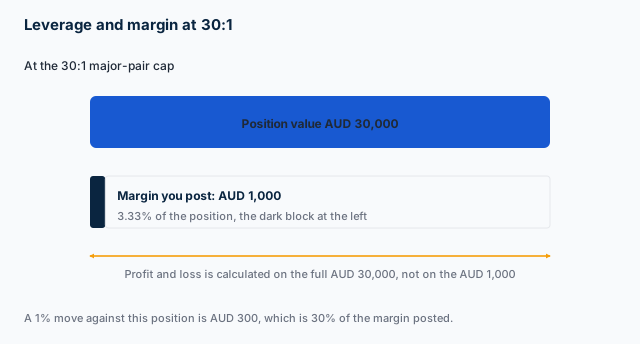
The diagram shows AUD 1,000 of margin supporting an AUD 30,000 position at the 30:1 major-pair cap, the same 3.33% margin rate the worked examples on this page use.
Here’s a simple example. The trade is a EUR/USD position worth AUD 30,000. Because EUR/USD is a major pair, ASIC’s Product Intervention Order applies the major-pair cap. The broker requires AUD 1,000 of margin to be posted (AUD 30,000 divided by 30), and that is the arrangement I would call leverage at the cap. AUD 1,000 is committed from the account balance; the broker carries the AUD 29,000 of position exposure on the client’s behalf, and the full P&L on the AUD 30,000 notional stays with the trader.
That AUD 1,000 is collateral, not a payment, and it’s locked while the position is open. It cannot be withdrawn, used to open another trade, or moved, and that lock is the part I would not ignore. When the position closes, the AUD 1,000 is released back to the free balance, plus or minus the P&L on the trade.
Margin is not a fee, not a charge, not interest. The fee structure on a CFD account is the spread, commission and overnight financing, and margin is separate from all of those.
To see the requirement for your own pair and position size, with the ASIC cap for each asset class applied automatically, try our forex margin calculator.
Why brokers require margin
Margin protects the broker against losses on a leveraged trade. Imagine AUD 1,000 of margin is posted to control AUD 30,000 of EUR/USD and the trade moves AUD 1,000 against the account. At that point, the broker is carrying the full risk on the remaining position. The close-out rule is the backstop I would want at exactly that point; ASIC’s close-out rule (described below) limits how far this can go.
The system works because retail accounts are diversified across hundreds of clients with offsetting positions, and brokers hedge the net exposure they carry. AUD 1,000 of margin is just one piece of the broker’s overall risk book.
Initial margin and maintenance margin
Two margin figures matter on every active CFD account.
Initial margin
Initial margin is the deposit required to open the position. It’s calculated as:
Initial margin = Position size / Leverage ratio
ASIC’s product intervention order sets maximum leverage by asset class for retail clients, and David Levy checked these tier limits against the source order. You’re capped at 30:1 on major forex pairs, with lower limits on everything else, and margin close-out at no less than 50% of initial margin. Our ASIC regulation guide sets out the full tier ladder.
Maintenance margin and ASIC’s 50% close-out rule
Once a position is open, the broker monitors the account equity against the initial margin in use. ASIC’s PIO sets a hard rule for retail clients:
The broker must start closing your positions by the time your account equity falls to 50% of the total initial margin used across all open positions.
The floor is regulatory, not broker discretion, and that is the part I’d stress. Before the PIO (pre-March 2021), brokers set their own close-out levels, typically 20 to 40%, and some retail accounts could ride positions all the way to 5% margin level. The PIO replaced that variability with a uniform 50% minimum across every ASIC-regulated retail account; a broker may set its own trigger higher, never lower.
Here’s the maths. With AUD 1,000 of initial margin committed across open positions, the broker must start liquidating by the time account equity drops to AUD 500. Positions are closed in order of largest unrealised loss first, which I would rather not learn by watching, until the close-out condition is no longer met or the account is flat.
Negative balance protection
That’s the other half of the retail protection package. ASIC mandates that retail accounts cannot go into negative equity. If a market gap or extreme move pushes account equity below zero, the broker absorbs the difference, so the account cannot owe the broker more than what is in it, and that absorption is the protection I would want.
Negative balance protection works alongside the 50% close-out rule, capping retail downside at ‘lose the deposit but no more’. Wholesale (professional) clients don’t get this protection and can be required to top up after a negative-equity event. Our negative balance protection guide covers the one situation that removes it.
Reading equity, free margin and margin level on your platform
On MT4, MT5, cTrader, TradingView or a proprietary platform like CMC’s Next Generation, the account summary displays four key numbers. Understanding what each one means separates an informed trader from one who learns the hard way, and those four are the numbers I would check before anything else.
| Figure | What it means |
|---|---|
| Balance | Your closed-out cash position. Doesn’t include unrealised P&L. |
| Equity | Balance plus or minus unrealised P&L on open trades. The live number. |
| Used margin | Total initial margin currently locked across open positions. |
| Free margin | Equity minus used margin. Available to open new positions. |
| Margin level (%) | (Equity / Used margin) × 100. The figure ASIC’s close-out rule watches. |
The equity figure is the one I would live by. It updates tick by tick as positions move. When equity drops toward 50% of used margin, the margin level percentage approaches 50%, and the close-out trigger with it.
A few example margin level readings:
- 300%+, comfortable. Plenty of cushion against adverse moves.
- 150 to 200%, trade is moving against you but you’re not at risk yet.
- 100%, equity equals used margin. Not yet at close-out, but the remaining buffer is thin.
- 50% and below, ASIC’s close-out rule is actively triggering. The broker is liquidating positions.
Brokers display this slightly differently. Some show ‘margin level %’ directly, others show ‘free margin’ and require the percentage to be computed, and some send push notifications, emails or in-platform warnings as the threshold approaches.
Worked example of a 0.1 lot EUR/USD position at the retail cap
Walk through one full position to see how the numbers move in practice.
The worked example starts with AUD 1,000 deposited into an ASIC-regulated retail account and one mini lot (0.1 standard lot, 10,000 units of base currency) of EUR/USD opened at 1.0850, which is the starting account I would use.
Position size and margin
A mini lot is 10,000 EUR. At 1.0850, that’s USD 10,850 of notional exposure. Converted at AUDUSD 0.65 (illustrative rate), that’s roughly AUD 16,690 of position size in AUD terms.
Initial margin = AUD 16,690 / 30 = AUD 556
So opening the trade locks AUD 556 of the AUD 1,000 deposit, leaving AUD 444 in free margin. Our forex position size calculator works the lot size back from a risk-per-trade rule and stop distance.
Your account summary at the moment of trade entry:
- Balance: AUD 1,000
- Equity: AUD 1,000 (no unrealised P&L yet)
- Used margin: AUD 556
- Free margin: AUD 444
- Margin level: 1,000 / 556 × 100 = 180%
180% is comfortable. You’ve got close to twice your used margin in equity.
Adverse move
Now suppose EUR/USD moves against the position by 100 pips, to 1.0750. On a 10,000-unit position, one pip is worth USD 1, so 100 pips is USD 100 of unrealised loss. At an illustrative AUDUSD rate of 0.65, that’s roughly AUD 154. Our profit and loss calculator shows this AUD result for any pair, direction and size.
Updated account summary:
- Balance: AUD 1,000
- Equity: AUD 846 (AUD 1,000 minus AUD 154 unrealised loss)
- Used margin: AUD 556
- Free margin: AUD 290
- Margin level: 846 / 556 × 100 = 152%
The position is still well above the close-out threshold. Equity would need to drop to AUD 278 (50% of used margin) for the close-out to trigger.
Approaching close-out
If EUR/USD keeps moving against you to 1.0670, that’s roughly 180 pips of total adverse movement, or AUD 278 of unrealised loss.
- Balance: AUD 1,000
- Equity: AUD 722
- Used margin: AUD 556
- Free margin: AUD 166
- Margin level: 722 / 556 × 100 = 130%
Still not at close-out. Close-out fires when your equity hits AUD 278, which is roughly 470 pips of adverse movement (AUD 722 of loss).
On a normal day, EUR/USD moves 60 to 100 pips. A 470-pip move demands a sustained directional trend over multiple sessions, typically with an event-driven shock (an NFP miss, an RBA rate surprise, a geopolitical headline); it’s possible, but the part I’d note is that it rarely happens inside a single day.
Here’s the lesson. With AUD 556 of margin on a single mini lot, the account can absorb meaningful adverse moves before close-out triggers. Trouble starts when traders open multiple positions or larger position sizes that consume more of the available margin. With AUD 1,000 of margin used (the maximum at the major-pair cap on a AUD 1,000 account), close-out triggers at AUD 500 of equity, which is half of the account balance gone. The rest of our forex calculators cover the pip value and profit and loss maths behind this worked example.
How margin call and stop-out changed under the PIO
Pre-PIO (before March 2021), Australian brokers operated a two-stage process:
- Margin call: a warning sent when account equity dropped to a broker-set level (commonly 80 to 100% margin level), asking the trader to deposit more funds or close positions
- Stop-out: the level at which the broker actually started closing positions, typically 20 to 50% margin level
Different brokers used different numbers, and the warning thresholds were broker discretion.
The PIO replaced this variability with a single rule: ASIC sets the close-out floor at 50% of initial margin (margin level 50%) for retail clients. Every ASIC-regulated broker offering CFDs to retail must close out by that level at the latest, and may set its own trigger higher. Brokers can still send warning notifications above the close-out level (push, email, in-platform), but the minimum close-out point is now regulated rather than broker-set.
Broker variations on margin notification
Although the close-out level is uniform, brokers differ in how they warn you that you’re getting close.
| Broker | Margin notification method | Close-out level |
|---|---|---|
| CMC Markets | Email + in-platform | 50% of initial margin (ASIC) |
| IG Markets | Email + in-platform + push | 50% of initial margin (ASIC) |
| Pepperstone | Email + push (MT4/MT5/cTrader) | 50% of initial margin (ASIC) |
| IC Markets | Email + push | 50% of initial margin (ASIC) |
| eToro | In-app + email | 50% of initial margin (ASIC) |
| Plus500 | In-platform + email + push | 50% of initial margin (ASIC) |






Confirm notification preferences in your broker’s account settings before placing leveraged trades. Push notifications on mobile are the fastest channel; email can lag by minutes.
Retail margin rules are identical across every ASIC broker, so the real differences sit in pricing and platforms. The comparison I’d start with is the top ASIC-regulated brokers we rank.
Common margin mistakes Australian traders make
Confusing initial margin with the only money at risk
In our worked example, the AUD 556 of initial margin is the deposit required to open the position, not your maximum loss. The full account equity is at risk on the trade, capped at zero by negative balance protection. Many new traders read ‘initial margin: AUD 556’ as a cap on losses, and it is not one.
Over-using free margin to add positions
With AUD 444 of free margin remaining, the temptation is to open another position. But 56% of the account has already been used on the first trade. Adding another doubles the exposure and halves the buffer against close-out. Professional AU traders often keep free margin at 50%+ of total balance at all times.
Ignoring used margin across multiple positions
The 50% close-out rule applies to total used margin across all open positions, not per trade. If five positions are opened each using AUD 200 of margin (AUD 1,000 total), the close-out triggers when total equity falls to AUD 500. A single bad trade in one of the five can push the whole account toward close-out.
Not checking the broker’s notification settings
Push notifications on mobile, email warnings, in-platform alerts. Brokers default to different combinations: some default to email only (the slowest channel), while others allow thresholds to be configured (e.g., a warning at 150% margin level, another at 110%). These should be set before they are needed.
Margin is the mechanism, but the stop is what keeps the account away from it. Our forex stop loss orders for Australian traders page covers that side, and the wider picture sits in our forex education hub.
FAQs
What's the margin requirement for forex trading in Australia?
What does ASIC's 50% margin close-out mean?
Can I lose more than my deposit on a margin account in Australia?
What's the difference between initial margin and maintenance margin?
How is margin level calculated?
Will my broker call or email me before margin close-out?
Related pages
About the author

Justin co-founded CompareForexBrokers in 2014 and has traded forex since 1998. Based in Melbourne, he has tested every ASIC-regulated broker on this site personally and has written for Forbes, Kiplinger, Finance Magnates, the Australian Financial Review and The Age. He holds a Bachelor of Commerce (Honours) and a Master of Marketing from Monash University. Justin is the co-founder and CEO of CompareForexBrokers.