
What ASIC regulation means for retail traders
ASIC regulation means the broker used by an Australian retail trader holds an Australian Financial Services Licence and must follow the CFD Product Intervention Order, so you get leverage capped at 30:1 on major pairs, negative balance protection, segregated client money, banned bonuses, and AFCA membership for disputes. It has applied to every AFSL-holding CFD issuer since 29 March 2021.
That single paragraph is the whole deal. The rest of this page unpacks each protection, what it costs a trader in practice, and where the safety net has holes that broker marketing tends not to mention. Every figure carries its source and date, so you can check each claim directly.
The framing point before the detail is this. ASIC does not vet brokers for quality, pricing or honesty of marketing. An AFSL tells a trader the entity met the licensing bar and is subject to the rules below, but it does not tell a trader the spreads are fair. That part sits with the trader, or with our ranked list of ASIC-regulated brokers, where we test pricing with live accounts and where I would start before opening any account.
The Product Intervention Order caps
ASIC Corporations (Product Intervention Order - Contracts for Difference) Instrument 2020/986 is the legal instrument behind the caps. It took effect on 29 March 2021 (ASIC media release 21-060MR) and was extended by Instrument 2022/259 for a further five years, to 23 May 2027 (ASIC media release 22-082MR, 6 April 2022), a date I would not want to trade without.
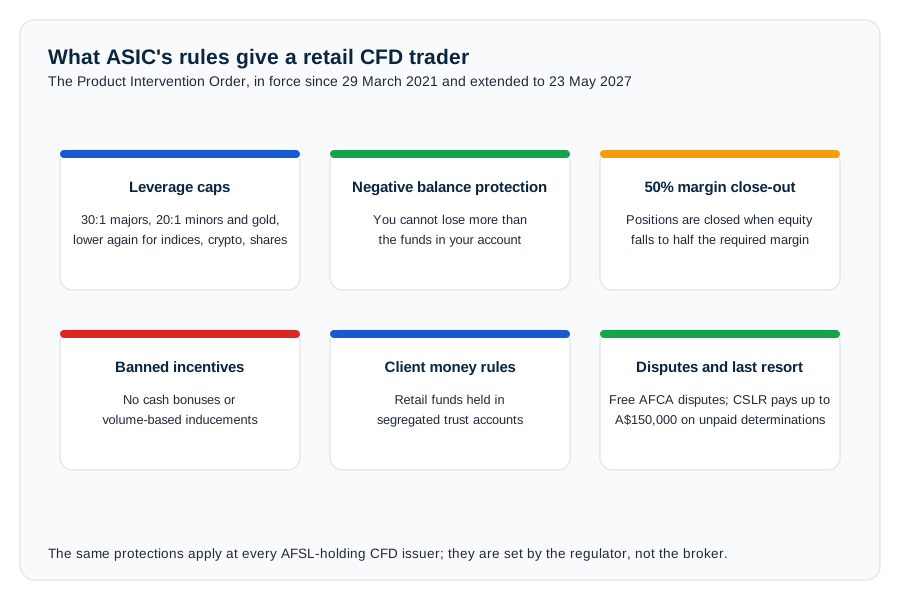
The diagram shows the six protections together for a reason: they read as one package rather than a menu, and I would not want to trade without any of them. Leverage caps limit the size of a position, the 50% close-out and negative balance protection limit what a losing one can cost, and the inducement ban and client money rules limit what the broker can do around it. AFCA sits behind the package for disputes. The CSLR’s scope leaves forex and CFD trading out.
Retail leverage caps under the order:
| Asset class | Maximum retail leverage |
|---|---|
| Major forex pairs | 30:1 |
| Minor forex pairs, gold, major indices | 20:1 |
| Commodities (excluding gold), minor indices | 10:1 |
| Shares and other reference assets | 5:1 |
| Crypto assets | 2:1 |
Alongside the caps, the order also requires margin close-out at no less than 50% of initial margin, mandatory negative balance protection for retail clients, and a ban on inducements such as deposit bonuses and rebate promotions to retail clients. The position-sizing maths behind these caps, with the margin formulas and worked AUD examples, is on our leverage guide, and our margin calculator applies the right cap to a position size you enter. These same protections decide which brokers earn trust: our safest forex brokers guide scores them on it, the negative balance protection guide shows how the loss floor works in practice, and the high-leverage brokers guide explains what leaving the 30:1 cap actually costs.
The caps are identical at every ASIC broker, so a broker advertising “flexible leverage up to 500:1” to Australian retail clients is either describing its wholesale tier or its offshore entity. The distinction matters, and I would check it every time; it is covered below.
ASIC measured the damage before it wrote the order. In REP 828, published 20 January 2026, ASIC reported that 68% of retail CFD investors lost money in the 2024 financial year. That figure sits alongside trader counts, account sizes and platform usage in our forex trading statistics Australia reference set.
Negative balance protection
Can an account go below zero? No. On an ASIC retail account, negative balance protection limits your losses to the funds in the CFD trading account. If a market gaps through a stop and the equity would land negative, the broker wears the shortfall.
Since the Product Intervention Order took effect on 29 March 2021, this protection has been mandatory for every retail account, so you now have it by default. Before then it was a marketing feature some brokers offered and some did not. The January 2015 Swiss franc de-peg, which left retail accounts across the industry owing brokers money, is the scenario the rule exists to prevent.
Two boundaries I would want any trader to know. The protection applies to the CFD account as a whole, not per trade. Wholesale clients are excluded: qualify as wholesale for the higher leverage and negative balance protection goes with it.
Client money rules and the CSLR
Client money at an ASIC broker must be held in segregated trust accounts with Australian authorised deposit-taking institutions, separate from the broker’s operating funds, under Part 7.8 of the Corporations Act. Segregation protects your funds from being used to run the broker’s business. It is not a guarantee against every failure mode, and Australia has no direct equivalent of the UK’s FSCS deposit-style compensation for trading accounts.
The nearest thing is the Compensation Scheme of Last Resort. Operational since 2 April 2024, it pays up to A$150,000 per claim where a firm fails to pay an AFCA determination (source: cslr.org.au and asic.gov.au, checked July 2026), so if you win an AFCA determination that goes unpaid, this is the safety net.
Here is the part most comparison sites skip: CFD trading losses generally sit outside the CSLR. The scheme covers four subsectors: personal financial advice to retail clients, credit provision, credit intermediation, and dealing in securities for retail clients. A complaint about a CFD broker’s conduct is a derivatives matter, not one of the four. The CSLR is a safety net for advice victims, not insurance on a trading account.
AFCA: your dispute path
The Australian Financial Complaints Authority is the free external dispute resolution body every retail-facing AFSL holder must belong to. When a broker mistreats you, the path runs:
- Complain to the broker in writing first. The broker must respond through its internal dispute resolution process, normally within 30 days.
- No response or a poor one? Lodge with AFCA online. Lodging costs you nothing, and the broker pays the case fees.
- AFCA investigates and issues a determination. Once you accept it, the determination binds the broker.
Effective 1 January 2024, the monetary limits let AFCA consider claims you bring up to A$1,263,000 and award compensation up to A$631,500 for most direct financial loss claims (source: afca.org.au, AFCA Rules; the limits are indexed three-yearly, next on 1 January 2027). Superannuation complaints are uncapped, and some claim types carry lower sub-caps.
Before any broker is listed on this site, we confirm its AFCA membership. A broker that drops the membership comes off the list.
How to verify an AFSL on the Professional Registers Search
I would give this check about two minutes. A worked example with Pepperstone, the top-ranked broker in our 2026 testing:
- Open ASIC’s Professional Registers Search at service.asic.gov.au/search.
- Search the licence number you find in the broker’s website footer or PDS, then filter the results to the “Australian Financial Services (AFS) licensees” register, checking the result is on the register you want. For Pepperstone that number is 414530.
- Confirm the result: the licensee is Pepperstone Group Limited, status Current. The entity name should match the one named in the PDS exactly.
- Open the licence record, then confirm the authorisations cover derivatives and foreign exchange contracts for retail clients.
- Cross-check the entity, not just the brand. Some brands run several entities. IC Markets (AFSL 335692) and Fusion Markets (AFSL 385620, held by FMGP Trading Group Pty Ltd) both check out. The FMGP example is the one to study because it shows why the entity name matters, since the same licensee also operates the Global Prime brand. This verification process is run by the live capture programme Noam Korbl runs.
When the licence number on a broker’s website returns nothing on the Professional Registers Search, or returns a different company, stop. That mismatch is a clear warning sign of a scam.
Wholesale client classification: what you give up
The Corporations Act lets a trader opt out of retail protections by qualifying as a wholesale client. The two common tests: net assets of at least A$2.5 million, or gross income of at least A$250,000 in each of the last two financial years, certified by a qualified accountant.
Qualify, and brokers can offer leverage up to 500:1. You also give up negative balance protection, the 50% margin close-out standard, the PIO caps and, for some complaint types, AFCA access. The trade is real: higher leverage against the full retail safety net, and I would not make it. The short version is that most traders who can qualify still should not.
Why the same broker offers 500:1 offshore
Search any large broker’s name and versions of it appear offering 500:1 leverage with no wholesale test. Same brand, different company. Pepperstone’s Australian clients face ASIC’s caps under Pepperstone Group Limited; clients who sign up through an offshore entity of the same group, often licensed in the Seychelles, Vanuatu or the Bahamas, sit outside ASIC’s rules entirely.
Going through the offshore entity means you lose the Product Intervention Order caps, and also no negative balance protection mandate, no Corporations Act client money segregation, no AFCA. If the offshore entity fails or refuses to pay out, recourse runs through that jurisdiction’s courts, not Australia’s. This site reviews Australian entities only, which is why every broker listed holds a current AFSL. The higher offshore leverage is real; so is the missing safety net, and I would not trade without the protections.
The rest of this material sits inside the frame of regulation. For the wider picture, from position sizing to chart patterns, the starting point is our forex education hub.
FAQs
Is forex trading legal in Australia?
Can I lose more than my deposit with an ASIC broker?
What is the CSLR limit?
How do I check if a broker is ASIC regulated?
Related pages
About the author

Justin co-founded CompareForexBrokers in 2014 and has traded forex since 1998. Based in Melbourne, he leads the site's research, and has written for Forbes, Kiplinger, Finance Magnates, the Australian Financial Review and The Age. He holds a Bachelor of Commerce (Honours) and a Master of Marketing from Monash University. Justin is the co-founder and CEO of CompareForexBrokers.