
Summary of leverage caps for Australian retail traders
If you only read this far, here’s what I’d want you to know: under ASIC’s Product Intervention Order (in force since 29 March 2021 and extended to 23 May 2027), major forex pairs carry a retail cap of 30:1, and every other asset class sits lower. The full tier ladder, from minor pairs down to crypto, is set out in our ASIC regulation guide.
Every ASIC-regulated retail account in Australia sits under these caps. Brokers cannot go higher, no matter what, so you can size your trades from a known ceiling. I consider that a useful constraint. Wholesale (professional) clients can request more, typically up to 500:1, but only after meeting the Corporations Act wholesale tests certified by an accountant. Our guide to high-leverage forex brokers in Australia sets out what that wholesale route costs in protections.
Margin close-out is set at 50% of initial margin, so brokers must start closing positions when equity drops to that level. Negative balance protection is mandatory for retail clients, and bonuses and trading inducements to retail clients are banned. I consider that ban a strong consumer safeguard, meaning you are not tempted by inducements that encourage over-trading.
Margin Calculator
Margin required under ASIC leverage caps
Rates as of Fri 25 Sep 2026, 5pm New York close
A 0.30-lot EUR/USD position needs A$1,623.25 margin at the ASIC 30:1 cap.
A$1,623.25
margin required
- Notional valueA$48,697.57
- ASIC leverage cap for major forex pairs30:1
- Margin rate3.33%
- Close-out floor (50% of margin)A$811.63
I’d run this maths on any trade before committing capital. Let’s walk through what the 30:1 cap means for a single trade, 25 September 2026. A 0.30-lot EUR/USD position is A$48,698 of exposure. At the major-pair cap the margin rate is 3.33%, so the initial margin is A$1,623.25, and the 50% close-out floor sits at A$811.63 of equity. Change the pair, lot size or account currency above to see how the numbers shift for your own position.
What is leverage in forex?
Leverage lets you control a larger position than your cash balance would otherwise allow. I’d call it a loan from the broker, secured by account equity, used to amplify exposure on a trade.
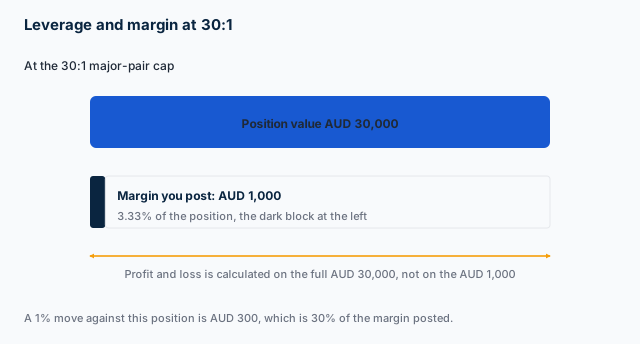
The diagram shows AUD 1,000 of margin supporting an AUD 30,000 position at the 30:1 major-pair cap. Profit and loss are calculated on the full AUD 30,000, so a 1% move is AUD 300, or 30% of the margin posted. I’d note that a 1% move in forex is not unusual, so you can expect that kind of swing on a regular basis.
Here’s the simplest framing I’d offer. With AUD 10,000 in a trading account and 10:1 leverage, positions of up to AUD 100,000 are possible. The AUD 10,000 is the margin. The other AUD 90,000 is the broker’s exposure. Profit and loss are calculated on the full AUD 100,000, not on the AUD 10,000 you put up.
That’s the appeal, and the risk I want to highlight. A 1% favourable move on AUD 100,000 is AUD 1,000 of profit, a 10% return on the AUD 10,000 committed. The flip side is identical: a 1% adverse move is AUD 1,000 lost, also 10% of the committed capital. Leverage cuts both ways and the maths is symmetric.
Forex leverage is expressed as a ratio. At 10:1, every AUD 1 of margin controls AUD 10 of position. At 5:1, each AUD 1 controls just AUD 5. The lower the ratio, the more cash required to open the same trade, so you need more capital to commit.
Leverage versus margin
Traders often mix up leverage and margin, but they’re not the same. Leverage is the ratio. Margin is the dollar figure. Opening a AUD 30,000 EUR/USD position at the major-pair cap requires initial margin of AUD 1,000, the position size divided by the leverage ratio. Same trade, two ways of describing the same number.
How ASIC’s caps apply across asset classes
ASIC introduced the leverage caps in March 2021 after Australian retail traders were losing money at high rates on CFD products. The order was extended by ASIC in 2022 for a further five years, to 23 May 2027. It covers every CFD product offered to retail clients by an Australian Financial Services Licence holder, which means your broker must comply.
I’d highlight two details that trip people up. The “major” forex list is specific: the instrument defines a major pair as any two of the Australian dollar, British pound, Canadian dollar, euro, Japanese yen, Swiss franc and US dollar. So AUD/USD, AUD/JPY and EUR/AUD all take the 30:1 cap. If a pair involves any currency outside those seven, like AUD/NZD or NZD/USD, it drops into the tighter minor-pair tier. Crypto CFDs took the sharpest cut of all, down from the 100:1 some brokers once offered on Bitcoin to a small fraction of that today.
How margin works across initial margin, maintenance margin and close-out
Initial margin is the cash required to open a position. The formula is straightforward:
Initial margin = Position size / Leverage ratio
Open a EUR/USD position worth AUD 30,000 at the major-pair cap and the initial margin is AUD 30,000 / 30 = AUD 1,000.
Once the position is live, that AUD 1,000 is locked and cannot be withdrawn. The remaining account balance is the free margin, which absorbs the trade’s mark-to-market profit and loss.
Margin close-out at 50%
ASIC’s Product Intervention Order also sets a mandatory margin close-out level for retail clients. When account equity falls to 50% of the total initial margin used across all open positions, the broker must start closing positions, starting with the largest unrealised loss.
Example. Suppose a trader has AUD 1,000 of initial margin tied up in one EUR/USD trade. If unrealised losses cut account equity to AUD 500 (half of the initial margin), the close-out triggers. The broker liquidates the position. The trader cannot override this. It’s regulatory, not broker discretion.
The close-out exists to stop retail accounts going negative. Combined with mandatory negative balance protection, you can’t lose more than you deposit on an ASIC-regulated retail account.
What “free margin” means in your trading platform
In MT4, MT5, cTrader or a broker’s web platform, four numbers appear in the account summary:
- Balance, closed-out cash position
- Equity, balance plus or minus unrealised P&L on open trades
- Used margin, initial margin currently locked across open positions
- Free margin, equity minus used margin
Keep an eye on the equity number. That’s the live one. When equity drops toward 50% of used margin, close-out is approaching.
Retail versus wholesale leverage in Australia
The PIO caps bind Australian retail clients; wholesale (professional) clients sit outside them. To qualify as wholesale under the Corporations Act, a trader typically needs net assets of AUD 2.5 million or gross income of AUD 250,000 across two consecutive years, certified by an accountant. That lets a broker offer higher leverage at its discretion, typically up to 500:1 on major pairs. The trade-off is real: wholesale classification strips out negative balance protection, the mandatory 50% margin close-out and some AFCA dispute access, so for most traders it is not a fair swap. The full wholesale-client tests, the tier-by-tier caps and exactly what is forfeited are set out in our ASIC forex regulation guide.
A worked AUD example at the retail cap
Concrete numbers always make this easier. Let’s walk through a single trade.
I’ll walk you through a worked example. Deposit AUD 1,000 into an ASIC-regulated retail account and open one mini lot of EUR/USD at 1.0850. EUR/USD is a major pair, so it takes the major-pair cap.
Position size and margin
A mini lot is 10,000 units of the base currency. So you’re buying 10,000 EUR. At 1.0850, that’s USD 10,850 of notional exposure. Converted to AUD at AUDUSD 0.65 (illustrative rate), that’s roughly AUD 16,690 of position size.
Initial margin = AUD 16,690 / 30 = AUD 556
The margin required is AUD 556 of the AUD 1,000 balance, leaving AUD 444 in free margin. I’d use the margin calculator to run this AUD 556 figure for any pair, lot size and leverage tier.
Pip value
On EUR/USD a pip is the fourth decimal place. Put a 10,000-unit (mini lot) position behind it and one pip is worth USD 1, which at AUDUSD 0.65 is roughly AUD 1.54. The forex pip value calculator converts one pip to AUD for any pair and lot size.
| EUR/USD move | P&L (USD) | P&L (AUD) | Account impact |
|---|---|---|---|
| +20 pips (to 1.0870) | +USD 20 | +AUD 31 | +3.1% on AUD 1,000 |
| +50 pips (to 1.0900) | +USD 50 | +AUD 77 | +7.7% on AUD 1,000 |
| +100 pips (to 1.0950) | +USD 100 | +AUD 154 | +15.4% on AUD 1,000 |
| -20 pips (to 1.0830) | -USD 20 | -AUD 31 | -3.1% on AUD 1,000 |
| -50 pips (to 1.0800) | -USD 50 | -AUD 77 | -7.7% on AUD 1,000 |
| -470 pips (close-out) | -USD 470 | -AUD 723 | Equity at 50% of margin, position liquidates |
This close-out arithmetic is the one I would internalise first. Equity starts at AUD 1,000 and the close-out floor is AUD 278 (50% of the AUD 556 initial margin), so the position can absorb about AUD 722 of unrealised loss before ASIC’s close-out rule kicks in. At AUD 1.54 per pip, that is roughly 470 pips of EUR/USD movement against you.
That buffer sounds generous, and on a single mini lot it is. EUR/USD moves 60 to 100 pips on a normal day and can move 200+ pips on a major data print, so a sustained trend against the position can still exhaust the buffer over a week or two. Larger position sizes shrink that buffer much faster. This is why I would focus on position sizing before the leverage cap.
Same trade, different position sizes
Open two mini lots instead of one on the same AUD 1,000 deposit and the initial margin doubles to AUD 1,112. That is already above the account balance, so the broker would reject the order. The major-pair cap leaves room for roughly 1.7 mini lots of EUR/USD on a AUD 1,000 deposit before you run out of margin to open.
No sensible trader would max out in practice. A common rule among AU traders we survey is to risk no more than 1% to 2% of the account per trade. On AUD 1,000, that is AUD 10 to AUD 20 of risk, which is 6 to 13 pips of stop-loss distance on a single mini lot. The leverage caps do not stop over-sizing; they just slow you down. Our trading calculators run the margin, pip value and position size behind this example for any trade.
Why ASIC capped leverage in the first place
The Product Intervention Order was not a sudden decision. ASIC ran a market-wide review of CFD trading outcomes for Australian retail clients in 2019 and 2020, and the findings were grim. I would read those findings as the reason the cap exists.
ASIC drew on broker disclosures during the review, and the retail CFD account performance data showed:
- 65% to 85% of retail CFD accounts at major Australian brokers lost money over the review period
- Average losses far outweighed average gains across the active client population
- Leverage was the single biggest driver of large losses, with 100:1 to 500:1 retail accounts (the pre-PIO norm) producing the worst outcomes
- Retail clients overwhelmingly underestimated the risk of leveraged products at sign-up
Those leverage caps are calibrated against equivalent ESMA rules in Europe, introduced in 2018, and those rules showed a measurable reduction in retail losses post-implementation. ASIC followed a similar template, which is why I would not call the local cap experimental.
ASIC considered requiring each broker to display its own loss percentage, as proposed in Consultation Paper 322, then decided against it, so Australian brokers publish no such figure. The regulator reports the sector number itself instead: 68% of retail CFD investors lost money in the 2024 financial year (REP 828, published 20 January 2026).
That is the regulatory context. ASIC saw retail CFD trading producing systematically poor outcomes, and it judged the leverage cap the most direct lever to reduce harm. The statistic I keep coming back to is the 72% of retail CFD clients ASIC found losing money in its 2019 review (REP 626), the headline statistic that drove the change.
Comparing leverage between Australian brokers
Retail clients get the same maximum leverage at every ASIC broker. That is the point of a regulator-imposed cap. A broker can still apply less than the ceiling, and Interactive Brokers does, classifying every AUD pair, AUD/USD included, as a minor at 20:1 rather than a major at 30:1. ASIC’s caps set the same ceiling for the brokers our team reviews on our reviews page, so retail leverage alone rarely separates them. I would not spend comparison time there.
The differences sit in two places: how easily a broker moves a trader into the wholesale tier, and what offshore options exist for clients who want higher leverage outside the ASIC framework. For a broader comparison beyond leverage, start with the ASIC-regulated brokers we rank highest. To translate a leverage cap into an actual trade size for your account balance and risk, use our position size calculator.
| Broker | Wholesale tier | Offshore option for high leverage |
|---|---|---|
| CMC Markets | Available, conservative | None offered |
| IG Markets | Available, conservative | IG global brand (varies by country) |
| Pepperstone | Yes, up to 500:1 | Pepperstone Bahamas (SCB-regulated) |
| IC Markets | Yes, up to 500:1 | IC Markets Global (FSA Seychelles) |
| Vantage | Yes, up to 500:1 | Vantage Global (VFSC Vanuatu) |
| TMGM | Yes, up to 500:1 | TMGM offshore (VFSC Vanuatu) |
| Fusion Markets | Yes | Fusion Markets International (VFSC) |







Move to a broker’s offshore entity and you trade away ASIC oversight, AFCA dispute resolution, the AUSTRAC framework, and the segregated client money rules under the Corporations Act. That makes you a client of an offshore licensee with weaker protections. Some Australian traders make that trade-off knowingly. Many do not realise what they have signed away.
Qualified traders who want higher leverage should consider the wholesale tier on an ASIC broker as the safer route, and that is the one I would take. For those who do not qualify, and cannot, the honest answer is that the retail caps are designed for your own protection. Trade smaller positions, not bigger leverage.
Common leverage mistakes Australian traders make
Confusing maximum leverage with required leverage
Think of the retail cap as a ceiling rather than a target. No one has to use it. A EUR/USD position can run at effectively 5:1 leverage simply by depositing more margin than the minimum required. Maximum leverage is what the broker will allow; effective leverage is what you actually choose to run, and lower is usually safer.
Over-sizing relative to account equity
This is the most common mistake we see. A trader with AUD 2,000 opens three to five mini lots on EUR/USD because the leverage cap permits it. The 50-pip adverse move that is normal intraday becomes AUD 230 to AUD 380 of loss, or 11 to 19% of the account. Two of those in a row and the trader is down 30%; three of those and they are approaching margin close-out.
Base position sizing on the dollar risk per trade, not on what the leverage cap allows. The standard professional rule is 1% risk per trade. On AUD 2,000, that is AUD 20 risk. With a 20-pip stop, that is a position size of one mini lot. The leverage cap permits five times that, but that does not mean you should use it.
Ignoring overnight swap costs
Hold a leveraged position overnight and it accrues swap (rollover) interest. The swap is calculated on the full notional position size, not on the margin you committed. A AUD 30,000 position attracts swap on AUD 30,000, not on the AUD 1,000 of margin used to open it. On a high-leverage account this can compound quickly, and a negative-swap position held for two weeks can cost more than the trade’s potential profit on a small move.
Before you hold positions overnight, check the broker’s swap rates, especially across weekends, where Wednesday swaps are typically tripled to cover Saturday and Sunday.
Gap risk on weekends and around news
Forex markets close from roughly 5pm Friday New York time to 5pm Sunday New York time (so 7am Saturday AEDT to 7am Monday AEDT). A market-moving event during that window can gap prices on Monday’s open. The position you hold through the weekend can move significantly more than your stop-loss distance.
ASIC’s negative balance protection caps the downside at zero account equity, but that does not mean the deposit is safe. A gap move can still consume the entire deposit. Do not carry leveraged positions through weekends unless you have sized them for the gap risk specifically.
Trading the leverage, not the strategy
Leverage does not generate edge. It amplifies whatever edge, or lack of edge, your strategy already has. A strategy with a positive expected value of 0.2R per trade at 5:1 leverage still has the same 0.2R at the retail cap. The difference is variance. Higher leverage means bigger swings around the same expected value, and for most traders that is worse, not better.
One dial among several is leverage, and it does least on its own. To see how it sits alongside margin, stops and sizing, work through our forex education hub.
FAQs
What's the maximum leverage for forex trading in Australia?
Why did ASIC cap retail leverage?
Can I legally get higher leverage in Australia?
What does margin close-out at 50% mean?
Is the retail leverage cap enough to trade profitably?
Should I use an offshore broker to get higher leverage?
Related pages
About the author

Justin co-founded CompareForexBrokers in 2014 and has traded forex since 1998. Based in Melbourne, he has tested every ASIC-regulated broker on this site personally and has written for Forbes, Kiplinger, Finance Magnates, the Australian Financial Review and The Age. He holds a Bachelor of Commerce (Honours) and a Master of Marketing from Monash University. Justin is the co-founder and CEO of CompareForexBrokers.