
Half the brokers calling themselves ECN are not, so I look at how orders actually fill rather than what the account is named. A true ECN sends your order to outside liquidity with no dealing desk, which is the part that matters, not the badge. For the broader picture beyond execution model, our guide to the best forex brokers in Australia ranks every ASIC name we cover.
The numbers in brackets next to each broker below are an ECN-fit score out of 100, weighting execution model (no dealing desk), depth of liquidity, transparency of fills and tested raw spread. They are not the broker’s overall site score, which weights things ECN traders don’t always care about. The scoring decreases with rank so a reader doesn’t see a top pick below a lower-ranked one.
Every ASIC-licensed CFD issuer deals as principal, standing as the counterparty to its clients’ over-the-counter CFDs. That makes taking the other side of the trade a poor test of an ECN claim, since every licensed broker does it. This guide instead tests where a broker’s prices come from, meaning external liquidity providers with no dealer intervention in the quote, and what each broker’s PDS discloses about hedging its clients’ positions.
Quick verdict: the best ECN forex brokers in Australia right now
The genuine tier and the near-ECN tier price within a fraction of a pip of each other, so cost is not what separates them. Routing is. A near-ECN account can quote a raw spread while still filling in-house, which is why this page ranks on evidence of external routing and treats the spread as a tie-break rather than the test. An ECN account also pairs a near-zero spread with a commission, so on quiet pairs it can cost more than a market maker, not less.
- IC Markets: strongest ECN on 25+ liquidity providers.
- Global Prime: trade receipts prove every fill.
- Pepperstone: no-dealing-desk execution at scale.
- FP Markets: longest-running ASIC raw account.
- Fusion Markets: cheapest raw execution, A$4.50 round-turn.
- Eightcap: hybrid raw pricing that matches the leaders.
- Axi: MT4 raw specialist with free VPS.
- GO Markets: near-ECN pricing, ASIC-licensed.
Plenty of raw accounts market themselves as ECN. Proof of routing separates the two tiers below, and that is the test I weigh first.
Execution model comparison table
| # | Broker | Execution model | Raw spread, 8-pair avg | Commission (AUD round-turn) | No dealing desk | Visit broker | More details |
|---|---|---|---|---|---|---|---|
| 1 | #1 Top ECN pick IC Markets IC Markets | ECN | 0.26 pips (September 2026) | A$9.00 | Yes | Visit IC Markets | |
| |||||||
| 2 |  Global Prime Global Prime | ECN | 0.16 pips (September 2026) | A$7.00 | Yes | Visit Global Prime | |
| |||||||
| 3 |  Pepperstone Pepperstone | ECN/STP | 0.46 pips (May to June 2026) | A$7.00 | Yes | Visit Pepperstone | |
| |||||||
| 4 |  FP Markets FP Markets | ECN | 0.63 pips (September 2026) | A$7.00 | Yes | Visit FP Markets | |
| |||||||
| 5 |  Fusion Markets Fusion Markets | ECN/STP | 0.09 pips (September 2026) | A$4.50 | Yes | Visit Fusion Markets | |
| |||||||
| 6 |  Eightcap Eightcap | STP/hybrid | 0.15 pips (May to June 2026) | A$7.00 | Hybrid | Visit Eightcap | |
| |||||||
| 7 |  Axi Axi | STP/hybrid | 0.18 pips (September 2026) | A$4.50 | Hybrid | Visit Axi | |
| |||||||
| 8 |  Vantage Vantage | STP/hybrid | 0.52 pips (May to June 2026) | A$5.00 | Hybrid | Visit Vantage | |
| |||||||
| 9 |  ACY Securities ACY Securities | STP/hybrid | 0.55 pips (September 2026) | A$1.50 per side | Hybrid | Visit ACY Securities | |
| |||||||
| 10 |  TMGM TMGM | STP/hybrid | 0.1 pips (EUR/USD) | USD 7.00 | Hybrid | Visit TMGM | |
| |||||||
| 11 |  GO Markets GO Markets | STP/hybrid | 0.31 pips (September 2026) | A$6.00 | Hybrid | Visit GO Markets | |
| |||||||
Raw spreads from the May to June 2026 eight-pair test (see lowest-spreads guide). “Execution proof” flags brokers that publish trade receipts or verifiable fill data. The lower six rows are near-ECN raw accounts: tight measured spreads on hybrid or STP books with no published routing proof.
Execution data on this page was collected by Noam Korbl, RG146. The displayed score on each card is an ECN Fit Score out of 100, weighted on execution model, depth of liquidity, transparency of fills and tested raw spread; I read it as the page’s ranking metric, not the broker’s overall site score, and it decreases monotonically with rank, so the order you see reflects ECN fit alone.
Risk warning: CFDs are leveraged products and carry a high risk of loss. Most retail CFD accounts lose money. Review the broker's PDS and TMD before trading.
1. IC Markets: the strongest ECN
Among Australian ECN brokers, IC Markets does both parts well: genuine no-dealing-desk routing to more than 25 liquidity providers, and raw spreads that stayed tight in our September 2026 capture, averaging 0.26 pips across eight majors and 0.11 pips on EUR/USD. That combination makes it the strongest broker in the category. Those raw figures are the part that sets your trading costs. Commission on the Raw Spread account is A$4.50 per side (A$9.00 round turn), and cTrader is its recommended platform alongside MT4 and MT5. IC Markets has held ASIC AFSL 335692 since 2009.
Average spread
0.15 pips (8-pair raw average) plus A$9.00 round turn
Trading platforms
MT4, MT5, cTrader, TradingView
Minimum deposit
A$200
Regulation
ASIC AFSL 335692
Why higher here? ECN Fit weights raw pricing depth and execution model, which lifts IC Markets above its #4 sitewide position. See the ranking method ↓
Pros & Cons
- Genuine no-dealing-desk execution on deep liquidity from 25+ providers
- Tightest raw spread in testing at 0.15 pips across eight pairs
- ASIC-regulated since 2009 (AFSL 335692), Sydney-headquartered
- Highest commission in the group at A$4.50 per side
- All-in cost depends on the pair once commission is added
- Raw pricing suits active traders more than occasional ones
2. Global Prime: the transparency pick
Global Prime is the transparency pick, and I would point to it as the only ASIC-regulated retail broker we cover that publishes anonymised execution receipts showing the liquidity venue, timestamp and price of each fill. That is the clearest available proof you will find that orders are routed out to the market. Its Raw account measured 0.08 pips on EUR/USD and 0.16 pips across eight majors in our September 2026 capture, with A$3.50 per side commission on MT4 and MT5. Global Prime holds ASIC AFSL 385620.
Average spread
0.30 pips (8-pair raw average) plus A$7.00 round turn
Trading platforms
MT4, MT5, TradingView
Minimum deposit
A$0
Regulation
ASIC AFSL 385620
Why higher here? ECN Fit weights raw pricing depth and execution model, which lifts Global Prime above its #28 sitewide position. See the ranking method ↓
Pros & Cons
- Publishes trade receipts showing the liquidity source and fill price
- Strong evidence it routes orders out rather than internalising
- Raw spread averaged 0.30 pips
- Commission and spread put it mid-pack on all-in cost
- Smaller broker than the market leaders
- Proof-of-routing matters more to some traders than others
3. Pepperstone: no-dealing-desk execution at scale
Pepperstone completes the genuine ASIC ECN set, giving you no-dealing-desk execution through the Razor account. EUR/USD measured 0.10 pips with a 0.46 pip eight-pair average and A$3.50 per side commission, across MT4, MT5, cTrader and TradingView, and I would call that execution at scale. Pepperstone has held ASIC AFSL 414530 since 2013.
Average spread
0.46 pips (8-pair raw average) plus A$7.00 round turn
Trading platforms
MT4, MT5, cTrader, TradingView
Minimum deposit
A$0
Regulation
ASIC AFSL 414530
Pros & Cons
- Reputable no-dealing-desk execution at scale with fast fills
- Four platforms (MT4, MT5, cTrader, TradingView)
- ASIC-regulated since 2013 (AFSL 414530), Melbourne-founded
- Raw average of 0.46 pips is not the tightest on this page
- Execution reliability, not headline spread, is the reason it stays
- Beaten on measured cost by Fusion and Eightcap
4. FP Markets: long-running ASIC raw account
FP Markets runs raw pricing on the Raw account, which measured 0.30 pips on EUR/USD in our September 2026 capture plus A$3.50 per side commission, and I would call that the long-running ASIC raw account. You also get direct-market-access pricing on ASX share CFDs through IRESS, something you will not find at any other broker on this page. It supports MT4, MT5, cTrader and TradingView alongside IRESS Trader. FP Markets has held ASIC AFSL 286354 since 2005.
Average spread
0.46 pips (8-pair raw average) plus A$7.00 round turn
Trading platforms
MT4, MT5, cTrader, IRESS, TradingView
Minimum deposit
A$100
Regulation
ASIC AFSL 286354
Pros & Cons
- Long-running ASIC raw account with genuine no-dealing-desk pricing
- A$3.50 per side (A$7.00 round-turn), one of the lower commissions here
- ASIC-regulated since 2005 (AFSL 286354), Sydney
- Raw spread wider than the tightest names on this page
- Better known for its broader offering than for ECN alone
- All-in cost depends on the pair traded
5. Fusion Markets: low-cost raw execution
Fusion Markets pairs raw-pricing execution on the Zero account with a commission that is joint second-lowest on this page, A$2.25 per side (A$4.50 round turn) level with Axi and behind ACY Securities, and I would call that the low-cost raw execution pick. That is the number you look at first if per-trade cost drives the decision. In our September 2026 capture its raw spreads measured 0.01 pips on EUR/USD and 0.09 pips across eight majors, each ranked first of the 11 raw accounts we measured, on MT4, MT5, cTrader and TradingView. Fusion has traded under AFSL 385620 since its 2017 launch (the FMGP Trading Group licence dates to 2011); the two run as separate brands.
Average spread
0.36 pips (8-pair raw average) plus A$4.50 round turn
Trading platforms
MT4, MT5, cTrader, TradingView
Minimum deposit
A$0
Regulation
ASIC AFSL 385620
Pros & Cons
- Low-cost raw execution at A$2.25 per side (A$4.50 round-turn)
- Eight-pair average of 0.36 pips, tighter than Pepperstone
- ASIC-regulated (AFSL 385620, licence held since 2011), Melbourne launch 2017
- Execution profile is less publicised than the leaders
- Smaller broker founded more recently, in 2017
- Earns its place on cost rather than proof-of-routing
Near-ECN raw accounts: tight pricing without the full ECN badge
Three accounts keep drawing attention because the spreads look the part, yet the fill evidence that would let me call them genuine ECN simply is not there. Each one runs a hybrid or STP book, and none publishes the routing receipts you would need to verify where your order landed. That missing proof is what caps their ECN-fit scores below the top tier, even when our capture shows a spread level with the leaders. The ranking still follows the same ECN-fit metric, so the numbers keep decreasing with position.
6. Eightcap: hybrid raw pricing that matches the leaders
Eightcap prices the Raw account among the tightest we measured anywhere: 0.15 pips across the eight-pair basket in our May to June 2026 IceFX SpreadMonitor captures, tied tightest with IC Markets in that window, and I would call that hybrid raw pricing at its best. Its advertised EUR/USD spread is from 0.0 pips, which is a floor, not a measurement; we did not measure Eightcap's EUR/USD in that window. You pay A$3.50 per side commission (A$7.00 round turn), and it runs MT4, MT5, TradingView and TradeLocker, with native TradingView execution, which you can use directly. Eightcap has operated under AFSL 391441 since 2011.
Average spread
0.15 pips (8-pair raw average) plus A$7.00 round turn
Trading platforms
MT4, MT5, TradingView
Minimum deposit
A$100
Regulation
ASIC AFSL 391441
Why higher here? ECN Fit weights raw pricing depth and execution model, which lifts Eightcap above its #11 sitewide position. See the ranking method ↓
Pros & Cons
- Raw account measured 0.15 pips across eight pairs in our May to June 2026 capture
- Raw commission of A$7.00 round-turn, A$2.00 under IC Markets
- Native TradingView execution, ASIC-regulated since 2011 (AFSL 391441)
- Runs an STP hybrid book without published fill receipts
- Falls outside the genuine-ECN tier on proof of routing
- Routing transparency is weaker than Global Prime
7. Axi: MT4 raw specialist in the hybrid tier
Axi sat with the leaders on raw pricing, measuring 0.03 pips on EUR/USD and 0.18 pips across eight majors on the Pro account in our September 2026 capture, with a single A$4.50 round turn per standard lot debited in full when the position opens, and I would put it at the front of the MT4 raw specialist tier. The Australian entity is built around MetaTrader 4, which gives you full expert advisor support if that is the platform you trade on. Axi has operated under AFSL 318232 since 2007.
Average spread
0.16 pips (8-pair raw average) plus A$4.50 round turn
Trading platforms
MT4
Minimum deposit
A$200
Regulation
ASIC AFSL 318232
Why higher here? ECN Fit weights raw pricing depth and execution model, which lifts Axi above its #26 sitewide position. See the ranking method ↓
Pros & Cons
- Pro account measured 0.16 pips across eight pairs, third-tightest here
- EUR/USD averaged 0.00, with an EA-friendly MT4 setup and free VPS at volume
- ASIC-regulated since 2007 (AFSL 318232), Sydney
- Execution is hybrid rather than receipt-verified
- Free VPS depends on trading volume
- Sits below the genuine-ECN tier on proof of routing
8. GO Markets: ASIC history with near-ECN pricing
GO Markets rounds out the alternatives with raw pricing on the GO Plus+ account. In our September 2026 capture you get 0.09 pips on EUR/USD and 0.31 pips across eight majors, plus a competitive A$3.00 per side commission (A$6.00 round turn), which is the pricing your comparison should weigh. One of the longest-running Australian brokers, it has held AFSL 254963 and runs MT4, MT5, cTrader and TradingView.
Average spread
0.24 pips (8-pair raw average) plus A$6.00 round turn
Trading platforms
MT4, MT5, cTrader, TradingView
Minimum deposit
A$200
Regulation
ASIC AFSL 254963
Why higher here? ECN Fit weights raw pricing depth and execution model, which lifts GO Markets above its #12 sitewide position. See the ranking method ↓
Pros & Cons
- One of the longest continuous Australian licences here (AFSL 254963)
- GO Plus+ raw averaged 0.10 pips on EUR/USD at A$3.00 per side
- Four platforms on one account, including cTrader and TradingView
- Eight-pair average of 0.24 pips is wider than the leaders
- Hybrid STP book without published fill evidence
- Placed below the genuine-ECN tier on routing proof
What ECN actually means
ECN vs STP vs market maker
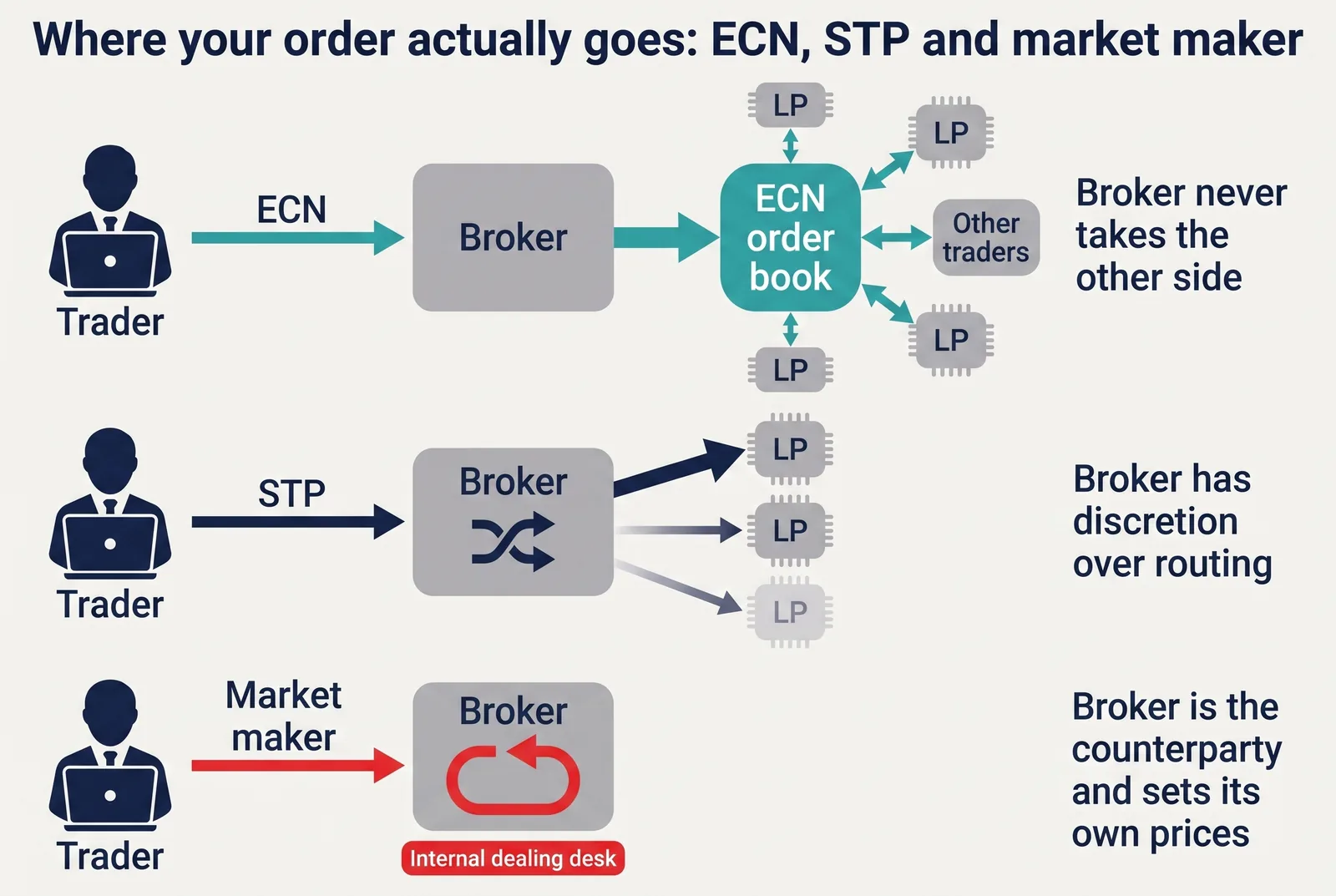
ECN brokers route your order into a network of outside liquidity providers and never take the other side of the trade. An STP broker passes orders to liquidity providers too, but with more discretion over routing. A market maker is the counterparty to the trade and sets its own prices, which can create a conflict of interest against your order. Many retail accounts marketed as ‘ECN’ are really STP or hybrid, so I look at how a broker prices and whether it can evidence its fills.
DMA and depth of market
DMA (direct market access) lets you see and trade against the actual order book of a liquidity venue. Depth of market shows the prices and sizes available at each level above and below the current bid and ask, so you are not guessing at the liquidity behind a price. I put both above the ECN label alone, because they show the routing rather than asserting it. cTrader is the platform that surfaces depth of market most clearly. Forex.com offers that routing as its own account type, Direct Market Access, beside Standard and RAW Pricing, with orders routed against direct market liquidity rather than the internal book.
How to tell a real ECN from a relabelled market maker
Three things separate a real ECN from a market maker wearing the label.
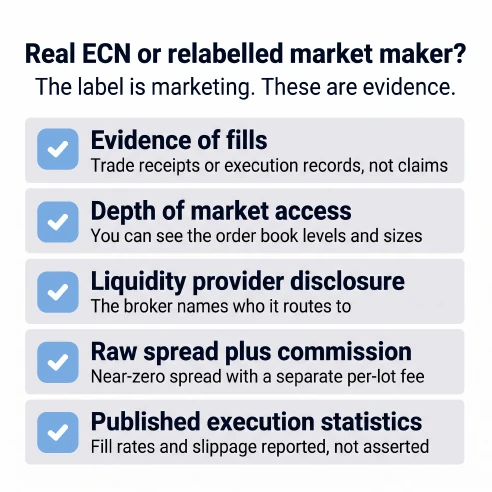
Commission-based pricing is the first test: a true ECN charges a small commission on a near-zero spread, rather than burying its margin in a wide spread. Named liquidity and depth-of-market is the second: the prices behind your order are visible. Proof of execution is the third and the rarest: Global Prime, for example, lets you verify where a trade filled. If a broker offers none of these, I would treat the ‘ECN’ badge with caution.
Tight but not pure ECN. What I would want you to take from this is that a raw spread alone does not make an ECN broker. Axi (0.18 pips eight-pair) and GO Markets (0.31 pips eight-pair) in our September 2026 capture, and Eightcap (0.15 pips) in our May to June 2026 capture, all deliver pricing that sits close to the leaders, and our captures confirm it. The distinction is structural: they operate STP or hybrid books, not a pure ECN model, and that is precisely why they land in the near-ECN raw tier rather than the genuine set above. It is also why their fills carry no published proof you can check for yourself. If your view is spread-led, these accounts also appear on our lowest-spreads guide.
Cost of an ECN account
ECN accounts pair a near-zero spread with a per-lot commission, so what you pay per round turn is split into two visible parts. Not every broker publishes both parts, and MultiBank Group is one: its ECN account measured 0.40 pips across eight pairs in our May to June 2026 capture, but its commission rate is not published and sits in its PDS. On a heavily traded pair the low spread offsets the commission; on quieter pairs it does not. Whether the spread offsets the commission depends on the pair and volume, so compare total trading costs across both before you commit. For the spread-led view, see lowest spread forex brokers. The commission-led view is at lowest commission forex brokers.
Whether the tight spread offsets the commission is a question about volume, so here I answer it against the measured field for the volume you choose. The card below ranks the raw and ECN accounts we hold pricing for by what a month of trading costs, cheapest first.
When ECN is not worth it
ECN suits active traders who care about execution quality and tight spreads. For low-frequency traders, I would point to a tight standard account or a fixed-spread broker like Trade Nation (covered on fixed spread brokers) as simpler and similar. ECN also requires a platform with depth-of-market (typically cTrader or MT5) to show its full value, and a basic web platform may not reveal that benefit. Sizing matters more than the account label, so work out position size from your risk and stop before opening.
Compare brokers by the factor that decides it
Each shortlist below re-ranks the market for one decision factor, tested the same way as this page.

The platform decides it
Rankings change once the trading software is fixed. Pick yours first, then compare.

Your strategy decides it
Execution speed, copy functionality and EA support separate these shortlists.

What you trade decides it
CFD shortlists re-ranked for the asset class you trade most.
FAQs
What is an ECN forex broker?
Is ECN better than a market maker?
Which Australian brokers are true ECN?
Does ECN mean lower cost?
Can I see where my ECN order was filled?
Which broker is better, ECN or STP?
What is a true ECN broker?
Related pages
About the author

Justin co-founded CompareForexBrokers in 2014 and has traded forex since 1998. Based in Melbourne, he has tested every ASIC-regulated broker on this site personally and has written for Forbes, Kiplinger, Finance Magnates, the Australian Financial Review and The Age. He holds a Bachelor of Commerce (Honours) and a Master of Marketing from Monash University. Justin is the co-founder and CEO of CompareForexBrokers.