




What Fusion Markets costs per trade
MEASUREDMonthly spread cost converts pips to dollars using the EUR/USD pip value as the proxy for the 8-pair average, footnoted on-page. AUD pip value A$14.27 per standard lot at AUD/USD 0.7010 (25 Sept 2026).
Raw saves A$60.56 a month at this volume
At 10 standard lots per month on Raw accounts, Fusion Markets costs approximately A$57.84 in spread and commission costs. Rates as of Fri 25 Sep 2026, 5pm New York close.
Trading CFDs and forex carries a high level of risk and may not be suitable for all investors. Read the relevant Product Disclosure Statement before opening an account.
Our verdict on Fusion Markets
The gap between Fusion Markets' A$4.50 round turn and Pepperstone's A$7.00 or IC Markets' A$9.00 compounds fast once volume passes a few lots a week. Fusion ranks third of 32 ASIC-regulated brokers in 2026, with the joint second lowest commission at A$2.25 per side, level with Axi's A$4.50 round-turn charge. Our September 2026 capture measured EUR/USD at 0.01 pips, on an advertised spread from 0.0 pips, and its all-in cost of 0.46 pips ranked first of the 19 accounts we measured.
Fusion Markets is smaller than Pepperstone, IC Markets or CMC Markets, its research stack is five components, and share CFD coverage is narrower. The trade-offs are clear. There's no proprietary platform. What you buy with the pricing is execution and cost, not hand-holding, so the saving is for a trader who already knows their platform.
Pros
- I'm comfortable with the ASIC licence: AFSL 385620 held by FMGP Trading Group Pty Ltd since 2011, trading as Fusion Markets from Melbourne since 2017
- The Zero account's A$4.50 round turn (A$2.25 per side) is the joint second lowest commission with Axi, behind ACY Securities, across all 32 ASIC-regulated brokers we cover.
- Our May to June 2026 capture measured 0.04 pips on EUR/USD and 0.36 pips across eight pairs on the Zero account.
- You can trade on MT4, MT5, cTrader and TradingView, with cTrader Copy for copy trading.
- There's A$0 minimum deposit, A$0 inactivity fee, and no deposit fee on the methods our capture showed.
Cons
- The Classic account measured 0.83 pips on EUR/USD and 1.12 pips across eight pairs, much wider than the Zero account.
- The research and education stack is five components, thin next to Pepperstone Insights or the CMC Markets analyst programme.
- Share CFD coverage is narrow, well under the 10,000+ at CMC Markets, and there's no native ASX share investing.
- Customer support runs 24/5 only, closed weekends.
- There's no proprietary platform; you get MT4, MT5, cTrader and TradingView only.
Fusion Markets score breakdown
4.5/5 · Excellent
The overall CFB Score comes from the full methodology, more than 100 data points per broker.
How is our rating calculated?Is Fusion Markets safe? ASIC AFSL 385620
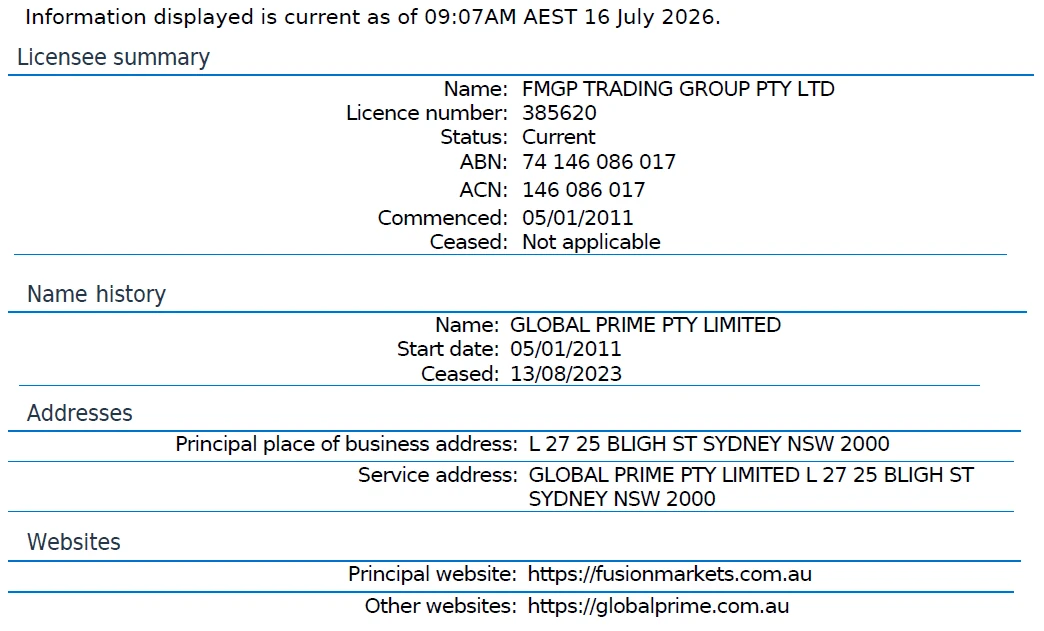
Fusion Markets operates under ASIC AFSL 385620, held by FMGP Trading Group Pty Ltd, which has been trading as Fusion Markets since 2017.
The VFSC registration in Vanuatu is for offshore wholesale business only. The licence predates the brand by six years, so the entity behind your account has a regulatory track record that extends well before the marketing began.
ASIC regulation and global licences
We checked the ASIC register: FMGP Trading Group Pty Ltd holds AFSL 385620, current since 5 January 2011. That’s six years before the Fusion Markets brand launched, which gives confidence in the regulatory history. For you, the practical point is that this licence has survived multiple ASIC surveillance cycles under a product intervention regime, which is a harder test than simply holding a number.
The Vanuatu registration only matters if you’re onboarding offshore. I wouldn’t recommend that path for retail traders. If you qualify as a Professional Client, you can reach higher leverage onshore through Fusion Markets Pro under ASIC.
History and ownership
Fusion Markets was founded in Melbourne in 2017 by Phil Horner, ex-Pepperstone senior executive. The pitch is simple: the same execution model at a lower commission. It’s been ASIC-regulated since launch. It’s smaller than Pepperstone or IC Markets, but it consistently places in our top three on measured cost. I would want any trader considering this broker to weigh that cost advantage against the shallower research and support coverage, because the two are linked by the same lean-operations model.
Before depositing, confirm Fusion Markets holds AFSL 385620 using the site's guide to checking a broker on ASIC's register.
Fusion Markets client money protection and the shared FMGP licence
Fusion Markets client money sits in segregated accounts at an Approved Australian Bank. AFSL 385620 belongs to FMGP Trading Group Pty Ltd, ABN 74 146 086 017, which is also the licensee behind Global Prime.
Common ownership disclosure. Global Prime and Fusion Markets are both trading names of FMGP Trading Group Pty Ltd under the same AFSL, 385620. They run as separate broker brands with different platforms and pricing models, but the licensee is the same legal entity. They are ranked independently because the trading experience differs, and the shared licence is disclosed on both review pages.
The shared licensee matters for counterparty risk. Holding accounts at both Fusion Markets and Global Prime means no diversification; one licensee and one set of client-money arrangements sit behind both. In my view, spreading capital across two ASIC brokers makes more sense if they operate under different licensees, because a licence-level event at FMGP would touch both accounts at once.
Fusion Markets client money is kept separate from company funds. ASIC requires negative balance protection on retail CFD accounts, so traders cannot lose more than they deposit. AFCA hears claims up to A$1,263,000 and can award up to A$631,500. The Compensation Scheme of Last Resort pays up to A$150,000 for personal advice, securities dealing and credit, and forex and derivatives trading, CFDs included, sit outside its scope. The retail standard is explained in negative balance protection explained.
One carve-out I need to highlight: the retail client money protections do not apply if you’re approved for Fusion Markets Pro. That’s the trade the wholesale tier asks for higher leverage.
Public reviews
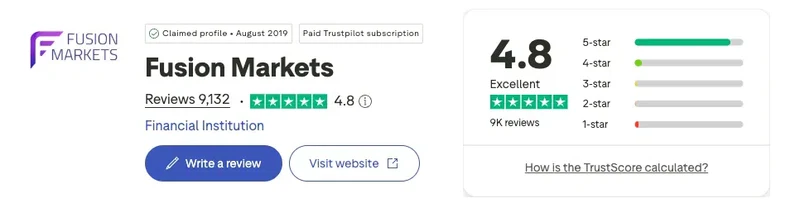
Fusion Markets holds a Trustpilot rating of 4.8 out of 5 from 9,133 reviews, which Trustpilot labels excellent, captured September 2026. The profile has been claimed by the broker since August 2019.
How popular is Fusion Markets in Australia?
Of the 32 brokers we review, Fusion Markets holds 12th place for search interest in August 2026, on 2,950 branded searches from Australia. Search interest measures attention, not quality; the score above is the review verdict.
- 2,950
- Brand searches, August 2026
- 0.0%
- vs July 2026
- 260
- Login searches
- 1.6%
- Share of all broker searches
Source: Google search volume, Australia, August 2026. How this is measured
What other review sites say
Fusion Markets' iOS app rates 4.71 out of 5 from 17 ratings on the Australian App Store (September 2026), listed as Fusion Markets cTrader.
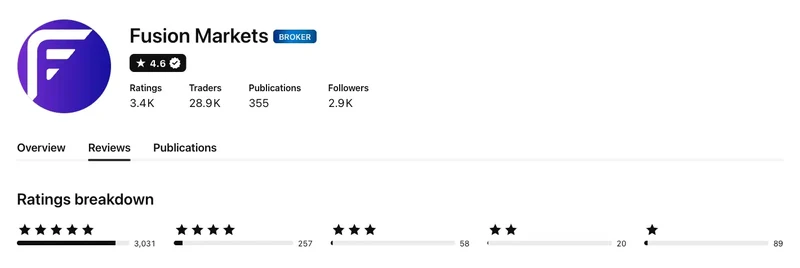
TradingView users rate Fusion Markets 4.6 out of 5 from 3,455 ratings (September 2026). 28.9K TradingView users have connected a Fusion Markets account.
Fusion Markets at a glance: 18 key facts
Fusion Markets offers four platforms and an A$0 minimum deposit on both retail accounts under ASIC AFSL 385620, with the 18 key facts in the table below.
This layout surfaces the cost numbers you actually need before opening an account, without digging through the full review.
| Item | Detail |
|---|---|
| Australian regulator | ASIC, AFSL 385620, current since 5 January 2011 |
| Australian entity | FMGP Trading Group Pty Ltd trading as Fusion Markets |
| Other regulators | VFSC (Vanuatu, Tier 5, used for offshore wholesale only) |
| Year founded | 2017, Melbourne |
| Founder | Phil Horner (ex-Pepperstone) |
| Headquarters | Melbourne, VIC |
| Trading platforms | MetaTrader 4, MetaTrader 5, cTrader, TradingView |
| Account types | Zero (commission), Classic (spread-only), Islamic |
| Minimum deposit | A$0 |
| Maximum retail leverage | 30:1 (forex majors), ASIC-capped |
| Spreads from (EUR/USD) | 0.0 pips advertised, 0.04 pips measured (Zero) / 0.83 pips measured (Classic) |
| Zero account commission | A$4.50 per round-turn standard lot |
| Funding methods (AU) | Bank transfer, PayID, Visa, Mastercard, crypto, PayPal, Neteller, Jetonbank, Skrill (portal deposit menu, 28 August 2026); BPAY listed by Fusion Markets, not on the captured menu |
| Inactivity fee | A$0 |
| Negative balance protection | Yes (mandatory under ASIC) |
| AFCA member | Yes |
| Demo account | Free, 30 days (extendable once a live account is funded) |
| Customer support | 24/5 live chat, email, phone |
At Fusion Markets, you choose between two retail pricing models, and it’s the commission that drives the ranking you see on this page.
Fusion Markets commission and spreads, measured
Fusion Markets’ Zero account spread measured 0.01 pips on EUR/USD and averaged 0.09 pips across eight pairs in our September 2026 capture, with commission at A$2.25 per side (A$4.50 round turn).
Noam Korbl ran this 48-hour capture from a London VPS to keep the measurement clean, so the numbers represent what the broker’s liquidity delivered, not what your home connection might add.
That’s the joint second lowest commission among the ASIC-regulated brokers we cover, level with Axi’s single A$4.50 round-turn charge. ACY Securities charges A$1.50 per side and sits below both. Fusion Markets is joint second in our lowest commission forex brokers table, not first. The honest takeaway for you is that the cost gap to first place is real but narrow, so the platform and execution differences carry more weight in the decision.
Zero account commission and spread
In our September 2026 capture the Zero account cost 0.33 pips all-in on EUR/USD; May to June 2026 figures, at AUD/USD 0.66, run roughly 0.34 pips all-in. There’s no dealing desk, which is a transparency advantage: orders go straight to liquidity providers without internalised pricing. That means the spread seen during liquid hours is what the market is actually showing, with no markup layer inserted between you and the quote.
| Broker | Account | EUR/USD typical (incl. commission equivalent) |
|---|---|---|
| Fusion Markets | Zero | 0.33 pips |
| Pepperstone | Razor | 0.55 pips |
| IC Markets | Raw Spread | 0.60 pips |
| FP Markets | Raw | 0.60 pips |
| CMC Markets | FX Active | 1.00 pip |
Those figures use our May to June 2026 measured EUR/USD averages plus each broker’s commission converted at AUD/USD 0.66. On the eight-pair raw average, the Zero account ranked first of the 11 raw accounts in our September 2026 capture. So Fusion Markets now leads on raw spread as well as commission, and it’s the commission that widens its lead once costs are counted all in. I take this as a clear signal: when you compare brokers on raw spread alone, you still miss the part that makes Fusion cheaper.
A trader doing 50 standard lots a month with Fusion Markets saves roughly A$125 against Pepperstone and A$225 against IC Markets. At 200 lots, that’s A$500 and A$900 back. This is running costs that compound with volume, so the saving scales directly with how actively you trade.
Classic (no-commission) spreads
The Classic account is spread-only, and our capture measured 0.83 pips on EUR/USD and a 1.12 pip eight-pair average over the same window. An infrequent trader who hates tracking a separate commission line might consider it, but it costs materially more per lot than Zero on majors, so the savings case weakens considerably. The straightforward takeaway is that paying the commission on Zero almost always leaves more money in your account than accepting the wider Classic spread.
Other fees AU traders should check
- Overnight swap rates apply on positions held past 5 PM New York time and vary with trade direction.
- Currency conversion applies to any instrument denominated outside the account base currency.
- Withdrawals cost A$0 on most methods, including PayID, BPAY, PayPal and bank transfer.
- No inactivity fee applies at any balance or duration.
- Deposits cost A$0 on cards and most local rails. Crypto deposits carry the network fee and no Fusion Markets charge.
Fusion Markets funding methods and withdrawal times
Fusion Markets deposits cost A$0 except crypto, which carries a network fee, and withdrawals cost A$0 on most methods. Withdrawals return to the deposit method wherever possible. No withdrawal was made on the CFB account, so no withdrawal time appears.
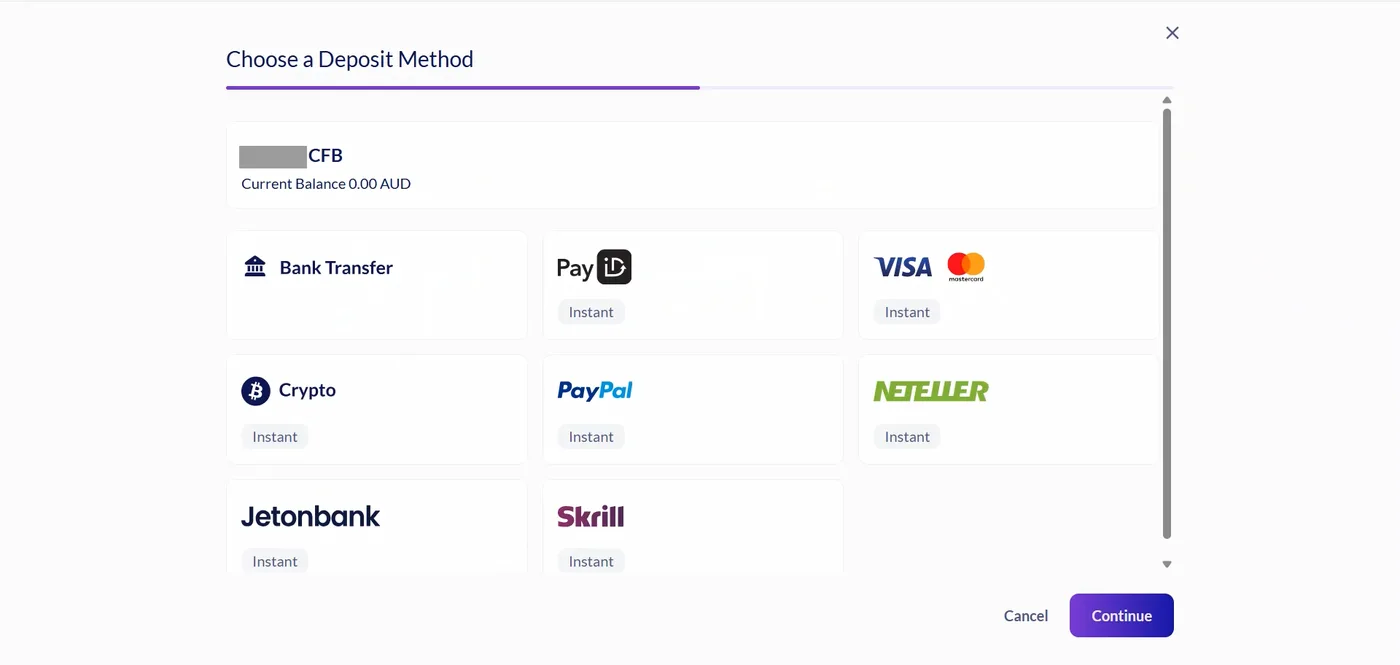
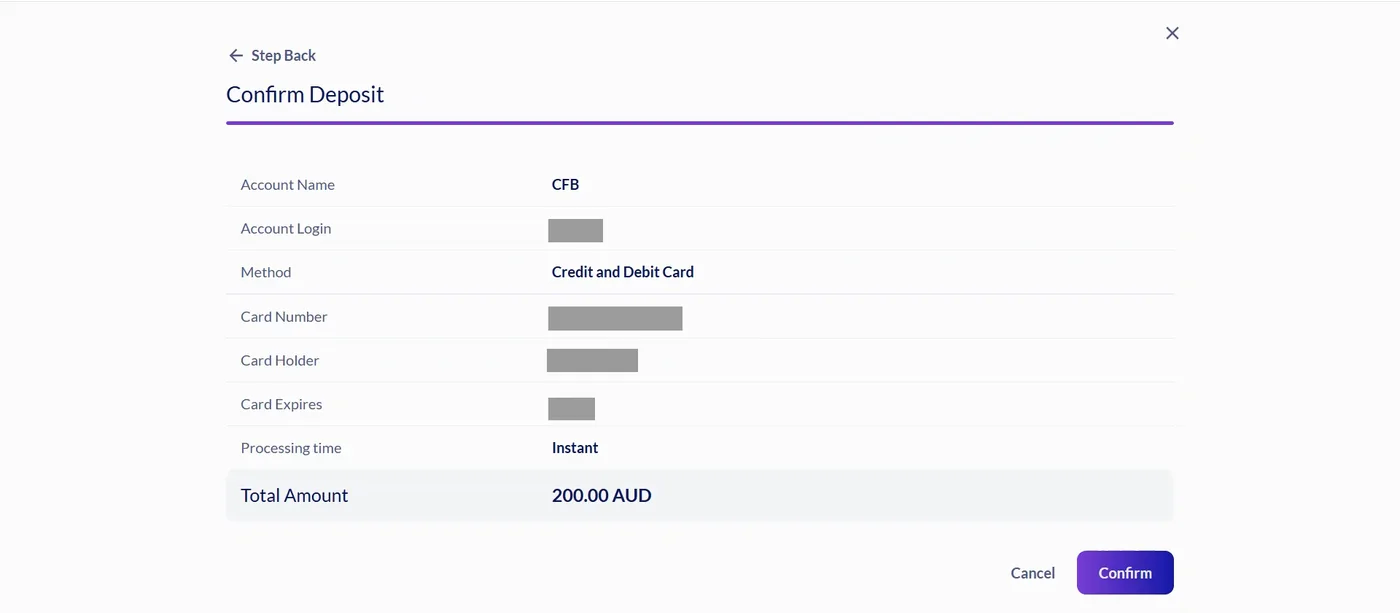
Funding runs through the portal Noam Korbl captured on 28 August 2026, which showed eight deposit tiles, every electronic option labelled “Instant”, and no fee on our A$200 card deposit. The practical result is that funding lag is effectively zero, so you can act on a setup the same day money is moved.
Deposit methods (AU clients)
| Method | Fee | Speed |
|---|---|---|
| Visa / Mastercard | A$0 (our A$200 Visa deposit, 28 August 2026) | Instant (portal label, 28 August 2026); credited after a page refresh in our test |
| PayID | A$0 | Instant (portal label, 28 August 2026) |
| BPAY | A$0 | Next business day; listed by Fusion Markets, not on the deposit menu captured 28 August 2026 |
| Bank transfer (EFT) | A$0 | 1 to 2 business days |
| PayPal | A$0 | Instant (portal label, 28 August 2026) |
| Skrill | A$0 | Instant (portal label, 28 August 2026) |
| Neteller | A$0 | Instant (portal label, 28 August 2026) |
| Jetonbank | A$0 | Instant (portal label, 28 August 2026) |
| Crypto (BTC, USDT, ETH) | Network fee only | Instant (portal label, 28 August 2026); 30 mins to a few hours quoted before this capture |
The crypto deposit rail is unusual among ASIC-regulated brokers. Funding with BTC, USDT and ETH is possible, but that’s separate from trading crypto CFDs, covered in the product section. I would treat this as a convenience feature rather than a reason to choose the broker, because the ASIC 2:1 cap on crypto CFDs still applies regardless of how you fund the account.
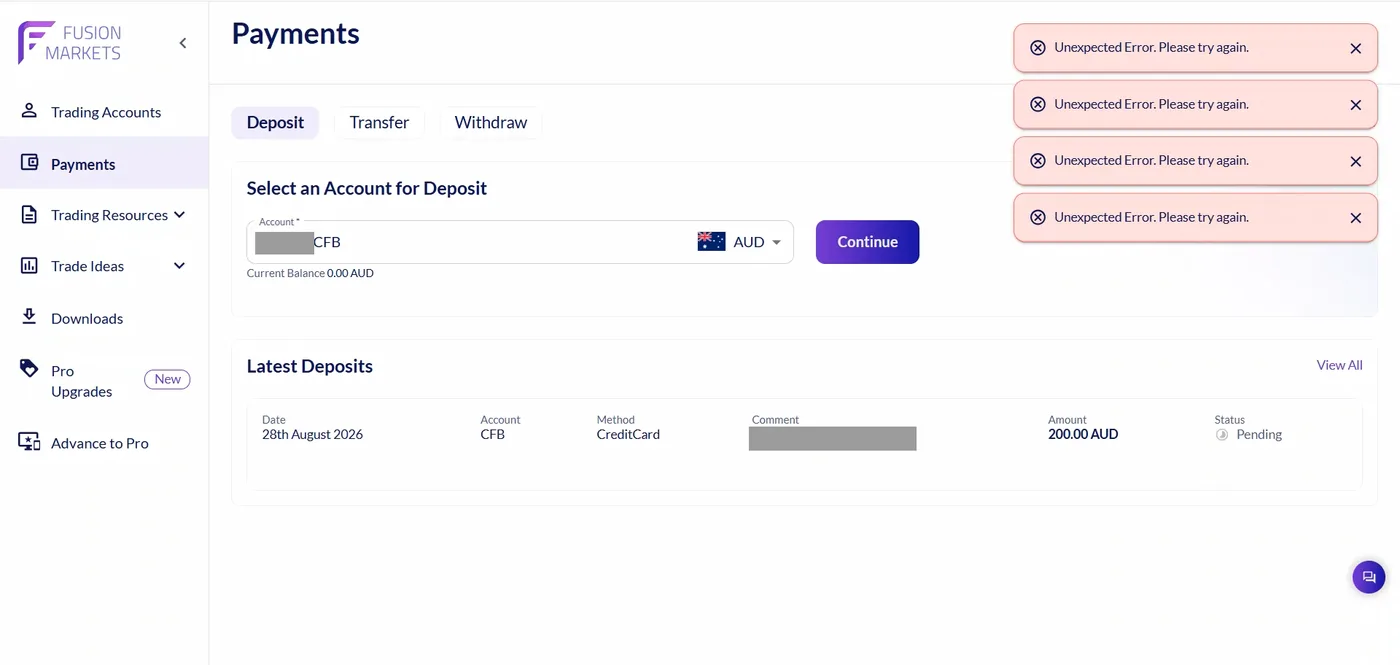
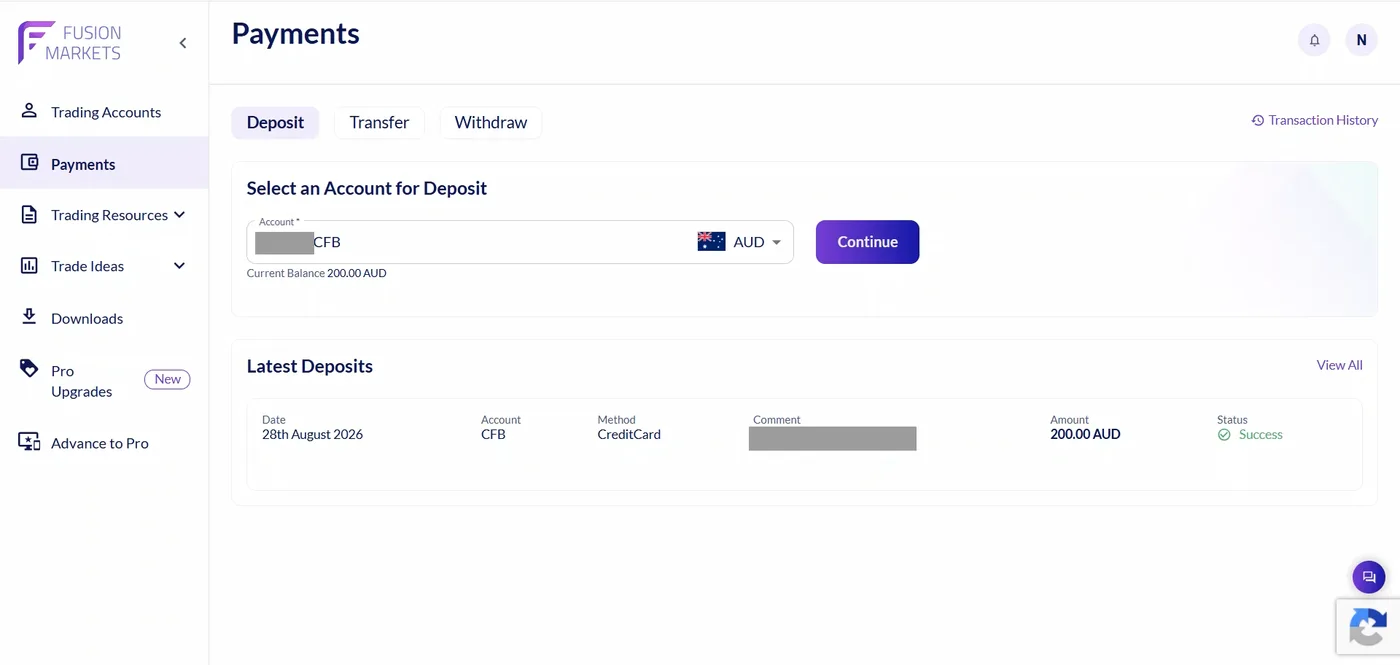
Noam Korbl captured the deposit menu on 28 August 2026, which showed eight tiles, Bank Transfer, PayID, Visa/Mastercard, Crypto, PayPal, Neteller, Jetonbank and Skrill, with every tile but bank transfer labelled “Instant”, and BPAY was not among the eight tiles captured. He paid A$200 by Visa, and the confirmation screen promised “Instant” processing. The portal then returned four “Unexpected Error. Please try again.” toasts while the deposit sat as Pending and the balance read 0.00 AUD. A page refresh showed A$200 and a Success status, with no second payment made. In Noam’s view the false error is the flaw of the funding experience, because a customer trusting it risks a duplicate deposit. On my reading, a deposit that reports an error deserves a balance check before any retry.
Withdrawals
Withdrawals cost A$0 on most methods. For AML compliance, Fusion Markets routes funds back to the deposit method wherever possible. The AML routing rule means you cannot withdraw to a different method than the deposit method without verification, so plan the funding rail accordingly.
Account opening
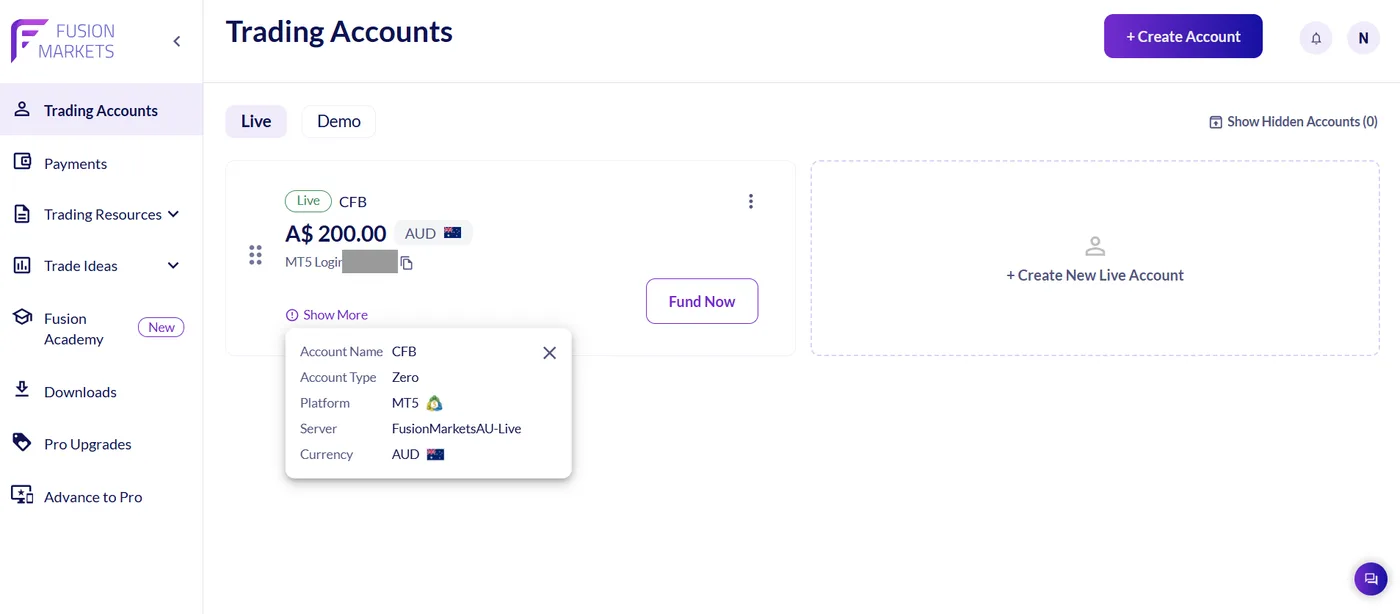
Fusion Markets opens accounts under FMGP Trading Group Pty Ltd, the ASIC licensee behind AFSL 385620, and its dashboard claims most accounts are verified within an hour. Noam Korbl applied at 5:05 pm on 24 August 2026, with approval arriving at 3:46 pm on 26 August, 46 hours and 41 minutes later by his record. An A$200 deposit followed on 28 August.
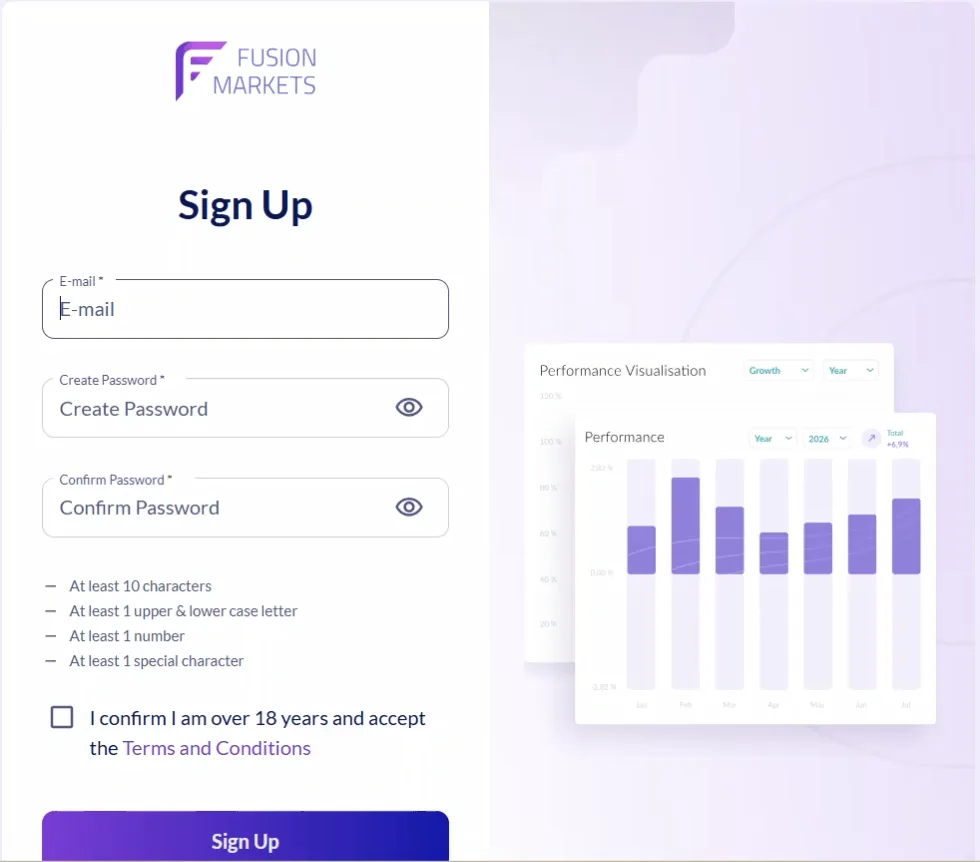
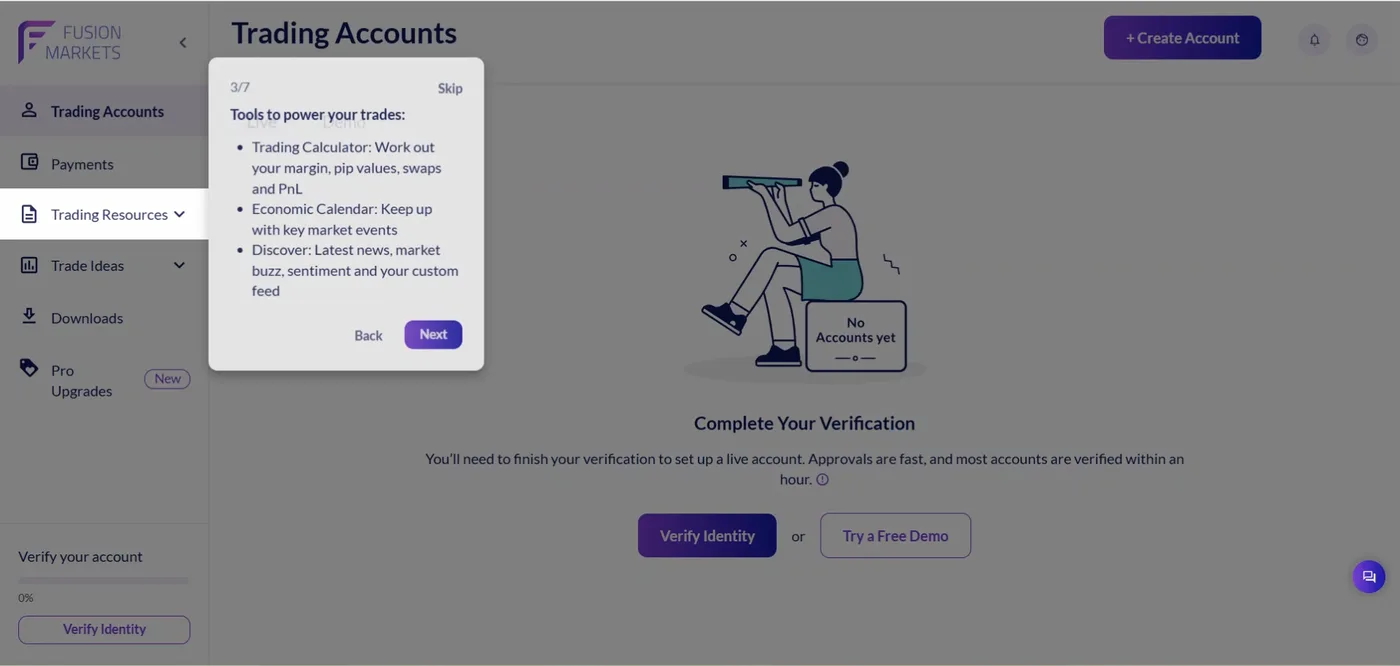
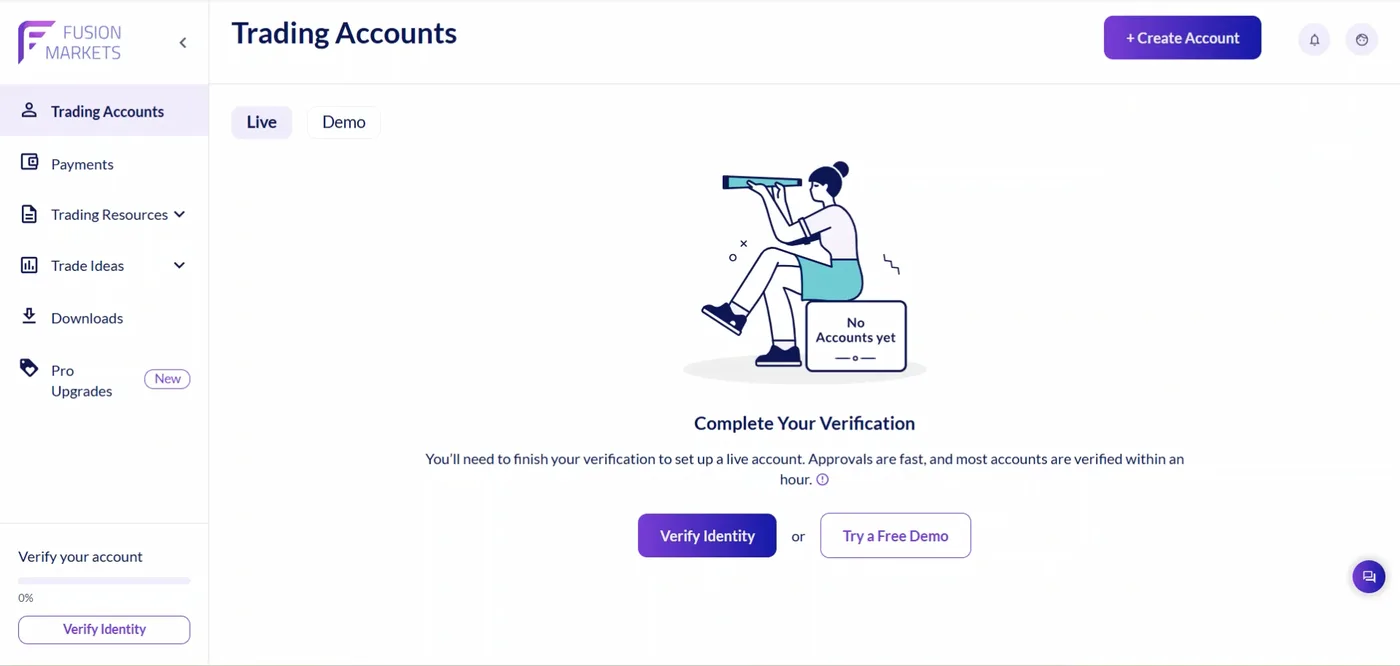
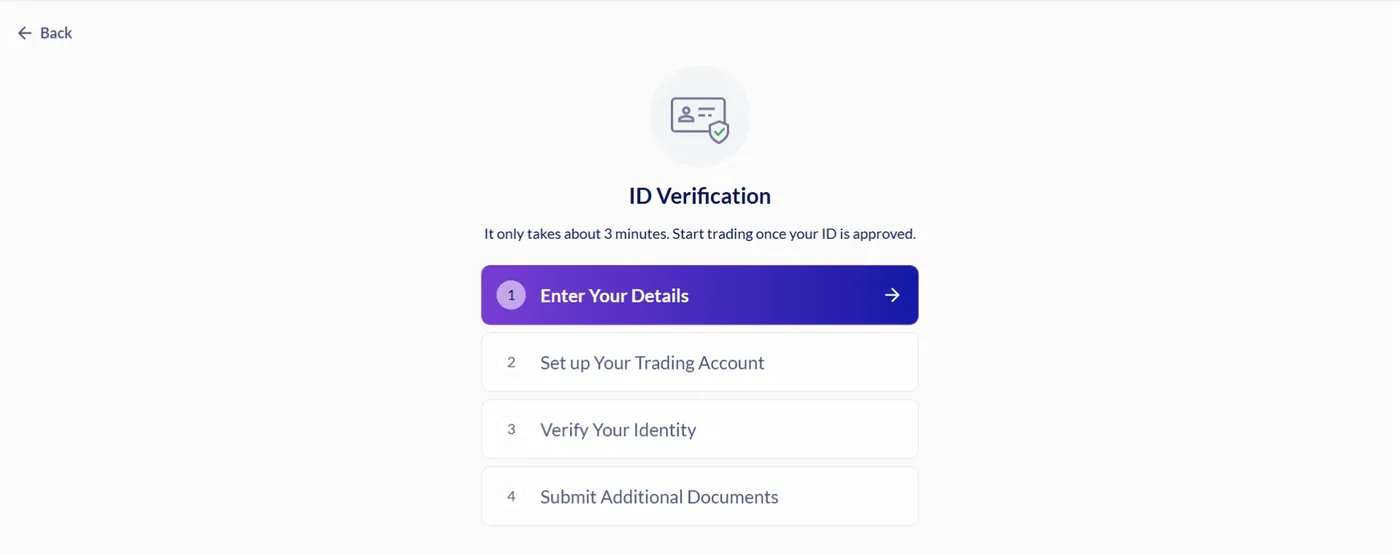
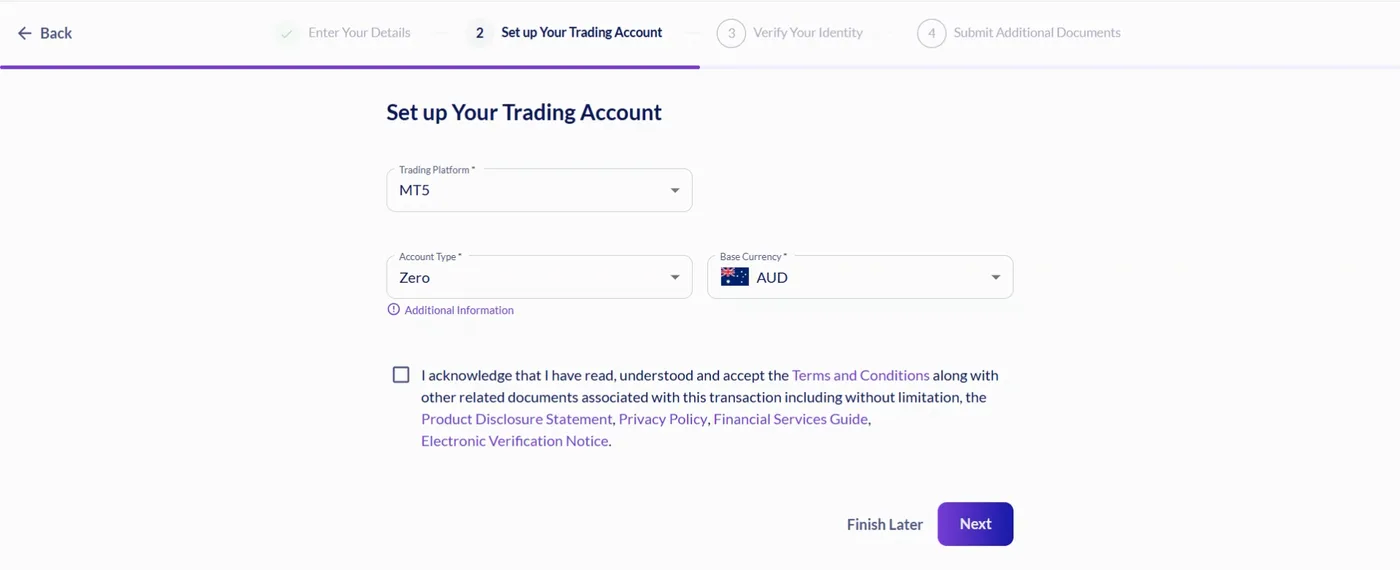
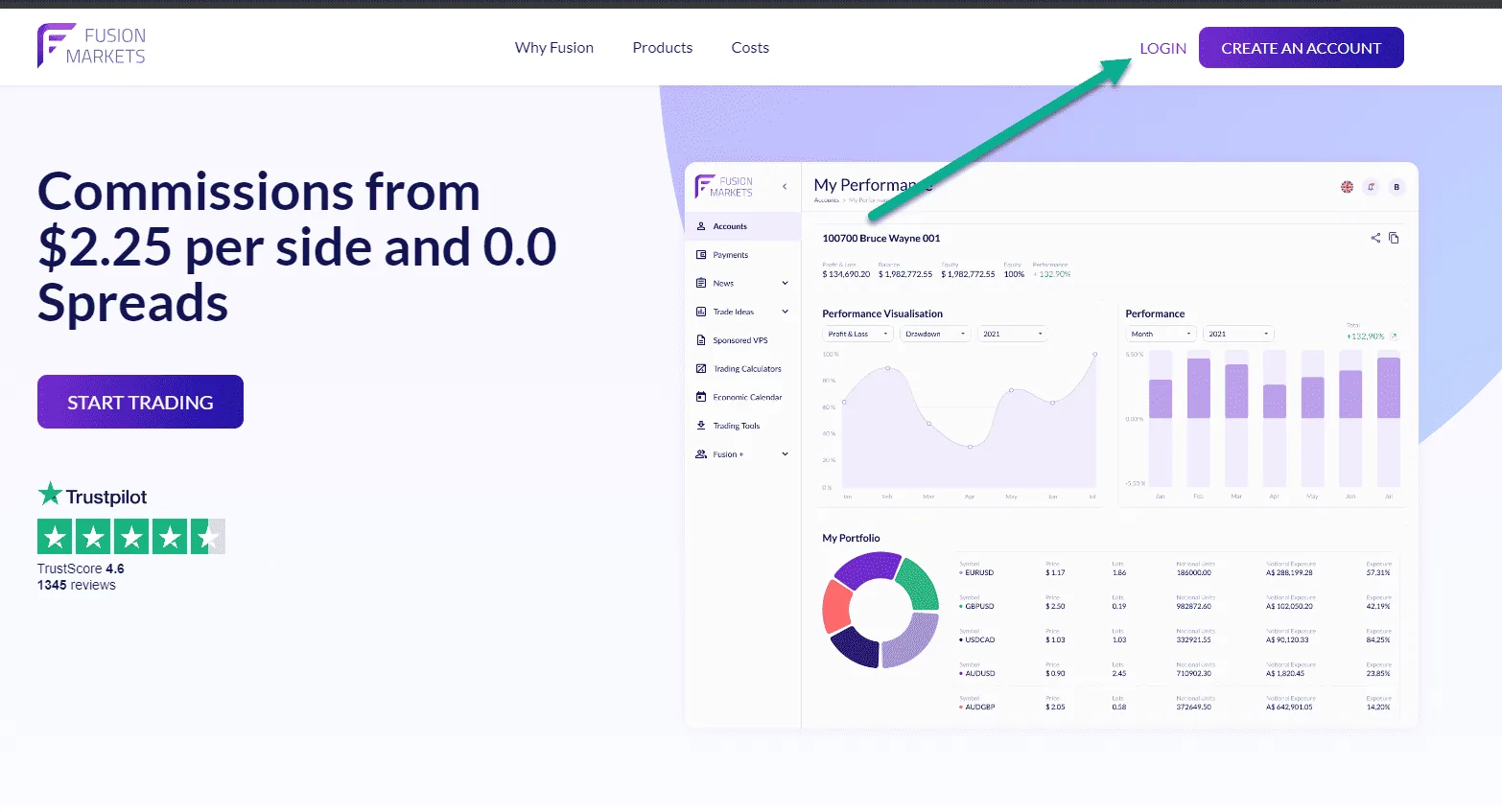
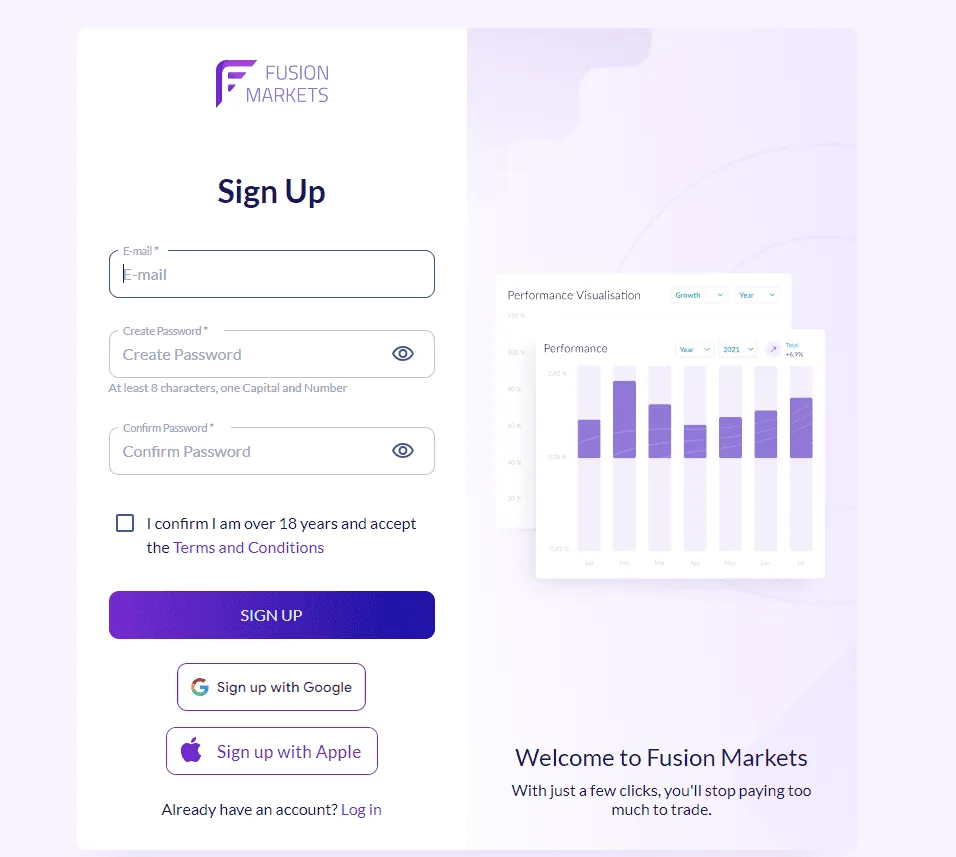
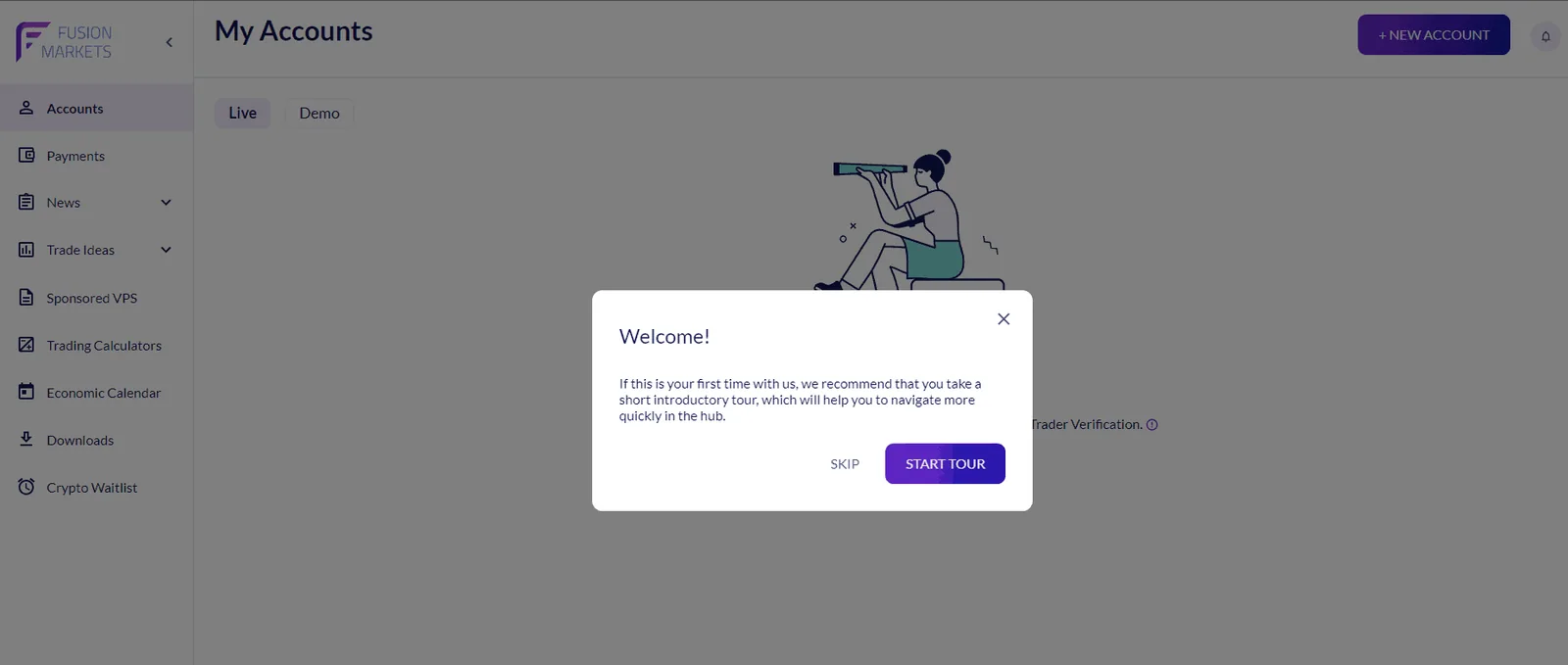
You sign up with an e-mail, a password and a tick box confirming you are over 18 and accept the Terms and Conditions. The portal then opens on Trading Accounts with a seven-step guided tour you can skip, which Noam found useful because it explains the main areas before any live account exists. From there, the ID Verification page lists four stages, Enter Your Details, Set up Your Trading Account, Verify Your Identity and Submit Additional Documents, and claims it only takes about 3 minutes. You enter your personal details, answer the referral question and verify your phone by SMS code, then choose a security question. Platform, account type and base currency sit together on one screen, MT5, Zero and AUD in Noam’s case, with a single acknowledgement covering the PDS, FSG, privacy policy and electronic verification notice.
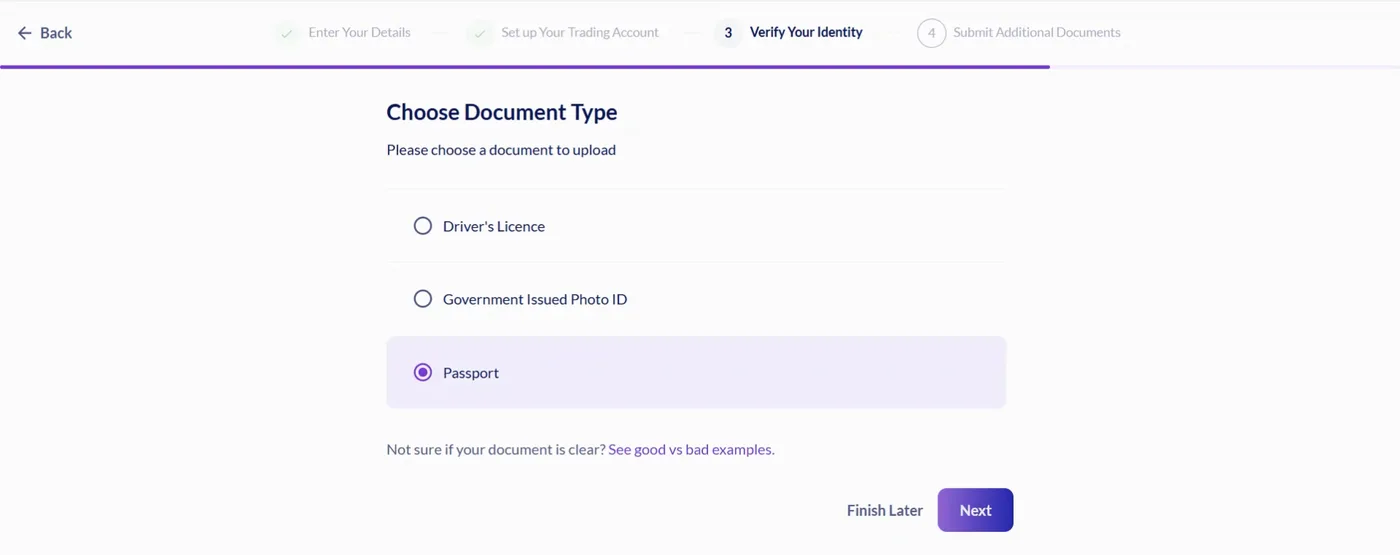
Identity verification asks you to pick a driver licence, a government issued photo ID or a passport, uploaded as a file or photographed, in JPG, JPEG, PNG or PDF form up to 20 MB, and a separate fourth stage covers anything further Fusion Markets requests. Once you submit, the account sits on the Trading Accounts page as Pending, with A$0.00 against it, fundable but not tradable until the quiz gate is passed. An Appropriateness Test asks how much you are prepared to risk each year, from bands under $1,000 up to $50,000 or more, and a Client Suitability Test follows with a leverage-and-notional question. Noam noted that some single-choice questions appeared to have more than one defensible answer, which he calls the main weakness of the flow. No frame times the identity check itself, and the two-day approval is his record rather than a captured stamp.
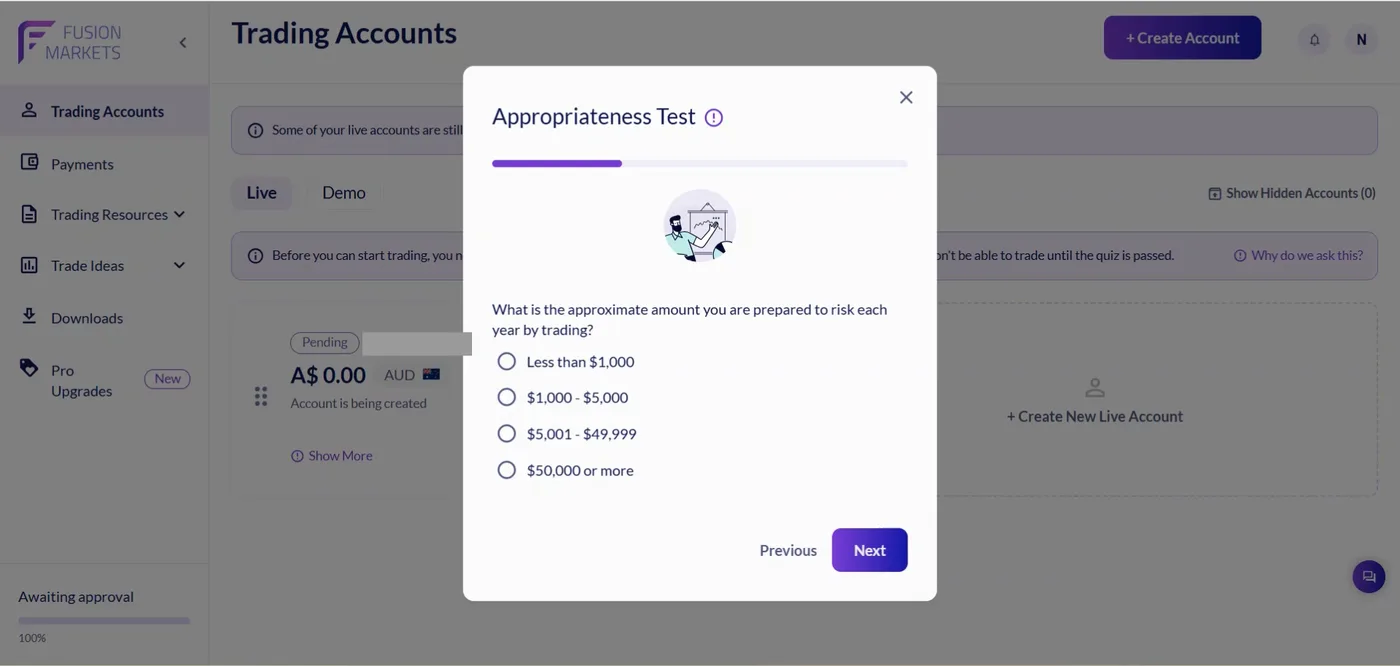
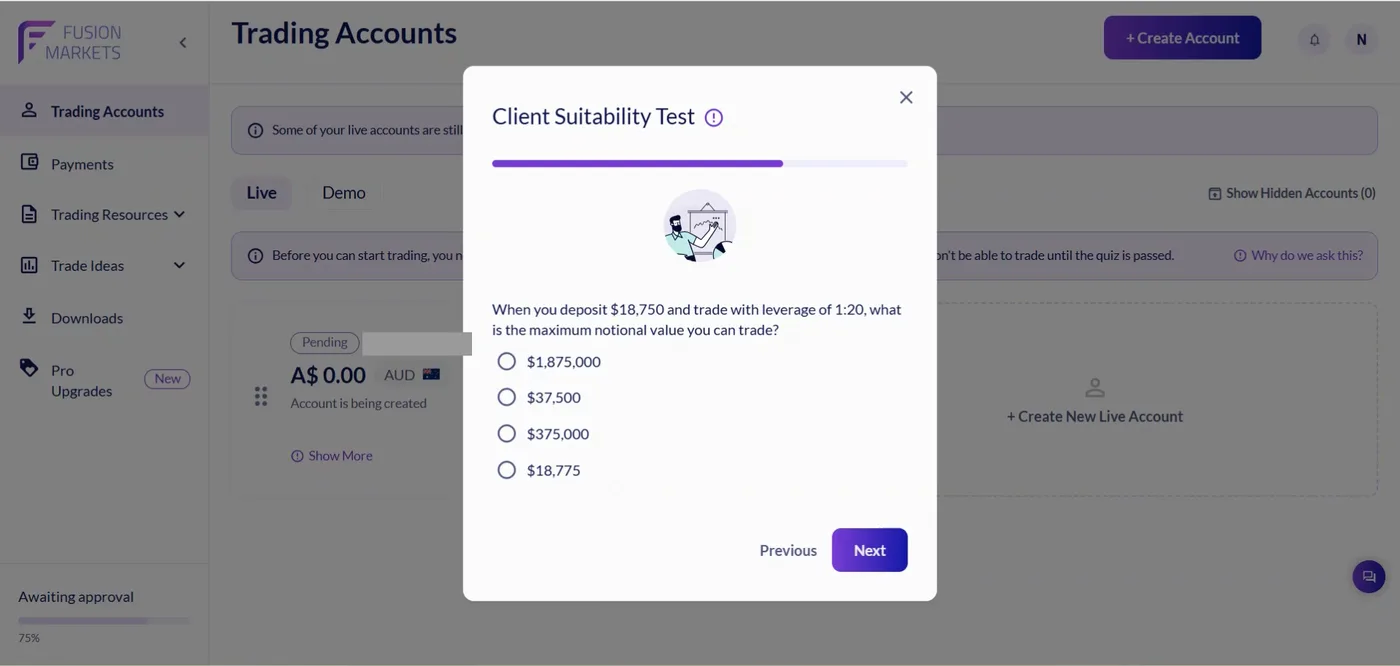
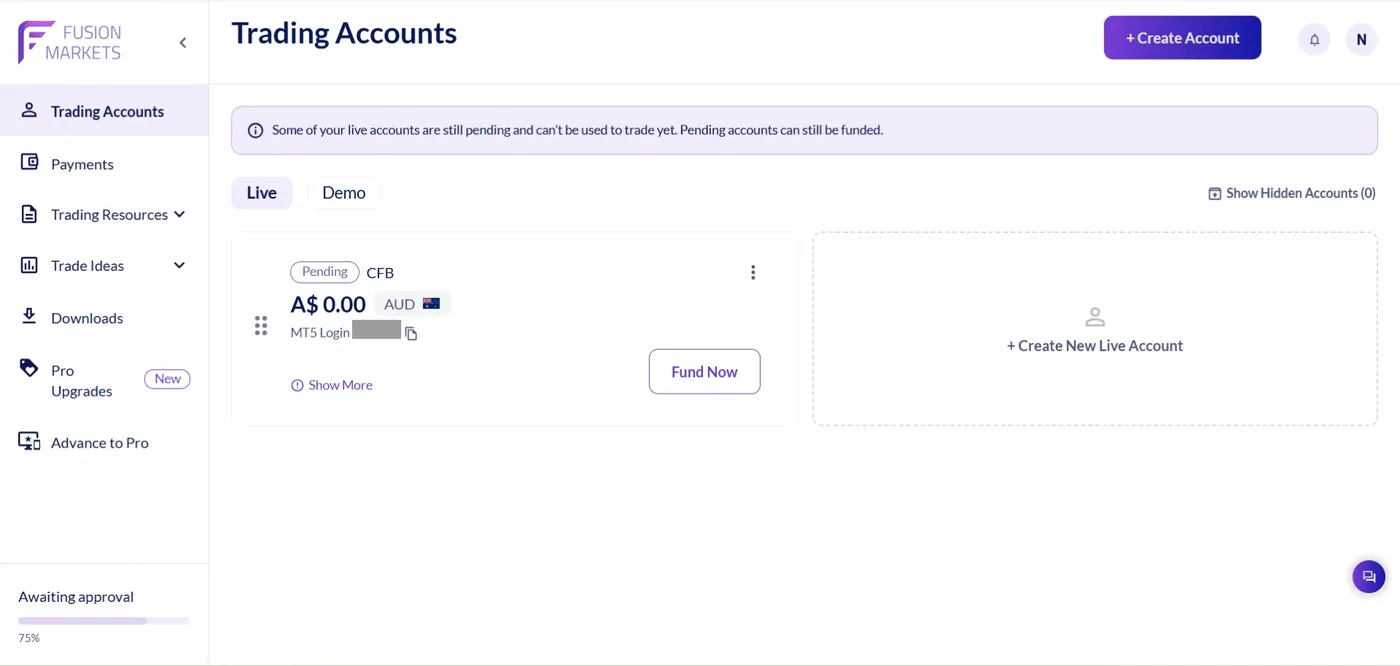
Noam’s notes rate the flow as easy and efficient to work through, with the dashboard tour and the four-stage layout its strongest parts, and he liked having platform, account type and base currency grouped on one screen. The final approval was not quick in this test. I read the gap between the hour promised on the dashboard and the two days on Noam’s record as the number that matters most to you. Next comes what Fusion Markets lets you trade.
Fusion Markets account types and minimum deposit
You have four account tiers to choose from, starting at A$0: Zero, Classic, an Islamic swap-free option, and Fusion Markets Pro for wholesale clients.
| Account | Pricing model | Min deposit | Best for |
|---|---|---|---|
| Zero | RAW spread + A$4.50 round-turn commission | A$0 | Active forex traders |
| Classic | Spread-only, no commission | A$0 | Casual / multi-asset traders |
| Islamic | Swap-free, available on Zero or Classic | A$0 | Traders requiring Sharia-compliant accounts |
| Fusion Pro | Professional Client tier under ASIC | A$0 | Experienced traders seeking higher leverage |
The Islamic swap-free option sits on top of either retail pricing model, not as a separate price book. Most Australian brokers restrict swap-free to one account type, so having it available on both Zero and Classic gives you pricing choice without losing the feature.
Opening a Fusion Markets account: step by step
Minimum deposit
A Zero or Classic account can be opened with A$0. No formal minimum, though some payment methods need around A$10. That puts Fusion Markets level with Pepperstone at the entry point and ahead of IC Markets, which states a US$200 deposit. The demo runs for 30 days and extends once a live account is funded. The A$0 floor means funding exactly what you intend to trade and not a dollar more, a genuine advantage if testing live execution on a small starting balance.
Fusion Pro (Professional Account)
Qualifying as a Professional Client under ASIC allows application for Fusion Pro onshore under the same AFSL 385620. Leverage rises to 500:1 on forex, gold, other commodities and energies, 100:1 on indices, 20:1 on share CFDs and 10:1 on crypto CFDs. The catch is serious: retail client money protections do not apply. There is no need to go offshore for higher leverage; Fusion Pro provides it under ASIC.
Fusion Markets trading platforms
Fusion Markets offers four trading platforms, none of them proprietary: MT4, MT5, cTrader and TradingView.
They all run on the same account credentials, and cTrader Copy handles copy trading. For you, the practical benefit is that switching platforms carries no friction: same login, same funds, same pricing.
The lack of a proprietary platform is not a gap. The positioning is cheap execution on platforms traders already know. Building a proprietary stack would cost money the pricing doesn’t leave room for. This is a purposeful trade-off, and the saving it creates lands directly in your round-turn cost.
cTrader
For active forex traders, cTrader is the standout choice at Fusion Markets: it delivers level 2 depth-of-book pricing, advanced order types, and a cleaner execution model than MetaTrader. The cTrader Copy layer is there for following other strategies. If you care about seeing exactly where liquidity sits before placing an order, the depth-of-book display is the feature that makes cTrader the pick over the MetaTrader options.
MetaTrader 4 and MetaTrader 5
I’d recommend MT5 for broader asset-class support: indices, stocks, futures natively, plus modern expert advisors. The Fusion Markets MT5 build connects to the Zero account. MT4 is still there for legacy expert advisors, so existing strategies keep running.
TradingView
TradingView on Fusion Markets is a full trading platform, not just charting. Orders execute live, routed through the cTrader backend, and commission follows the cTrader method. What I value here is that you chart and trade in one window, so the gap between spotting a setup and executing it closes to a single click.
Copy trading and mobile
As an Australian client, copy trading is accessed through cTrader Copy, plus cAlgo and MQL5 Signals on the MetaTrader builds. I want to flag that DupliTrade and Fusion+ Copy Trading run only through the offshore Vanuatu entity and are not available to Australian clients. That’s a real limit, not a technicality. On mobile, MT4, MT5 and cTrader all have full-featured apps, with biometric login on iOS and Android for cTrader and MT5.
Fusion Markets markets and instrument counts
Fusion Markets offers seven asset classes, and instrument counts show narrower share CFD coverage than CMC Markets, IG Markets and Interactive Brokers, with no real share investing.
If shares are the main game, this is the constraint you’ll hit. My honest assessment is that a share-focused portfolio belongs at a broker that built its business on equity coverage, and the cost advantage on FX does not close that gap.
That narrowness is the trade-off for the pricing. I see Fusion Markets as a forex specialist that carries other classes, not a multi-asset venue.
| Asset class | Count | Note |
|---|---|---|
| Forex | 90+ pairs | Major and minor AUD crosses |
| Indices | Major global benchmarks | ASX 200, S&P 500, NASDAQ, FTSE 100, DAX |
| Commodities | Metals, energy, softs | Gold, silver, WTI, Brent, natural gas |
| Share CFDs | Narrower than CMC’s 10,000+ | CFD only, no native ASX share investing |
| Cryptocurrencies | BTC, ETH, XRP and other majors | CFDs only, 2:1 retail cap |
| ETFs | Offered | ETF CFDs |
| Bonds | Limited | Fixed income is not a depth market here |
Indices cover the ASX 200, S&P 500, NASDAQ, FTSE 100 and DAX at the 20:1 retail cap. Commodities include gold, silver, WTI, Brent and natural gas, at 10:1 except gold. Bonds are thin; rates traders should look to the broader-range brokers in the comparison below. The message I take from the bond range is that Fusion Markets built its instrument list around what its core forex trader also wants to touch, and anything beyond that circle gets light coverage.
Share CFDs and crypto CFDs
The share CFD range is materially narrower than CMC Markets’ 10,000 plus, and there’s no ASX share investing. Fusion Markets is a forex specialist that carries shares, not a shares venue. The class can be compared in our share CFDs at AU brokers guide. The practical upshot is that if you trade FX and occasionally dip into a handful of US large-cap CFDs, the range works; if full ASX coverage is needed, it does not.
Fusion Markets crypto CFDs cover BTC, ETH, XRP and other majors at the ASIC 2:1 retail cap. These are contracts on price, not coins that can be owned or withdrawn to a wallet. What that distinction means for you is that you are trading exposure to price movement, not holding an asset that can be moved to cold storage, and the 2:1 cap is an ASIC blanket, not a Fusion choice.
Fusion Markets leverage and margin under ASIC rules
Fusion Markets leverage in Australia reaches 30:1 on majors for retail clients under ASIC rules, with lower caps on indices, commodities and crypto. Fusion Markets Pro reaches up to 500:1 for wholesale clients.
ASIC caps retail CFD leverage at 30:1 on majors, 20:1 on minors, gold and major indices, 10:1 on commodities other than gold, 5:1 on share CFDs and 2:1 on crypto. These caps come from a product intervention order extended to 23 May 2027, so they apply at every ASIC broker, not just Fusion Markets. The same caps apply on Zero and Classic, so account choice is a pricing decision, not a leverage one.
Fusion Pro lifts those to 500:1 on forex, gold, other commodities and energies, 100:1 on indices, 20:1 on share CFDs and 10:1 on crypto CFDs, if eligibility tests are passed. The trade-off I want you to see clearly is that the higher gearing arrives only once you leave the retail client money protections at the door.
Retail margin close-out is at 50%. ASIC requires brokers to close positions once equity falls below half the total initial margin on all open positions. Positions can’t be netted to reduce that figure, and a gapping market can close positions below 50%. The tier structure behind the 30:1 cap is explained in leverage in CFD trading.
Fusion Markets customer support
You should know that Fusion Markets customer support runs 24 hours a day, five days a week, and closes on weekends Sydney time.
In our 2026 testing, live chat replied inside 90 seconds during Australian business hours, across phone, chat and email. That’s competitive with brokers several times the size, and it matters because the cost case depends on running lean. If support were slow, the savings on commission would feel less certain. The part I find reassuring is that the speed metric held up under measurement, which is a harder test than a broker’s own claims about response time.
The Fusion Markets weekend closure is the counterweight, and it’s listed in the cons. A funding or verification question on Saturday waits until Monday, while Pepperstone answers the same question at any hour. If a trading schedule spans weekends, that gap is a real friction. I would put it bluntly: the five-day desk is the single largest service compromise the lean model asks you to accept, and it cannot be worked around.
There are three support channels, not two, which is rare for a low-cost broker. A phone line is usually the first thing a lean operation cuts. Fusion Markets keeps one, and the desk is in Melbourne, not offshore. That’s the opposite trade-off Pepperstone makes at several times the scale. What I value in this setup is that when you call, you speak to someone on the same time zone who can see the same ASIC-regulated entity your account sits under.
Support quality is where lean brokers often give ground, but our measured reply time says Fusion Markets hasn’t. The gap against larger desks is coverage, not speed: five days instead of seven. For most Australian business-hours traders, the speed during the working week is what you’ll actually feel.
Fusion Markets research, tools and education
Fusion Markets research, tools and education span five components: daily and weekly market analysis, an economic calendar, beginner guides, a webinar series, and Trading Central on certain account tiers.
I would characterise this as a functional but deliberately narrow stack, built for a trader who brings their own research process and just needs the calendar and the headline analysis as a cross-check.
- Daily and weekly market analysis posts
- Economic calendar
- Beginner forex and CFD guides
- Webinar series, less frequent than Pepperstone Insights or the CMC Markets analyst programme
- Trading Central integration on certain account tiers
Five components is a light stack, and one is gated by account tier. That’s consistent with the cost positioning; research desks are expensive, and the commission reflects their absence. If you run your own analysis, the saving is pure upside; if you rely on broker research, the gap is real. What I cannot get past is the tier-gating on Trading Central: the one third-party research tool in the stack is not available to every client, which means the already-thin offering gets thinner at the entry level.
Traders who rely on research and education are better served by CMC Markets, IG Markets or Pepperstone. Those who run their own analysis lose nothing here. The question I would ask yourself before opening an account is whether you regularly read broker-provided trade ideas or market briefings, because if the answer is yes, Fusion will feel incomplete from day one.
What traders say about Fusion Markets
| Rating site | Rating | Based on | Who rated | Captured |
|---|---|---|---|---|
| Trustpilot | 4.8 out of 5 | 9,133 reviews | Worldwide | September 2026 |
| App Store | 4.71 out of 5 | 17 ratings | Australia only | September 2026 |
| TradingView | 4.6 out of 5 | 3,455 ratings | Worldwide | September 2026 |
Each row above is a public rating of Fusion Markets taken from a rating site, dated to the month its figure was captured. An App Store rating counts ratings left on Apple's Australian App Store only, while a Trustpilot figure counts reviews and a TradingView figure counts ratings from anywhere in the world. A site with no row has no rating for Fusion Markets, withholds it, cannot be matched to Fusion Markets with confidence, or we have not captured it yet.
How Fusion Markets compares to Pepperstone and IC Markets
Fusion Markets charges A$4.50 round turn against A$7.00 at Pepperstone and A$9.00 at IC Markets, with an all-in EUR/USD cost around 0.33 pips in our May to June 2026 testing.
The all-in EUR/USD cost sat at 0.55 at Pepperstone and 0.60 at IC Markets in the same testing. So Fusion Markets leads on commission but trails on scale, platform count and research. I would frame the comparison this way: if your decision ranks cost per lot above everything else, Fusion wins the number; if platform range and weekend support matter more, Pepperstone reclaims the lead.
The closest head-to-head is covered in Pepperstone vs Fusion Markets.
Pepperstone offers five platforms to Fusion’s four, including a proprietary option, and publishes a measured execution figure Fusion doesn’t. IC Markets measured wider raw spreads in our September 2026 capture, at 0.26 pips across the eight-pair basket against 0.09 here in the same window. Fusion Markets wins on commission and loses on scale, but the all-in EUR/USD cost advantage from commission is the larger effect. For the trader counting round-turn cost per lot, the saving compounds faster than the spread difference.
Put Fusion Markets next to any of the other 31 ASIC-regulated brokers we cover.
Fusion Markets IC Markets Middle of the measured field
Fusion Markets' measured 0.09 pips sits 0.31 below the middle broker's 0.4; IC Markets' 0.26 pips sits 0.14 below it.
Fusion Markets' measured 0.01 pips and IC Markets' measured 0.11 pips straddle the middle broker's 0.1.
IC Markets' measured 1.0 pips matches the middle broker's 1.0; Fusion Markets' 0.83 sits 0.17 below it.
Fusion Markets' A$4.50 and IC Markets' A$9.00 straddle the middle broker's A$7.00.
Fusion Markets' A$57.84 a month sits A$67.79 under the middle broker's A$125.63; IC Markets' A$127.09 sits A$1.46 over it.
IC Markets' A$142.65 matches the middle broker's A$142.65; Fusion Markets' A$118.40 sits A$24.25 below it.
Fusion Markets opens at A$0 on the minimum deposit; IC Markets carries no figure, minimum published in US dollars, not converted on this row.
Fusion Markets runs MT4, MT5, cTrader, TradingView; IC Markets runs MT4, MT5, cTrader, TradingView.
Fusion Markets holds AFSL 385620; IC Markets holds AFSL 335692.
Fusion Markets' 91 / 100 sits 16 above the middle broker's 75; IC Markets' 90 / 100 sits 15 above it.
Fusion Markets' 4.8 / 5 and IC Markets' 3.9 / 5 straddle the middle broker's 4.3.
Fusion Markets' 4.71 / 5 sits 0.17 above the middle broker's 4.54; IC Markets' 4.67 / 5 sits 0.13 above it.
Fusion Markets and IC Markets both come to 4.6 / 5 on this row, 0.1 above the middle broker's 4.5.
Fusion Markets' 2,950 sits 1,600 above the middle broker's 1,350; IC Markets' 6,010 sits 4,660 above it.
Capture: September 2026 · AUD/USD 0.7010 (25 Sept 2026) · field: the measured field varies by row, from 16 to 24 brokers, of 32 reviewed.
Bars run lowest to highest across the measured field; the tick marks the middle broker.
| If you value… | Consider |
|---|---|
| A proprietary platform alongside the mainstream stack | Pepperstone |
| Largest single-broker forex flow | IC Markets |
| Broad multi-asset product range | CMC Markets or IG Markets |
| Direct ASX shares + CFDs | CMC Markets or Interactive Brokers |
| Beginner-focused platform | Plus500 or eToro |
| Copy trading depth | eToro or Pepperstone (cTrader Copy) |
Should you open a Fusion Markets account?
For cost-first active traders, I’d point to a Fusion Markets account: A$4.50 round turn per standard lot, A$0 minimum deposit, and four platforms.
Two groups get clear value from a Fusion Markets account. High-frequency forex traders save A$2.50 round turn against Pepperstone on every standard lot, compounding to A$500 a month at 200 lots. Traders who already know their platform lose nothing without a proprietary stack; MT4, MT5, cTrader and TradingView cover the mainstream. If either describes your setup, the cost case holds. What I would add is that the saving is most reliable on the Zero account with cTrader, where the all-in cost advantage is at its widest and the execution model gives you the cleanest read on the price you are actually getting.
I’d steer share investors to CMC Markets for deep CFD coverage and real ASX ownership. Research-led traders need a desk Fusion Markets doesn’t run.
Fusion Markets ranks third in our best forex brokers in Australia for 2026, and the case rests on commission, not breadth. The demo mirrors Zero account pricing, so costs can be tested before funding a cent. I think the demo is the right next step if the commission saving appeals but the five-day support or the light research stack gives you pause, because you can measure the on-screen spread against the published averages and decide whether the numbers hold up in your own trading window.
FAQs
Is Fusion Markets regulated in Australia?
What withdrawal methods are available at Fusion Markets?
What leverage does Fusion Markets offer in Australia?
What is Fusion Markets' commission on the Zero account?
Is Fusion Markets cheaper than IC Markets and Pepperstone?
Does Fusion Markets offer cTrader and MT5?
What is the minimum deposit required for Fusion Markets?
Does Fusion Markets charge an inactivity fee?
Testing log
| Record | Detail |
|---|---|
| Review published | 16 May 2026 |
| Last content change | 27 September 2026 |
| Spread capture | Zero account, 0.01 pips EUR/USD, 0.09 pips eight-pair average |
| Capture window | September 2026 |
| Verification | Live account (****7615) funded 30 June 2026; funding records verified. Second live MT5 Zero AUD account, login ending 8728, applied for 24 August 2026, approved 26 August and funded by Visa with A$200 on 28 August 2026 |