




What IG Markets costs per trade
MEASUREDMonthly spread cost converts pips to dollars using the EUR/USD pip value as the proxy for the 8-pair average, footnoted on-page. AUD pip value A$14.27 per standard lot at AUD/USD 0.7010 (25 Sept 2026).
Standard saves A$51.46 a month at this volume
At 10 standard lots per month on Raw accounts, IG Markets costs approximately A$154.17 in spread and commission costs. Rates as of Fri 25 Sep 2026, 5pm New York close.
Trading CFDs and forex carries a high level of risk and may not be suitable for all investors. Read the relevant Product Disclosure Statement before opening an account.
Our verdict on IG Markets
I shortlist IG Markets early for multi-asset traders, and the product range is the reason why. Over 17,000 markets sit behind one login, including more than 13,000 share CFDs across every major exchange. No other Australian broker comes close on breadth. Add a 1974 London founding, Australian operations since 2002, an FTSE 250 listing and Tier-1 regulation in four jurisdictions, and the trust profile is as strong as anything in this category.
What you give up here is specific. IG Markets runs neither MT5 nor cTrader on the Australian entity, so a strategy living inside either platform has no home. The IG web platform is genuinely good, ProRealTime handles advanced charting, MT4 covers legacy expert advisors, and TradingView trading is supported natively. That is still a narrower menu than Pepperstone or IC Markets offers. Our September 2026 capture measured standard-account forex spreads at 0.72 pips on EUR/USD, second of the eight standard accounts, though all-in costs sit 14th of 19 behind the raw accounts, and share CFD financing runs above the Australian market average.
Pros
- I would point first to the regulatory stack: IG Australia Pty Ltd holds ASIC AFSL 515106, current since 2 June 2020, with Australian operations since 2002 under AFSL 220440 held by IG Markets Limited, plus FCA, MAS and CIRO regulation and an LSE-listed FTSE 250 parent.
- 17,000+ tradeable markets including 13,000+ share CFDs, the broadest range of any ASIC-regulated broker.
- Six platform routes give you the IG web platform, MT4, ProRealTime, L2 Dealer, the trading API and native TradingView.
- 24/7 customer support on phone, chat and email, where CMC Markets and Plus500 both close at the weekend.
- Knock-Out and Barrier options are available to retail clients, a product no other broker on this site lists.
Cons
- No MT5 and no cTrader on the AU entity.
- Our September 2026 capture measured the standard account at 0.72 pips on EUR/USD and 1.35 pips across eight pairs, against 0.26 at IC Markets in the same capture.
- Share CFD overnight financing runs at the RBA cash rate plus 2.5% on AUD long positions, above the AU market average.
- An inactivity fee of A$25 per quarter applies after 24 months dormant.
- Credit card deposits carry 1% on Visa and 0.5% on Mastercard, rising to 1.5% on non-AUD.
IG Markets score breakdown
4/5 · Great
The overall CFB Score comes from the full methodology, more than 100 data points per broker.
How is our rating calculated?Is IG Markets safe? ASIC AFSL 515106
IG Markets operates under ASIC AFSL 515106, held by IG Australia Pty Ltd and current since 2 June 2020.
The LSE-listed FTSE 250 parent adds FCA, MAS and CIRO oversight, a regulatory stack that is the baseline you want before funding an account.
ASIC regulation and global licences
The ASIC register shows IG Australia Pty Ltd holds AFSL 515106 with the Australian Securities and Investments Commission. That register records that licence as current since 2 June 2020. The longer Australian presence runs on the earlier licence, AFSL 220440, held by IG Markets Limited, a separate entity within the group. Our register check found no material ASIC enforcement action or imposed licence condition against IG Australia Pty Ltd in the last 36 months. I would put that clean record in the plus column for you, though it is a snapshot rather than a promise.
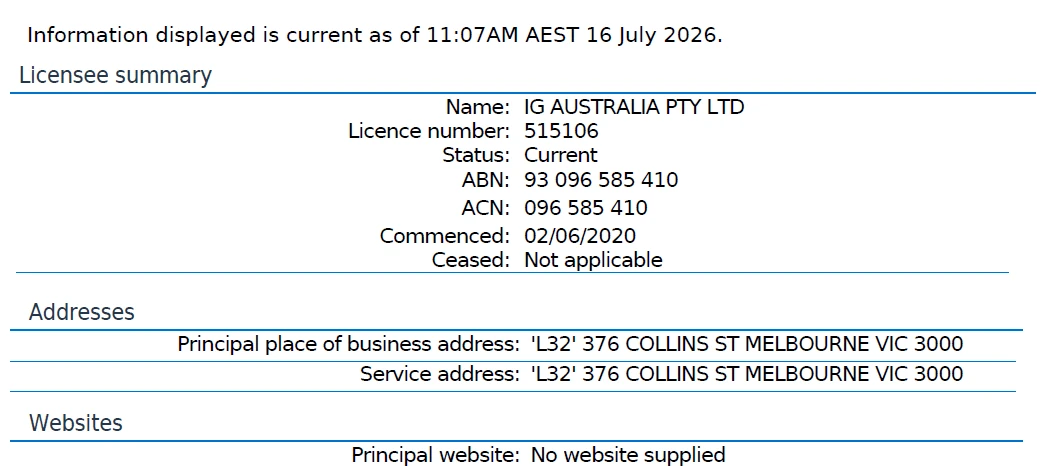
The licence stack holds five further entries:
- Financial Conduct Authority, UK (Tier 1), the home regulator since 1974
- Monetary Authority of Singapore (Tier 1)
- Canadian Investment Regulatory Organization (Tier 1)
- DFSA, UAE (Tier 2)
- Financial Sector Conduct Authority, South Africa
Few retail brokers hold Tier-1 licences in this many jurisdictions. In my view, the practical licence effect is that IG Markets operates under multiple capital and disclosure regimes at once, which constrains the regulatory arbitrage weaker brokers sometimes use. That is the kind of multi-regulator overlap you want if holding large balances.
History and ownership
Stuart Wheeler founded IG Markets in London in 1974 as Investors Gold Index, to let UK investors trade gold price movements without owning the metal. The business pioneered spread betting in the 1970s and CFDs in the 1990s, listed on the London Stock Exchange in 2000, and is a current FTSE 250 constituent. Australian operations opened in 2002 under IG Markets Limited. The entity you deal with today is IG Australia Pty Ltd, licensed since 2 June 2020, so the long history belongs to the group rather than that entity.
Before depositing, confirm IG Markets holds AFSL 515106 using the site's guide to checking a broker on ASIC's register.
IG Markets client money protection and AFCA membership
IG Markets underpins client money protection with mandatory negative balance protection and segregation at an Approved Australian Bank.
Both measures matter for a live balance, and AFCA membership carries disputes to an external ombudsman at no cost to the client.
Money held in client accounts sits separate from company funds. AFCA hears claims up to A$1,263,000 and awards compensation up to A$631,500. Under the Compensation Scheme of Last Resort, eligible consumers can receive up to A$150,000, but the scheme covers only personal advice, securities dealing and credit, and forex and derivatives trading, CFDs included, sit outside it. That scheme is useful but narrower than many traders assume, so you should not treat it as insurance against a losing position. That retail protection standard is set out in the guide to protection against negative balances.
One account carve-out matters before you chase leverage. The Pro and Wholesale classification surrenders negative balance protection along with the ASIC leverage caps.
The public-company entity structure is the additional protection here. A FTSE 250 constituent files audited annual reports and answers to a market regulator on top of ASIC, and IG Markets traded through the 2008 financial crisis, the 2015 Swiss franc de-pegging, the 2020 volatility spike and the 2022 commodity squeeze while remaining well capitalised. That capital record is a relevant data point rather than a guarantee, and I would treat it as evidence rather than a promise. For you, the practical value is a listed parent with public reporting that can be checked.
Public reviews
IG holds a Trustpilot rating of 3.7 out of 5 from 9,979 reviews, which Trustpilot labels average, captured September 2026. The profile has been claimed by the broker since March 2016.
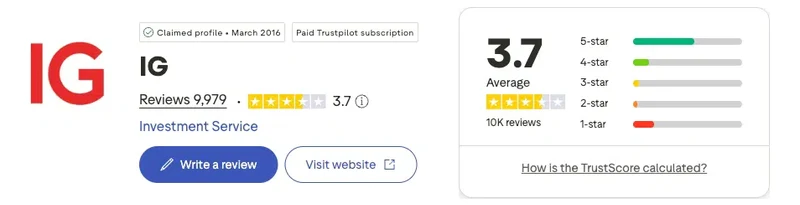
Recurring platform praise covers stability, product breadth and support quality. Complaints recur around withdrawal verification delays, the share CFD financing rates and the inactivity fee structure. I would weigh those complaints most heavily if you rely on fast withdrawals or hold positions overnight.
How popular is IG Markets in Australia?
IG Markets ranked 3rd for search interest among the 32 brokers we review in August 2026, on 14,880 branded Google searches from Australia, behind Interactive Brokers. Search interest measures attention, not quality; the score above is the review verdict.
- 14,880
- Brand searches, August 2026
- +34.4%
- vs July 2026
- 2,480
- Login searches
- 8.3%
- Share of all broker searches
Source: Google search volume, Australia, August 2026. How this is measured
What other review sites say
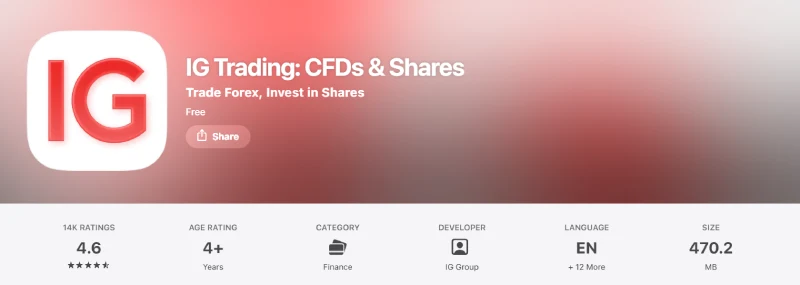
IG Markets' iOS app rates 4.57 out of 5 from 13,726 ratings on the Australian App Store (August 2026), listed as IG Trading: CFDs & Shares.
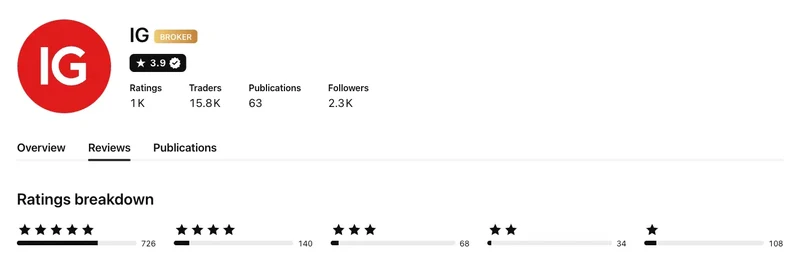
TradingView users rate IG Markets 3.9 out of 5 from 1,076 ratings (September 2026). 15.8K TradingView users have connected a IG Markets account.
IG Markets at a glance: 17 key facts
IG Markets is summarised in 17 key facts covering six regulators, and IG Australia Pty Ltd holds ASIC AFSL 515106.
IG Australia Pty Ltd, ABN 93 096 585 410, has held that licence since 2 June 2020. The group’s Australian operations date from 2002 under an earlier licence, AFSL 220440, held by IG Markets Limited. I focus on IG Australia Pty Ltd because it is the entity you deal with as an Australian client, and the table below carries the full set.
| Item | Detail |
|---|---|
| Australian regulator | ASIC, AFSL 515106, current since 2 June 2020 |
| Australian entity | IG Australia Pty Ltd |
| Other regulators | FCA (UK, Tier 1), MAS (Singapore, Tier 1), CIRO (Canada, Tier 1), DFSA (UAE, Tier 2), FSCA (South Africa) |
| Year founded | 1974 (London); AU operations since 2002 |
| Listed | LSE:IGG (FTSE 250 constituent) |
| Trading platforms | IG web platform (proprietary), MT4, TradingView, ProRealTime, L2 Dealer (DMA), IG Trading API |
| Account types | CFD Trading (Standard), Limited Risk, Share Investing (separate account), Pro / Wholesale |
| Minimum deposit | A$100 (card, PayPal, Apple Pay); A$10 (BPAY); A$450 (EFT with proof of payment) |
| Maximum retail leverage | 30:1 (forex majors), ASIC-capped |
| Spreads from (EUR/USD) | 0.6 pips advertised; 1.13 pips measured average, May to June 2026 |
| Spreads from (AUD/USD) | 0.6 pips advertised |
| Funding methods (AU) | Visa, Mastercard, BPAY, PayID, bank transfer, PayPal |
| Inactivity fee | A$25/quarter after 24 months |
| Negative balance protection | Yes (mandatory under ASIC) |
| AFCA member | Yes |
| Demo account | Free, unlimited |
| Customer support | 24/7 phone, chat, email |
Those two licence numbers are the fact most often confused about this broker, and the trust section below separates them.
IG Markets standard-account spreads, measured
IG Markets came in at 0.72 pips on EUR/USD on standard-account spreads in the 48-hour capture from 22 to 24 September 2026.
Our standard-account spread capture, which Noam Korbl ran, also measured 1.35 pips across the eight-pair basket. That sits against an advertised 0.6 pips at the London and New York overlap. The measured number reflects the full sample and belongs in a realistic cost model rather than the advertised one.
The gap between advertised and measured spreads is the honest headline. That advertised figure is real at the most liquid hour of the day, and the measured figure is what a full rolling sample returns. In my view, that measured figure is the one you should plan around.
| Measure (May to June 2026) | Result |
|---|---|
| EUR/USD, standard CFD account | 1.13 pips average |
| 8-pair basket, standard CFD account | 1.62 pips average |
Forex Direct is the raw-pricing route at IG Markets, a direct market access product open to retail clients in Australia. Its spreads are not in the table above, and that is deliberate: the figures IG publishes for Forex Direct (EUR/USD 0.16 pips, 0.59 across eight pairs) are IG’s own advertised data carrying IG’s own footnote, “average spread for the 12 weeks ending 19th March 2019”. The IG UK page publishes the identical numbers with no footnote at all, and the IG South African page carries the same March 2019 footnote against a different dataset, so the window and the data do not reconcile. These are unmaintained advertised figures rather than a measurement, and they do not belong in a measured column. I would not plan a cost comparison around them, and you should not anchor a cost estimate to them.
Unlike the standard account, Forex Direct does not price per lot. IG charges a volume-tiered commission in US dollars per US$1 million of notional, billed on top of the market spread rather than instead of it. Before comparing a real round-turn cost, add that commission to the raw spread.
| Previous month volume (US$m) | Commission (US$ per US$1m of notional) |
|---|---|
| 1,500+ | 10 |
| Under 1,500 | 20 |
| Under 500 | 30 |
| Under 100 | 60 |
Under the Australian Margin PDS, the cap is US$60 per US$1 million traded, converted to the account base currency where that is not USD, with no published per-trade minimum. At the entry tier a standard lot costs roughly US$6 a side. Both accounts appear in the lowest spread brokers in Australia comparison, where Forex Direct placed 15th tightest of the raw accounts we tested and the standard account 18th of 19. The Forex Direct placement rests on the advertised figures above rather than on our own capture. For your own shortlist, treat that ranking as provisional, because the measured standard account tells a different cost story.
One practical point the pricing pages do not make obvious: DMA has to be activated on the account, and app users cannot do it themselves. In IG’s own wording, “you will need to give us a call to request DMA access” (IG Forex Direct, checked 29 July 2026).
For anyone placing more than a few standard lots a week, the spread cost here runs above a raw account at IC Markets, Pepperstone or Fusion Markets. In my view, forex pricing is not what IG Markets competes on, so you should not choose this account for forex cost alone.
What it costs to trade with IG Markets
IG Markets takes no separate commission on forex, and the costs to trade one standard lot of EUR/USD sit at the 1.13 pip measured spread alone.
Treat that spread as the full execution line on a forex trade, while share CFDs carry commission plus overnight financing instead.
Share CFD costs
Share CFD pricing is where the IG Markets trading-floor heritage shows. On Australian share CFDs, commission starts at A$10 per trade or 0.10% of trade value, whichever is greater. US shares start from US$15 or 2 cents per share. Check that minimum against trade size, because smaller orders can pay a much higher effective percentage.
The overnight financing charge runs at the relevant benchmark rate, being the RBA cash rate plus 2.5% on AUD-denominated long positions, with a similar structure in other currencies and a reduced benchmark received on short positions. Those financing rates run above the Australian market average, which I would call the main cost weakness here and the line you should model first for any overnight share CFD.
On a position held overnight for weeks at a time, the financing line dominates the commission. I would run the numbers against Interactive Brokers before committing, because its commission-driven model usually works out cheaper at that scale and leaves more of your return intact.
Other fees AU traders should check
- Overnight holding cost applies to CFD positions held past 5 PM New York time, direction-dependent, with long positions paying benchmark plus a margin.
- Currency conversion runs 0.50% on any instrument priced outside the account base currency.
- The inactivity fee runs A$25 per quarter after 24 months without trading activity, a more lenient window than the CMC Markets 12 months and a heavier charge once it starts.
- The guaranteed stop-loss premium is charged only when the guaranteed stop triggers, and the premium is shown before the order is placed.
IG Markets funding methods and withdrawal times
IG Markets keeps most funding methods free, charges 0.5% on Mastercard and 1% on Visa credit cards, and processes withdrawals free of charge.
PayPal deposits cost 0.5%, so the funding costs you need to watch are those card and PayPal charges.
Deposit methods (AU clients)
| Method | Fee | Speed | Maximum |
|---|---|---|---|
| Debit card | A$0 | Typically instant | A$99,999 |
| Credit card (Mastercard) | 0.5% | Typically instant | A$50,000 |
| Credit card (Visa) | 1% | Typically instant | A$50,000 |
| Apple Pay | A$0 on a debit card, 0.5% Mastercard or 1% Visa on credit | Typically instant | Not stated |
| PayID | A$0 | Typically instant | Set by your bank |
| BPAY | A$0 | 1 to 2 business days | A$1,000,000 |
| PayPal | 0.5% | Instant | A$30,000 |
| Bank transfer (EFT) | A$0 | 1 to 3 business days | No maximum |
Fees are from IG’s deposit help article dated 20 May 2026, card, bank and PayID times are from the deposit screen inside a live account a colleague opened in September 2026, and maximum deposit amounts are from the help article ‘What are the minimum and maximum amounts I can deposit?’ dated 9 April 2026.
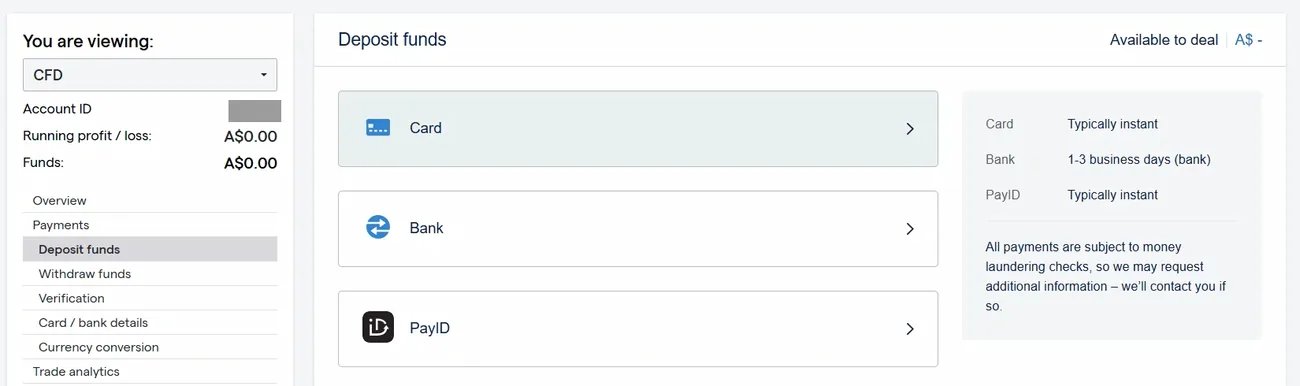
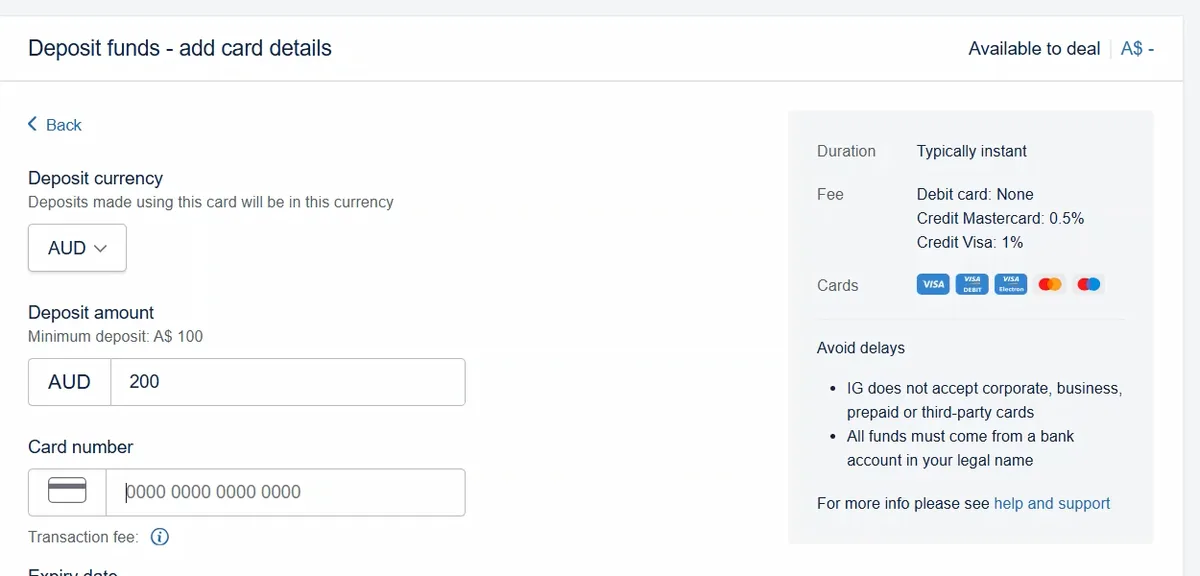
I find it unusual that three of IG’s eight deposit routes carry a percentage charge, because most Australian brokers I review absorb card costs. The five fee-free methods (debit card, Apple Pay on debit, PayID, BPAY and bank transfer) cover nearly every funding need you are likely to have. What I would flag, though, is that IG refuses funding from digital banks like Wise and Revolut, so check your funding source before opening an account.
Withdrawals
Withdrawals cost A$0 on all standard methods. IG Markets requires withdrawals to use the same source as the deposit where possible, in line with AUSTRAC anti-money-laundering rules, so keep at least one original deposit method active because a withdrawal may need to trace back to it.
Account opening
Noam Korbl, who leads our capture programme, opened and funded the account for our September 2026 capture. The application moved through six sections (Profile, Contact, Personal, Finances, Experience, Account) in a few minutes with no technical problems. Australia offers two account types: Share trading and CFD and FX trading, with the CFD and FX account marked as MT4-compatible. The experience section asks how many times you have traded shares and bonds, exchange-traded derivatives and OTC derivatives over the past three years.
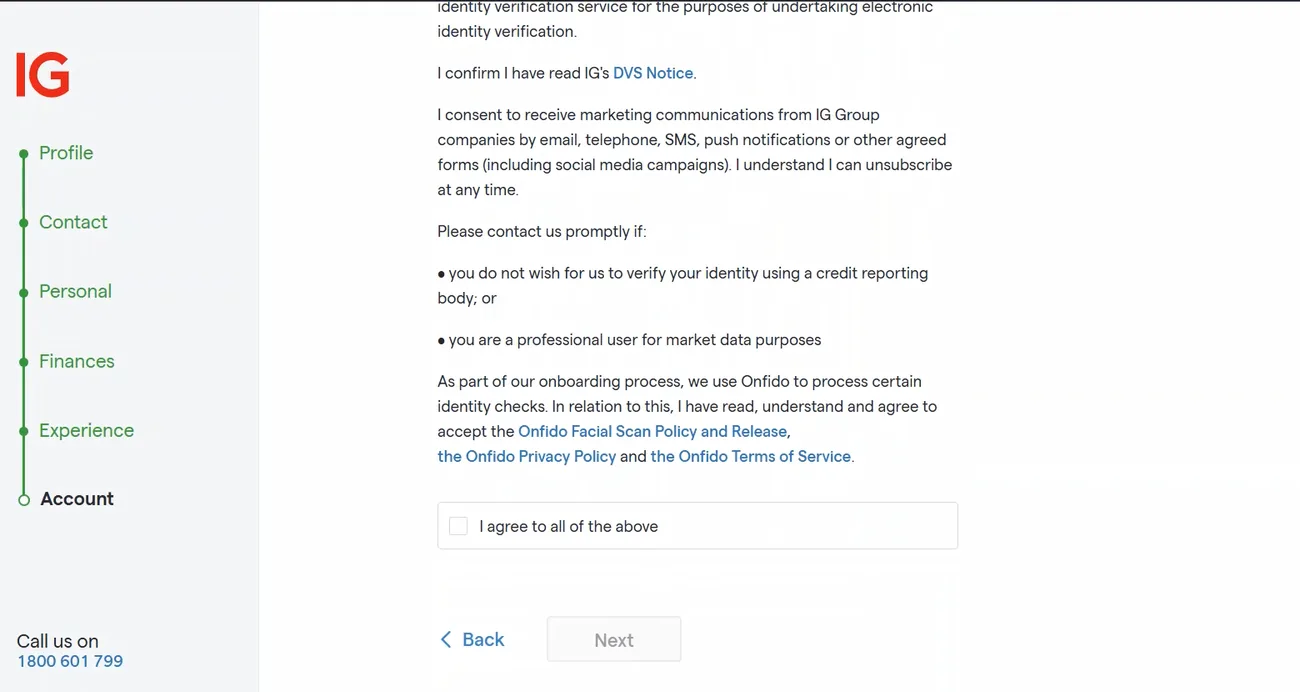
No identity document, proof of address, selfie or camera step appeared at any point, and there was no obvious place in the portal to upload them afterwards. The consent screen names three mechanisms: IG’s DVS Notice, verifying identity using a credit reporting body, and Onfido processing certain identity checks. I’d take a background verification over uploading a passport photo and waiting any day; it’s the fastest identity step I’ve seen in this coverage. Because nothing visible confirms the check passed, you never get a moment where you know you’re verified, and the capture can’t show which of the three mechanisms IG actually relied on or when it finished.
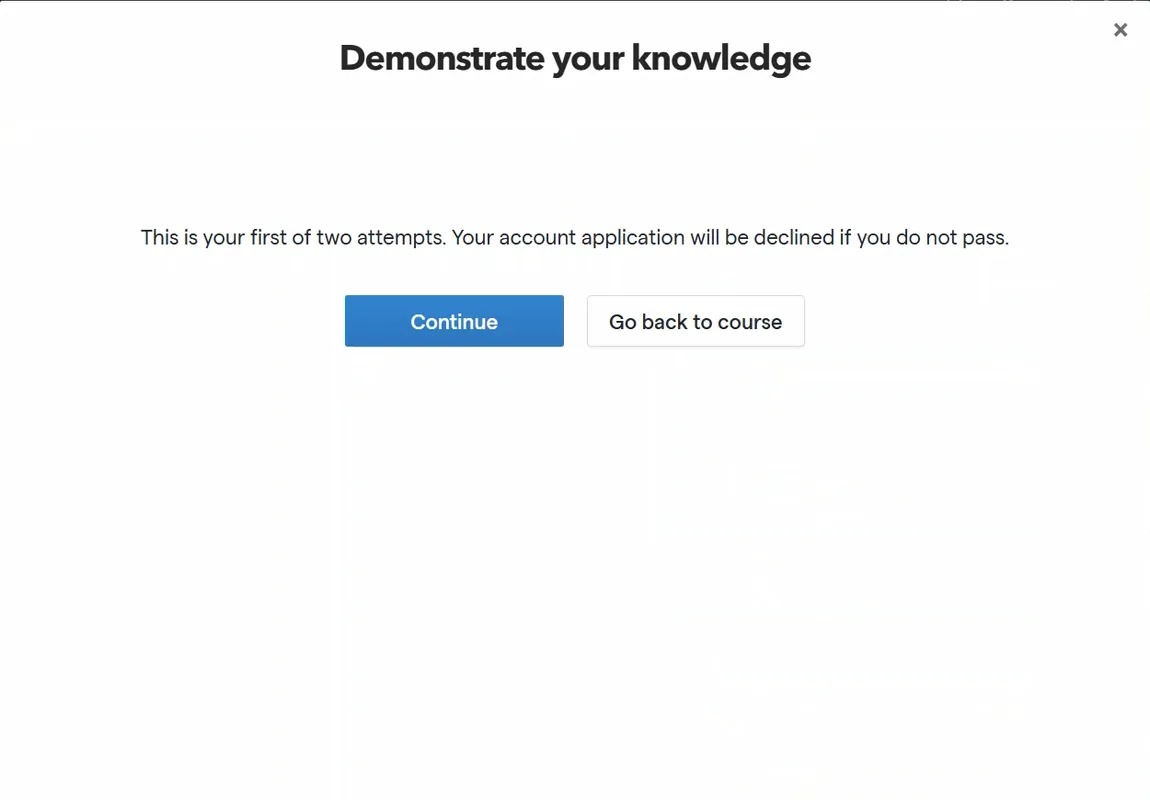
The part of the process I think every applicant needs to understand is the CFD knowledge assessment. After submission the CFD account showed as PENDING with a “Demonstrate your knowledge” prompt. IG offers optional short courses on CFD risk and dealing before you begin. The test screen states: “This is your first of two attempts. Your account application will be declined if you do not pass.” Ten multiple-choice questions cover topics including what happens if your internet connection fails while you are trying to trade. Noam passed at 100% on the first attempt.
Once the assessment was complete, the dashboard displayed Client Status: RETAIL and the CFD account showed Open platform and Add funds. Noam deposited A$200 by card on 3 September 2026, and the full amount appeared as Funds A$200.00 and Available A$200.00 with no pending stage shown.
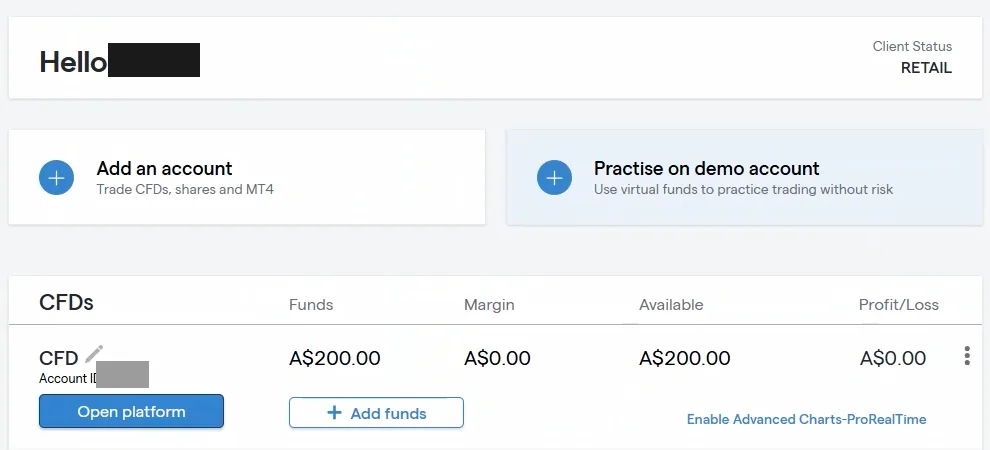
In my opinion, this is a fast, well-structured application. I particularly like that IG gives you optional courses before the knowledge test. The hard rule is the two-attempt limit: fail twice and your account application is declined, so I would treat that test seriously from the start.
IG Markets account types and minimum deposit
IG Markets offers four account types, and the minimum deposit is A$100 by card, Apple Pay or PayPal.
The minimum first deposit drops to A$10 by BPAY and sits at A$450 only for an EFT deposit sent with a proof-of-payment upload. Pick the card or BPAY route for speed unless the bank details are already linked.
| Account | Pricing model | Min deposit | Best for |
|---|---|---|---|
| CFD Trading (Standard) | Spread-only on forex; commission plus financing on shares | A$100 | Multi-asset CFD traders |
| Limited Risk | As CFD Trading; every position carries a guaranteed stop | A$100 | Traders who want a capped, known maximum loss |
| Share Investing | Per-trade brokerage on direct equities | A$100 | Direct ASX and international share buyers |
| Pro / Wholesale | Bespoke pricing, higher leverage | Varies | Wholesale-eligible clients only |
Those tiered deposit figures come from the IG help page dated 10 April 2026. I would look closely at the Limited Risk account where downside control is the priority for you, because every position must carry a guaranteed stop, capping the maximum loss at a known figure before the trade is placed.
Pro and wholesale
The Pro and Wholesale account requires the Corporations Act wholesale client criteria through one of two paths: a Wealth Test of net assets over A$2.5 million or income over A$250,000 for two consecutive years plus recent trading, or an Experience Test of income over A$100,000 or savings over A$500,000 plus sufficient volume and a knowledge assessment. Pro leverage rises to 250:1 on major forex and gold and 167:1 on minors, though the MT4 Pro accounts run 200:1 and 133:1 instead, which is why both figures circulate. Either wholesale path surrenders negative balance protection, so only take that route if the leverage benefit outweighs the loss shield given up.
Minimum deposit and account notes
Spread betting accounts exist on the IG UK entity and are not available to Australian clients. IG Markets runs no swap-free account, confirmed with the desk in July 2026, so you need another broker if overnight swap cannot be paid or received. The free unlimited demo account runs the full web platform.
IG Markets trading platforms
IG Markets lists six trading platforms: the IG web platform, MT4, ProRealTime, L2 Dealer for direct market access, the trading API, and native TradingView.
On the Australian entity, the platform list excludes MT5 and cTrader. The absence of MT5 and cTrader is the first thing to check against a workflow.
IG web platform (proprietary)
IG’s web platform is the flagship route and the one most retail clients use. It runs in browser, on Windows and macOS desktop apps, and on iOS and Android. The build is clean and quick, order placement is straightforward, and guaranteed stops and trailing stops work natively. It gives up some technical-analysis depth to the CMC Markets Next Generation platform, but covers more product types, with the full 17,000-market range sitting behind it. For most Australian clients, this is the default you will live in day to day.
ProRealTime and MetaTrader 4
ProRealTime is the premium charting partner, carrying 100+ indicators, multi-timeframe analysis, automated trading through ProBuilder code and dataset access going back decades. The ProRealTime fee is waived for clients trading four or more times a month and charged as a subscription otherwise. MT4 covers legacy expert advisors with the full forex and key CFD ranges, though the MT4 build excludes the full 17,000-instrument range, so pick ProRealTime for charting depth unless a legacy MT4 advisor locks you in.
L2 Dealer and the trading API
L2 Dealer is the direct market access platform for high-volume share traders. It exposes the underlying order book and routes to the exchange where supported, rather than internalising against the IG quote. Volume thresholds and additional fees apply, and most retail traders have no use for it. I would not send most retail traders here, because you need real size to justify the added complexity. The IG trading API covers REST and streaming, is free with an active account, and supports the full product range.
What IG Markets does not offer
No MT5, no cTrader and no integrated copy or social trading exist on the Australian entity. That platform absence is the single biggest reason an active forex trader picks a competitor here if you rely on either platform. The IG mobile app is among the better trading apps in the Australian market, with biometric login and full order types.
IG Markets execution speed and slippage
IG Markets gets no execution speed or slippage figure in this review. The site holds no raw log of dates, VPS, order count and method behind any fill speed claim, and it publishes no cross-broker latency ranking either.
IG runs a market-maker model on its standard CFD account. Your order flow is matched against the IG book first, and only the residual is hedged with tier-1 liquidity providers. That pricing model is the structural difference from the ECN brokers on this site.
L2 Dealer offers exchange execution where available, which is a different model again. I suggest you choose the platform route that matches the product you trade.
IG Markets instrument counts across nine asset classes
IG Markets lists more than 17,000 tradeable markets across nine asset classes, including more than 13,000 share CFDs.
No ASIC-regulated broker on this site lists a broader count. If you want a single login that reaches most global share markets, this is the catalogue I would check first.
| Asset class | Count | Note |
|---|---|---|
| Forex | 80+ pairs | 6 AUD crosses plus the full EUR, GBP, USD and JPY sets |
| Indices | 36+ | ASX 200, S&P/ASX SPI 200, S&P 500, NASDAQ, FTSE 100, DAX, Nikkei |
| Share CFDs | 13,000+ | ASX, NYSE, NASDAQ, LSE, EU and Asian exchanges |
| Commodities | 35+ | Gold, silver, WTI and Brent crude, natural gas, agricultural softs |
| Cryptocurrencies | Selected list | Selected crypto CFDs at the ASIC 2:1 retail cap |
| Treasuries and bonds | Australian and global government debt | Australian 10-year bond, US T-Notes, German Bund, UK Gilts |
| ETFs | Large global range | ETF CFDs across global markets |
| Knock-Outs and Barriers | Available to retail | Defined risk with a known maximum loss |
| Share investing | Separate account | Direct ASX and international shares |
Forex runs to 80 plus pairs with six AUD crosses, enough for any Australian strategy though not the cheapest place to run one. Commodities reach 35 plus across metals, energy and agricultural softs. Direct share investing sits in a separate account for investors who want to own shares rather than trade them as CFDs, so keep that separation in your planning.
Share CFDs and rates
IG Markets lists 13,000 plus share CFDs across ASX, NYSE, NASDAQ, LSE, EU and Asian exchanges. That is the broadest share CFD range of any ASIC-regulated broker and the lead strength this review scores. The share CFD range prices a less-traded LSE mid-cap, a Hong Kong-listed industrial or an ASX small-cap where most Australian brokers cannot quote them at all. CMC Markets and Interactive Brokers are the only realistic alternatives at this level, so this range is the direct reason you would open an account if small-cap names matter.
In rates CFDs, IG Markets and CMC Markets are also the two Australian brokers with real depth, covering the Australian 10-year bond, US T-Notes, the German Bund and UK Gilts. Look here if you trade macro rates rather than just forex, because most competitors do not quote the full set.
IG Markets Knock-Out and Barrier options
Retail clients can trade Knock-Out and Barrier options at IG Markets, a product no other broker reviewed on this site lists, alongside the 17,000 plus markets on the same login. That exclusivity is the most distinctive product point available here.
Both instruments are defined-risk products. The knockout level caps the maximum loss at the moment the position opens, so your worst case is a known figure rather than a margin calculation that moves with the market. That cost sits inside the product rather than in a separate commission line, and the figure is shown at the point of trade. Check that knockout cost before entry, because it is the price paid for the known loss.
This product structure answers a real problem. An ordinary margined account cannot show the worst case in advance, because a gapping market can close a position past the stop. A knockout cannot gap through its own level, because the level is the contract. That distinction matters if you need to know the maximum loss before committing.
No comparison page exists for the class anywhere on this site, so this section is the coverage. In my view, the Knock-Out range is genuinely uncommon in the Australian retail market, and it is the clearest thing IG Markets offers that no rival here matches. If that defined-risk exposure is what you are missing, this is the account feature to investigate first.
IG Markets leverage and margin under ASIC rules
IG Markets leverage and margin operate under a maximum retail leverage of 30:1 on major forex pairs, which is the starting constraint you face, with lower caps on minors, indices, commodities and cryptocurrency.
ASIC caps retail CFD leverage at 30:1 on major forex pairs, 20:1 on minor pairs, gold and major indices, 10:1 on commodities other than gold, 5:1 on share CFDs and 2:1 on crypto assets. The caps come from a product intervention order extended to 23 May 2027, so they apply at every ASIC broker rather than at IG Markets alone, making retail leverage a pointless point of comparison between providers.
Knock-Out margin works differently by design, because maximum loss is fixed by the knockout level rather than by leverage. The Limited Risk account takes the same idea further and puts a guaranteed stop on every position. Choose one of those structures if you want a hard cap on loss rather than a leverage calculation.
The wholesale tier reaches about 250:1 on major forex for clients passing the eligibility tests. Retail margin close-out sits at 50%: ASIC requires every CFD issuer to close a retail client’s positions once account equity falls below half the total initial margin on all open positions. Positions cannot be netted against each other to reduce that figure, and a gapping market can close a position below the 50% level. Model the 50% close-out rule into your risk plan, because it is the point where the broker must act regardless of the market. The leverage tier structure is set out in how trading leverage works.
IG Markets customer support
IG Markets runs customer support 24/7 on phone, live chat and email, coverage two of its closest Australian rivals do not match.
CMC Markets and Plus500 both close at the weekend. I would treat that 24/7 coverage as the practical safety net you need for weekend holdings.
Live chat replied in under 60 seconds during Australian business hours and around 90 seconds during the overnight US session. Agent knowledge of platform features is strong, and on Australian tax treatment agents correctly defer to a registered accountant rather than guessing. Set your expectations around those times, because support is fast but not instant.
Weekend support coverage is the differentiator that matters most to this broker’s audience. The support desk answers a weekend crypto question or an Asia-Pacific Sunday open query where most of the Australian field is closed. That gap is worth more than a few tenths of a pip to a client holding positions over a weekend, and it is the reason the service score sits where it does. Value that coverage highest if you carry positions outside Australian business hours.
Language support covers English, Mandarin, French, German, Italian and Spanish. That is broad for an Australian-facing desk and reflects the international group behind it.
IG Markets research, tools and education
IG Markets runs a research, tools and education stack of eleven components across two stacks, built on an in-house analyst team.
That team publishes daily commentary across forex, indices, commodities and shares. Use that daily commentary as a starting point, but still check the numbers before acting.
Research feeds
- IG analyst daily commentary and weekly outlooks
- Reuters news feed integrated into the platform
- MetaTrader Charts for third-party technical setups
- ProRealTime advanced charting, free at four or more trades a month
- Economic calendar with custom alert support
- Client sentiment data showing position bias on each instrument
- IG TV on YouTube with regular market analysis
Education content
- IG Academy course library covering forex, CFDs, options and shares
- Beginner through advanced levels
- Live webinars on market events and platform features
- Glossary of trading terms
That stack runs well past the norm for a retail-tier broker. In my view, the integrated Reuters feed and analyst commentary carry real value for a client trading equities and indices alongside forex. The research stack is the deepest of any Australian broker in this coverage, so you can do much of the pre-trade reading inside the one platform.
What traders say about IG Markets
| Rating site | Rating | Based on | Who rated | Captured |
|---|---|---|---|---|
| Trustpilot | 3.7 out of 5 | 9,979 reviews | Worldwide | September 2026 |
| App Store | 4.57 out of 5 | 13,726 ratings | Australia only | August 2026 |
| TradingView | 3.9 out of 5 | 1,076 ratings | Worldwide | September 2026 |
Each row above is a public rating of IG Markets taken from a rating site, dated to the month its figure was captured. An App Store rating counts ratings left on Apple's Australian App Store only, while a Trustpilot figure counts reviews and a TradingView figure counts ratings from anywhere in the world. A site with no row has no rating for IG Markets, withholds it, cannot be matched to IG Markets with confidence, or we have not captured it yet.
How IG Markets compares to CMC Markets and Pepperstone
IG Markets compares to CMC Markets and Pepperstone on breadth against platform and breadth against price, listing 17,000 plus markets against 12,000 plus at CMC Markets.
Our September 2026 capture measured IG Markets at 0.72 pips on EUR/USD, while the Pepperstone Razor account averaged 0.10 pips on EUR/USD in our May to June 2026 capture. I would frame your choice that way rather than asking one broker to win both.
The two longest-running ASIC-regulated CFD accounts are set against each other in CMC Markets vs IG Markets. Both parent companies are LSE-listed with two decades of Australian operation. IG Markets leads on market count, 24/7 support and Knock-Out options. CMC Markets leads on integrated stockbroking and on the proprietary platform. Put the priority first, because the better account depends on whether breadth or platform quality matters more to you.
Pepperstone wins the pricing comparison outright, and it is not close. A forex-first trader pays materially more here for a range that may never be used. Absorb that cost only if the broad instrument list is actually being traded.
Put IG Markets next to any of the other 31 ASIC-regulated brokers we cover.
IG Markets ACY Securities Middle of the measured field
ACY Securities measures 0.55 pips on the raw eight-pair basket; IG Markets carries no figure, published figures, not a capture of ours.
ACY Securities measures 0.16 pips on raw EUR/USD; IG Markets carries no figure, published figures, not a capture of ours.
ACY Securities' measured 1.0 pips matches the middle broker's 1.0; IG Markets' 0.72 sits 0.28 below it.
IG Markets' A$7.00 matches the middle broker's A$7.00; ACY Securities' A$3.00 sits A$4.00 below it.
ACY Securities' A$108.46 a month sits A$17.17 under the middle broker's A$125.63; IG Markets' A$154.17 sits A$28.54 over it.
ACY Securities' A$142.65 matches the middle broker's A$142.65; IG Markets' A$102.71 sits A$39.94 below it.
IG Markets opens at A$100 on the minimum deposit; ACY Securities carries no figure, minimum published in US dollars, not converted on this row.
IG Markets runs MT4, TradingView, Own platform; ACY Securities runs MT4, MT5.
IG Markets holds AFSL 515106; ACY Securities holds AFSL 403863.
IG Markets and ACY Securities both come to 77 / 100 on this row, 2 above the middle broker's 75.
IG Markets' 3.7 / 5 and ACY Securities' 4.4 / 5 straddle the middle broker's 4.3.
IG Markets' 4.57 / 5 and ACY Securities' 4.5 / 5 straddle the middle broker's 4.54.
IG Markets rates 3.9 / 5 on the TradingView broker rating; ACY Securities carries no figure, no TradingView broker profile.
IG Markets' 14,880 and ACY Securities' 1,220 straddle the middle broker's 1,350.
Capture: September 2026 · AUD/USD 0.7010 (25 Sept 2026) · field: the measured field varies by row, from 16 to 24 brokers, of 32 reviewed.
Bars run lowest to highest across the measured field; the tick marks the middle broker.
| If you value… | Consider |
|---|---|
| Tightest forex spreads | Pepperstone or IC Markets |
| Strongest proprietary platform | CMC Markets (Next Generation) |
| Native cTrader | Pepperstone or Fusion Markets |
| MT5 support | Pepperstone, IC Markets or FP Markets |
| Cheaper share CFDs | Interactive Brokers |
| Beginner-focused platform | Plus500 or eToro |
| Direct ASX shares plus CFDs under one login | CMC Markets |
Should you open an IG Markets account?
I would send multi-asset traders here if they want 17,000 plus markets and 13,000 plus share CFDs behind one login. Traders running MT5 or cTrader workflows, or holding share CFDs overnight for weeks, are served better elsewhere than by an IG Markets account. For your own shortlist, the platform and financing lines should decide whether this account fits.
Clear value at IG Markets concentrates in two groups of trader. The instrument range reaches markets no other Australian broker prices, from LSE mid-caps to Australian government bonds. Its defined-risk range covers Knock-Outs and a Limited Risk account, neither of which has a rival here. I would start your review with that combination, because it is rare for one broker to offer both breadth and defined-risk products.
My advice is to look past an IG Markets account if you fall into two groups. Forex-first traders pay 0.72 pips on EUR/USD in our September 2026 capture, where IC Markets measured 0.11 pips on the same pair in the same capture plus its A$9.00 round-turn commission. Overnight share holders pay financing above the market average, and Interactive Brokers is cheaper at scale. The cost gap will show up fastest in those two lines.
IG Markets ranks 13th among the top-rated forex brokers in Australia on the 2026 scoring. Cost holds it there rather than trust, where it scores at the top of the field. Read the ranking as a cost verdict you can offset only if the market range or defined-risk products matter more.
FAQs
Is IG Markets trustworthy?
Is my money safe with IG Markets?
How to withdraw money from IG Markets?
What leverage does IG Markets offer in Australia?
Does IG Markets offer MetaTrader 5 in Australia?
Does IG Markets offer cTrader or TradingView?
What is the minimum deposit for IG Markets?
Does IG Markets charge an inactivity fee?
How does IG Markets compare to CMC Markets?
Testing log
| Record | Detail |
|---|---|
| Review published | 16 May 2026 |
| Last content change | 27 September 2026 |
| Spread capture | IG MT4 CFD account, 0.72 pips EUR/USD |
| Capture window | September 2026 |
| Verification | Live account spreads captured (AUD/USD and EUR/USD, 5 July 2026); IG's Australian deposit help article dated 20 May 2026 read 15 September 2026; live AUD CFD account opened, knowledge test passed and funded by card with A$200 in Australian dollars on 3 September 2026 |