




Trading CFDs and forex carries a high level of risk and may not be suitable for all investors. Read the relevant Product Disclosure Statement before opening an account.
Our verdict on Trading 212
Trading 212 does the entry-level job well for an Australian beginner who wants real shares and CFDs in one app funded with almost nothing. A$1 opens the account, commission is zero on both sides of the business, and the Australian fee schedule carries no deposit, withdrawal, statement or account closure charge. Uninvested Australian dollars earn 5.2% APY paid daily, per the broker's own terms page checked 6 August 2026.
The problem that sits above the rest is a pricing one rather than a safety one. Trading 212 publishes no spread for any instrument, anywhere outside its app. Its own CFD terms page invites you to check the average spread for each instrument, then links to a table whose columns are symbol, name, ISIN, type and exchange, with no spread column on it. You cannot cost a position before opening an account, and because this site has run no live capture here, this review quotes no Trading 212 spread at all.
The score also reflects two further gaps. You get one platform, the Trading 212 app and its web client, with no MT4, MT5, cTrader or TradingView and no expert advisors. The Australian licence dates only from 17 August 2023, so the entity has a short local history behind it. If you want measured pricing and platform choice, the brokers named at the end of this review serve you better.
Pros
- ASIC AFSL 541122, held by Trading 212 AU Pty Ltd since 17 August 2023. Client money sits in a segregated account under the Australian Invest Terms.
- A$1 minimum deposit and A$1 minimum withdrawal, both stated on the Australian terms page.
- You pay zero commission on both accounts, and the Australian schedule carries no deposit, withdrawal, statement or account closure fee.
- 9,221 CFD instruments are available to Australian clients across seven asset classes, crypto included at the 2:1 retail cap.
- 5.2% APY is paid daily on uninvested Australian dollars, per the terms page checked 6 August 2026.
Cons
- No spread is published for any instrument outside the app, so you cannot cost a position before the account is open.
- One proprietary platform only. No MT4, MT5, cTrader or TradingView, and no expert advisors.
- No compensation scheme exists in Australia, and neither AFCA membership nor professional indemnity cover substitutes for one.
- Invest orders are executed offshore by Trading 212 Markets (Ireland) Limited under clause 1.3 of the Australian Invest Terms.
- Card and wallet deposits turn from free to 0.70% once cumulative card funding passes A$4,000 on the investing account.
Trading 212 score breakdown
3.5/5 · Good
The overall CFB Score comes from the full methodology, more than 100 data points per broker.
How is our rating calculated?Is Trading 212 safe? ASIC AFSL 541122
Trading 212 AU Pty Ltd holds ASIC AFSL 541122, status current since 17 August 2023, under ABN 46 660 342 763 and ACN 660 342 763, from principal place of business at Suite 102, 135-151 Clarence Street, Sydney NSW 2000. Every licence should be verified directly, and it can be checked on the ASIC professional registers .
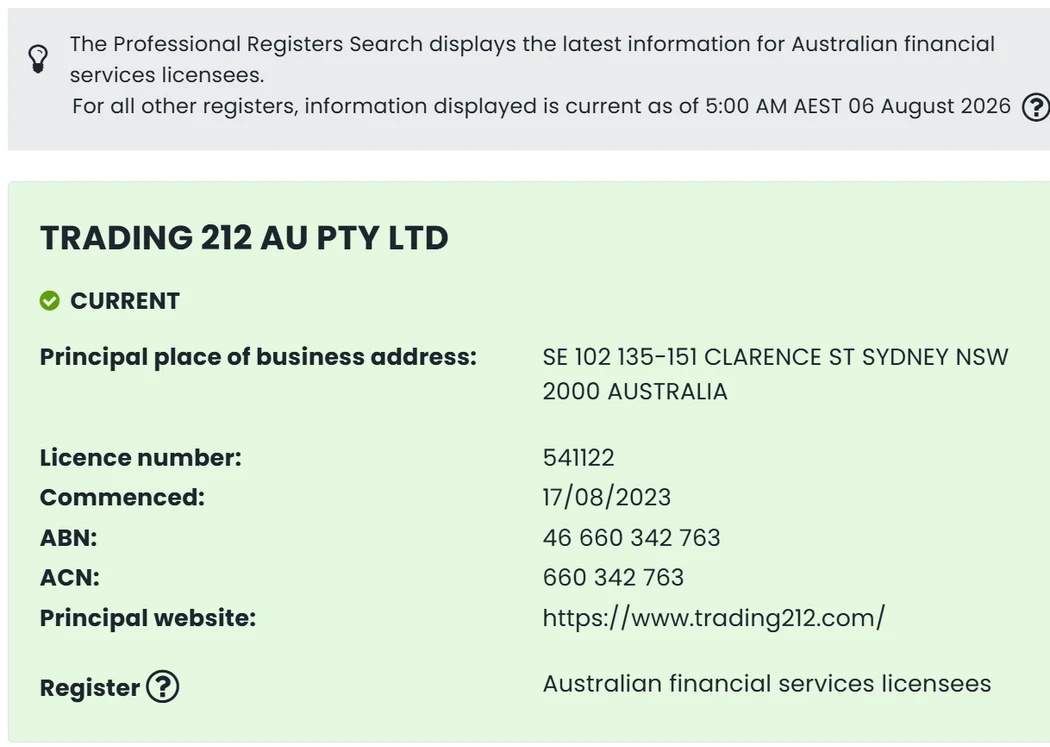
A few details about that entity should be stated plainly. It appoints no authorised representatives, so the ASIC authorised representative dataset returns no records against it. It is a member of AFCA, reachable on 1800 931 678, which is the path to external dispute resolution if a dead end is hit. It also holds professional indemnity insurance as its compensation arrangement under section 912B of the Corporations Act and ASIC Regulatory Guide 126. PI insurance covers the licensee, not the account balance.
None of those protections is a compensation scheme, and the distinction matters more for you than most readers expect. AFCA resolves disputes and professional indemnity cover protects the licensee against its own liability. Neither one returns client money if a broker fails. I cannot stress enough that Australia has no equivalent of the United Kingdom’s deposit-style investor compensation, so any comparison drawn from a Trading 212 review written for a British audience simply does not apply here.
The group behind the Australian entity
Beyond ASIC, the group holds authorisations from the Financial Conduct Authority in the United Kingdom, BaFin in Germany and CySEC in Cyprus, each named in the footer of the broker’s own site. The group is privately held and carries no stock exchange listing, which sets it apart from Plus500 and CMC Markets, whose listed parents file audited public accounts. I find that lack of transparency a concern, because it means you have fewer data points to stress-test the broker’s stability.
What has not been checked
Two trust checks on this entity are still open, and both should be stated on the page. No search of ASIC enforcement action against Trading 212 AU Pty Ltd has been run. No live funded account has been opened either, so nothing in this review rests on direct testing of execution, withdrawals or support. The score below reflects both gaps, and the review carries less certainty than the full-coverage assessments.
Public reviews
Where direct testing stops, third-party rating platforms carry the corroboration. Three of them hold enough Trading 212 volume to be worth reading. Each figure below is read off a dated screenshot rather than typed in once, and the captures are refreshed monthly. These are a useful cross-check, and they can be treated as crowd-sourced intelligence while direct execution data is absent.
Trading 212 holds a Trustpilot rating of 4.6 out of 5 from 101,785 reviews, which Trustpilot labels excellent, captured September 2026. The profile has been claimed by the broker since April 2019.
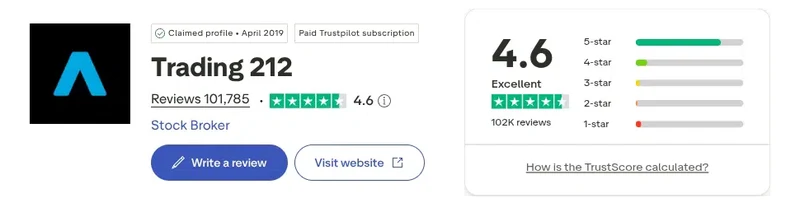
Read that profile with its subscription status attached. The broker pays for a Trustpilot plan, which lets a company invite its own customers to review it, so you should not compare the score directly with an unpaid profile. The number should be read with the understanding that it may tilt upward. Both the claimed date and the paid badge sit in the capture above.
How popular is Trading 212 in Australia?
Australians made 12,790 branded searches for Trading 212 in August 2026, placing it 5th of the 32 brokers we test. Search interest measures attention, not quality; the score above is the review verdict.
- 12,790
- Brand searches, August 2026
- +55.0%
- vs July 2026
- 360
- Login searches
- 7.1%
- Share of all broker searches
Source: Google search volume, Australia, August 2026. How this is measured
What other review sites say
Trading 212's iOS app rates 4.77 out of 5 from 1,598 ratings on the Australian App Store (August 2026), listed as Trading 212 - Stocks & ETFs.
Android users rate Trading 212's Android app 4.7 out of 5 from 258K reviews worldwide on Google Play (August 2026), listed as Trading 212: Stocks, ETFs, ISA. That is the broker's United Kingdom listing, which Google Play serves to Australian visitors as well; the ISA it names is a UK account with no Australian equivalent.
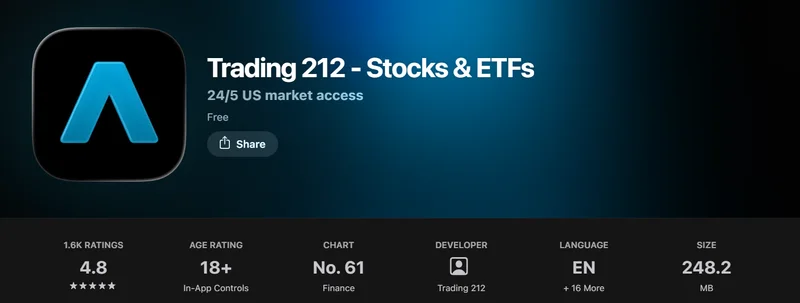
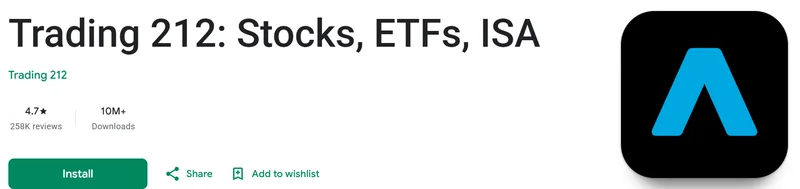
App store ratings measure the app rather than the broker, which suits this entity better than most. One proprietary app is the whole platform offering here, so the store scores are rating the only software a Trading 212 client ever touches. That makes the store ratings unusually representative: if the app works for you, the broker works. The licence conditions behind that offering are what the next section takes apart.
What AFSL 541122 actually authorises
AFSL 541122 authorises Trading 212 AU to issue derivatives to retail and wholesale clients, which is the CFD business, and to deal in securities on behalf of another person, which is the investing business. Forex CFDs are derivatives, so Australians can trade them here. That authorisation is the legal backbone of the entire forex offering, and it means you can open a forex CFD position without running into a regulatory wall.
That point needs stating because the licence condition is easy to misread, and I have seen that mistake made too often. The full condition excludes foreign exchange contracts from one authorisation only, the market making authorisation, alongside government debentures, stocks and bonds. Market making in spot foreign exchange is a distinct financial product category, and excluding it says nothing about whether the broker may issue forex CFDs. It may, and the Product Disclosure Statement lists forex CFDs among the products offered with worked examples. If you read the licence incorrectly, that mistake is easy to make, so the PDS wording can be relied on to settle the question.
The licence also runs to general financial product advice only. Trading 212 AU holds no personal advice authorisation, so nothing it publishes or says takes an individual’s own objectives, financial situation or needs into account. Its own site says as much in the disclaimer under the footer. This is the standard setup for execution-only brokers, and it means the responsibility for fit rests entirely with you.
Client money, custody and negative balance protection
Client money at Trading 212 sits in a segregated bank account alongside money of other clients, in accordance with the ASIC client money rules, under clause 14.1 of the Australian Invest Terms. I consider segregation the bedrock of safety: it means your money is ring-fenced and negative balance protection caps the downside, which retail clients get and wholesale clients explicitly do not.
Segregation is the strongest single protection on this page, and I find the comparison with eToro telling. The Australian terms at eToro describe its client account as a non-segregated account held on trust for the client and other clients. Trading 212’s Australian Invest Terms say segregated. Both statements come from the brokers’ own Australian documents, and the difference is real rather than a matter of wording. Money here is ring-fenced in a way eToro’s is not, and that matters for your safety.
On custody, Trading 212 AU acts as custodian itself and holds assets in safe custody under the ASIC rules, with the right to appoint third-party custodians, under clauses 16.1 and 16.2. Fractional share entitlements carry sole beneficial interest with pro-rata dividends and voting under clause 13.2, so a fractional holding is a real economic interest rather than a synthetic exposure. That is a meaningful distinction for you: a real slice of the asset is owned, not a contract referencing it. Unclaimed money falls under Division 2 of Part 7.8 of the Corporations Act 2001 and the Unclaimed Money Act 2024 in New South Wales.
One structural fact belongs alongside those protections. Under clause 1.3 of the Australian Invest Terms, orders are executed by Trading 212 Markets (Ireland) Limited under the Australian entity’s own order execution policy. Orders from an Australian client are therefore handled by an Irish company. I flag it because it changes where your orders go: nothing improper, but it is worth knowing that trades execute offshore. The standard that applies to the retail protection is set out in negative balance cover on CFD accounts.
Trading 212 at a glance: 18 key facts
18 key facts on Trading 212 are laid out in the table below. The three that matter most, in my view, are ASIC AFSL 541122, a A$1 minimum deposit, and 9,221 CFD instruments available to Australian clients. The licence confirms the entity is ASIC-regulated, the low deposit lets you open an account with pocket change, and the count means there is a market to fit most strategies.
| Item | Detail |
|---|---|
| Australian regulator | ASIC, AFSL 541122, status current since 17 August 2023 |
| Australian entity | Trading 212 AU Pty Ltd, ABN 46 660 342 763 |
| Registered office | Suite 102, 135-151 Clarence Street, Sydney NSW 2000 |
| Other group regulators | FCA (UK), BaFin (Germany), CySEC (Cyprus) |
| Listed | No. The group is privately held |
| Trading platforms | Trading 212 app and web client, proprietary only |
| Account types | Invest (real shares and ETFs) and CFD |
| Minimum deposit | A$1, and A$1 minimum withdrawal |
| Minimum trade value | A$100 forex, A$20 futures, A$10 crypto, A$5 shares and ETFs |
| Trading commission | A$0 on both accounts |
| Spreads | Not published. In-app only, on each instrument’s Product Details page |
| FX conversion fee | 0.15% on Invest, 0.50% on CFD results |
| Maximum retail leverage | 30:1 on major currency pairs, ASIC-capped |
| CFD instruments (AU) | 9,221 across seven asset classes |
| Interest on cash | 5.2% APY on uninvested Australian dollars, paid daily |
| Inactivity fee | None listed in the Australian fee schedule |
| Negative balance protection | Yes for retail clients, explicitly not for wholesale |
| AFCA member | Yes |
Every figure above comes from the Australian legal documentation set pulled on 5 August 2026 or the broker’s Australian terms page checked on 6 August 2026, and David Levy checked this against source. The trail means the numbers can be verified without opening the documents directly. The section below explains why one row of that table reads “not published”.
Trading 212 fees, and the one number it will not publish
Trading 212 does not publish a spread. Both its Australian accounts carry A$0 commission, and its published fee schedule carries no deposit fee, no withdrawal fee, no statement fee, no account closure fee and no inactivity fee. Without a published spread, you cannot compare the real cost of a trade before opening an account, a point that resurfaces every time this page is reviewed.
That gap is the single most important fact on this page, and I walked the broker’s own documentation trail to confirm it. Three documents were opened in order on 6 August 2026, on an Australian session, and the trail below is where each one sent the next. If you follow that trail, the gap becomes clearer: each document points to the next and none publishes a number.
Following Trading 212's own documents to a spread
- Australian Product Disclosure Statement, section 11 States that the spread for each instrument sits on that instrument's Product Details page inside the app.
- Australian CFD terms page Invites the reader to check the average spread for each instrument, and links those words to the broker's public instrument table.
- Public instrument table Carries five columns: symbol, name, ISIN, type and exchange. No spread column exists on it, and no per-instrument detail view opens from it.
- Where it stops The trail closes inside the app. Every route the documentation offers ends at a screen that needs an open account to reach, and no public page carries a spread for any instrument.
What I cannot stress enough is that you cannot cost a position before opening an account. This site has run no live capture on a funded Trading 212 account either, so no Trading 212 spread appears anywhere in this review, and the broker sits outside both cost league tables on this site for the same reason. If a measured figure matters more than anything else, the brokers with one are set out in the guide to Australian brokers with the tightest measured spreads.
The published Australian fee schedule
| Fee | Invest account | CFD account |
|---|---|---|
| Trading commission | A$0 | A$0 |
| Custody fee | A$0 | Not applicable |
| Currency conversion | 0.15% on non-base-currency instruments | 0.50%, applied to the result on closing |
| Bank transfer deposit | A$0 | A$0 |
| Card, Google Pay, Apple Pay deposit | A$0 to A$4,000 cumulative, then 0.70% | A$0 |
| Withdrawal | A$0 | A$0 |
| Statements and account closure | A$0 | A$0 |
| Overnight interest | Not applicable | Per instrument, in-app only |
Two rows deserve a second look, and I want to flag both because they hit your costs directly. The 0.70% card charge starts once cumulative card and wallet funding passes A$4,000 on the investing account, so heavy card funding raises costs once that line is crossed. The threshold is Australian: the equivalent figure on the United Kingdom entity is different and does not apply here. Overnight interest on the CFD side is charged on positions held past midnight EEST, which is UTC+3, and the rate is quoted per instrument inside the app rather than published. That means the overnight cost cannot be previewed before a trade is opened.
Interest on uninvested cash
Uninvested Australian dollars earn 5.2% APY, accrued and paid daily, per the Australian terms page checked 6 August 2026. The Australian Invest Terms explain the mechanism behind it at clauses 14.2 and 14.3: cash may be placed in interest-bearing deposits with authorised deposit-taking institutions, with the broker selecting and periodically reviewing those institutions. The rate moves with the cash rate, so the 5.2% is a dated figure rather than a fixed term. What you earn tomorrow could be different, and I would not treat that 5.2% as a guarantee.
Funding and withdrawals
Trading 212 charges no deposit or withdrawal fee, and the minimum withdrawal is A$1. Card, Google Pay and Apple Pay deposits on the investing account turn from free to 0.70% once cumulative card funding passes A$4,000. Free bank transfers make that threshold easy for you to sidestep, but the method must be switched before hitting the A$4,000 mark.
Bank transfers carry no fee at any volume, which makes them the sensible route when funding beyond that A$4,000 card threshold. On the CFD account, deposits by every method are free with no cumulative threshold at all, per the Australian fee tables checked 5 August 2026. Bank transfer is the safest choice regardless; it keeps your funding cost at zero with no threshold to track.
Withdrawals are free and the minimum is A$1. The broker notes that third-party banks and payment processors may levy their own charges outside its control, which is standard and applies at every broker on this site, so it is always worth checking your bank’s own incoming transfer fees because that is the only place a cost can appear.
Trading 212 account types and minimum deposit
Trading 212 offers two Australian accounts with a minimum deposit of A$1: Invest for real shares and ETFs, or CFD for leveraged positions. Both also have a A$1 minimum withdrawal. The A$1 entry is one of the most accessible in the market, and it means you can test the platform without a real financial commitment.
| Account | What it holds | Commission | Minimum deposit |
|---|---|---|---|
| Invest | Real shares and ETFs, including fractional holdings | A$0 | A$1 |
| CFD | Leveraged contracts across seven asset classes | A$0 | A$1 |
A$1 is a genuinely low bar, though it is not the lowest on this site: several Australian brokers set no minimum at all. The figure that matters more for a first trade is the minimum trade value, which is separate and higher. Forex positions start at A$100 of total exposure, futures at A$20, crypto at A$10, and shares and ETFs at A$5. For you, those minima are the real entry costs, because enough margin is needed to cover the exposure, not just the A$1 deposit. Those are exposure figures including leverage rather than the margin needed to open the position.
Short selling is not permitted on the Invest account under clause 12.8 of the Australian Invest Terms. Going short is done through the CFD account, taking the leverage rules that come with it. That is a deliberate design choice: if you plan to short, bearish trades will always carry leverage.
Trading 212 platforms: one app, no MetaTrader
Trading 212 offers one platform, its own app, delivered as a mobile client and a web client. MT4, MT5, cTrader and TradingView are all absent, and so are expert advisors. That is the narrowest platform set among Australian CFD brokers, and I find that a hard constraint if you rely on MetaTrader or expert advisors: the entire trading workflow must fit inside their app alone.
That count of one is the lowest among brokers on this site, and it follows the product design. One app holds the investing and CFD businesses side by side. The Pies and AutoInvest tooling automates recurring investment into a basket, which is a different job from automating a trading strategy. I think that simplicity is the main draw here: everything from a share buy to a leveraged trade happens in the same screen, so you never need to switch between two different accounts.
What the platform does and does not carry
The platform carries fractional share investing, Pies and AutoInvest for scheduled recurring investment, and a single interface spanning real shares and CFDs, which is tidy, but what I cannot get past is that it means your entire trading experience lives in a single app with no fallback. The Australian Pies and AutoInvest Terms govern that tooling as a distinct product set.
The platform omits expert advisors and algorithmic strategy tools, depth-of-book pricing, and third-party charting through MetaTrader or TradingView. Whether an application programming interface is available to Australian clients was not established for this review, and I would treat it as an open question. If you depend on an API to run custom strategies, that leaves the question unanswered.
What the single platform does have is a strong user reception on both mobile stores. The App Store and Google Play figures are set out with their dates in the ratings panel further down this page. The Google Play figure is a global count, and the listing served to Australians is the broker’s United Kingdom one, so the reviews shown may not fully represent the Australian experience.
If you want the MetaTrader builds or cTrader, the platform comparison sets out which Australian brokers carry each one.
Trading 212 markets and instrument counts
Trading 212 offers Australian clients 9,221 CFD instruments across seven asset classes. That was counted from the broker’s own published instrument list on 6 August 2026 with its Australian exclusions applied. The count is large, but what matters is whether your preferred market sits inside it. Forex and commodities are a tiny slice.
| Asset class | Count available to AU clients |
|---|---|
| Share CFDs | 7,493 |
| ETF CFDs | 1,420 |
| Forex | 209 |
| Futures | 44 |
| Indices | 23 |
| Crypto | 22 |
| Treasuries | 10 |
| Total | 9,221 |
Where that total sits matters more than how large it is. Share and ETF CFDs account for 8,913 of the 9,221 between them. The 209 forex pairs an account might be opened for are a small corner of the same list, as are the 44 futures, 23 indices, 22 crypto and 10 treasury lines. The distribution skews the platform toward equity traders, and if your focus is currencies, that matters.
How Trading 212's 9,221 Australian CFDs divide by asset class
Those counts need their method stated, because the broker publishes no Australian instrument total of its own. Trading 212 publishes one global instrument list and tags each entry with the dealer entities that cannot offer it. Nineteen instruments carry an exclusion against the Australian entity, and every one of the nineteen is a United States spot bitcoin or ether exchange-traded product. Subtracting those nineteen from the published global list of 9,240 gives the 9,221 above. The broker’s own marketing states more than 180 forex pairs, which is consistent with the 209 forex entries counted here, and you can run that cross-check independently to verify the figure.
The Product Disclosure Statement adds two product facts the counts do not show. CFDs confer no title, no voting rights and no interest in the underlying instrument, and there is no physical delivery, under clause 4.2 of the CFD Terms. That is the line between a derivative and an asset: a buy through the CFD account buys a contract. The Invest account is the opposite, holding real shares and ETFs where a buy buys the asset, and fractional entitlements carry pro-rata dividends and voting.
Crypto is available here, at 2:1
Crypto CFDs are available to Australian retail clients at the ASIC cap of 2:1, and all 22 crypto entries in the instrument list carry that ratio. This is a real difference between the Australian and British offerings, because British retail clients are barred from crypto derivatives entirely under the Financial Conduct Authority ban. Any Trading 212 review written for a British audience will say there is no crypto, and that statement does not apply to you. The asset class is covered in the guide to crypto CFDs and the 2:1 cap.
Trading 212 leverage, margin and close-out
Trading 212 holds major currency pairs to a maximum retail leverage of 30:1 under the ASIC product intervention order. That 30:1 is the legal ceiling, so it is the most the regulatory category allows. It closes positions automatically once account equity falls to 50% or below of the minimum required margin, a safety net that kicks in without your input, but it cannot protect against a gapping market.
| Product | Maximum retail leverage | Margin requirement |
|---|---|---|
| Major currency pair | 30:1 | 3.33% |
| Minor pair, gold, major index | 20:1 | 5% |
| Commodity other than gold, minor index | 10:1 | 10% |
| Shares and ETFs | 5:1 | 20% |
| Crypto-assets | 2:1 | 50% |
Those caps come from the ASIC product intervention order and apply at every Australian licensee rather than at this broker alone, so they are not a point of difference. What is worth noting is that the broker’s published instrument data matches them exactly: of the 209 forex entries, 17 carry 30:1 and 191 carry 20:1, every crypto entry carries 2:1, and every share and ETF entry carries 5:1. I would check those ratios against the instrument you plan to trade: the alignment is clean, but it means position sizing adjusts accordingly. The tier structure and what it does to position sizing are set out in the guide to leverage, and the caps themselves in ASIC’s CFD rules.
Margin close-out sits at 50% of minimum required margin, per section 5 of the Product Disclosure Statement. The broker states that positions close automatically without further notice at that point, though a gapping market can still close a position below that level. I would never assume the close-out protects against a gap: your account can breach the floor in a sudden move, leaving a debit balance if the gap is large.
Support and disclosure documents
Trading 212 runs support 24 hours a day, seven days a week. That is a real plus if you work irregular hours, because help is available when other desks are closed. Its Australian target market determination was first issued on 10 July 2026, with the first annual review due in July 2027.
The 24/7 window is genuinely wider than the 24/5 desks most Australian brokers run. The broker also advertises a 29 second average response time, though it labels that figure as a global statistic rather than an Australian one, so a live chat wait in Sydney may be longer for you.
On the disclosure side, the Australian documentation set is complete and recent: a Product Disclosure Statement, Financial Services Guide, CFD Terms, Invest Terms, Order Execution Policy, Disclosure Notice, Pies and AutoInvest Terms and a Target Market Determination, all published under the Australian entity. The target market determination was under a month old at the time of writing, which makes it the freshest document in the set, and it carries a ten business day review trigger alongside the annual cycle. The TMD’s freshness is a sign of active compliance, and it means the documents you rely on are less likely to be out of date.
One disclosure item is worth flagging for what it does not contain. Australian CFD issuers must publish the percentage of their retail clients who lose money and update it at least annually, and the Financial Services Guide states that Trading 212 publishes this figure on its website. A check on 6 August 2026 found that the Australian CFD page carries the qualitative warning that most retail investors lose money trading CFDs, with no percentage attached. That gap troubles me because it denies you a key risk metric: without a hard number, there is no way to see how many clients lose. No number is quoted here because none was found published.
How Trading 212 compares to eToro and Plus500
Trading 212 opens from A$1 with zero commission and 9,221 CFD instruments, against a proprietary-only platform and no published spread. The most direct comparison is to eToro and Plus500: it beats both on entry cost and product breadth and loses to both on published pricing. I would weigh that lost transparency heavily: it means you cannot compare spreads before opening an account.
Client money segregation is where Trading 212 separates itself from eToro, whose Australian terms describe a non-segregated trust account. Trading 212 also opens at A$1 against eToro’s US$50, and its instrument count is far larger. I consider segregation the single most important difference: it means your money is in a dedicated account rather than a commingled trust. Copy trading, which eToro built its business on, does not exist here.
Against Plus500 the comparison narrows. Plus500 publishes typical spread ranges and holds a FTSE 250 listing behind its Australian entity, both of which Trading 212 lacks. Trading 212 answers with a much larger instrument list, an A$1 entry against Plus500’s A$100, and no inactivity fee against a charge that starts after three dormant months. I would frame the choice this way: if seeing a spread before trading matters to you, Plus500 delivers that; if the widest menu and a dollar to start are the priority, Trading 212 delivers.
Put Trading 212 next to any of the other 31 ASIC-regulated brokers we cover.
Trading 212 Vantage Middle of the measured field
Vantage measures 0.52 pips on the raw eight-pair basket; Trading 212 carries no figure, no measured 8-pair raw average.
Vantage measures 0.18 pips on raw EUR/USD; Trading 212 carries no figure, no single-pair EUR/USD figure on record.
Vantage quotes 1.4 pips on standard EUR/USD; Trading 212 carries no figure, no typical standard-account EUR/USD figure.
Vantage charges A$5.00 on round-turn commission; Trading 212 carries no figure, no per-lot commission on record.
Vantage comes to A$123.38 on raw account cost at ten standard lots a month; Trading 212 carries no figure, no measured 8-pair raw average.
Vantage comes to A$197.57 on standard account cost at ten standard lots a month; Trading 212 carries no figure, no typical standard-account EUR/USD figure.
Vantage's A$50 matches the middle broker's A$50; Trading 212's A$1 sits A$49 below it.
Trading 212 runs Own platform; Vantage runs MT4, MT5, TradingView.
Trading 212 holds AFSL 541122; Vantage holds AFSL 428901.
Trading 212's 68 / 100 sits 7 below the middle broker's 75; Vantage's 66 / 100 sits 9 below it.
Trading 212's 4.6 / 5 sits 0.3 above the middle broker's 4.3; Vantage's 4.4 / 5 sits 0.1 above it.
Trading 212's 4.77 / 5 sits 0.23 above the middle broker's 4.54; Vantage's 4.67 / 5 sits 0.13 above it.
Vantage rates 4.5 / 5 on the TradingView broker rating; Trading 212 carries no figure, not in the TradingView capture.
Trading 212's 12,790 and Vantage's 840 straddle the middle broker's 1,350.
Capture: May to June 2026 · AUD/USD 0.7086 (17 Sept 2026) · field: the measured field varies by row, from 13 to 25 brokers, of 32 reviewed.
Bars run lowest to highest across the measured field; the tick marks the middle broker.
An off-window figure is comparable in method, not in dates.
| If you value… | Consider |
|---|---|
| Measured, published spreads | Pepperstone or IC Markets |
| MT4, MT5 or cTrader | Pepperstone, IC Markets or Eightcap |
| A listed parent company | Plus500 or CMC Markets |
| Copy trading | eToro |
| Direct ASX share ownership | CMC Markets or Interactive Brokers |
| Fractional share investing with CFDs alongside | Trading 212 |
Should you open a Trading 212 account?
A Trading 212 account fits well for the Australian beginner who wants fractional share investing and CFDs in a single app for a A$1 entry. That is the profile the broker was built for, in my view. If you need a measured spread, MetaTrader or an audited listed parent, better options appear in the ranked list.
The unpublished spread deserves one more mention outside the cons list, because it is the single fact most likely to swing your close decision. Every other broker in this coverage either advertises a headline pricing figure or has been measured by this site, and most do both. I would not make a decision without a spread figure: what a broker will not show cannot be compared, and that falls hardest on the active forex trader who cares about it most.
I see clear value for two groups here. If you are a beginner investing small and regularly, a rare combination is available: real fractional shares, automated recurring investment through Pies, segregated client money and 5.2% on cash not yet put to work. The tools to automate and earn on idle cash are available from day one. Traders who want breadth get 9,221 instruments across seven asset classes, including the crypto CFDs their British counterparts cannot touch.
Two groups should look past it, in my view. If you trade forex actively, a trade cannot be costed before funding an account. Strategy traders get one platform, no expert advisors and no confirmed API, which is a hard stop when automation is the requirement.
Trading 212 scores 68 on the 2026 assessment, which places it 23rd of the 32 brokers covered here. That score should not pass without its caveat: it rests on 52% evidence coverage, below the 80% threshold the scoring model itself sets for publication, because the trading cost input is estimated rather than measured and no enforcement search has been run. I would treat that 68 as a provisional score: the ranking is softer than the top scores, and you should weigh it accordingly. It will be revised once a funded Australian account produces a real spread capture. The broader ranked set is at the best forex brokers in Australia.
No affiliate arrangement is in place with Trading 212 as at 6 August 2026, so no commission is earned on any click from this page. I disclose that because it matters for trust: the site has no financial incentive to push you toward an account. The site’s full position on commercial arrangements is set out in the advertiser disclosure.
FAQs
Is Trading 212 regulated in Australia?
Can Australians trade forex with Trading 212?
What is the minimum deposit at Trading 212 in Australia?
What spread does Trading 212 charge on EUR/USD?
Does Trading 212 offer MetaTrader 4 or MetaTrader 5?
Does Trading 212 charge an inactivity fee in Australia?
Are Trading 212 client funds protected in Australia?
Testing log
| Record | Detail |
|---|---|
| Review published | 6 August 2026 |
| Last content change | 18 September 2026 |
| Verification | AU legal documentation set and ASIC register record (AFSL 541122) reviewed 5 August 2026; AU fee schedule and instrument list checked 6 August 2026 |