
Summary of interest rates and forex for Australian traders
If you only read the summary:
- Central bank policy rates set the interest rate differential between two currencies, and the differential drives medium-term forex direction
- The RBA cash rate is the headline domestic rate. It’s set on the first Tuesday of each month except January, with a media release at 2:30pm AEST/AEDT.
- The AUD/USD pair has historically traded as a “carry currency” because Australian rates ran above US rates for most of the post-2000 era
- A carry trade borrows the lower-rate currency and buys the higher-rate currency to capture the differential
- Broker swap rates (overnight financing) are the retail trader’s exposure to the rate differential, charged or credited daily on positions held past 5pm New York time
- ASIC’s retail leverage cap and 50% margin close-out limit gap risk on rate-decision volatility, but they don’t eliminate it
Rate decisions create some of the cleanest, most repeatable volatility in the forex calendar. They also produce the worst surprises when the central bank diverges from market expectations, which is where I see most retail traders get hurt and where your pre-positioned stop can get cleaned out before the real move begins.
Why interest rates drive forex
A currency is a claim on future cash flows in that economy. Higher interest rates make holding the currency more attractive, because the same amount of cash earns more in interest, while lower rates do the opposite. Capital flows toward higher-yielding currencies and away from lower-yielding ones, so the rate decision your broker lists on the economic calendar is the starting point for every medium-term directional trade, and the one I would anchor a directional bias to.
That’s the simple version. The full picture is more nuanced because forex prices reflect expected future rates, not just current rates. The market prices in the central bank’s anticipated path months ahead. When the central bank surprises the market by being more hawkish (raising rates faster, or signalling more hikes ahead) the currency typically rallies. When the surprise is dovish, the currency falls, and that is the gap I focus on because it is the one your position is actually exposed to, not the rate itself.
This is why “rates higher = currency higher” doesn’t always work in real time. The market may already have priced 50bp of hikes into the AUD before the RBA delivers the first 25bp. The actual hike can be a sell-the-news event because it’s less than the market expected, and you can be on the right side of the rate call and still lose money on the trade, which is the scenario I find most traders underestimate.
The interest rate differential
For any currency pair, what matters is the differential between the two currencies’ rates. AUD/USD reflects the gap between the RBA cash rate and the Fed funds rate. EUR/USD reflects the gap between ECB rates and Fed rates. The pair tends to follow the differential over months and quarters, which gives you a directional bias I would trust over any single technical signal.
When the RBA hikes and the Fed holds, the AUD-USD rate gap widens in AUD’s favour, and AUD/USD typically rises, which is the backdrop for long AUD exposure. When the RBA holds and the Fed hikes, the gap narrows, and AUD/USD typically falls. The relationship is loose enough to break down for weeks at a time on other macro flows (commodity prices, risk sentiment, China data), but tight enough to be the dominant signal over longer windows, which is the part I would lean on and the reason you can trade the differential with a wider stop and a longer holding period than a pure technical setup.
The major central banks AU traders watch
Six central banks set the rates that move the major forex pairs. The decision dates and policy frameworks are public. I would build a calendar from their published schedules rather than trade each meeting blind, because the dates a trader does not know about are the ones that hit your open positions hardest.
| Central bank | Country | Headline rate | Decision frequency |
|---|---|---|---|
| RBA (Reserve Bank of Australia) | AU | Cash rate target | First Tuesday monthly (except January) |
| Federal Reserve (Fed / FOMC) | US | Fed funds target range | 8 times per year (every ~6 weeks) |
| ECB (European Central Bank) | EU | Deposit facility rate | 8 times per year |
| BoE (Bank of England) | UK | Bank Rate | 8 times per year |
| BoJ (Bank of Japan) | JP | Policy rate | 8 times per year |
| RBNZ (Reserve Bank of New Zealand) | NZ | Official Cash Rate (OCR) | 7 times per year |
Each decision releases a rate statement, often with a press conference and a quarterly Statement on Monetary Policy or equivalent forecast publication. The currency moves come on three things, and I would watch all three rather than just the headline rate: the rate itself (when it surprises), the forward guidance (the statement language), and the press conference (where the governor or chair takes questions). Your position can survive the rate number and still get unwound by a single hawkish sentence in the statement.
RBA-specific timing for AU traders
The RBA decision is at 2:30pm AEST/AEDT on the first Tuesday of each month except January. The post-decision media release goes live at 2:30pm sharp, so the blocked-out time is shorter than it looks. The Governor’s statement is released alongside, and quarterly press conferences run from 3:30pm. The rest of the trading day can be planned around a single half-hour window, so you can schedule around it.
In practice the AUD/USD price can move 30 to 80 pips in the first few seconds of a surprise decision, with wider moves on outsized surprises (50bp instead of 25bp, or a hold instead of an expected hike). Spreads widen briefly as liquidity providers reprice. The first 30 to 60 seconds is rarely a good time to enter on retail spreads, and entering then puts the fill price at the mercy of the widest quote of the minute, which you cannot appeal.
The Quarterly Statement on Monetary Policy (released the Friday after the May, August, November and February decisions) contains the RBA’s updated economic forecasts and is itself a market-moving release, often the one to have on the calendar next to the decision itself. Your post-decision position can get a second volatility event the same week.
The carry trade
The carry trade is the cleanest expression of how rate differentials drive forex.
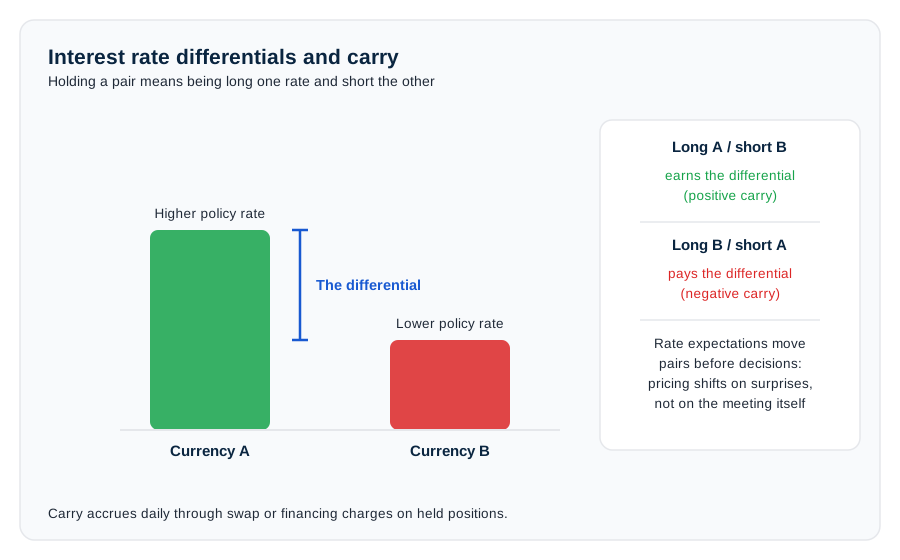
Holding a pair means holding two interest rates at once, one earned and one paid. The diagram shows how the gap between them becomes a credit or a debit each night, why the direction of the trade decides which side of that gap you are on, and how ignoring the swap can quietly turn a flat trade into a negative-carry position.
The mechanic: borrow a low-yielding currency, sell it for a high-yielding currency, hold the position, and earn the rate differential. If JPY rates are 0.5% and AUD rates are 4.5%, a long AUD/JPY position notionally earns 4 percentage points of carry per year, paid daily through the broker’s swap mechanism, and that daily credit is a steady contributor that adds up quietly.
For most of the 2000s and 2010s, AUD was a textbook carry currency. AU rates ran above US, EU, UK, JP and CH rates. AUD/JPY and AUD/CHF were the standard carry pairs. Hedge funds and macro shops ran multi-billion-dollar positions in them. Retail traders followed, which is the era most of the carry lore comes from, but the rate differentials that made those trades work have narrowed considerably, and what is read in a ten-year-old carry-trade article, I would caution, may not match the swap rate your broker quotes today.
The risk: carry trades are a positive-yield, negative-skew strategy. The position earns a small spread daily, sometimes for years. Then a risk-off event hits (2008 Lehman, 2011 European sovereign crisis, March 2020 COVID, August 2024 carry unwind) and the high-yielders dump in days. A year of accumulated carry can vanish in a week, which is the drawdown that surprises people and the reason you cannot size a carry trade the way a short-term scalp is sized.
Carry trade maths in AUD
Consider a long AUD/JPY position. Hypothetical numbers:
- Position size: AUD 30,000 (1 mini lot of AUD/JPY at maximum retail leverage on AUD 1,000 margin)
- Notional rate differential: AU 4.5% minus JP 0.5% = 4.0% per year
- Daily carry, theoretical: AUD 30,000 × 4.0% / 365 = AUD 3.29 per day
In practice, the broker’s swap rate is the credit actually received (or paid). It’s based on the interbank rate differential plus the broker’s mark-up, and it’s not always the headline central bank rates. Broker swap rates sit a few percentage points wider than the policy differential, with the broker keeping the spread, so I would treat the published cash rate as the starting point only and you should pull the live swap rate from the platform before committing capital to a multi-week hold.
Wednesday’s swap is typically tripled to cover the weekend (because forex settles in two business days, so a position open at the Wednesday roll captures Saturday and Sunday’s accrual). Some brokers apply triple swap on Friday instead. Check the broker’s swap schedule before holding overnight, because a triple-swap debit on a position you thought was flat can turn a small negative into a meaningful drag inside a single week.
When carry trades blow up
The standard pattern is a sudden risk-off event that dumps the high-yielder. AUD/JPY can lose 10% in 48 hours when carry positions unwind. At maximum retail leverage that’s catastrophic for an account, and I would not run a carry trade at that size. ASIC’s 50% margin close-out limits how far a retail account can fall before the broker liquidates positions, but a wild gap on Monday’s open can still wipe a deposit, and your close-out happens at the broker’s price, not at the stop level.
The honest reading: the carry trade is a strategy that works most of the time and fails violently when it fails. I would only point unleveraged or lightly leveraged accounts toward it, not retail accounts running maximum leverage. The drawdown that erases a year of carry in a week is the outcome you have to size for, not the daily credit that shows up in the statement each morning.
How broker swap rates work
When a forex position is held past 5pm New York time (roughly 7am AEST in summer or 9am AEDT in winter, give or take daylight saving), the broker rolls the position to the next trade date. The roll becomes an overnight interest charge or credit, depending on which side of the rate differential the position is on. The platform shows the swap rate in the deal ticket before entry, and I would ensure that number is checked on every trade you plan to hold past the roll.
The maths the broker uses:
- The funding cost on the currency you’re effectively borrowing (the one you’re short)
- Minus the interest earned on the currency you’re effectively long
- Plus the broker’s mark-up (or spread)
Being long AUD/JPY means effectively being long AUD (earning AU rates) and short JPY (paying JP rates). If AU rates are above JP rates, a positive swap is received. Flip the trade and go short AUD/JPY, and a negative swap is paid. The direction of the trade decides whether the swap works for or against the position, and the same pair can be a carry-positive or carry-negative trade depending on which way you face, which I would keep in mind.
AU broker swap rate transparency
Most ASIC-regulated brokers publish their swap rates daily on the broker website or inside the trading platform. Across the AU brokers our team tracks, the pattern is:
| Broker | Swap rate transparency |
|---|---|
| CMC Markets | Published per instrument inside Next Generation, updated daily |
| IG Markets | Published per instrument on website and inside platform |
| Pepperstone | Published in MT4/MT5/cTrader specifications, updated daily |
| IC Markets | Published in MT4/MT5/cTrader specifications, updated daily |
| FP Markets | Published in platform; swap calculator on website |
| Fusion Markets | Published in MT4/MT5 specifications |
| OANDA | Published with full transparency, swap calculator on website |







A few brokers offer swap-free (Islamic) accounts where the swap is replaced with a flat administration fee after a defined number of days. They suit clients whose religious or ethical preferences prohibit interest-based products. IC Markets, FP Markets, Fusion Markets and Axi all offer swap-free terms to Australian clients. AvaTrade offers one too, but only to clients who cannot trade swaps for religious reasons: the spread is not widened, though an administration fee applies and a position can stay open for five days before swaps resume. Availability is what I would check rather than assume, because Pepperstone runs a swap-free account but does not list Australia among its eligible countries, so an Australian resident cannot open one; Vantage has no swap-free account; and several ASIC-regulated brokers have no swap-free product at all, which means the choice of broker narrows considerably if a swap-free account is a requirement for you.
My rule is simple: always check the swap rate before holding a position overnight. On a low-conviction trade with a negative swap, the daily cost can erode the trade’s profit potential. On a high-conviction multi-week swing trade in a carry-positive direction, the swap can add meaningfully to total return. The swap column in the platform is easy to skip, and it is the line item that turns a breakeven trade into a net loser over a holding period measured in days rather than hours. Our team’s forex broker reviews cover each broker’s full cost structure. For swap and spread costs ranked side by side, compare the top-rated forex brokers in Australia, or total the spread and commission side at your own volume with our broker cost calculator.
Rate decisions and ASIC’s retail framework
Rate-decision days are some of the highest-volatility moments in the forex calendar. The retail-trader rules under ASIC’s Product Intervention Order (in force since 29 March 2021, extended to 23 May 2027) shape how that volatility hits an account, and the protections they provide are worth understanding before you put a position through a central-bank event:
- 30:1 maximum leverage on AUD/USD and other major pairs caps position size relative to deposit, as set out in our ASIC leverage rules explainer
- 50% margin close-out requires the broker to liquidate positions when account equity falls to half the initial margin used
- Negative balance protection ensures retail accounts can’t go below zero
Net effect: a wild rate-day spike that would have wiped out and over-drawn a 100:1 account in 2019 is contained on a 2026 ASIC retail account. A trader can still lose the full deposit on a sufficiently bad gap, but cannot go negative, and that is the difference between starting again from zero and owing the broker money you do not have.
This isn’t a green light to trade rate decisions casually. The first 30 to 60 seconds after the release are the worst time to enter a market on retail spreads. Spreads widen, slippage gets ugly, and the immediate price action often reverses within minutes as the market digests the statement language. I would either size positions much smaller than usual, or wait 5 to 10 minutes for the dust to settle, because the fill you get in the chaos is rarely the fill planned for.
For longer holding periods, the rate decision is the input to the macro view rather than the trade trigger itself. I would build the position around the expected forward-rate path, sizing for the volatility you know is coming rather than the quiet market seen the night before. Adjust position size for the elevated volatility around release windows.
A worked AUD example
Let’s run through a single rate-aware trade.
The RBA is going to hike at the next meeting, in your view, because the latest CPI print came in hot. The market is pricing a 60% probability of a hike. The trader’s view is the actual probability is closer to 90%. The trade is long AUD/USD ahead of the decision.
Your AUD 5,000 account sits under the standard ASIC retail leverage cap. The trader decides to risk 2% of the account, so the maximum loss on the trade is AUD 100.
The entry is at AUDUSD 0.6520, and the pre-decision range puts the swing low at 0.6480, so a stop at 0.6470 gives you 50 pips of stop distance.
On a mini lot of AUD/USD, pip value is roughly AUD 1.54 at AUDUSD 0.65 (illustrative rate) conversion. So 50 pips of stop = AUD 77 of risk per mini lot, and you can run 1 mini lot comfortably within the 2% budget.
The decision drops at 2:30pm AEDT on the first Tuesday of the month. RBA hikes 25bp as expected, but the statement language reads more hawkish than the market expected. AUD/USD spikes to 0.6580 in the first 90 seconds, then settles around 0.6555, which is where the position starts to work, and the entry price from the pre-decision session looks well-timed in hindsight.
After the spike, the position is up 35 pips on a 50-pip stop, which is roughly AUD 54 of unrealised profit on the AUD 5,000 account, or ~1.1%. From there the trader can bank it, move the stop to break-even, or hold for a multi-day continuation if the rate-path repricing has further to run.
The point of the example: position size based on dollar risk, stop level based on chart structure, and the rate decision as the catalyst. The trader is not betting the account on the decision. The position is sized to survive a wrong call, which is the outcome I would want from the setup and the one that keeps you in the game when the central bank does what nobody expected.
Rates set the medium-term direction, and the rest of your trade is sizing and risk. For how those pieces fit together, work through our forex education hub.
FAQs
How do interest rates affect the AUD?
What is a carry trade?
How are forex swap rates calculated?
When does the RBA announce rate decisions?
Should I trade the news on rate decisions?
Are forex profits from rate trades taxed differently in Australia?
Related pages
About the author

Justin co-founded CompareForexBrokers in 2014 and has traded forex since 1998. Based in Melbourne, he has tested every ASIC-regulated broker on this site personally and has written for Forbes, Kiplinger, Finance Magnates, the Australian Financial Review and The Age. He holds a Bachelor of Commerce (Honours) and a Master of Marketing from Monash University. Justin is the co-founder and CEO of CompareForexBrokers.