
Summary
- Forex pairs split into three groups: majors (seven USD pairs), minors (cross pairs without USD), and exotics (a major paired with an emerging-market currency).
- AUD/USD is the home pair for Australian traders and counts as a major. Spreads are tight, liquidity is deep during Sydney/Tokyo and London/NY overlap.
- ASIC leverage caps depend on pair class: highest on major pairs, lower on minors, and tighter again on commodities, shares and crypto. The caps section below has the figures.
- Common AUD pairs at the ASIC-regulated brokers we review include AUD/USD, AUD/JPY, AUD/NZD, AUD/CAD, AUD/CHF, AUD/SGD, AUD/HKD.
- Pip values on AUD-quoted pairs differ from USD-quoted pairs. We work through the maths below.
Pip Value Calculator
What one pip is worth in your account currency
Rates as of Fri 25 Sep 2026, 5pm New York close
One pip on AUD/USD at 1.00 lots is worth A$14.27 in AUD.
A$14.27
per pip at 1.00 lot(s)
- Pip size0.0001
- Contract size100,000 units per lot
- Conversion rate (USD to AUD)1.4265
What one pip is worth in AUD, 25 September 2026. A one-lot position pays A$14.27 per pip on AUD/USD and A$14.27 on EUR/USD. The gap is your account currency conversion, which is why the same pip move pays differently by pair. Change the pair, lot size or account currency above for any trade being sized.
How currency pairs work
A forex pair quotes one currency in terms of another. AUD/USD at 0.6500 means one Australian dollar buys 65 US cents. The first currency is the base. The second is the quote or counter currency. Buying AUD/USD means you are buying AUD and selling USD at the same time.
Most pairs are quoted to four decimal places, with five for some pairs at most ASIC brokers. The smallest standard movement is one pip: the fourth decimal place on most pairs and the second decimal place on JPY-quoted pairs (USD/JPY, AUD/JPY). The fifth decimal is called a fractional pip or pipette.
Standard lot sizes:
- 1 standard lot = 100,000 units of the base currency
- 1 mini lot = 10,000 units
- 1 micro lot = 1,000 units
- 1 nano lot (some brokers) = 100 units
Most ASIC-regulated brokers in our shortlist allow retail traders to trade fractional lots from 0.01 standard lots upwards. IC Markets, Pepperstone and FP Markets all support 0.01 lots on every pair, so you can size a position without overcommitting.
Major forex pairs
The majors are the seven (sometimes eight) most-traded forex pairs, all of which include the US dollar on one side. Combined, they account for roughly 75% of global forex turnover, so most of your price action and spread comparisons cluster there.
| Pair | Nickname | Typical spread (RAW) |
|---|---|---|
| EUR/USD | Fibre / Euro | 0.0 to 0.2 pips |
| USD/JPY | Gopher / Ninja | 0.1 to 0.3 pips |
| GBP/USD | Cable | 0.2 to 0.5 pips |
| USD/CHF | Swissy | 0.2 to 0.5 pips |
| AUD/USD | Aussie | 0.1 to 0.4 pips |
| USD/CAD | Loonie | 0.2 to 0.5 pips |
| NZD/USD | Kiwi | 0.4 to 0.8 pips |
Some sources include EUR/GBP as a major, but for margin purposes I would rely on ASIC’s Product Intervention Order, which treats EUR/GBP, EUR/JPY and GBP/JPY as majors for leverage purposes even though strict definitions classify them as minors.
AUD/USD, the Aussie
AUD/USD is your home pair and the most-traded AUD cross. It is one of the seven major pairs globally, nicknamed “the Aussie” by traders. Its price correlates strongly with commodity prices (especially iron ore and gold), Chinese economic data, and the RBA cash rate, which is why I watch those together.
Why AU traders gravitate to AUD/USD:
- AUD is the account currency for most ASIC-regulated brokers. No conversion cost on profits.
- Spreads are among the tightest on most accounts. RAW pricing typically 0.1 to 0.4 pips.
- High liquidity during Sydney session (7am to 4pm AEST), Tokyo session (10am to 7pm AEST) and London/NY overlap (11pm to 2am AEST).
- Strongly driven by AU-specific catalysts: RBA decisions, ABS labour data, commodities, China.
AUD/USD can be a choppy pair for beginners, and the timing of the moves can catch you off guard. Australian dollar prices often react to Chinese data released while you are asleep, or to US numbers that hit during Sydney’s evening. That means the pair can gap at the Monday open or lurch sharply when sessions change over, leaving your stops in a tough spot.
Minor pairs (cross pairs)
Minor pairs, also called cross pairs, pair major currencies without the US dollar. EUR/JPY, GBP/JPY, EUR/CHF and AUD/JPY all fall here. Liquidity is good, but I would place it a tier below the seven majors. Spreads on RAW accounts are wider, often 0.5 to 1.5 pips on EUR/JPY and AUD/JPY.
Common minors AU traders use:
- AUD/JPY, sensitive to risk-on/risk-off flows. Carry trade favourite when interest rate differentials widen.
- AUD/NZD, RBA versus RBNZ trade. Tight range, slow-mover, popular with mean-reversion strategies.
- AUD/CAD, two commodity currencies. Often correlated to oil and iron ore.
- EUR/JPY, risk barometer for European versus Asian flows.
- GBP/JPY, high volatility minor, popular with swing traders.
Under ASIC’s Product Intervention Order, retail leverage on minor forex pairs is capped at 20:1, but the order defines “major” more broadly than the market convention above: any pair of the Australian dollar, British pound, Canadian dollar, euro, Japanese yen, Swiss franc and US dollar counts as a major. That puts EUR/GBP, EUR/JPY, GBP/JPY and the AUD crosses such as AUD/JPY and AUD/CAD at the 30:1 cap. The 20:1 tier applies to pairs involving a currency outside those seven, such as AUD/NZD or NZD/USD. I would always check the broker’s PDS for the exact classification because this is where margin errors start.
Exotic pairs
Exotics combine a major currency with an emerging-market currency. USD/SGD, USD/HKD, USD/MXN, USD/ZAR and EUR/TRY are common examples. Liquidity is thinner, spreads are wider, often 5 to 50 pips on the most exotic pairs, and slippage risk is higher. I would keep your position size small here.
For AU traders, exotic AUD pairs are the most relevant. AUD/SGD and AUD/HKD are offered by several ASIC brokers and suit traders with Asia-Pacific business or travel exposure. Most retail forex traders don’t trade exotics regularly, because the cost of entry and exit eats most of the move.
ASIC leverage caps on exotic pairs typically default to the 20:1 minor pair cap. Some brokers apply tighter risk limits, so I would confirm the number in your broker’s published margin schedule before committing.
AUD crosses available across the capture set
Not every broker offers every AUD cross. The availability figures below come from the 29 ASIC-regulated brokers our team covered in the May to June 2026 instrument capture, which is not the whole shortlist. Focus Markets, Trading 212 and Fortrade were all onboarded after that capture closed, so the three of them sit in our review coverage but not in the counts on this page.
| Pair | Available at most brokers? | Examples |
|---|---|---|
| AUD/USD | All 29 | Every broker in the capture set |
| AUD/JPY | All 29 | Every broker in the capture set |
| AUD/NZD | 28 of 29 | Available at IC Markets, Pepperstone, CMC, IG, Plus500, eToro, OANDA, FP Markets |
| AUD/CAD | 26 of 29 | Available at IC Markets, Pepperstone, CMC, IG, FP Markets, Eightcap |
| AUD/CHF | 26 of 29 | Available at IC Markets, Pepperstone, CMC, IG, FP Markets, Eightcap |
| AUD/SGD | 19 of 29 | Available at IC Markets, Pepperstone, CMC, IG, FP Markets |
| AUD/HKD | 15 of 29 | Available at IC Markets, Pepperstone, CMC, IG |
| AUD/MXN | 4 of 29 | Available at CMC, IG |
| AUD/PLN | 6 of 29 | Available at IC Markets, Pepperstone, CMC, IG |
Before you open a position in an unusual AUD cross, check the broker’s instrument list. CMC Markets and IG Markets have the broadest AUD cross coverage in the capture set. To shortlist a provider, our top Australian forex brokers guide compares the ASIC-regulated field.
How closely these pairs move together
Two positions in correlated pairs are closer to one position than two, which is the part that surprises traders who size each trade on its own. The matrix below is our own measurement over the last 90 shared trading days, and I would learn the two relationships in the paragraph above before using it.
Over the last 90 shared trading days, the strongest positive relationship in this set is XAU/USD and XAG/USD at +0.87, so the two have tended to rise and fall together and holding both is closer to one position than two. The strongest inverse relationship is EUR/USD and USD/CHF at -0.87, where a gain in one has usually coincided with a loss in the other. Correlations move, so treat these as a description of the measured window rather than a rule.
| Pair | AUD/USD | EUR/USD | GBP/USD | USD/JPY | USD/CAD | USD/CHF | NZD/USD | USD/SGD | EUR/AUD | GBP/AUD | AUD/JPY | EUR/GBP | GBP/JPY | XAU/USD | XAG/USD |
|---|---|---|---|---|---|---|---|---|---|---|---|---|---|---|---|
| AUD/USD | +1.00 | +0.73 | +0.68 | -0.50 | -0.55 | -0.68 | +0.81 | -0.81 | -0.76 | -0.60 | +0.45 | -0.19 | +0.02 | +0.60 | +0.64 |
| EUR/USD | +0.73 | +1.00 | +0.85 | -0.53 | -0.66 | -0.87 | +0.77 | -0.85 | -0.12 | -0.06 | +0.17 | -0.08 | +0.14 | +0.58 | +0.56 |
| GBP/USD | +0.68 | +0.85 | +1.00 | -0.51 | -0.59 | -0.75 | +0.72 | -0.76 | -0.20 | +0.18 | +0.13 | -0.59 | +0.28 | +0.49 | +0.50 |
| USD/JPY | -0.50 | -0.53 | -0.51 | +1.00 | +0.43 | +0.64 | -0.54 | +0.69 | +0.25 | +0.12 | +0.54 | +0.17 | +0.68 | -0.28 | -0.24 |
| USD/CAD | -0.55 | -0.66 | -0.59 | +0.43 | +1.00 | +0.65 | -0.58 | +0.63 | +0.18 | +0.10 | -0.09 | +0.13 | -0.02 | -0.40 | -0.34 |
| USD/CHF | -0.68 | -0.87 | -0.75 | +0.64 | +0.65 | +1.00 | -0.74 | +0.83 | +0.18 | +0.10 | 0.00 | +0.10 | +0.07 | -0.63 | -0.55 |
| NZD/USD | +0.81 | +0.77 | +0.72 | -0.54 | -0.58 | -0.74 | +1.00 | -0.82 | -0.47 | -0.31 | +0.23 | -0.19 | +0.01 | +0.50 | +0.53 |
| USD/SGD | -0.81 | -0.85 | -0.76 | +0.69 | +0.63 | +0.83 | -0.82 | +1.00 | +0.39 | +0.26 | -0.08 | +0.15 | +0.12 | -0.59 | -0.57 |
| EUR/AUD | -0.76 | -0.12 | -0.20 | +0.25 | +0.18 | +0.18 | -0.47 | +0.39 | +1.00 | +0.81 | -0.49 | +0.21 | +0.11 | -0.33 | -0.40 |
| GBP/AUD | -0.60 | -0.06 | +0.18 | +0.12 | +0.10 | +0.10 | -0.31 | +0.26 | +0.81 | +1.00 | -0.47 | -0.39 | +0.28 | -0.28 | -0.32 |
| AUD/JPY | +0.45 | +0.17 | +0.13 | +0.54 | -0.09 | 0.00 | +0.23 | -0.08 | -0.49 | -0.47 | +1.00 | 0.00 | +0.72 | +0.30 | +0.38 |
| EUR/GBP | -0.19 | -0.08 | -0.59 | +0.17 | +0.13 | +0.10 | -0.19 | +0.15 | +0.21 | -0.39 | 0.00 | +1.00 | -0.31 | -0.05 | -0.09 |
| GBP/JPY | +0.02 | +0.14 | +0.28 | +0.68 | -0.02 | +0.07 | +0.01 | +0.12 | +0.11 | +0.28 | +0.72 | -0.31 | +1.00 | +0.11 | +0.15 |
| XAU/USD | +0.60 | +0.58 | +0.49 | -0.28 | -0.40 | -0.63 | +0.50 | -0.59 | -0.33 | -0.28 | +0.30 | -0.05 | +0.11 | +1.00 | +0.87 |
| XAG/USD | +0.64 | +0.56 | +0.50 | -0.24 | -0.34 | -0.55 | +0.53 | -0.57 | -0.40 | -0.32 | +0.38 | -0.09 | +0.15 | +0.87 | +1.00 |
Source: our own capture from the rates vendor's daily history, weekday bars only, flat and malformed bars dropped. Gold and silver are included: their daily returns correlate against the pairs on the same basis.
Pip values explained
A pip is the standard unit of price movement. On a USD-quoted pair such as EUR/USD, AUD/USD or GBP/USD, one pip is the fourth decimal place. On a JPY-quoted pair, it is the second decimal place.
Pip value calculation: pip value = (one pip / exchange rate) × lot size, expressed in the quote currency. You can use our pip value calculator to do this conversion for any pair, lot size and account currency.
For a standard lot (100,000 units) of EUR/USD:
- One pip is 0.0001
- Pip value = 0.0001 × 100,000 = $10 USD per pip
- For an AUD account at AUD/USD 0.65 (illustrative rate), that’s roughly AUD 15.40 per pip
For a standard lot of AUD/USD:
- One pip is 0.0001
- Pip value = 0.0001 × 100,000 = $10 USD per pip
- For an AUD account at AUD/USD 0.65, that’s roughly AUD 15.40 per pip
For a standard lot of AUD/JPY (assume rate of 100):
- One pip is 0.01 (JPY pair)
- Pip value = 0.01 × 100,000 / 100 = AUD 10 per pip
- AUD-quoted on the base side, so the conversion lands closer to AUD 10
Trading a mini lot (10,000 units) divides all pip values by 10. A micro lot (1,000) means dividing by 100.
This is why broker platforms quote pip value live. On your AUD account, the pip value of EUR/USD changes daily with the AUD/USD exchange rate. For EAs and strategy testers, I would build pip value as a dynamic input rather than a hard-coded number.
Spread expectations across pair types
| Pair type | Typical RAW spread | Typical Standard spread |
|---|---|---|
| Majors (EUR/USD, AUD/USD, USD/JPY, GBP/USD) | 0.0 to 0.4 pips | 0.6 to 1.5 pips |
| AUD crosses (AUD/JPY, AUD/NZD, AUD/CAD) | 0.5 to 1.5 pips | 1.5 to 3.5 pips |
| Other minors (EUR/JPY, GBP/JPY, EUR/CHF) | 0.4 to 1.5 pips | 1.2 to 3.0 pips |
| Exotic AUD (AUD/SGD, AUD/HKD) | 2 to 5 pips | 4 to 10 pips |
| Exotic USD (USD/MXN, USD/ZAR, USD/TRY) | 5 to 50 pips | 15 to 100 pips |
RAW spreads are quoted from typical averages at IC Markets, Pepperstone and FP Markets RAW/Razor accounts. Standard spreads come from CMC, IG and Plus500 typical no-commission accounts. Both are quoted during the London/NY overlap on a typical Tuesday or Wednesday, which is the window I would use for comparison.
Active traders will almost always find RAW plus commission cheaper on majors, and that is where I would point you first. Casual traders trading once or twice a week often come out ahead with a flat-spread Standard account, because the convenience wins. Our guide to the lowest spread forex brokers in Australia breaks the maths down on measured figures.
ASIC leverage caps by pair type
ASIC’s Product Intervention Order caps Australian retail traders at 30:1 leverage on major forex pairs and 20:1 on minors and exotics. For the lower tiers on gold, indices, commodities, share CFDs and crypto, see our ASIC leverage caps guide.
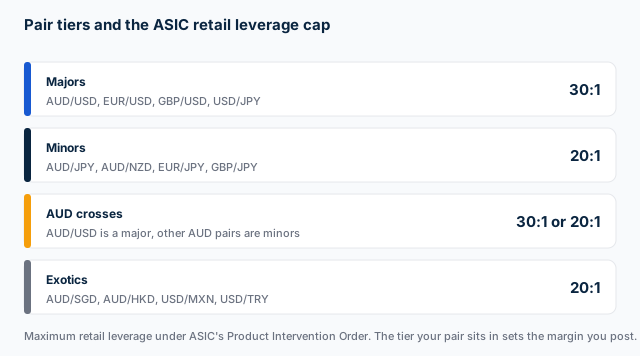
The diagram sets the four pair tiers against the retail cap that applies to each: 30:1 on majors including AUD/USD, and 20:1 on minors, other AUD crosses and exotics.
Wholesale clients can request higher leverage at the broker’s discretion, typically up to 500:1. The wholesale-client tests under section 761G of the Corporations Act require net assets of AUD 2.5 million, or gross income of AUD 250,000 in each of the last two financial years, certified by a qualified accountant.
When ASIC defines a major pair, this is the list that applies: AUD/USD, EUR/USD, GBP/USD, USD/JPY, USD/CAD, USD/CHF, NZD/USD, EUR/GBP, EUR/JPY, GBP/JPY. Anything outside that list falls into the 20:1 minor pair cap, so your margin jumps. It is worth memorising if you trade under an ASIC-regulated broker, because the list directly shapes how much you can put on.
Why AUD/USD is called the Aussie
The “Aussie” nickname dates from the 1980s when AUD/USD was first floated. The Hawke government deregulated the Australian dollar in December 1983, and forex traders in Sydney and London needed shorthand for the new pair. “Aussie” stuck. The same nickname now applies more loosely to the AUD itself (“the Aussie was up half a cent”), though traders typically mean AUD/USD specifically when they say “the Aussie”.
By contrast, NZD/USD is “the Kiwi”, USD/CAD is “the Loonie” (named after the loon on the Canadian dollar coin), and EUR/USD is sometimes called “the Fibre”. That name comes from the fibre-optic cables that carry forex data, distinguishing it from “the Cable” used for GBP/USD, named for the original transatlantic telegraph cable.
These nicknames matter because they appear in market commentary, broker research, and Reuters newswires. When your broker’s morning analysis says “the Aussie tested 0.6480 overnight”, that is AUD/USD.
Your pair choice sets the spread, the pip value and the leverage cap all at once. For how those pieces fit with margin, stops and sizing, work through our forex education hub.
FAQs
What's the most popular forex pair for Australian traders?
How many forex pairs are there in total?
What's the difference between a major and a minor forex pair?
Are AUD pairs cheaper to trade for Australian traders?
What pip value applies on an AUD trading account?
What's the highest leverage available on AUD/USD in Australia?
Related pages
About the author

Justin co-founded CompareForexBrokers in 2014 and has traded forex since 1998. Based in Melbourne, he has tested every ASIC-regulated broker on this site personally and has written for Forbes, Kiplinger, Finance Magnates, the Australian Financial Review and The Age. He holds a Bachelor of Commerce (Honours) and a Master of Marketing from Monash University. Justin is the co-founder and CEO of CompareForexBrokers.