




What FXCM costs per trade
MEASUREDMonthly spread cost converts pips to dollars using the EUR/USD pip value as the proxy for the 8-pair average, footnoted on-page. AUD pip value A$14.27 per standard lot at AUD/USD 0.7010 (25 Sept 2026).
At 10 standard lots per month on Standard accounts, FXCM costs approximately A$121.26 in spread costs. Rates as of Fri 25 Sep 2026, 5pm New York close.
Trading CFDs and forex carries a high level of risk and may not be suitable for all investors. Read the relevant Product Disclosure Statement before opening an account.
Our verdict on FXCM
FXCM is one of the longest-running names in retail forex, founded in New York in 1999, licensed in Australia since 15 May 2007, and owned since 2017 by Jefferies Financial Group, a NYSE-listed investment bank. The Australian entity trades as Stratos Trading Pty Limited under AFSL 309763. Trading Station, MT4 and native TradingView execution are the platform story, and the A$50 minimum deposit is among the lowest at any established Australian broker.
Pricing is where the case narrows. The Standard account carries the cost in the spread with no commission line. Our May to June 2026 capture measured 0.7 pips on EUR/USD and 1.31 pips across the eight-pair basket. The Active Trader tier prices tighter, but it is wholesale-only in Australia, so a retail client has no commission account to move to. The product range stays close to forex, indices, commodities and the proprietary baskets rather than reaching the multi-asset houses.
Pros
- ASIC AFSL 309763 has been current since 15 May 2007, and it stayed unbroken through the group's 2017 ownership change.
- The ownership here is Jefferies Financial Group, a NYSE-listed investment bank, since 2017. For me, that parentage counts as a structural plus.
- I value native TradingView execution, and the broker covering your paid TradingView plan from 5 lots a month is a genuine cost saver.
- At A$50, the Minimum deposit sits among the lowest at any established Australian broker, which means you can start with very little.
- Proprietary basket CFDs including USDOLLAR and JPYBASKET, which no other Australian broker in this coverage carries.
Cons
- Our capture put Active Trader at 0.68 pips across eight pairs, the widest of the tightest raw account spreads we tested, and that is not where I want to be on cost.
- Because Active Trader pricing is wholesale-only, retail clients have no commission tier to move to. If you want raw pricing, you are stuck.
- I find it a drawback that the Australian entity offers no MT5 and no cTrader, and the ZuluTrade copy tie-up was never extended to it.
- After 12 months of inactivity you face a A$50 fee, and wire withdrawals cost A$15 domestic or A$30 international, so you need to factor those in.
- I note the December 2025 ASIC interim DDO stop order over target market determination deficiencies, since revoked, because it sits on the regulatory record.
FXCM score breakdown
3.5/5 · Great
The overall CFB Score comes from the full methodology, more than 100 data points per broker.
How is our rating calculated?Is FXCM safe? ASIC AFSL 309763
FXCM operates under Stratos Trading Pty Limited, which holds ASIC AFSL 309763, current since 15 May 2007. That licence number is the one to check first on the ASIC register.
The group adds three further licences across the UK, Cyprus and South Africa.
ASIC regulation and global licences
The name on the licence has changed more often than the licence itself. AFSL 309763 has run current since 15 May 2007. The ASIC register lists FXCM Australia Limited and FXCM Australia Pty Limited among the former names on the same entry, before the group’s rebrand to Stratos. The FXCM business name was registered to Stratos Trading on the ABR in December 2023, which is why the platform says FXCM while the legal documents say Stratos Trading Pty. Limited.
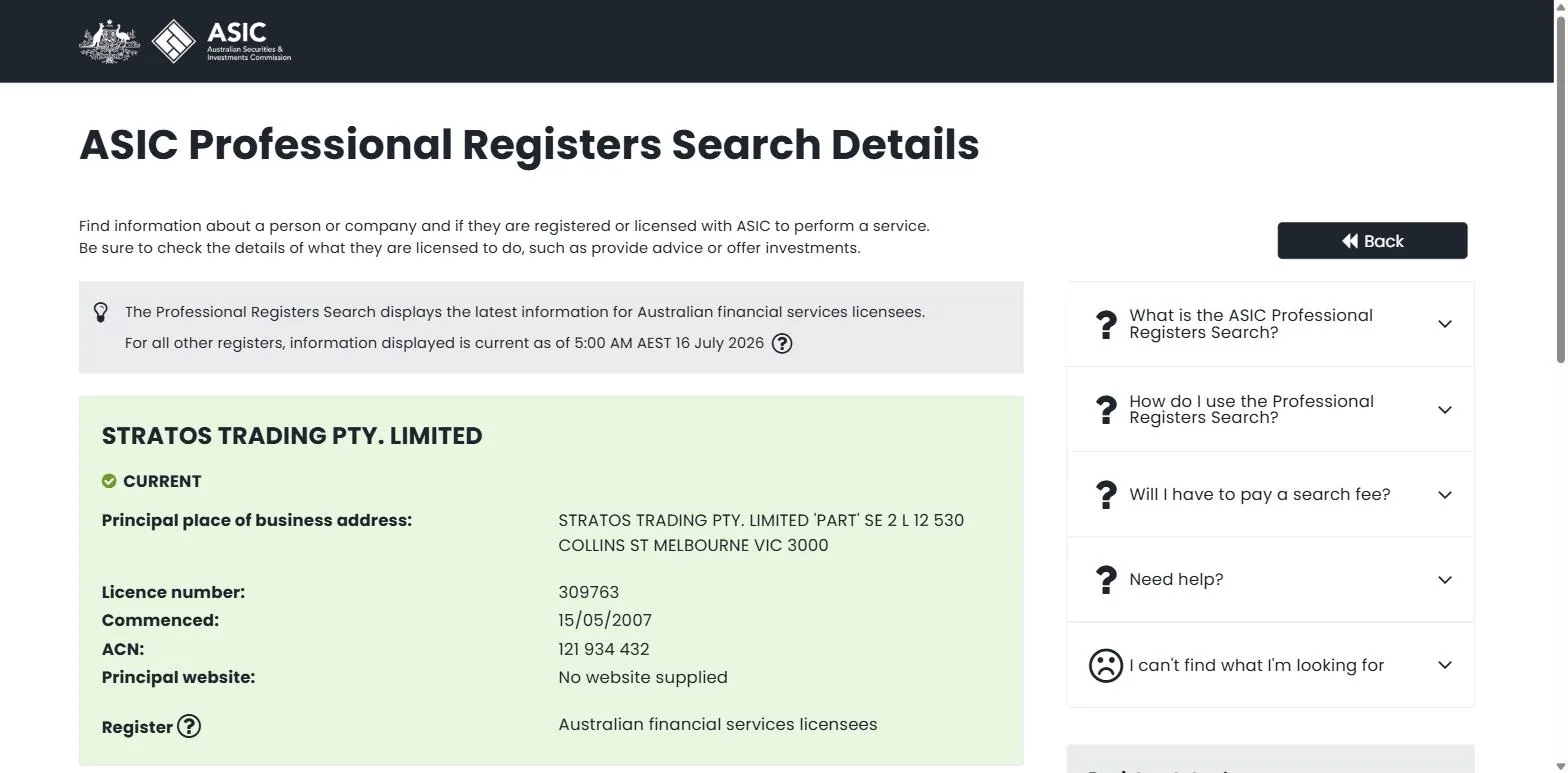
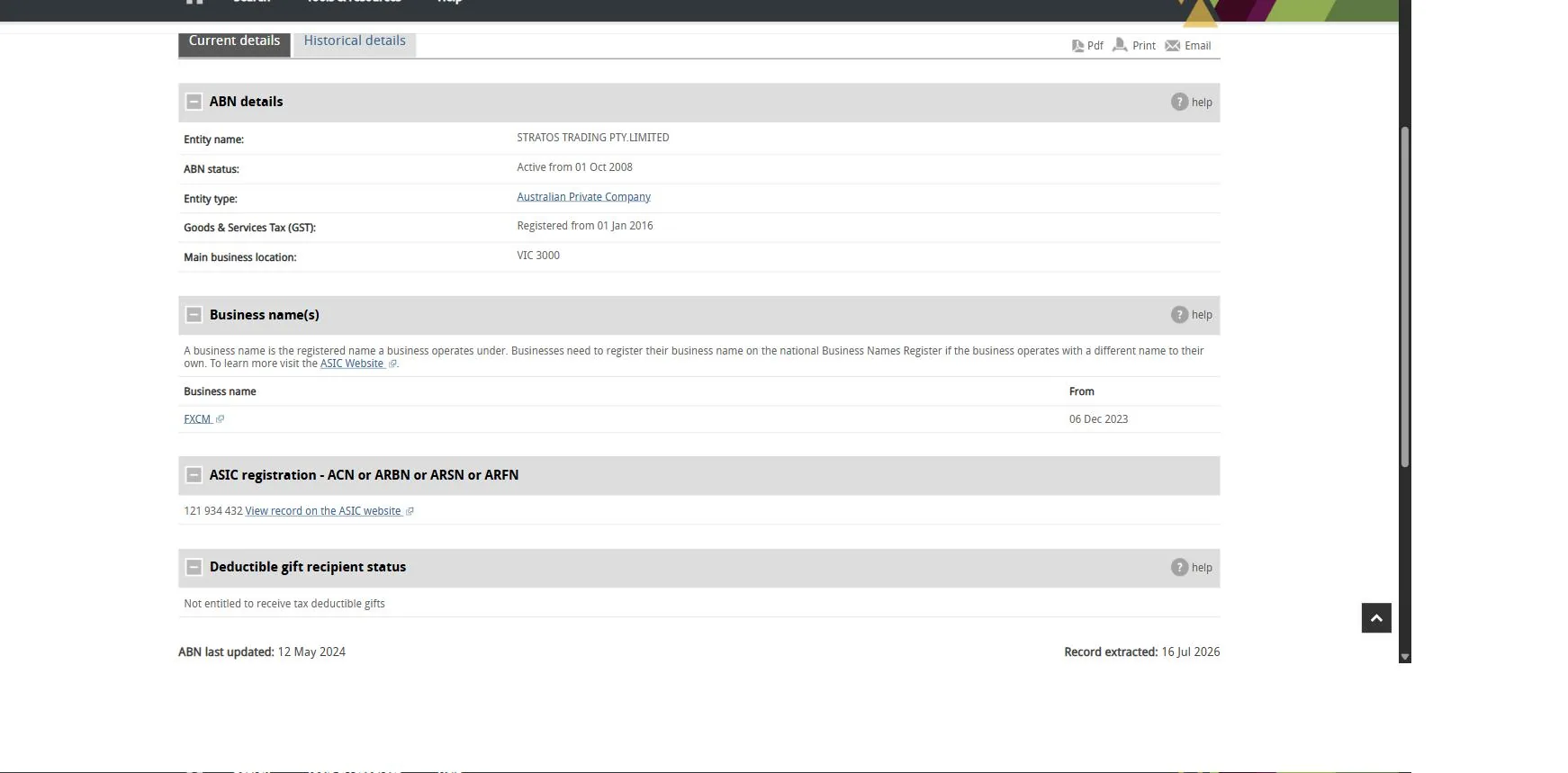
Beyond the Australian licence, the group stack holds three further entries: the Financial Conduct Authority in the UK at Tier 1, CySEC in Cyprus at Tier 1, and the FSCA in South Africa at Tier 2. That gives you a multi-jurisdictional safety net.
The December 2025 DDO stop order
The entity drew an interim DDO stop order from ASIC in December 2025 over deficiencies in its target market determination. The licence file shows the order revoked after the determination was amended, so no ongoing restriction applies. The episode still belongs in the entity’s recent compliance record.
Before depositing, confirm FXCM holds AFSL 309763 using the site's guide to checking a broker on ASIC's register.
The 2017 CFTC matter and what it means for FXCM clients
In February 2017, the CFTC settled an action against FXCM’s US entity over non-disclosure of a market-making affiliate. The broker withdrew from the US retail forex market as part of that settlement.
I keep the 2017 CFTC matter and its licence consequences on this page, because the history shapes how the trust rating reads. Four licence and ownership points sit alongside it:
- The action and the market exit applied to the US entity. The Australian entity under AFSL 309763 was not a party.
- Leucadia National Corporation, now operating as Jefferies Financial Group, acquired the global FXCM business in 2017. Jefferies is a NYSE-listed investment bank with a long operating history.
- Almost a decade has passed, and the current ownership and management are not the people involved in the 2017 matter.
- ASIC, FCA and CySEC oversight continued without interruption on the non-US entities throughout.
The trust rating and the licence record on this page carry that history rather than ignoring it. Both rate the Australian entity on current merits. The parent company changed hands in 2017, the founders departed at the time of the settlement, and neither has a role in the business today.
Public reviews
FXCM holds a Trustpilot rating of 4.6 out of 5 from 974 reviews, which Trustpilot labels excellent, captured September 2026. The profile has been claimed by the broker since November 2019.
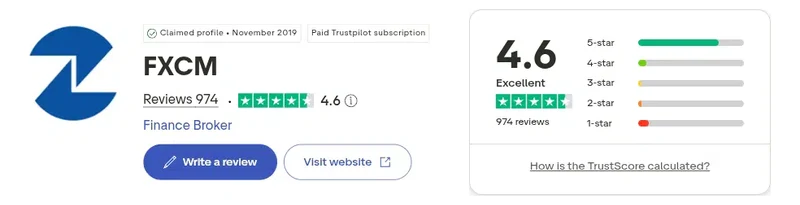
Behind that rating sits the smallest comparison base of any broker in this coverage with a Trustpilot capture, a fraction of what the large market makers have collected. So a handful of reviews moves it in a way it cannot move theirs. The figure is high and the evidence behind it is thin, which, in my view, makes it directional rather than settled.
How popular is FXCM in Australia?
FXCM is searched too rarely in Australia for month-on-month change to be meaningful: 600 branded searches in August 2026, 25th of 32. Search interest measures attention, not quality; the score above is the review verdict.
- 600
- Brand searches, August 2026
- n/a below 1,000
- vs July 2026
- 150
- Login searches
- 0.3%
- Share of all broker searches
Source: Google search volume, Australia, August 2026. How this is measured
What other review sites say
FXCM's iOS app rates 2.72 out of 5 from 60 ratings on the Australian App Store (September 2026), listed as FXCM - Trade Forex, Stocks CFD.
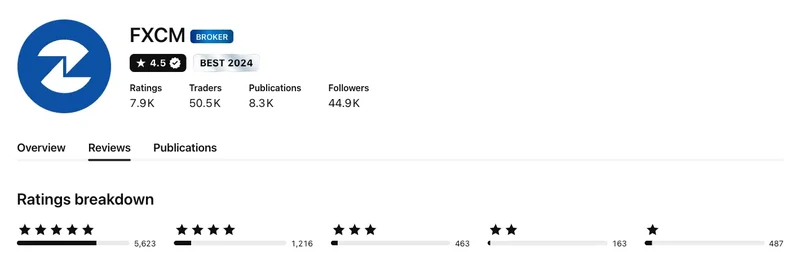
TradingView users rate FXCM 4.5 out of 5 from 7,952 ratings (September 2026). 50.5K TradingView users have connected a FXCM account. TradingView named FXCM its Social Champion 2024.
FXCM client money protection and AFCA membership
FXCM client money protection runs through segregated accounts at an Approved Australian Bank. AFCA can hear claims up to A$1,263,000 and award compensation up to A$631,500.
Client money accounts sit separate from company funds. ASIC requires negative balance protection on retail CFD accounts, so your retail account cannot lose more than the money in it. Even the Compensation Scheme of Last Resort, which pays up to A$150,000, covers only personal advice, securities dealing and credit, so CFD and forex trading complaints do not reach it.
The retail licence protections are identical to those at every other holder in this coverage, because the regime sets them rather than the broker. The comparison across the field sits in our ranking of which forex brokers protect clients best, and the mechanism itself in the guide to negative balance protection under ASIC rules.
One account carve-out matters before you apply for the Active Trader tier. The wholesale tier surrenders the leverage caps and those retail protections together, and the surrender applies to the account rather than to a single trade.
FXCM at a glance: 17 key facts
FXCM operates under ASIC AFSL 309763, held by Stratos Trading Pty Limited and current since 15 May 2007, with accounts opening from a A$50 minimum deposit. The 17 key facts cover the entity, the platform list and the fee schedule.
I would start with the entity.
| Item | Detail |
|---|---|
| Australian regulator | ASIC, AFSL 309763, current since 15 May 2007 |
| Australian entity | Stratos Trading Pty. Limited (FXCM Australia) |
| Parent company | Jefferies Financial Group (NYSE: JEF) since 2017 |
| Other regulators | FCA (UK), CySEC (Cyprus), FSCA (South Africa) |
| Year founded | 1999 (New York); AU licence issued 15 May 2007 |
| Headquarters | London, UK; AU office 530 Collins Street, Melbourne |
| Trading platforms | Trading Station, MetaTrader 4, TradingView (native) |
| Account types | Standard (retail); Active Trader (wholesale clients only) |
| Minimum deposit | A$50 |
| Maximum retail leverage | 30:1 (forex majors), ASIC-capped; up to 400:1 for wholesale clients |
| Spreads, Standard (EUR/USD) | 0.7 pips measured average, markup-based, May to June 2026 |
| Spreads, Active Trader (EUR/USD) | 0.3 pips measured average, wholesale clients only |
| Funding methods (AU) | Visa, Mastercard, Discover, PayPal, Google Pay, BPAY, bank transfer, Skrill, Neteller |
| Inactivity fee | A$50 (account currency) after 12 months |
| Negative balance protection | Yes (mandatory under ASIC) |
| AFCA member | Yes |
| Demo account | Free, unlimited |
| Customer support | 24/5 phone, live chat, email |
The two spread rows describe two different accounts. Only one of them is open to a retail client in Australia, so you need to know which row applies.
FXCM Standard account spreads, measured
FXCM spreads on the Standard account start at 0.85 pips on EUR/USD, measured by Noam Korbl in our 48-hour September 2026 capture. The eight-pair basket averaged 1.49 pips on a markup-only basis with no commission line.
The spread capture window ran 48 hours from 22 to 24 September 2026 through CFB-SpreadLogger 1.1.0 on a London VPS, the same rig we use across the lowest spread brokers in Australia comparison. That means the FXCM Standard account spreads sit on the same basis as every other broker in that table.
| Measure (May to June 2026) | Result |
|---|---|
| EUR/USD, Standard account | 0.7 pips average |
| Eight-pair basket, Standard account | 1.31 pips average |
| EUR/USD, Active Trader pricing | 0.3 pips average |
| Eight-pair basket, Active Trader pricing | 0.68 pips average |
Markup pricing model is the thing to understand before you open an account here. No commission appears on your statement; the broker’s revenue arrives inside the quote instead. So the headline of zero commission is a presentation choice rather than a saving. The comparison that matters runs against a raw account plus its commission, and the section below does that arithmetic for you.
FXCM Active Trader pricing and volume rebates
FXCM Active Trader pricing runs tighter than the Standard account and pays volume rebates from US$2.50 per million traded.
In Australia the tier is open to wholesale clients only, so it is, in my view, one of two accounts a retail trader cannot reach.
The account eligibility bar runs to wholesale classification plus US$10 million a month in notional volume. The rebate table starts at US$2.50 per million and steps through US$5 and US$10 to US$15 per million once monthly volume passes US$400 million. Index markets pay rebates separately at US$3 per million on most, dropping to US$1 per million on UK100 and US30.
Commission on that tier is A$4.00 per side, which ranks twelfth of the 15 accounts in our lowest commission brokers comparison. That puts it ahead of IC Markets, Blueberry Markets and TMGM.
One account consequence deserves stating plainly before you chase the 400:1 leverage that comes with it. The wholesale account classification surrenders the ASIC retail protections, and that trade is permanent for the account rather than switchable per trade.
The retail account position is simpler: the Standard account is the only retail account in Australia, so the 0.68 pip basket figure above describes pricing you cannot reach.
What it costs to trade with FXCM
FXCM costs 0.85 pips to trade with on the Standard account, on one standard lot of EUR/USD in our September 2026 capture, with no commission on top.
So what it costs to trade with FXCM lands near A$11.93 a round turn at the A$14.04 pip value our capture read from its terminals.
| Account | EUR/USD all-in (pips) |
|---|---|
| FXCM Standard | 0.85 (September 2026) |
| CMC FX Active | 1.0 |
| Pepperstone Razor | 0.55 |
| IC Markets Raw | 0.6 |
| Forex.com RAW Pricing | 0.7 to 0.9 |
The Standard account beats CMC FX Active on the headline pair and trails Pepperstone Razor and IC Markets Raw. Across the eight-pair basket the gap widens, because 1.31 pips on a markup account compares with figures near 0.6 on a raw account once you fold in commission. The basket comparison is the one I would weight most.
Other fees AU traders should check
- Overnight financing applies to positions held past 5 PM New York time, direction-dependent.
- Currency conversion applies to any instrument denominated outside the account base currency.
- The inactivity fee runs 50 units of the account currency after 12 months without a trade, so A$50 on an AUD account, capped at the remaining balance.
- Accounts sitting at zero balance for six straight months get closed.
- Card withdrawals carry no fee, and bank wires cost A$15 domestic and A$30 international on AUD accounts.
FXCM funding methods and withdrawal fees
FXCM’s rate card says deposits normally cost nothing, but the Google Pay tile warns that additional fees may apply. Wire withdrawals cost A$15 domestically and A$30 internationally on an AUD account.
Deposit methods (AU clients)
| Method | Fee | Deposit time | Monthly maximum |
|---|---|---|---|
| Visa / Mastercard / Discover | A$0 | Under 1 minute per FXCM’s deposit screen, 1 to 3 hours per FXCM support | A$30,000 |
| PayPal | A$0 | Not published | Not published |
| Google Pay | A$0 from FXCM; the deposit screen warns that additional fees may apply | Under 1 minute per FXCM’s deposit screen, 1 to 3 hours per FXCM support | A$30,000 |
| BPAY | A$0 | 1 to 2 business days | None stated |
| Bank transfer | A$0 | Domestic 1 to 2 business days, international 3 to 5 | Not published |
| Skrill | A$0 | Under 1 minute per FXCM’s deposit screen | A$20,000 |
| Neteller | A$0 | Not published | A$20,000 |
Figures come from FXCM’s Deposit Funds screen inside a live Australian account on 2 September 2026, FXCM’s support desk on 15 September 2026, and FXCM’s rate card dated 25 June 2026.
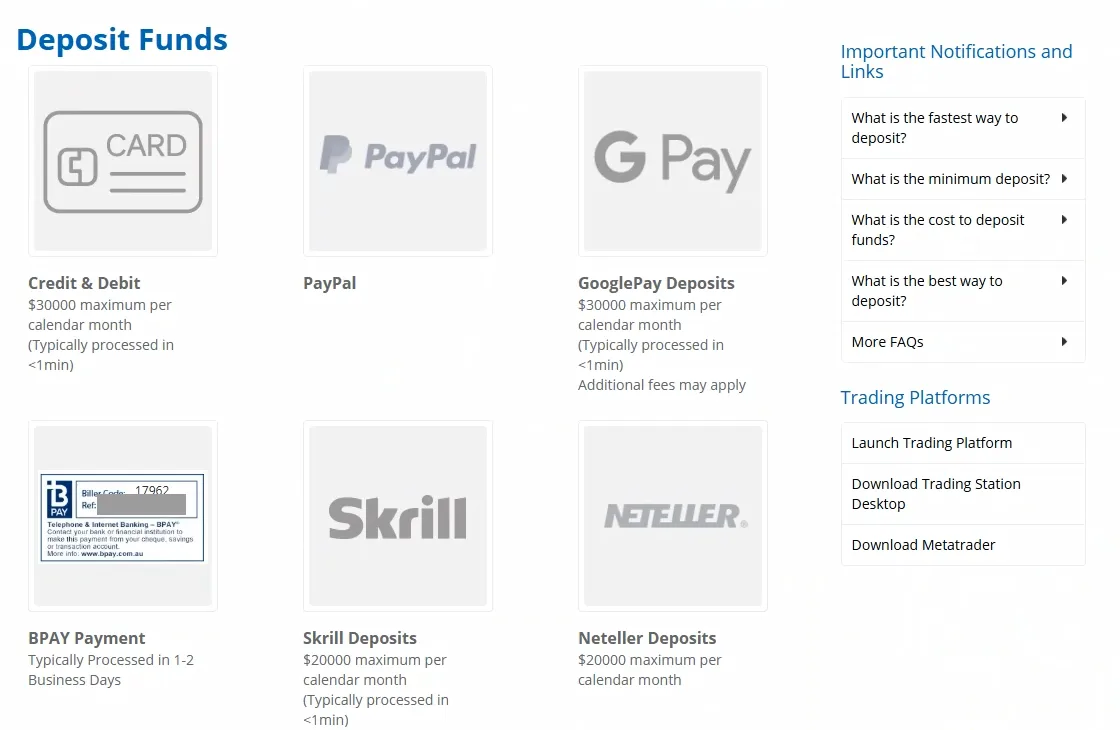
The table above lists no FXCM fee on these routes, so I’d weigh speed and whether your money needs converting. You’ll find those monthly ceilings pinch only when you fund heavily: A$30,000 on cards and Google Pay, A$20,000 on Skrill and Neteller. BPAY has no stated maximum but takes 1 to 2 business days, slower than cards and e-wallets. For you, the real cost appears whenever a conversion is needed, and deposits under US$10,000 equivalent fall within the tier that carries a mark-up of 150 pips. This mark-up is added to the conversion rate used, so the converted amount may be lower in your account than it would be at the market rate. I’d flag it as the main funding cost to watch when currency conversion is needed. Funding in your account’s own currency may avoid the conversion mark-up.
Withdrawals
FXCM’s support desk states that Google Pay and BPAY cannot be used for withdrawals. Because anti-money-laundering rules typically require funds to return via the same method you used to deposit, funding through either one means you will need to arrange a different route out.
Card withdrawals take 3 to 5 business days and are capped at the amount you deposited using that same card within the past six months. Wire withdrawals also take 3 to 5 business days and cost A$15 for domestic transfers or A$30 for international ones on an AUD account, per FXCM’s rate card dated 25 June 2026. Monthly wire withdrawals add up to A$180 a year domestically, and several brokers in our coverage charge nothing for wires; in my view, that makes the wire habit the one funding choice at FXCM worth changing.
Account opening
Noam Korbl, who leads our capture programme, opened the account. Sign-up took a few minutes, and the form asks only for an email and password before account configuration, which is a light first step.
The platform choice screen offers FXCM Trading Station (standard) and MetaTrader 4 (additional), and both can be selected together. I like that you can pick both platforms at the outset, avoiding the need for a second account later. Each card includes free TradingView access. Currency choice is AUD or USD for Australian accounts.
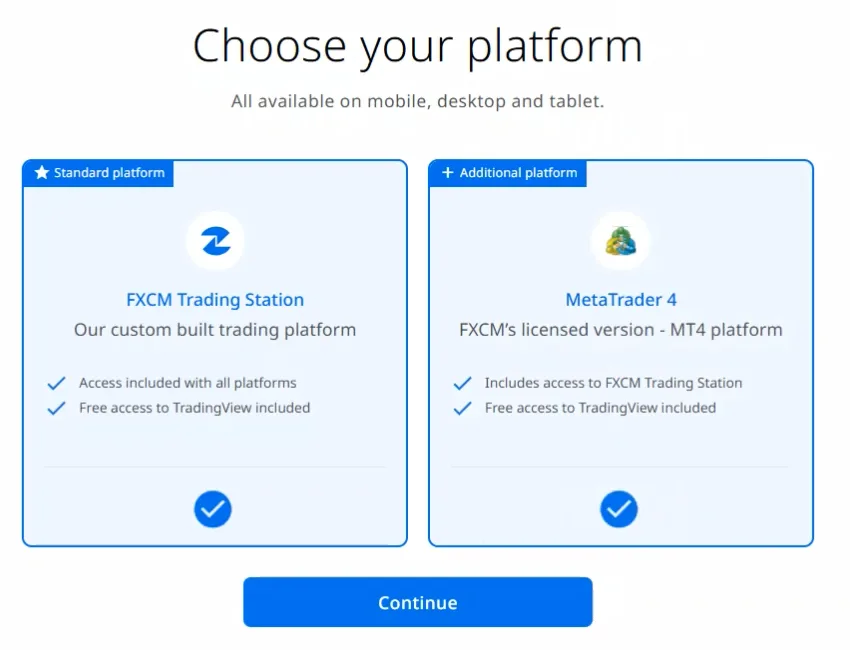
Separate screens then collect name, date of birth, gender, residency, citizenship, address, and phone number, followed by industry, work experience, financial circumstances, and a risk tolerance questionnaire. A 10-question quiz covers stop-loss orders, platform monitoring, and EUR/USD moves when the euro strengthens.
To me, the verification step is the strongest part. A “Get Verified faster” screen asks for a driver’s licence or passport number and may allow verification without documents. Noam supplied his details, and verification completed during sign-up with no document upload, selfie or video call.
After agreeing to disclosures, the portal confirms verification and sends an email. The status bar shows Application Submitted, Get Verified, Deposit Funds, Start Trading. Noam noticed a friction point: MyFXCM would not accept his email after setup, reporting no matching account. The verification email provided a new FXCM account number, and using that as the username worked, so keep that number handy. I’d prefer the login switch to be flagged during sign-up, not discovered after the fact.
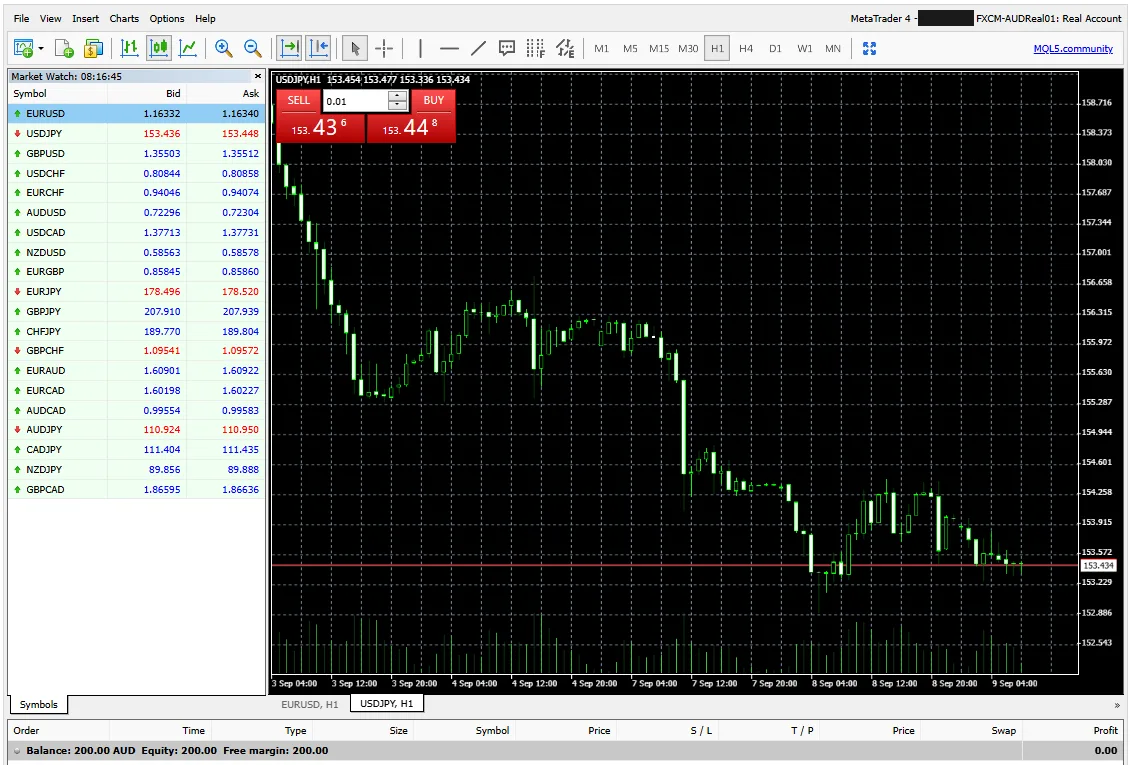
Funding was straightforward. Noam deposited A$200 by card, approved immediately. The deposit showed the same timestamp of 2 September 2026 at 14:16:22 for Received, In Queue, and Processed. A manual refresh was needed before the balance updated to A$200, then the account showed Active with the full amount. I consider that a small friction. In MetaTrader 4, balance, equity, and free margin all read 200.00 AUD with no open positions.
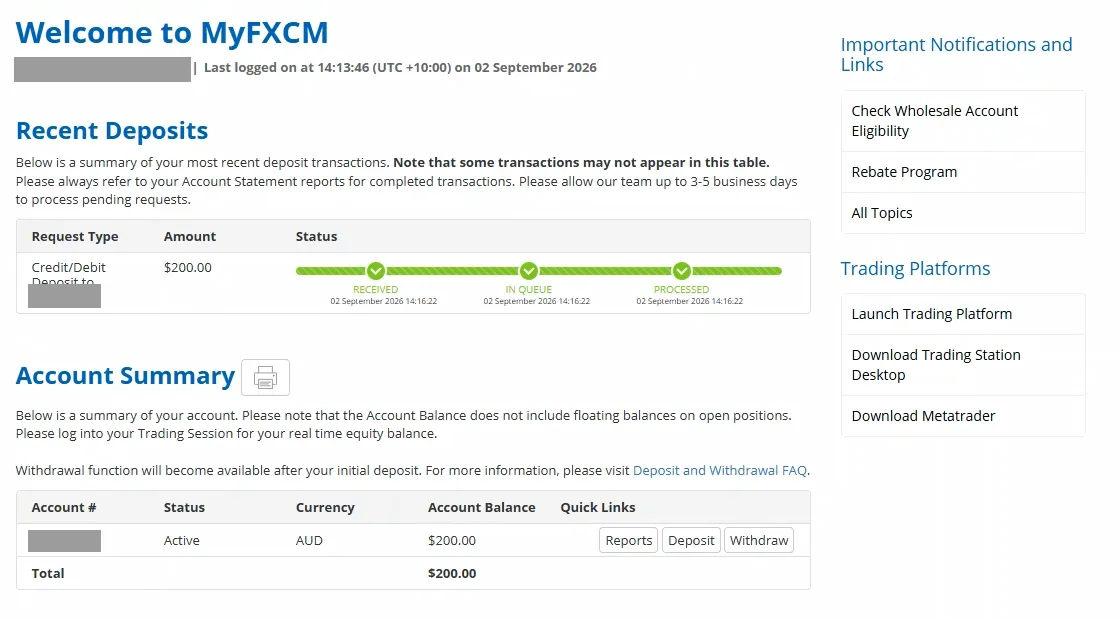
Overall, the application is fast and well-sequenced. Picking both platforms upfront and document-free verification worked well. The only weak point is the login change, which is easy to miss after a smooth sign-up.
FXCM account types and minimum deposit
FXCM account types include one retail account with a A$50 minimum deposit, among the lowest at any established Australian broker. The Standard account opens with very little and the Active Trader account sits behind it for volume traders.
| Account | Pricing model | Min deposit | Best for |
|---|---|---|---|
| Standard | Markup-based, no commission | A$50 | Retail traders, the only retail account in Australia |
| Active Trader | Tighter pricing plus commission rebates | Higher, unpublished | Wholesale clients only |
| Wholesale (Pro) | Bespoke pricing, higher leverage | Varies | Wholesale clients only |
The account ladder stops at the first rung for retail traders. Two of the three account tiers require wholesale classification, so you trade markup pricing or you trade somewhere else.
Swap-free account
FXCM runs a swap-free account and Australian residents can open one. We confirmed with the desk in July 2026. That answer is worth stating plainly, because several brokers in this coverage run the product globally and will not open one for an Australian.
The swap fee is replaced rather than waived. On the Standard account, the only retail account available here, the cost returns as a spread widened by 0.4 pips. If you are on a commission-based account, the substitute is a per-lot commission near A$2.00, but those remain a wholesale-only route.
Minimum deposit
At A$50, the minimum is one of the lower entry points at an established broker. Most active traders open with A$200 to A$500 so that position sizing works on the Standard account, and I would suggest you do the same.
FXCM trading platforms
Three trading platforms make up FXCM’s offering: the proprietary Trading Station, MT4 and native TradingView execution. The platform list excludes MT5 and cTrader entirely, so you are working with a focused set, in my view.
Trading Station (proprietary)
Trading Station is the flagship platform and the first stop for a new client. It runs web, desktop and mobile builds. The platform feature set covers a built-in market scanner and trading signals, native handling of the proprietary basket CFDs, a cleaner order ticket than MT4 with one-click trading and partial close, a strategy backtester for simple rule-based ideas, and tighter integration with the broker’s own market data and research.
MetaTrader 4
The MT4 platform build carries the full execution stack across forex, indices, gold and oil. The proprietary basket CFDs do not appear on it, so you need Trading Station for those.
TradingView and copy trading
FXCM is one of a handful of ASIC-regulated brokers offering native TradingView trading. You connect a TradingView account directly and execute from the chart with no third-party bridge. The TradingView volume deal attached to it is worth knowing: 5 lots a month covers a TradingView Essential plan, 10 lots covers Plus and 15 lots covers Premium.
Australian clients get no copy trading product. The specialty platform list carries third-party integrations aimed at systematic traders instead, covering QuantConnect, MotiveWave, Sierra Chart and AgenaTrader. Those platform tools suit strategy builders and do nothing for you if you want to follow someone else.
FXCM execution speed and slippage statistics
I would read FXCM’s 2025 execution statistics, showing more than 85% of orders filled with zero or positive slippage, against 30.83% positive and 14.64% negative, as meaning your orders are likely to get a fair fill.
The spread capture above ran from 22 to 24 September 2026. This site holds no execution speed measurement for FXCM, and it publishes no cross-broker latency ranking.
I like that the execution figure breakdown goes further than most broker disclosures. The limit and limit-entry rows received price improvement on 74.58% of fills. The stop and stop-entry rows ran negative on 57.42%, which is ordinary mechanics rather than a warning sign, because a triggered stop becomes a market order in a market already moving against the position.
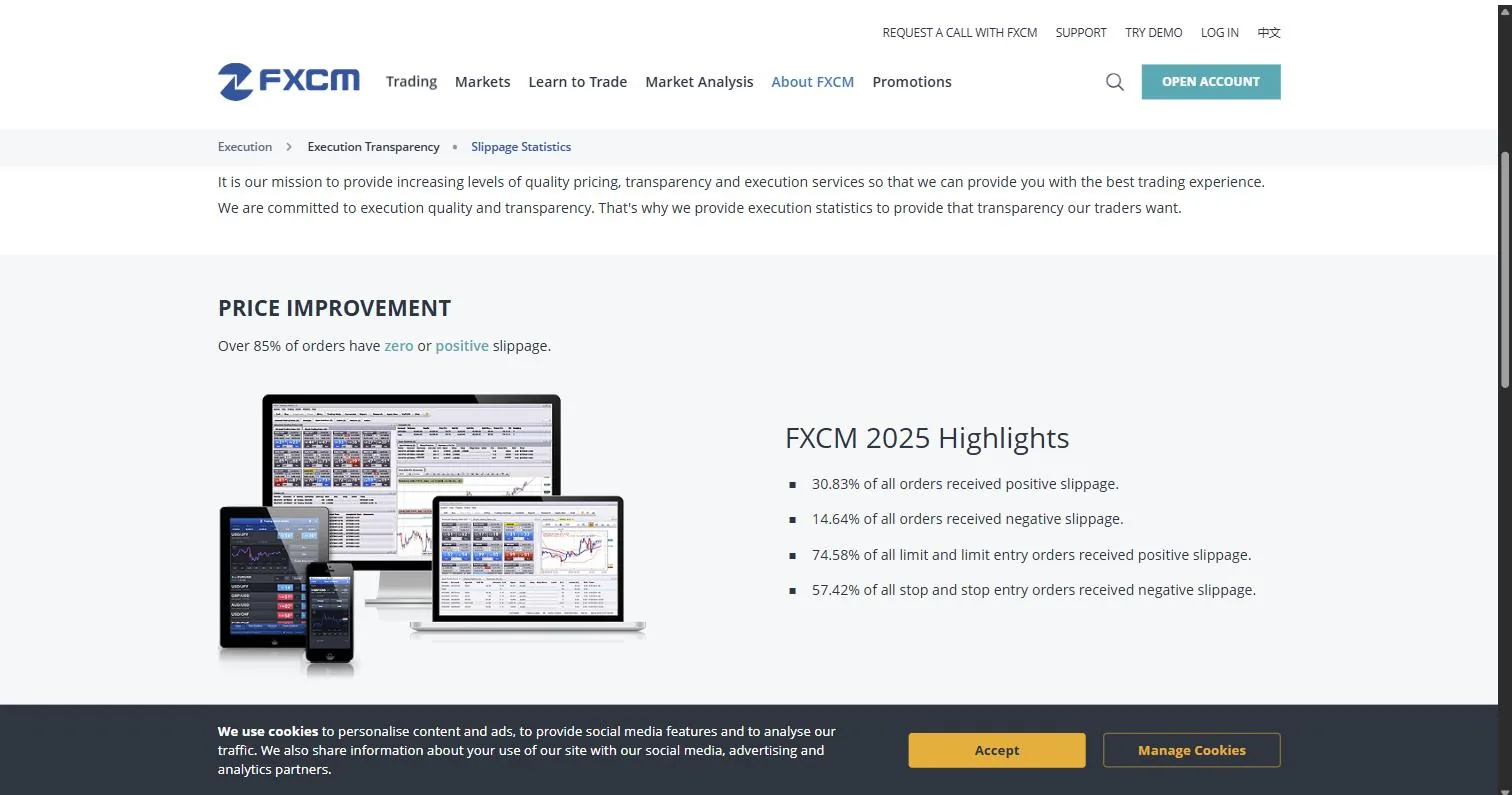
The figure set is the broker’s own, on the broker’s methodology, so it reads as an account of itself rather than as an independent measurement. Still, the disclosure stack puts FXCM in a small minority of the brokers in this coverage, which I think is worth something.
FXCM markets and instrument counts
Across FXCM’s five asset classes, built around the forex majors and minors, 14 index CFDs and the proprietary basket products, I find the basket range the most interesting part.
| Asset class | Count | Note |
|---|---|---|
| Forex | Majors and minors | Major and minor AUD crosses |
| Indices | 14 markets | AUS200 plus US, European and Asian majors |
| Commodities | Metals and energy | Gold, silver, WTI, Brent, natural gas |
| Basket CFDs | Proprietary | USDOLLAR, JPYBASKET, EMBASKET, CryptoMajor and stock baskets |
| Cryptocurrencies | 4 pairs plus 1 basket | BTC, ETH, LTC, BCH and CryptoMajor; 2:1 retail cap |
Five asset classes is where the range stops, narrower than the multi-asset CFD specialists carry. The gaps are worth stating plainly: no ASX single-stock depth, no share ownership route, and no bond or treasury CFDs at all. The class range stops at five, and our CFD asset class comparison covers where they sit against the field.
Basket CFDs
Basket products are the one real point of difference. The basket range trades USDOLLAR as a USD strength index, and JPYBASKET and the equity-themed baskets package a macro view into a single CFD. No other Australian broker in this coverage carries them. The basket instruments run on Trading Station only, because MT4 does not list them.
Share CFDs
The share CFD range is short, and the cons name the consequence: traders who want equities as a first-class product get more elsewhere. If share CFDs matter to you, the guide to share CFD alternatives compares the options.
Index CFDs
The index range runs to 14 markets: AUS200 for the ASX 200, then US30, SPX500, NAS100 and US2000 across the American benchmarks, UK100, GER30, FRA40, ESP35 and EUSTX50 in Europe, JPN225, HKG33 and CHN50 in Asia, and VOLX for volatility. If you trade the ASX 200 alongside US or European benchmarks, that list covers you without a second account.
FXCM leverage and margin under ASIC rules
FXCM leverage and margin hold at the ASIC retail caps of 30:1 on major forex pairs. The Active Trader tier does not change them for a retail client.
ASIC caps retail CFD leverage at 30:1 on major forex pairs, 20:1 on minor pairs, gold and major indices, 10:1 on commodities other than gold, 5:1 on share CFDs and 2:1 on crypto assets. The caps come from a product intervention order extended to 23 May 2027, so they apply at every ASIC broker, not just FXCM, and you need to factor them into your position sizing.
Because the wholesale leverage route reaches up to 400:1 for clients who pass the eligibility tests, and because it surrenders the retail protections in exchange, I would only consider that route if you fully understand what you are giving up.
Under the retail margin rule, every CFD issuer must close your positions once account equity falls below half the total initial margin on all open positions. Positions cannot be netted against each other to cut that figure, and a gapping market can close a position below the 50% level. The margin trade-off is set out in CFD leverage explained and compared across the field in high leverage forex accounts.
FXCM customer support
FXCM customer support runs 24 hours a day, five days a week, opening with the global forex market on Sunday afternoon AEDT and closing Saturday morning, so you can reach them whenever the market is open.
The service stack runs to five channels: an Australian phone line on 1800 109 751, live chat, email, SMS and WhatsApp. Those last two entries are the differentiator, because few Australian brokers answer on either.
Weekend closure is the main gap: the service stack closes entirely at the weekend. Pepperstone, IG Markets and Plus500 all run 24/7. If you hold a leveraged position across the Sunday open, you wait until Monday for a phone answer. That margin question matters most in exactly that window, because it cannot wait two days for a reply.
The service stack breadth is why the rating sits high on this page despite the weekend gap. The two are worth separating: the hours are ordinary and the routes into the desk are not.
FXCM research, tools and education
Seven components make up FXCM research, tools and education, led by DailyFX, the market analysis arm that has published forex commentary for more than a decade. I rely on DailyFX regularly.
The research stack, which gives systematic traders a lot of useful data, covers daily market analysis and an economic calendar, the Trading Station market scanner, the FXCM Plus tools carrying Real Volume, Market Depth and Trader Sentiment data, VPS hosting for automated strategies, the DailyFX archive, an education library covering forex basics, technical analysis and platform tutorials, and a webinar programme run by in-house and partner analysts.
DailyFX research archive is the pick of those seven. The research back catalogue depth is unusual, because most of the field syndicates a third-party feed or publishes unsigned notes that vanish after a week. I value that depth.
FXCM Plus data is the second standout. The FXCM Plus research feeds give a positioning read that a pure charting package does not carry, and both feed directly into Trading Station, so you get the data where you trade rather than in a separate library.
What traders say about FXCM
| Rating site | Rating | Based on | Who rated | Captured |
|---|---|---|---|---|
| Trustpilot | 4.6 out of 5 | 974 reviews | Worldwide | September 2026 |
| App Store | 2.72 out of 5 | 60 ratings | Australia only | September 2026 |
| TradingView | 4.5 out of 5 | 7,952 ratings | Worldwide | September 2026 |
Each row above is a public rating of FXCM taken from a rating site, dated to the month its figure was captured. An App Store rating counts ratings left on Apple's Australian App Store only, while a Trustpilot figure counts reviews and a TradingView figure counts ratings from anywhere in the world. A site with no row has no rating for FXCM, withholds it, cannot be matched to FXCM with confidence, or we have not captured it yet.
How FXCM compares to Pepperstone and CMC Markets
FXCM measured 0.85 pips on EUR/USD in the September 2026 capture and lists five asset classes, against Pepperstone and CMC Markets on cost and breadth.
Pepperstone Razor measured 0.10 pips on EUR/USD plus its A$7.00 round-turn commission in our May to June 2026 capture, and CMC Markets has 12,000 plus instruments. How FXCM compares to Pepperstone and CMC Markets is a platform and history win against a cost and breadth loss, in my view.
Pepperstone’s five platforms and an A$0 minimum are the trade-offs you need to weigh against CMC Markets’ broader product range, integrated ASX stockbroking and a stronger proprietary platform.
Against both, the combination of the basket CFD range, the SMS and WhatsApp support routes, and native TradingView execution with the paid plan covered on volume is, I think, a genuine differentiator for FXCM.
Put FXCM next to any of the other 31 ASIC-regulated brokers we cover.
FXCM Forex.com Middle of the measured field
Forex.com measures 0.39 pips on the raw eight-pair basket; FXCM carries no figure, raw pricing is wholesale-only in Australia.
Forex.com measures 0.02 pips on raw EUR/USD; FXCM carries no figure, raw pricing is wholesale-only in Australia.
FXCM's measured 0.85 pips sits 0.15 below the middle broker's 1.0; Forex.com's 0.82 pips sits 0.18 below it.
Forex.com charges A$7.00 on round-turn commission; FXCM carries no figure, no per-lot commission on record.
Forex.com comes to A$125.63 on raw account cost at ten standard lots a month; FXCM carries no figure, raw pricing is wholesale-only in Australia.
FXCM's A$121.26 sits A$21.39 below the middle broker's A$142.65; Forex.com's A$116.98 sits A$25.67 below it.
FXCM's A$50 matches the middle broker's A$50; Forex.com's A$150 sits A$100 above it.
FXCM runs MT4, TradingView, Own platform; Forex.com runs MT4, MT5, TradingView, Own platform.
FXCM holds AFSL 309763; Forex.com holds AFSL 345646.
FXCM's 74 / 100 sits 1 below the middle broker's 75; Forex.com's 73 / 100 sits 2 below it.
FXCM and Forex.com both come to 4.6 / 5 on this row, 0.3 above the middle broker's 4.3.
FXCM's 2.72 / 5 sits 1.82 below the middle broker's 4.54; Forex.com's 4.31 / 5 sits 0.23 below it.
FXCM and Forex.com both come to 4.5 / 5 on this row, matching the middle broker's 4.5.
FXCM's 600 sits 750 below the middle broker's 1,350; Forex.com's 220 sits 1,130 below it.
Capture: September 2026 · AUD/USD 0.7010 (25 Sept 2026) · field: the measured field varies by row, from 16 to 24 brokers, of 32 reviewed.
Bars run lowest to highest across the measured field; the tick marks the middle broker.
| If you value… | Consider |
|---|---|
| Tighter raw spreads | IC Markets or Pepperstone |
| Broader product range | CMC Markets or IG Markets |
| Direct ASX shares plus CFDs | CMC Markets |
| Beginner-focused platform | Plus500 or eToro |
| Native TradingView | Pepperstone, OANDA or Eightcap |
| A retail commission account | Fusion Markets or Forex.com |
Should you open an FXCM account?
FXCM suits traders drawn to Trading Station’s tooling or the proprietary basket products, on a A$50 minimum deposit and a licence running since 15 May 2007. The account fit breaks for traders filtering on raw pricing or product breadth, who are served better elsewhere than by an FXCM account, in my opinion.
Two groups of trader gain clear value from an FXCM account, and if you fit either profile it is worth a look. The platform stack carries native TradingView execution with the paid plan covered from 5 lots a month, which few Australian brokers match. The basket range packages a macro view into one CFD, and no other broker in this coverage carries it.
A different two groups should look past an FXCM account. The measured Standard spread runs 0.85 pips on EUR/USD in our September 2026 capture, while Pepperstone Razor measured 0.10 pips on EUR/USD plus its A$7.00 round-turn commission in our May to June 2026 capture, and FXCM has no retail commission tier to move to. The product range stops at five asset classes, with no ASX ownership and no treasuries. I would not recommend it for those traders.
FXCM ranks seventeenth among the highest-rated forex brokers in Australia on the 2026 scoring, held there by cost and range rather than by platform or trust. A free demo account runs Trading Station in full, so you can test the platform without risk.
FAQs
Is FXCM a trusted broker?
How long does it take to withdraw money from FXCM?
What leverage does FXCM offer in Australia?
What is the minimum deposit for FXCM?
Does FXCM offer MetaTrader 5?
Does FXCM offer TradingView trading?
What happened with FXCM and the CFTC in 2017?
Was FXCM banned in Australia?
Does FXCM offer copy trading?
Testing log
| Record | Detail |
|---|---|
| Review published | 16 May 2026 |
| Last content change | 27 September 2026 |
| Spread capture | Standard account, 0.85 pips EUR/USD |
| Capture window | September 2026 |
| Verification | AU spreads checked against published tables 20 June 2026; platform parity verified across group entities; the 25 June 2026 rate card and the Australian support desk checked 15 September 2026; live AUD MT4 account (****9019) funded by card with A$200 in Australian dollars on 2 September 2026 |