
What hedging is and what it costs
Hedging is the practice of opening a position that offsets the risk of another position already held. At its simplest, a trader opens a short EUR/USD trade equal in size to a long EUR/USD already held. Net market exposure is zero, and the trader pays spreads and commissions on both legs without changing directional risk. What I find worth stressing is that the cost is real and immediate, even though the direction is neutralised.
Every major ASIC-regulated AU broker (Pepperstone, IC Markets, FP Markets, CMC, IG, Plus500 and others) allows hedging on retail accounts. It is not allowed on US accounts under the NFA’s FIFO rule, and I regularly see AU traders coming from US-focused content assume the restriction applies here. It does not, in this jurisdiction.
For retail traders the ATO generally treats hedging trades as ordinary income or loss under TR 2005/15. There is no special tax treatment separating a hedging position from a speculative one on a retail CFD account, which I find makes tax reporting simpler than many traders expect.
Three main retail use cases:
- News event protection, flatten exposure before high-impact data without closing the underlying trade
- Business FX exposure, Australian importers and exporters hedge AUD-denominated cash flows
- Portfolio currency exposure, where investors with USD or EUR-denominated assets hedge the AUD translation risk.
The costs of hedging are not theoretical, and they add up. You face doubled spreads and commissions, doubled overnight financing that is often net negative, and margin tied up on both legs. Limited upside while the hedge is in place is the trade-off, and it is a risk-management tool, not a profit-generation strategy.
What hedging actually means in forex
When I say hedging in trading, I mean opening an offsetting position to neutralise some or all of the risk on an existing one. In forex, the most direct form is taking opposing long and short positions on the same currency pair. If a trader is long 1 lot of AUD/USD and opens a short of 1 lot, net exposure to AUD/USD is zero and whatever happens in the market, the long and short cancel out.
That sounds pointless. Why hold both positions when you could just close the original?
Three reasons retail traders do this rather than close out:
- Tax timing, closing a position realises P&L in the current tax year. Hedging holds the realised event open while neutralising the directional risk.
- Strategy switching, you might want to flatten exposure for a few hours over a high-impact news release without closing your longer-term position.
- Position complexity, if your original position is part of a multi-leg structure, closing it means rebuilding the structure later. Hedging preserves the structure.
Business and institutional traders use hedging more for cash flow protection. In my view, this is the most rational use of the tool. An Australian wine exporter expecting a USD 500,000 payment in 90 days is exposed to the AUD/USD rate on settlement, and locking in a forward or holding an offsetting CFD position protects the AUD-equivalent value.
ASIC and AU broker policy on hedging
This is where the AU context diverges most sharply from US trading content.
The US National Futures Association introduced a “FIFO” (First-In-First-Out) rule in 2009 that prevents US retail forex brokers from holding opposing positions on the same currency pair in the same account. If you are long EUR/USD and place a short EUR/USD order, the broker must close the long first, so running both simultaneously is not possible.
ASIC has no equivalent rule. An Australian retail account can hold opposing positions on the same pair concurrently, and every major ASIC-regulated broker in our best forex brokers in Australia list allows this:
| Broker | Direct hedging on same account | Notes |
|---|---|---|
| Pepperstone | Allowed | MT4/MT5/cTrader all support hedging mode |
| IC Markets | Allowed | Hedging supported on MT4, MT5 and cTrader |
| FP Markets | Allowed | Standard MT4/MT5 hedging account default |
| CMC Markets | Allowed | Next Generation platform supports opposing positions |
| IG Markets | Allowed | Both proprietary platform and MT4 |
| OANDA | Allowed | OANDA is one of the few brokers that operates in both AU (allowed) and US (not allowed via OANDA US entity) |
| Eightcap | Allowed | MT4/MT5 hedging mode default |
| Fusion Markets | Allowed | MT4/MT5 standard hedging support |
| Vantage | Allowed | MT4/MT5/TradingView |
| Plus500 | Allowed | Proprietary WebTrader supports opposing positions |










Note that on MT5, “hedging mode” is the account type that allows opposing positions. The alternative is “netting mode” which automatically nets opposing orders, and AU brokers default new MT5 accounts to hedging mode unless a trader specifically requests netting.
Hedging is governed by the standard PIO retail protections, not a separate ASIC rule. The protections include: 30:1 leverage cap on majors, 50% margin close-out, and negative balance protection. Both legs of your hedged position consume margin, so you are using twice the margin required for a single directional position.
Direct hedging with opposing positions on one pair
The simplest form is to open both a long and a short on the same currency pair, equal in size. Net market exposure is zero.
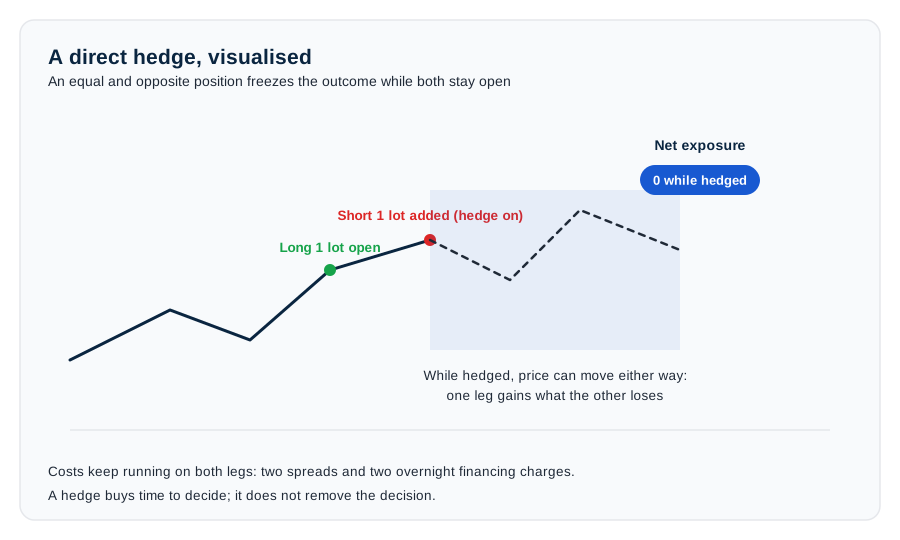
Opening the opposite position of equal size takes net exposure to zero, which is the whole point and also the whole catch: in my view, the costs keep running. The diagram shows the two legs cancelling on direction while both continue to pay spread, commission and overnight financing.
How a direct hedge looks on AUD/USD
Suppose you are long 1 lot of AUD/USD at 0.6500. The price has moved to 0.6450 (50 pips against the position, USD 500 of unrealised loss on a 100,000-unit position). The trader does not want to close the long because the expectation is still for a recovery, but also does not want more downside if it falls further before US payrolls in three days.
A short of 1 lot of AUD/USD at 0.6450 locks net P&L on the pair. If AUD/USD falls to 0.6400, the long loses another USD 500 and the short gains USD 500. A rise to 0.6500 means the long gains USD 500 and the short loses USD 500. The net position is flat.
You’re paying:
- Spread on the new short (one-way, about USD 5 to USD 10 depending on broker)
- Overnight financing on both legs (typically net negative, costing AUD 1 to AUD 5 per night per lot for AUD/USD)
- Margin on both legs (so AUD 3,333 of initial margin on each at 30:1, total AUD 6,666 of margin used)
After the news release, the trader closes the short and is back to the original directional exposure on the long. If the price moved in the trader’s favour during the hedge, the short has made money; if it moved against, the trader has crystallised more loss on the short while the long has either recovered or fallen further.
Pros and cons of direct hedging
Pros:
- Locks in current P&L on the original position without realising it
- Lets you protect against specific event risk (news, weekend gaps) without closing the directional view
- Simple to execute and reverse
- Works on every ASIC-regulated AU broker
Cons:
- Doubled spread and commission costs vs single-position management
- Net negative overnight financing on most pairs (you pay both sides, you don’t earn on either)
- Margin used on both legs (twice the capital tied up)
- No upside while the hedge is in place, you’ve neutralised your own position
- Tax timing only works if your strategy actually plans to lift the hedge later. If you don’t, you might as well have just closed.
For most retail traders, just closing the position is both cheaper and simpler. In my view, hedging is a tool for a narrow set of circumstances. Hedging earns its place when a trader has a specific structural reason to hold both sides open.
Cross-currency hedging
Cross-currency hedging uses the correlation between two different pairs to offset risk. I consider this a more advanced technique. The classic example is hedging AUD exposure with a related but not identical pair.
AUD/USD long hedged with USD/CAD long
Suppose a trader is long AUD/USD and wants to reduce USD risk without closing the AUD/USD position. AUD/USD and USD/CAD have a moderately strong positive correlation when the USD is the dominant driver, because both pairs move on USD strength.
Open a long USD/CAD position. If the USD strengthens, AUD/USD falls (the long loses) and USD/CAD rises (the long gains), so the two partially offset. A weaker USD produces the reverse: AUD/USD rises and USD/CAD falls, again offsetting.
The hedge is not perfect. The residual risk is what I focus on. AUD/USD also responds to commodity prices, RBA policy, China data, and risk-on/risk-off sentiment, while USD/CAD responds to oil prices and BoC policy. The correlation is meaningful but partial.
Cross-currency hedging suits a trader who wants to hedge a specific risk factor, such as USD exposure, rather than the full P&L on a position. It is more common in institutional and wholesale forex than in retail.
Other common cross hedges
- EUR/USD short hedged with USD/CHF long, EUR and CHF tend to move together against the USD, so a long USD/CHF offsets the USD short embedded in EUR/USD short
- GBP/USD long hedged with EUR/USD long, both share USD-side risk
- AUD/USD long hedged with NZD/USD short, both Antipodean currencies, moderate correlation
These work as partial hedges, not full neutralisations. You are trading some directional risk for offsetting commodity-currency or risk-sentiment risk.
Over the last 90 shared trading days, the strongest positive relationship in this set is XAU/USD and XAG/USD at +0.87, so the two have tended to rise and fall together and holding both is closer to one position than two. The strongest inverse relationship is EUR/USD and USD/CHF at -0.87, where a gain in one has usually coincided with a loss in the other. Correlations move, so treat these as a description of the measured window rather than a rule.
| Pair | AUD/USD | EUR/USD | GBP/USD | USD/JPY | USD/CAD | USD/CHF | NZD/USD | USD/SGD | EUR/AUD | GBP/AUD | AUD/JPY | EUR/GBP | GBP/JPY | XAU/USD | XAG/USD |
|---|---|---|---|---|---|---|---|---|---|---|---|---|---|---|---|
| AUD/USD | +1.00 | +0.73 | +0.68 | -0.50 | -0.55 | -0.68 | +0.81 | -0.81 | -0.76 | -0.60 | +0.45 | -0.19 | +0.02 | +0.60 | +0.64 |
| EUR/USD | +0.73 | +1.00 | +0.85 | -0.53 | -0.66 | -0.87 | +0.77 | -0.85 | -0.12 | -0.06 | +0.17 | -0.08 | +0.14 | +0.58 | +0.56 |
| GBP/USD | +0.68 | +0.85 | +1.00 | -0.51 | -0.59 | -0.75 | +0.72 | -0.76 | -0.20 | +0.18 | +0.13 | -0.59 | +0.28 | +0.49 | +0.50 |
| USD/JPY | -0.50 | -0.53 | -0.51 | +1.00 | +0.43 | +0.64 | -0.54 | +0.69 | +0.25 | +0.12 | +0.54 | +0.17 | +0.68 | -0.28 | -0.24 |
| USD/CAD | -0.55 | -0.66 | -0.59 | +0.43 | +1.00 | +0.65 | -0.58 | +0.63 | +0.18 | +0.10 | -0.09 | +0.13 | -0.02 | -0.40 | -0.34 |
| USD/CHF | -0.68 | -0.87 | -0.75 | +0.64 | +0.65 | +1.00 | -0.74 | +0.83 | +0.18 | +0.10 | 0.00 | +0.10 | +0.07 | -0.63 | -0.55 |
| NZD/USD | +0.81 | +0.77 | +0.72 | -0.54 | -0.58 | -0.74 | +1.00 | -0.82 | -0.47 | -0.31 | +0.23 | -0.19 | +0.01 | +0.50 | +0.53 |
| USD/SGD | -0.81 | -0.85 | -0.76 | +0.69 | +0.63 | +0.83 | -0.82 | +1.00 | +0.39 | +0.26 | -0.08 | +0.15 | +0.12 | -0.59 | -0.57 |
| EUR/AUD | -0.76 | -0.12 | -0.20 | +0.25 | +0.18 | +0.18 | -0.47 | +0.39 | +1.00 | +0.81 | -0.49 | +0.21 | +0.11 | -0.33 | -0.40 |
| GBP/AUD | -0.60 | -0.06 | +0.18 | +0.12 | +0.10 | +0.10 | -0.31 | +0.26 | +0.81 | +1.00 | -0.47 | -0.39 | +0.28 | -0.28 | -0.32 |
| AUD/JPY | +0.45 | +0.17 | +0.13 | +0.54 | -0.09 | 0.00 | +0.23 | -0.08 | -0.49 | -0.47 | +1.00 | 0.00 | +0.72 | +0.30 | +0.38 |
| EUR/GBP | -0.19 | -0.08 | -0.59 | +0.17 | +0.13 | +0.10 | -0.19 | +0.15 | +0.21 | -0.39 | 0.00 | +1.00 | -0.31 | -0.05 | -0.09 |
| GBP/JPY | +0.02 | +0.14 | +0.28 | +0.68 | -0.02 | +0.07 | +0.01 | +0.12 | +0.11 | +0.28 | +0.72 | -0.31 | +1.00 | +0.11 | +0.15 |
| XAU/USD | +0.60 | +0.58 | +0.49 | -0.28 | -0.40 | -0.63 | +0.50 | -0.59 | -0.33 | -0.28 | +0.30 | -0.05 | +0.11 | +1.00 | +0.87 |
| XAG/USD | +0.64 | +0.56 | +0.50 | -0.24 | -0.34 | -0.55 | +0.53 | -0.57 | -0.40 | -0.32 | +0.38 | -0.09 | +0.15 | +0.87 | +1.00 |
Source: our own capture from the rates vendor's daily history, weekday bars only, flat and malformed bars dropped. Gold and silver are included: their daily returns correlate against the pairs on the same basis.
Triangular hedging
If you want a mental model for triangular hedging, start with three pairs that share two currencies. The classic example uses AUD/USD, EUR/USD and EUR/AUD.
If a trader is long AUD/USD and short EUR/USD, the result is a synthetic long EUR/AUD position, because being long AUD against USD and short EUR against USD is equivalent to being long AUD against EUR, which is being short EUR/AUD. The synthetic can be closed out by trading EUR/AUD directly.
In practice, triangular setups are rarely used as retail risk management. They are more common in:
- Arbitrage (profiting from temporary mispricing between three pairs that should net to zero)
- Carry trade construction (combining pairs to express a view on interest rate differentials)
- Wholesale FX market making (managing inventory across crosses)
For most retail Australian traders, direct hedging on the same pair is far simpler and serves exactly the same risk-management purpose.
When hedging makes sense for AU traders
News event protection
A trader is holding a swing trade on AUD/USD over a US CPI release. The thesis is multi-day, so closing the position is not desirable, but the trader also does not want the trade to potentially gap 80 to 100 pips on the print. The solution is to open an offsetting short ahead of the release, hold through the announcement, and close the short once the volatility settles. You pay one spread and a few hours of net financing in exchange for flat exposure during the event window.
Across the AU traders our team surveys, this is the most common retail use of hedging.
Business FX exposure
Consider a Sydney-based importer paying USD 200,000 to a US supplier in 60 days. The scale of the risk is what I want to underline. With the current AUDUSD rate at 0.65, the AUD-equivalent cost today would be roughly AUD 308,000. If the AUD weakens to 0.60 by settlement, the AUD-equivalent cost rises to AUD 333,000, and that is AUD 25,000 of unhedged FX risk on a 60-day exposure.
Hedging options for the importer:
- Forward contract through a bank or specialist FX provider (most common for businesses)
- Short AUD/USD CFD held for 60 days (locks in the rate at the cost of overnight financing)
- AUD/USD options (forward extra protection at higher cost)
For SMB importers and exporters, the bank forward is usually the cleanest option. CFD-based hedging via a retail broker is less common at business scale because of margin requirements and the need to roll positions if the timing extends.
Portfolio currency exposure
An Australian investor holds USD 500,000 of US tech stocks via a stock broker like Interactive Brokers. The AUD-equivalent value of the portfolio fluctuates with AUDUSD, and if the AUD strengthens, the AUD value of the USD portfolio falls.
The investor can hedge the FX exposure by holding a long AUD/USD CFD (or equivalent forward) of approximately the same notional value. I would consider this a sensible approach for large exposures. If AUDUSD rises, the AUD portfolio value falls but the long AUD/USD CFD gains. Net AUD value of the position is more stable.
Australian self-directed investors with international portfolios know this strategy well. The financing cost is the part I keep coming back to. The cost is the financing on the CFD position, which can run AUD 30 to 50 per month per AUD 100,000 of notional, depending on the rate environment.
Risks and downsides of hedging
Doubled costs
Every leg of a hedge costs spread, possible commission, and overnight financing. Two legs running concurrently cost twice as much as a single position, and over weeks of holding, the financing alone can erode any benefit from the hedge. Since a hedge pays the spread twice, broker pricing matters more than usual; our lowest spread forex brokers guide compares the tested costs on majors, which Noam Korbl’s live capture programme tracks.
Margin tied up
Both legs of a direct hedge consume margin, so a 1-lot AUD/USD long plus 1-lot AUD/USD short uses twice the initial margin of a single position. The margin double-counting is the detail I think catches traders out. On a small account, this can leave very little free margin for new opportunities or for absorbing adverse moves on either leg. Our forex margin explained for Australian traders page covers how free margin is calculated, and our position size calculator sizes each leg against a fixed risk budget rather than a lot count.
Limited upside
While the hedge is in place, you have neutralised your directional view, and if the market moves favourably for the original position, the hedge offsets that gain. The trade-off is that downside protection comes at the cost of upside elimination.
Execution and slippage
In fast markets, around major news or thin overnight liquidity, placing two opposing orders can produce execution slippage on both legs. The result can be a locked-in spread loss bigger than intended.
Tax treatment
For retail Australian CFD traders, the ATO generally treats hedging trades the same as speculative trades under TR 2005/15. Profits and losses on the hedge legs are assessable income or deductible loss in the year realised. There is no separate “hedge accounting” treatment for retail forex on a CFD account. Speak to a registered tax agent about individual circumstances.
Businesses using hedging for genuine commercial FX exposure, importer or exporter cash flows, different tax treatments may apply under the TOFA rules in Division 230 of the Income Tax Assessment Act 1997. Business hedging is outside the scope of this education page.
Hedging is one answer to an exposure already held; a stop is the other, and usually the cheaper one. Our forex stop loss orders for Australian traders page sets out that alternative, and the rest of the groundwork sits in our forex education hub.
FAQs
Is forex hedging allowed in Australia?
Does hedging cost more than a single position?
What's the difference between direct and cross-currency hedging?
Are forex hedging profits taxed differently in Australia?
Why would I hedge instead of just closing the position?
Which AU broker is best for hedging?
Related pages
About the author

Justin co-founded CompareForexBrokers in 2014 and has traded forex since 1998. Based in Melbourne, he has tested every ASIC-regulated broker on this site personally and has written for Forbes, Kiplinger, Finance Magnates, the Australian Financial Review and The Age. He holds a Bachelor of Commerce (Honours) and a Master of Marketing from Monash University. Justin is the co-founder and CEO of CompareForexBrokers.