
I would start this comparison with time, not ownership. An ETF’s cost is a management fee of roughly 0.05% to 0.50% a year plus about AUD 5 to 10 of brokerage each way, and none of it changes with how long a position is held. A CFD’s cost is a spread paid once and financing paid every night a position stays open, so it climbs with the calendar. That asymmetry settles most of these comparisons before ownership, tax or leverage are reached: the same market view can be the cheaper trade as a CFD over three days and the dearer one over three months.
CFD vs ETF at a glance
| Attribute | CFD | ETF |
|---|---|---|
| Ownership | No | Yes |
| Leverage | Up to ASIC cap (5:1 shares, 20:1 indices) | None on standard ETFs |
| ASIC leverage cap | Per asset class | n/a |
| Typical cost | Spread + commission + overnight financing | Management fee + brokerage on entry/exit |
| Income | Cash dividend adjustment only | Distributions, sometimes with franking |
| Short selling | Yes, directly | Hard for retail |
| Time horizon | Short-term | Long-term |
| Expiry / holding | None (cash) or futures expiry | Indefinite |
| Regulation | ASIC; PIO rules apply | ASIC; managed investment scheme rules |
| Who it suits | Active traders, hedgers | Long-term investors |
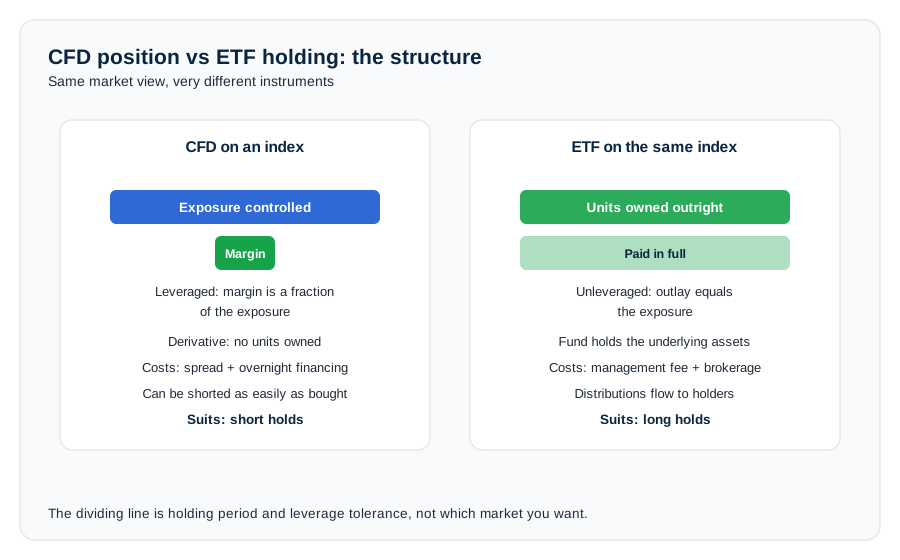
The structural difference drives everything else, and the diagram puts the two side by side: a CFD as a leveraged contract with a broker, an ETF as units owned in a fund. That single split is where the cost, tax and risk differences all originate.
What a CFD is
A CFD (contract for difference) is an agreement to exchange the change in an asset’s price without owning the asset. Traders can go long or short and use leverage up to the ASIC retail cap. Profit or loss is the price move multiplied by position size, minus costs: spread, commission, overnight financing. CFDs cover forex, shares, indices, commodities and crypto.
What an ETF is
An ETF (exchange-traded fund) is a fund that holds underlying assets and trades on a stock exchange like a share. An investor buys units in the fund through a stockbroker, owns those units, and receives any distributions the fund pays. ETFs cover index baskets (ASX 200, S&P 500), sectors, themes, bonds, commodities and currencies. Australian-domiciled ETFs holding Australian shares pass through franking credits. Totality carries 7,000+ ETFs, held directly rather than as CFDs.
Ownership and leverage
Ownership is the core difference. I would put it simply: buy an ETF and you own units in a fund that holds the underlying assets, so distributions and, for Australian-domiciled funds, franking credits are passed through, and holding for decades is possible. A CFD is a contract with a broker that mirrors a price: you own nothing, can use leverage up to the ASIC cap, can go short, and pay financing for every night a position stays open. Leverage cuts both ways, which is why CFDs suit short holds and ETFs suit long ones. At Trading 212 you hold real shares and ETFs in the Invest account and CFDs in a separate CFD account, and because clause 12.8 of its Invest Terms does not permit short selling, you go short through the CFD account. Our page on leverage in forex trading Australia works through what each cap does to a position size.
Cost structures compared
CFD costs fall into three pieces: spread (the gap between bid and ask), commission (on RAW/ECN accounts), and overnight financing on positions held past rollover. Holding a long CFD for weeks adds up because financing accrues daily, and that is the cost I would watch most closely. Spread pricing varies broker to broker; the lowest spread brokers guide tracks the tested figures from our capture runs.
ETF costs: a management expense ratio (the fund’s annual fee, typically 0.05% to 0.50% on Australian index ETFs), plus brokerage on entry and exit (typically AUD 5 to 10 per trade on a discount broker). No financing cost applies, because you own the units outright.
For a short hold, CFD costs win on smaller positions; for a long hold, ETF costs win because there is no financing. Our broker cost calculator prices the CFD side of that comparison at your own monthly volume, using the spreads that Noam Korbl’s capture programme records.
Time horizon and use case
A CFD makes sense for short-term exposure, the ability to go short, or leverage to hedge an existing holding. An ETF makes sense for owning an asset for years, collecting distributions and franking, and avoiding leverage and overnight costs. I would say day-traders use CFDs; pension-builders use ETFs. Many people use both for different jobs.
Tax treatment in Australia
Tax is where the two diverge most for Australian traders, and where I would not guess without the full numbers. CFD profits are generally taxed on revenue account as ordinary income, and losses can usually be offset against income, with no franking credits because the shares are never owned. ETF returns are different: distributions are taxable, often carrying franking credits that can reduce tax, and selling units held as an investment is usually a capital gains event, with the CGT discount potentially applying after twelve months. A profitable CFD trade and a profitable ETF holding can therefore be taxed quite differently. Confirm your position with the ATO or a tax adviser, since it turns on circumstances.
Regulation and protections
Both products are regulated by ASIC, but under different frameworks. CFDs sit under the Product Intervention Order with explicit leverage caps (30:1 majors down to 2:1 crypto), mandatory negative balance protection for retail clients (which I would call the single most important retail safeguard), and a ban on inducements. ETFs are managed investment schemes regulated under the Corporations Act, with disclosure requirements (PDS, target market determination) but no leverage caps or negative balance protection because they don’t carry leverage. Brokers for both products must be AFCA members for retail dispute resolution.
When a CFD makes sense, and when an ETF does
A CFD earns its place when short-term exposure, a short, or a hedge is the job, provided the financing cost and the added risk of leverage are accepted. An ETF earns its place when the job is owning an asset for years, collecting distributions and franking, and avoiding leverage and overnight costs. My read is that many people use both for different jobs. If a CFD fits, the CFD broker guide covers the options. To compare providers first, our leading Australian forex brokers guide lists the ASIC-regulated options.
The share-versus-derivative version of the same question is on our CFDs vs stocks for Australian traders page, and the broader groundwork sits in our forex education hub.
FAQs
Is a CFD or an ETF better for beginners?
Can you leverage an ETF?
Do you pay tax differently on CFDs and ETFs in Australia?
Can you short an ETF?
Do CFDs pay dividends or franking credits?
Related pages
About the author

Justin co-founded CompareForexBrokers in 2014 and has traded forex since 1998. Based in Melbourne, he has tested every ASIC-regulated broker on this site personally and has written for Forbes, Kiplinger, Finance Magnates, the Australian Financial Review and The Age. He holds a Bachelor of Commerce (Honours) and a Master of Marketing from Monash University. Justin is the co-founder and CEO of CompareForexBrokers.