




What Plus500 costs per trade
MEASUREDMonthly spread cost converts pips to dollars using the EUR/USD pip value as the proxy for the 8-pair average, footnoted on-page. AUD pip value A$13.97 per standard lot at AUD/USD 0.7159 (31 Aug 2026).
At 10 standard lots per month on Standard accounts, Plus500 costs approximately A$83.81 in spread costs. Rates as of Mon 31 Aug 2026, 5pm New York close.
Trading CFDs and forex carries a high level of risk and may not be suitable for all investors. Read the relevant Product Disclosure Statement before opening an account.
Our verdict on Plus500
Plus500 is the broker I recommend most often here to Australian beginners who want a clean, single-platform CFD experience without spending a weekend choosing between MT4, MT5 and cTrader. The WebTrader platform is the best beginner CFD interface in this 32-broker coverage, and the FTSE 250-listed parent, LSE:PLUS, gives it a trust profile most Australian brokers cannot match.
Plus500 is not for everyone. No MT4, MT5, cTrader or TradingView exists here, so if you run expert advisors or a custom charting setup, you are locked out. Forex pair coverage runs to around 70, narrower than active-trader brokers like Pepperstone and IC Markets. The inactivity fee is more aggressive than most: US$10 a month after just three months of dormancy, where the Australian market norm is six to twelve months. Forex scalpers and traders running automated strategies are served better elsewhere. A new CFD trader who wants one platform that works on web and mobile is served well here.
Pros
- That AFSL 417727 has been current since 2012, and the FTSE 250 listing (LSE:PLUS) gives you a trust profile most privately held brokers can't match.
- The proprietary WebTrader is the cleanest beginner CFD interface I've seen in this coverage, running on web, Windows desktop, iOS and Android.
- With over 2,800+ instruments, including ~2,000 share CFDs, indices, commodities and crypto, you can trade the names you actually search for.
- Live chat support runs 24/7, which I've found responsive in testing.
- The A$100 minimum deposit keeps the entry barrier low, so you can start small while you learn.
Cons
- Proprietary platform only, so if you rely on MT4, MT5, cTrader or TradingView, you'll need to look elsewhere.
- Around 70 forex pairs is a narrower list than you'd get at Pepperstone, IC Markets or OANDA, which matters if you trade exotics.
- The inactivity fee of US$10/month kicks in after just three months, the shortest window across the 32 brokers I track. If you fund an account and then pause for a quarter, that fee will find you.
- Retail clients get no phone support, just live chat and email, which is a gap I'd flag for anyone who values a voice call when something goes wrong.
- Copy trading, expert advisors and API access are all absent, so if your strategy depends on any of those, this broker won't fit.
Plus500 score breakdown
4/5 · Great
The overall CFB Score comes from the full methodology, more than 100 data points per broker.
How is our rating calculated?Is Plus500 safe? ASIC AFSL 417727
Plus500AU Pty Ltd holds AFSL 417727, current since 2012, and its parent company’s FCA and MAS licences, listed in the quick-facts table, add Tier-1 regulatory strength. This spread of Tier-1 regulators provides a strong trust profile.
ASIC regulation and global licences
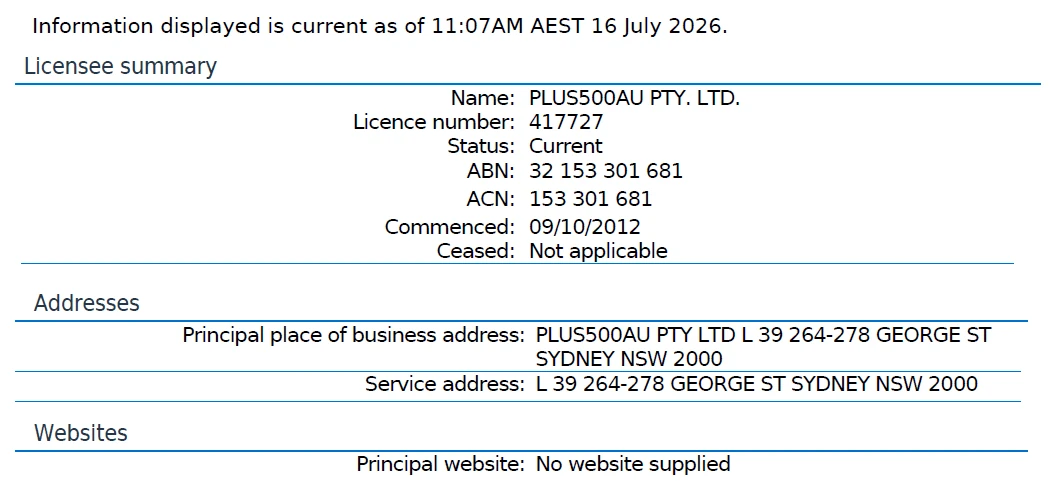
AFSL 417727 is held by Plus500AU Pty Ltd with the Australian Securities and Investments Commission. The register shows the licence as current since 9 October 2012, as verified during our review.
The parent group holds these further licences:
- Financial Conduct Authority, UK (Tier 1)
- CySEC, Cyprus (Tier 1)
- Monetary Authority of Singapore (Tier 1)
- Japan Financial Services Agency (Tier 1, via Plus500JP Securities, licence 156)
- Financial Sector Conduct Authority, South Africa (Tier 2)
- DFSA, UAE (Tier 2)
- Israel Securities Authority (Tier 2)
- Financial Markets Authority, New Zealand (Tier 2; held by the same Plus500AU entity, FSP 486026)
Four of those licences are Tier 1, an unusually strong spread for a broker this size. What stands out to me is that the New Zealand licence is held by the same Australian entity, not a separate offshore arm.
Plus500 client money protection and the FTSE 250 parent
Your money sits in segregated accounts at an Approved Australian Bank, with ASIC-mandated negative balance protection. The parent company is FTSE 250-listed, trading as PLUS on the London Stock Exchange since 2013, which adds a layer of public scrutiny.
What sets Plus500 apart on trust, in my view, is the listing. A FTSE 250 company files audited accounts, discloses client-money balances and answers to a market regulator on top of ASIC, a disclosure burden most private Australian brokers never carry.
Client money is kept separate from company funds. If something goes wrong, AFCA can hear claims up to A$1,263,000 and award up to A$631,500. The Compensation Scheme of Last Resort adds an A$150,000 backstop, but note that it excludes CFD trading losses, so it’s there for unpaid misconduct awards, not losing trades. For the full retail standard, see negative balance cover on CFD accounts.
One Plus500 carve-out matters. Negative balance protection is a retail protection, and clients electing Professional status surrender it along with the ASIC leverage caps. That is the whole trade in electing Pro, and it is why my recommendation steers beginners away from it.
History and ownership
The company started in 2008 in Haifa, Israel, founded by computer science graduates. It listed on the London Stock Exchange in 2013 and has held a FTSE 250 spot for several years now. I find that history reassuring.
Public reviews
Plus500 holds a Trustpilot rating of 4.2 out of 5 from 19,817 reviews, which Trustpilot labels great, captured September 2026. The profile has been claimed by the broker since May 2021.
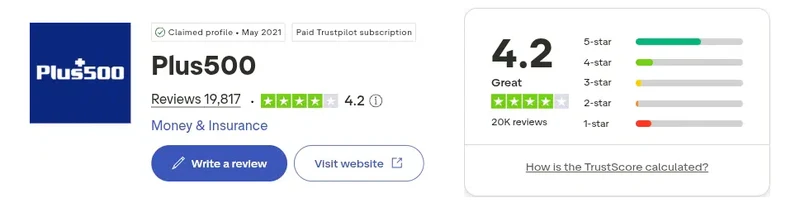
Reading through public reviews, the praise keeps coming back to the clean platform, fast onboarding and the mobile app. The complaints? Mostly the inactivity fee and chat-only support.
What other review sites say
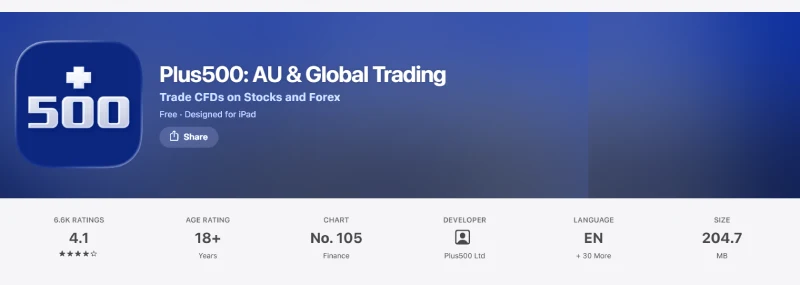
Plus500's iOS app rates 4.15 out of 5 from 6,612 ratings on the Australian App Store (August 2026), listed as Plus500: AU & Global Trading.
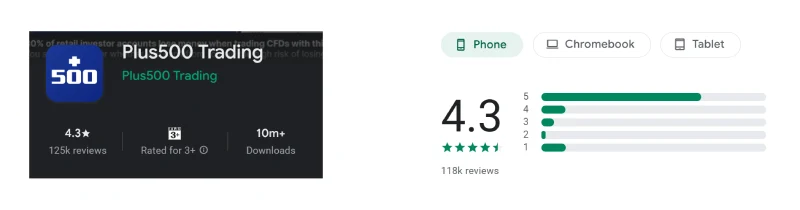
Android users rate Plus500's Android app 4.3 out of 5 from 125k reviews worldwide on Google Play (August 2026), listed as Plus500 Trading.
Plus500 at a glance: 17 key facts
17 key facts for Plus500 include ASIC AFSL 417727, a single retail CFD account, and 2,800 or more instruments, as the table below sets out.
| Item | Detail |
|---|---|
| Australian regulator | ASIC, AFSL 417727, current since 9 October 2012 |
| Australian entity | Plus500AU Pty Ltd |
| Other regulators | FCA (UK), CySEC (Cyprus), MAS (Singapore), JFSA (Japan), FSCA (South Africa), DFSA (UAE), ISA (Israel), FMA (NZ, held by Plus500AU) |
| Year founded | 2008 (Haifa, Israel); AU operations since 2012 |
| Listed | LSE:PLUS (FTSE 250 constituent) |
| Headquarters | Haifa, Israel; AU office in Sydney |
| Trading platforms | Plus500 WebTrader (web, Windows desktop app, iOS, Android), proprietary only |
| Account types | Standard CFD (retail); Professional (Elective Pro) for eligible traders |
| Minimum deposit | A$100 cards and e-wallets, A$500 bank transfer |
| Maximum retail leverage | 30:1 (forex majors), ASIC-capped |
| Spreads (eight-pair basket) | 0.6 pips average in our May to June 2026 capture; dynamic, no commission |
| Funding methods (AU) | Visa, Mastercard, PayPal, Skrill, bank transfer |
| Inactivity fee | US$10/month after 3 months |
| Negative balance protection | Yes (mandatory under ASIC) |
| AFCA member | Yes |
| Demo account | Free, unlimited |
| Customer support | 24/7 live chat and email (no phone for retail) |
All those instruments are priced through the spread alone, with no commission added. The section below puts a number on what that costs you.
Plus500 spreads and commission, measured
Spreads and commission boil down to one number here: zero commission, and our eight-pair basket measured 0.6 pips. Noam ran that capture from a London VPS, May to June 2026, rolling 24-hour, using IceFX SpreadMonitor.
That 0.6 pip figure is a basket average across eight pairs, not a EUR/USD reading, and we don’t have a measured EUR/USD number for this broker. Because Plus500 runs a single spread-only account, it doesn’t fit neatly into our raw or standard league tables.
Spreads on AUD/USD and majors
The typical ranges below are advertised, not measured, so treat them as indicative.
| Pair | Plus500 typical (pips) | AU industry avg (Standard) |
|---|---|---|
| EUR/USD | 0.6 to 1.0 | 1.1 |
| AUD/USD | 0.7 to 1.2 | 1.3 |
| GBP/USD | 1.0 to 1.5 | 1.4 |
| USD/JPY | 0.8 to 1.2 | 1.4 |
| EUR/GBP | 1.2 to 1.8 | 1.4 |
Day to day, the markup model behaves predictably, which is why I group Plus500 with the true fixed-price brokers in the fixed spread forex brokers comparison, even though its pricing is variable.
For an active forex scalper, the lack of a raw commission account is the main cost issue. At 50 standard lots a month or more, Plus500 costs you more than a Razor or Raw account elsewhere.
Other fees AU traders should check
- Overnight financing applies to positions held past the daily cut, and the charge depends on trade direction.
- The guaranteed stop-loss premium is charged through a wider spread set when the position opens, and is not refunded if the stop never fires. The leverage section below sets out the mechanism in full.
- The inactivity fee runs US$10 a month after three consecutive months without a login.
- Currency conversion applies to any instrument priced outside the account base currency.
- Withdrawals carry no fee for the first five in a month, then a small charge applies.
Plus500 funding methods and withdrawal times
Plus500 withdrawal times are instant for cards and e-wallets, and one to three business days for bank transfers; the first five withdrawals each month are free, and four funding methods (three instant) cover deposits.
Deposit methods (AU clients)
| Method | Fee | Speed |
|---|---|---|
| Visa / Mastercard | A$0 | Instant |
| PayPal | A$0 | Instant |
| Skrill | A$0 | Instant |
| Bank transfer | A$0 | 1 to 3 business days |
Four funding methods is a narrow menu compared to nine at Fusion Markets or seven at AvaTrade. PayID and BPAY are both missing, and for Australian clients used to paying that way, that’s a real gap.
Withdrawals
Withdrawals are free for the first five each month, then a small fee kicks in. That per-month allowance is unusual; most Australian brokers charge nothing on any number of withdrawals. Funds must return to the original deposit source where possible, standard AML practice.
Account opening
AUSTRAC-compliant account opening runs fully online. Most Australian applications clear within 30 minutes during business hours, which I’d call the lightest-touch process of any broker we cover.
Plus500 account types and minimum deposit
Plus500 account types are limited to a single retail CFD account with zero commission, funded by card from A$100 or bank transfer from A$500, and no tiered structures.
| Account | Pricing | Min deposit | Best for |
|---|---|---|---|
| Standard CFD (retail) | Spread-only, no commission | A$100 cards, A$500 bank transfer | All retail traders |
| Professional (Elective Pro) | Same spread-only pricing, higher leverage | A$100 | Experienced traders who meet the eligibility criteria |
That simplicity is deliberate and matches the platform design. Plus500 is on the beginner-friendly forex brokers list because there’s no second price book to compare, so you can’t pick the wrong account.
Professional (Elective Pro)
Traders who qualify for elective Professional status, the leverage caps lift to 300:1 on forex, 200:1 on indices, 150:1 to 200:1 on gold, 100:1 on other commodities, 20:1 to 50:1 on crypto and 20:1 on share CFDs. Qualification runs on the wholesale client tests in section 761G of the Corporations Act: an accountant’s certificate confirming net assets of at least A$2.5 million or gross income of at least A$250,000 in each of the last two financial years, a single product purchase of at least A$500,000, or the sophisticated investor route. But you’ll surrender retail protections, including negative balance protection, so I’d only suggest it if you fully understand the trade-off.
Minimum deposit
The A$100 minimum on cards and e-wallets (A$500 by bank transfer) applies to both retail and Professional accounts. For a beginner, that’s a low entry barrier, though several raw-spread brokers like Pepperstone open at A$0. The demo account needs only an email address and sits fourth in our demo account comparison.
Plus500 trading platforms
Trading platforms come down to one: the proprietary WebTrader, available as a web client, Windows desktop app and mobile app. MT4, MT5, cTrader and TradingView are absent, as noted in the cons.
The platform was built for beginners who don’t want to wrestle with an institutional charting tool, so the single-platform approach is deliberate, not a gap, and the hero chip confirms the count of one.
Plus500 WebTrader (proprietary)
The platform carries:
- Clean instrument search by category across forex, indices, shares, commodities, crypto, ETFs and options
- One-click trade tickets with built-in risk warnings before submission
- Native guaranteed stop-loss orders, premium charged through a wider spread when the position opens
- Trailing stops, take profits and standard stop losses out of the box
- Real-time alerts on price, volume and percentage moves
- An economic calendar and per-instrument sentiment data built in
The platform omits:
- Expert advisors and algorithmic trading
- Depth-of-book pricing
- Advanced charting comparable to TradingView or cTrader
- API access for custom integrations
- Copy trading
Desktop and mobile
A downloadable Windows desktop app mirrors the web platform’s layout and trade ticket. There’s no native Mac app, so Mac users trade through WebTrader in the browser. The mobile app for iOS and Android provides biometric login, push price alerts and the same trade ticket.
Plus500 markets and instrument counts
Markets and instrument counts reach 2,800 or more across seven asset classes, with around 2,000 share CFDs. Every instrument is a CFD, so you can’t take ownership of the underlying asset here.
| Asset class | Count | Note |
|---|---|---|
| Share CFDs | Around 2,000 | ASX, NYSE, NASDAQ, LSE, major European exchanges |
| Forex | Around 70 pairs | Majors, minors and the AUD crosses |
| Indices | 30+ | ASX 200, S&P/ASX SPI 200, all the major global indices |
| Commodities | Metals, energy, softs | Gold, silver, copper, WTI, Brent, natural gas |
| Cryptocurrencies | Major pairs only | CFDs, 2:1 retail cap |
| ETFs | Broad selection | ETF CFDs across regional and sector themes |
| Options | Selected markets | Options on selected indices and forex pairs |
That range is shaped for its audience: deep on shares, solid on indices and commodities, lighter on forex. Around 70 pairs covers the majors and AUD crosses, enough for most beginners, but for those needing the full currency suite, Pepperstone, IC Markets and OANDA go wider. Options on selected indices and forex pairs are also listed, which I find unusual on a beginner-focused platform.
Share CFDs
Around 2,000 of the 2,800+ instruments are share CFDs across ASX, NYSE, NASDAQ, LSE and major European exchanges. For a beginner, that breadth is the real strength, covering names beginners are likely to search for. There’s no ASX ownership route, so for those wanting to hold real shares, look to CMC Markets or Interactive Brokers. More on this in share CFDs for beginners.
Crypto, indices and commodities
Crypto covers the major pairs only, at the ASIC 2:1 retail cap, providing price exposure, not ownership of coins. Indices run 30+ benchmarks including the ASX 200 and S&P/ASX SPI 200, and commodities span gold, silver, copper, crude, natural gas and softs, all at standard ASIC retail caps.
Plus500 leverage, margin and guaranteed stop-loss orders
Plus500 leverage in Australia caps major forex at 30:1 under ASIC retail rules; guaranteed stop-loss orders are offered at a wider spread set when the position is opened.
The cost is visible on the ticket before confirmation, and it’s not refunded if the stop never fires. That’s standard among brokers offering a guaranteed stop, and it means if a guaranteed stop is attached to every position, you pay for the protection on every trade, not just the ones that gap. Three constraints apply: you can only attach a guaranteed stop to a new position, you can’t add it to a running position, and you can’t revoke it once placed, though the level can be moved. The mechanism is set out in the Plus500 Trading Academy FAQ, “What is a Guaranteed Stop Order?”, and on the Plus500 fees and charges page (accessed 29 July 2026).
ASIC caps retail CFD leverage at 30:1 on major forex pairs, 20:1 on minor pairs, gold and major indices, 10:1 on other commodities, 5:1 on share CFDs and 2:1 on crypto. These caps come from a product intervention order extended to 23 May 2027, so they apply at every ASIC broker, not just Plus500. The single retail account carries them in full, and nothing you choose changes them.
Retail margin close-out is at 50%. That means if the account equity drops below half the total initial margin on all open positions, the broker must close you out. Positions can’t be netted against each other to lower that number, and a gapping market can close you out below the 50% mark. The full tier structure is in what leverage does to position sizing.
Plus500 customer support
Customer support is available 24/7 via live chat and email, but there’s no phone line for retail clients. In testing, the chat was responsive.
In our 2026 testing, live chat replied in under 90 seconds during business hours and around three minutes overnight. Those reply times are competitive, and the 24/7 window beats the 24/5 desks at most Australian brokers.
The support gap I keep coming back to is the missing phone line, and it’s in the cons for a reason. CMC Markets, IG Markets and Pepperstone all publish a direct Australian number, and when dealing with a funding problem or a margin question, sometimes you need a voice, not a chat window.
For the beginner audience Plus500 targets, the chat-only setup is more defensible than it looks. Chat provides a written record of what the agent said, which can be re-read later, something a phone call can’t do.
Plus500 research, tools and education
Five components make up the research, tools and education suite, built around the Trader’s Guide, in-platform sentiment data and an economic calendar. I’d describe the education layer as deliberately thin.
- Trader’s Guide covering beginner concepts
- Economic calendar built into WebTrader
- Sentiment data per instrument
- News feed inside the platform
- Insights blog with market commentary
Four of the five sit inside the platform, not in a separate library. I like that for beginners: you learn by using the product, not by reading about it. The Trader’s Guide covers what a CFD is, what leverage does and how a stop loss works, and then it stops.
There’s no analyst desk, no webinar programme, no structured course series. For those who want those, CMC Markets, IG Markets or Pepperstone will serve better. The thin layer here is consistent with a broker that lets the product do the teaching.
How Plus500 compares to Pepperstone and eToro
0.6 pips across the eight-pair basket on A$0 commission, with a A$100 minimum deposit: that’s the result from our capture. Comparing Plus500 to Pepperstone and eToro, it loses to Pepperstone on pricing and platform power, and trades places with eToro for beginners.
For platform power, the Pepperstone review lists five platforms, a raw account and no inactivity fee. Plus500 concedes all three of those.
Plus500 runs no copy trading; that’s eToro’s domain, and the eToro review covers it. On interface cleanliness for a first CFD account, I’d say they’re close, and Plus500 holds the lower entry deposit.
| If you value… | Consider |
|---|---|
| Tightest forex spreads | Pepperstone or IC Markets |
| Broader product range | CMC Markets or IG Markets |
| MT4 / MT5 / cTrader | Pepperstone, IC Markets or Eightcap |
| Copy trading | eToro |
| Direct ASX share investing | CMC Markets or IG Markets |
| TradingView trading | Pepperstone or OANDA |
| No inactivity fee | Pepperstone (A$0) or Fusion Markets (A$0) |
Should you open a Plus500 account?
I’d recommend a Plus500 account for new CFD traders who want one clean platform and a A$100 entry. If you need MT4, expert advisors, an API or copy trading, Pepperstone is the better fit.
The dormancy fee is the factor most likely to swing a marginal decision, so it’s flagged again. US$10 a month starts after three consecutive months without a login, the shortest window of the 32 brokers on this site, and it catches the beginner who funds an account and then steps away for a quarter.
First-time CFD traders get the cleanest interface we’ve tested, a A$100 deposit and a listed parent behind it, while risk-first traders get a guaranteed stop with the cost shown on the ticket before the trade: those are two groups that gain clear value from a Plus500 account.
Two groups should look past Plus500. Active forex traders will pay a markup with no raw alternative. If your strategy relies on expert advisors, an API or copy trading, you’ll find none of those here.
On our 2026 scoring, Plus500 ranks mid-table among the best forex brokers in Australia. The demo account is the right first step, and it costs nothing to leave dormant, which I’d suggest before committing real money.
FAQs
Is Plus500 safe for Australian traders?
What leverage does Plus500 offer in Australia?
Does Plus500 offer MetaTrader 4 or MetaTrader 5?
What's the minimum deposit at Plus500 in Australia?
What is a Guaranteed Stop Loss Order at Plus500?
Does Plus500 charge an inactivity fee?
Is Plus500 good for beginners?
Testing log and corrections
| Record | Detail |
|---|---|
| Review published | 16 May 2026 |
| Last content change | 29 August 2026 |
| Verification | AU fee schedule verified 6 July 2026; platform assessed across group entities |