
Sessions right now
Session hours anchor to each centre's local market time; daylight saving in each region is applied automatically. The reference table below carries the full year-round schedule.
Summary
- Forex opens Monday 7am AEST in Sydney and runs continuously to Saturday 7am AEST.
- Four sessions matter: Sydney (7am to 4pm AEST), Tokyo (10am to 7pm AEST), London (5pm to 2am AEST), New York (10pm to 7am AEST). During daylight saving (October to April) add an hour: AEDT.
- The London open at 5pm AEST and the London/NY overlap from 10pm to 2am AEST are the highest-volume windows for AU traders.
- AUD/USD, AUD/JPY and AUD/NZD are most active during the Sydney and Tokyo sessions.
- Australian Daylight Saving (October to April) moves Sydney and Melbourne to AEDT (UTC+11). London and New York run their own DST cycles on different dates, so the exact offsets drift by an hour for a few weeks each year.
- All ASIC-regulated brokers in our reviews list align platform server time to either GMT, broker server GMT+2/+3, or local NY close. Confirm with your broker.
The four major forex sessions in AEST
The forex market is decentralised and runs across the world’s main financial centres. Liquidity rotates with the sun, and the four sessions overlap in pairs to create the highest-volume windows, but that rotation makes one hour cheap to trade and the next expensive.
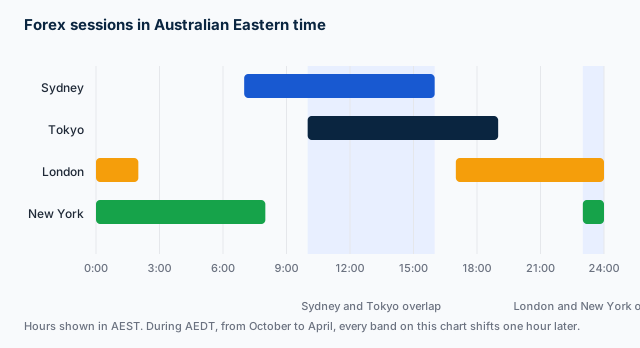
The diagram puts all four sessions on one 24-hour AEST timeline so you can see how the day overlaps. The Sydney and Tokyo overlap sits through the middle of the Australian day, the London and New York overlap sits late at night, and every band shifts an hour later during AEDT.
| Session | Local hours | AEST (UTC+10) | AEDT (UTC+11) |
|---|---|---|---|
| Sydney | 7am to 4pm AEST | 7am to 4pm | 8am to 5pm |
| Tokyo | 9am to 6pm JST | 10am to 7pm | 11am to 8pm |
| London | 8am to 5pm BST/GMT | 5pm to 2am | 7pm to 4am |
| New York | 8am to 5pm EST/EDT | 10pm to 7am | 12am to 9am |
Times are approximate and shift by one hour during each region’s daylight saving cycle. Australian DST runs roughly October to April. London’s BST runs late March to late October. US daylight saving runs early March to early November. The misalignments mean I treat the schedule as five distinct windows across the year, so you can see the session shifts clearly.
Sydney session (7am to 4pm AEST)
The Sydney session is the official forex week opener. Liquidity isn’t at its deepest, but the AUD pairs and NZD crosses see their most direct flows during this window. RBA cash rate announcements, ABS labour data, and Chinese economic releases all hit during Sydney hours and move AUD/USD and AUD/JPY directly, so this is the session where local traders get their news-driven action.
Traders whose main pair is AUD/USD or AUD/NZD will see the cleanest moves during the Sydney session. These crosses typically carry tight spreads through Sydney/Tokyo overlap, so your costs stay lower while the local session is busiest. Spreads on EUR/USD, GBP/USD and other European pairs are usually wider until London opens at 5pm AEST.
The Wellington open at 5am AEST technically beats Sydney by a couple of hours, but New Zealand liquidity is thin on its own. Most Australian brokers consider the trading week to begin from 7am Monday Sydney time, and that is the clock I would set my own trading week by.
Tokyo session (10am to 7pm AEST)
Tokyo overlaps with Sydney from 10am to 4pm AEST, and that overlap is the busiest part of the Asia-Pacific trading day. JPY pairs (USD/JPY, AUD/JPY, EUR/JPY, GBP/JPY) see their most active movement during Tokyo hours. Yen carry trade flows, Bank of Japan interventions, and Japanese economic data all hit this window, so it pays to have your JPY chart open.
For Australian traders, the Tokyo session is convenient. Major JPY pairs trade through the morning without forcing you to stay up late. Liquidity is good but not at its peak. EUR/USD typically sleeps through Tokyo and wakes up at the London open.
Public holidays on the Japanese calendar (Showa Day, Marine Day, Mountain Day) thin out Tokyo liquidity noticeably. Check the Japanese holiday calendar before trading JPY pairs around late April, mid-July or mid-August, because a holiday-thinned Tokyo session can widen spreads without much warning, so you can avoid it by checking the calendar.
London session (5pm to 2am AEST)
London opens at 5pm AEST and is where the trading day really starts for most active traders, and it is the session I would prioritise if I could only watch one. Roughly 40% of global forex turnover runs through London. The opening hour (5pm to 6pm AEST) is one of the most volatile of the day on EUR pairs, GBP pairs, and gold.
For Australian traders this is convenient: London opens just after dinner Sydney time and runs through the evening. The session covers the European economic calendar (German IFO, UK CPI, ECB decisions) and overlaps with the New York open from 10pm AEST, so the news flow stays busy rather than fading after dinner, meaning you can trade the main European data without staying up all night.
Most active retail traders we surveyed in 2025 do their primary trading during London hours. I see why: liquidity is deep, spreads on EUR/USD, GBP/USD and AUD/USD are typically at their tightest, and the price action is cleaner than the Asia-only sessions.
New York session (10pm to 7am AEST)
New York opens at 10pm AEST and runs overnight to 7am. The first four hours (10pm to 2am AEST) overlap with London and produce the highest single liquidity window of the entire forex week, which is why that block carries the tightest dealing prices and the window I would defend most aggressively. After 2am AEST when London closes, New York continues solo with thinner liquidity until the Sydney/Tokyo opens roll back round.
US data releases (Non-Farm Payrolls, CPI, FOMC decisions) hit during New York hours. NFP is the classic example. Released on the first Friday of each month at 8:30am New York time, that’s 10:30pm AEST or 12:30am AEDT in Australia. Volatility around NFP can move EUR/USD 80 to 150 pips in a 30-minute window, so your risk settings need to be ready before the number crosses the wire.
For Australian traders willing to stay up late, the London/NY overlap from 10pm to 2am AEST is your prime time. Traders who cannot stay up through the night can still catch most of the same opportunities in the London session.
Best times to trade for Australian traders
Three windows stand out.
London open (5pm to 6pm AEST). The single highest-volatility hour of the trading day on EUR/USD, GBP/USD and AUD/USD. Tight spreads, clean trends, and breakout setups are common. For a trader with only one hour to spare, this is the hour I would choose.
London/NY overlap (10pm to 2am AEST). Deepest liquidity of the week. Best for longer scalping and swing entries. Major US data lands in this window. This is the window I would rate above the London open for USD pairs.
Sydney/Tokyo overlap (10am to 4pm AEST). Best for AUD pairs, JPY pairs, and Asia-focused crosses. Less volatile than London but more predictable, which is why I rate it the daytime pick for AU traders.
The slowest window is the Sydney close to London open gap (4pm to 5pm AEST), and the New York close to Sydney open gap (7am to whenever liquidity returns the next morning, around 7am AEST Monday). Spreads widen, gaps appear on Monday open, and most active traders avoid these periods, which tells you that thin liquidity is a real cost if you must trade them.
Session choice is a cost decision as much as a volatility one, because the same pair prices differently at 10pm than it does at 7am. Our guide to the lowest spread forex brokers in Australia compares the measured figures our team compiles, and our broker cost calculator turns them into a monthly total at your own volume.
AUD pair high-volume hours
Different AUD pairs peak at different times, so the heat map below is not one-size-fits-all. Use the map to find the hour when your pair is busiest. Here’s the rough heat map for the most active AUD crosses on our 32 ASIC-regulated brokers.
| Pair | Highest volume window (AEST) | Why |
|---|---|---|
| AUD/USD | 10pm to 2am (London/NY overlap) | USD liquidity peak |
| AUD/JPY | 10am to 6pm (Sydney/Tokyo) | Yen flows during Asia |
| AUD/NZD | 7am to 1pm (Sydney) | RBA/RBNZ data |
| AUD/CAD | 10pm to 2am (London/NY) | USD and CAD liquidity |
| AUD/CHF | 5pm to 10pm (London) | CHF flows during Europe |
| AUD/SGD | 10am to 4pm (Tokyo) | Asian session liquidity |
| AUD/HKD | 10am to 4pm (Tokyo) | Hong Kong banking hours |
Spreads on AUD/USD on a RAW account at IC Markets or Pepperstone typically tighten to 0.0 to 0.2 pips during the London/NY overlap. The same pair can sit at 0.3 to 0.6 pips during the Sydney session and widen further around the daily rollover at 7am AEST, which is why I treat session timing as a cost decision. For a cost comparison across every session, see our guide to the highest-rated forex brokers in Australia.
Australian DST and the schedule shift
Australian Eastern Daylight Time (AEDT) runs from the first Sunday in October to the first Sunday in April. Sydney, Melbourne, Canberra, Hobart and the ACT shift to UTC+11 during these months, while Brisbane stays on AEST year-round. Perth is AWST (UTC+8) year-round. Adelaide runs ACDT (UTC+10:30) on DST and ACST (UTC+9:30) otherwise, so your session times depend on which city you trade from.
The mismatch between Australia, the UK and the US DST cycles creates roughly five distinct configurations across a typical year:
- AEST + GMT + EST (early April to late October, before AU DST) puts the UK and US on standard time while AU stays on standard time. London opens 6pm Sydney, NY opens midnight Sydney.
- AEST + BST + EDT (late March to early April, gap window) covers the brief period when the UK is in BST, the US is in EDT, and AU is still on AEST, so you can track the shift during this gap window.
- AEDT + BST + EDT (early October to late October, AU starts DST) aligns all three regions on summer time. London opens 5pm Sydney, NY opens 11pm Sydney, so you can plan around the 5pm London open.
- AEDT + GMT + EST (late October to early March, AU in summer, UK and US on winter) moves London’s open to 7pm Sydney and New York’s to 1am Sydney.
- AEDT + GMT + EDT (early March to late March, US enters DST first) is the year’s mid-window oddity.
Strategies that depend on session opens need a calendar that tracks all three DST cycles. Most charting platforms (TradingView, MT4/MT5, cTrader) display server time, not local time. Pepperstone and IC Markets MT4 servers run on GMT+2/+3 (broker server time, Cyprus). cTrader at IC Markets runs on UTC. Your local Sydney time conversion depends on the platform, so I would double-check on each platform before trusting a session open.
Australian public holidays and forex hours
The forex market itself does not close for Australian public holidays. You can still trade EUR/USD on Australia Day, ANZAC Day and Easter Monday. Three things change on those days, though:
- Broker support hours are reduced. Most ASIC-regulated brokers maintain trading but support phones go to email-only.
- AUD pair liquidity thins during the Sydney session if the local holiday is observed across major banks. AUD/USD spreads can sit slightly wider through Sydney hours.
- Bank settlement delays apply to deposits and withdrawals. PayID typically still clears, BPAY does not, and bank EFTs can take an extra day.
Global forex trading closes for Christmas Day and New Year’s Day. It also runs reduced hours on Christmas Eve and New Year’s Eve in most markets. Easter Friday closes most major markets. Before planning trades around these dates, confirm your broker’s published holiday hours, because a reduced-hours session can be far less liquid than it looks.
Broker server times and platform clocks
Most MT4 and MT5 servers run on broker time, typically GMT+2 in winter and GMT+3 in summer for Cyprus-hosted servers, which is where most ASIC brokers’ MT4 infrastructure sits. cTrader is more often on UTC. Proprietary platforms (CMC’s Next Generation, IG’s web platform, Plus500) usually display local time, so the clock on your chart is rarely Sydney time unless the broker says otherwise.
To convert MT4 broker time to AEST:
- Add 8 hours to broker GMT+2 winter time
- Add 7 hours to broker GMT+3 summer time
To convert UTC (cTrader) to AEST: add 10 hours (AEST) or 11 hours (AEDT).
For traders running EAs, the server time matters because most strategies have hard-coded session filters. An EA set to “trade only during London session” needs a clear time-zone definition: London local, server time, or your local AEST. We’ve seen traders run an EA for months on the wrong session because the time zone wasn’t set correctly.
Session momentum is also where continuation setups print most cleanly, since the London and New York opens are what carry a range into a breakout. I would start the technical side with our page on bullish chart patterns for Australian traders, which covers those formations and where the stop belongs on each. For the rest of the groundwork, start at our forex education hub.
FAQs
What time does the forex market open in Australia?
What's the best time to trade forex in Australia?
Does Australian DST affect forex trading?
Are Australian forex brokers open on public holidays?
What time is the London/NY overlap in Sydney?
Do I need to set my MT4 platform to Sydney time?
Related pages
About the author

Justin co-founded CompareForexBrokers in 2014 and has traded forex since 1998. Based in Melbourne, he has tested every ASIC-regulated broker on this site personally and has written for Forbes, Kiplinger, Finance Magnates, the Australian Financial Review and The Age. He holds a Bachelor of Commerce (Honours) and a Master of Marketing from Monash University. Justin is the co-founder and CEO of CompareForexBrokers.